SUBSCRIBE TO OUR FREE NEWSLETTER
Daily news & progressive opinion—funded by the people, not the corporations—delivered straight to your inbox.
5
#000000
#FFFFFF
To donate by check, phone, or other method, see our More Ways to Give page.
Here in the early stages of the Libor scandal -- and, yes, this thing is far from over -- there are two big surprises.
The first is that the bankers, traders, executives and others involved would so openly and, in some cases, gleefully collude to manipulate this key interest rate for their own benefit. With all the seedy bank behavior that has been exposed since the financial crisis, it's stunning that there's still dirty laundry left to be aired. We've had predatory subprime lending, fraudulent ratings, excessive risk-taking and even clients being taken advantage of in order to unload toxic mortgages.
Yet even with these precedents, the Libor scandal still manages to shock. Libor -- that's the London interbank offered rate -- represents a series of interest rates at which banks make unsecured loans to each other. More important, it is a benchmark that many financial instruments are pegged to. The Commodity Futures Trading Commission, which doggedly pursued the wrongdoing and brought the scandal to light, estimates that some $350 trillion worth of derivatives and $10 trillion worth of loans are based on Libor.
With so much depending on this one critical interest rate, there shouldn't ever be a question about its reliability. Yet beginning in 2005, according to the C.F.T.C. and the Justice Department, derivative traders at Barclays, the too-big-to-fail British bank, with the active involvement of traders at other yet-unnamed banks, persuaded their fellow bank employees to submit Libor numbers that were shaded in ways that would help ensure their trades were profitable. Even Robert Diamond Jr., the former Barclays chief executive who lost his job over the scandal, said that reading the traders' e-mails made him "physically ill."
In 2007, as the financial crisis was gathering steam, banks also began submitting false Libor rates for a different reason. Libor, you may recall, was a measure that gave the outside world a sense of how much trouble the banks were in; the higher the rate required to borrow, the worse shape they were assumed to be in. So Barclays -- with what appears to be the complicity of British bank regulators -- started submitting rates that were lower than the reality. Its executives said the purpose was to keep Barclays from "sticking its head above the parapet."
Even now, Barclays justifies the latter rationale as being a kind of emergency measure brought on by the financial crisis. But the bank is wrong about this. Submitting false data, for whatever reason, is a violation of the law -- not to mention a fundamental abuse of trust. Once again, it leads one to believe that bankers feel neither the constraints of the law nor of morality.
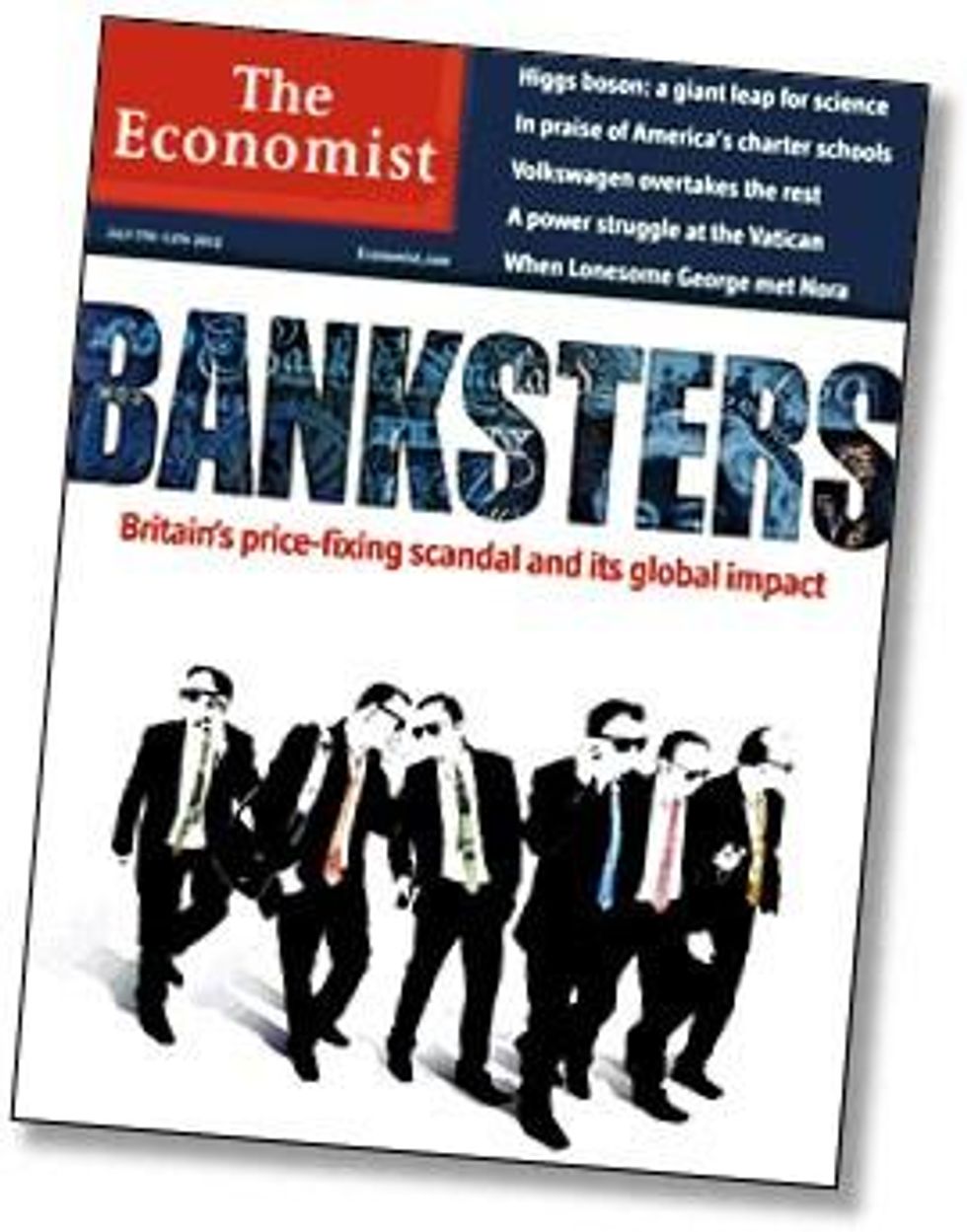
Which brings me to the second big surprise. Britain and America have reacted to the Libor scandal in completely different ways. Britain is in an utter frenzy over it, with wall-to-wall coverage, and the most respectable, pro-business publications expressing outrage. Yes, Barclays is a British bank, and the first word in Libor is "London." But still: The Economist ran a headline about the scandal that read, in its entirety, "Banksters."
Yet, on these shores, the reaction has been mainly a shrug. Perhaps we're suffering from bank-scandal fatigue, having lived through Bank of America's various travails, and the Goldman Sachs revelations, and, most recently, the big JPMorgan Chase trading loss. Or maybe Libor is just hard to gets one's head around.
But the Brits have this one right. They may not understand the intricacies of Libor any better than we do, but they sense, powerfully, that banks have once again made a mockery of the role that society entrusts to them.
"Why has the scandal created outrage in Britain? Because it truly is outrageous," said Karen Petrou, the managing partner of Federal Financial Analytics. "They weren't supposed to be fixing that rate -- no matter what the reason."
She continued: "If I give you my money, I need to be able to trust you with it. If you can only be trusted via regulation, then you might as well be a utility. And if banks can't be trusted to manage their trading desks, then we need to rethink our whole model of banking." Petrou is not an advocate of returning to the days of Glass-Steagall, the Depression-era law that separated investment banking and commercial banking. But with the Libor scandal, she said, she could certainly understand the growing calls for it.
Barclays, of course, is hardly the only big bank that manipulated Libor for fun and profit. It is simply the first to admit its wrongdoing and settle with the government. The word is that just about every big bank is under investigation for playing games with Libor, including JPMorgan Chase, Citigroup and other American-based financial giants.
Which means there is going to be a lot more opportunities for Americans to become outraged over this scandal. And, maybe, to finally summon the will to change banking once and for all.
Here in the early stages of the Libor scandal -- and, yes, this thing is far from over -- there are two big surprises.
The first is that the bankers, traders, executives and others involved would so openly and, in some cases, gleefully collude to manipulate this key interest rate for their own benefit. With all the seedy bank behavior that has been exposed since the financial crisis, it's stunning that there's still dirty laundry left to be aired. We've had predatory subprime lending, fraudulent ratings, excessive risk-taking and even clients being taken advantage of in order to unload toxic mortgages.
Yet even with these precedents, the Libor scandal still manages to shock. Libor -- that's the London interbank offered rate -- represents a series of interest rates at which banks make unsecured loans to each other. More important, it is a benchmark that many financial instruments are pegged to. The Commodity Futures Trading Commission, which doggedly pursued the wrongdoing and brought the scandal to light, estimates that some $350 trillion worth of derivatives and $10 trillion worth of loans are based on Libor.
With so much depending on this one critical interest rate, there shouldn't ever be a question about its reliability. Yet beginning in 2005, according to the C.F.T.C. and the Justice Department, derivative traders at Barclays, the too-big-to-fail British bank, with the active involvement of traders at other yet-unnamed banks, persuaded their fellow bank employees to submit Libor numbers that were shaded in ways that would help ensure their trades were profitable. Even Robert Diamond Jr., the former Barclays chief executive who lost his job over the scandal, said that reading the traders' e-mails made him "physically ill."
In 2007, as the financial crisis was gathering steam, banks also began submitting false Libor rates for a different reason. Libor, you may recall, was a measure that gave the outside world a sense of how much trouble the banks were in; the higher the rate required to borrow, the worse shape they were assumed to be in. So Barclays -- with what appears to be the complicity of British bank regulators -- started submitting rates that were lower than the reality. Its executives said the purpose was to keep Barclays from "sticking its head above the parapet."
Even now, Barclays justifies the latter rationale as being a kind of emergency measure brought on by the financial crisis. But the bank is wrong about this. Submitting false data, for whatever reason, is a violation of the law -- not to mention a fundamental abuse of trust. Once again, it leads one to believe that bankers feel neither the constraints of the law nor of morality.
Which brings me to the second big surprise. Britain and America have reacted to the Libor scandal in completely different ways. Britain is in an utter frenzy over it, with wall-to-wall coverage, and the most respectable, pro-business publications expressing outrage. Yes, Barclays is a British bank, and the first word in Libor is "London." But still: The Economist ran a headline about the scandal that read, in its entirety, "Banksters."
Yet, on these shores, the reaction has been mainly a shrug. Perhaps we're suffering from bank-scandal fatigue, having lived through Bank of America's various travails, and the Goldman Sachs revelations, and, most recently, the big JPMorgan Chase trading loss. Or maybe Libor is just hard to gets one's head around.
But the Brits have this one right. They may not understand the intricacies of Libor any better than we do, but they sense, powerfully, that banks have once again made a mockery of the role that society entrusts to them.
"Why has the scandal created outrage in Britain? Because it truly is outrageous," said Karen Petrou, the managing partner of Federal Financial Analytics. "They weren't supposed to be fixing that rate -- no matter what the reason."
She continued: "If I give you my money, I need to be able to trust you with it. If you can only be trusted via regulation, then you might as well be a utility. And if banks can't be trusted to manage their trading desks, then we need to rethink our whole model of banking." Petrou is not an advocate of returning to the days of Glass-Steagall, the Depression-era law that separated investment banking and commercial banking. But with the Libor scandal, she said, she could certainly understand the growing calls for it.
Barclays, of course, is hardly the only big bank that manipulated Libor for fun and profit. It is simply the first to admit its wrongdoing and settle with the government. The word is that just about every big bank is under investigation for playing games with Libor, including JPMorgan Chase, Citigroup and other American-based financial giants.
Which means there is going to be a lot more opportunities for Americans to become outraged over this scandal. And, maybe, to finally summon the will to change banking once and for all.
Here in the early stages of the Libor scandal -- and, yes, this thing is far from over -- there are two big surprises.
The first is that the bankers, traders, executives and others involved would so openly and, in some cases, gleefully collude to manipulate this key interest rate for their own benefit. With all the seedy bank behavior that has been exposed since the financial crisis, it's stunning that there's still dirty laundry left to be aired. We've had predatory subprime lending, fraudulent ratings, excessive risk-taking and even clients being taken advantage of in order to unload toxic mortgages.
Yet even with these precedents, the Libor scandal still manages to shock. Libor -- that's the London interbank offered rate -- represents a series of interest rates at which banks make unsecured loans to each other. More important, it is a benchmark that many financial instruments are pegged to. The Commodity Futures Trading Commission, which doggedly pursued the wrongdoing and brought the scandal to light, estimates that some $350 trillion worth of derivatives and $10 trillion worth of loans are based on Libor.
With so much depending on this one critical interest rate, there shouldn't ever be a question about its reliability. Yet beginning in 2005, according to the C.F.T.C. and the Justice Department, derivative traders at Barclays, the too-big-to-fail British bank, with the active involvement of traders at other yet-unnamed banks, persuaded their fellow bank employees to submit Libor numbers that were shaded in ways that would help ensure their trades were profitable. Even Robert Diamond Jr., the former Barclays chief executive who lost his job over the scandal, said that reading the traders' e-mails made him "physically ill."
In 2007, as the financial crisis was gathering steam, banks also began submitting false Libor rates for a different reason. Libor, you may recall, was a measure that gave the outside world a sense of how much trouble the banks were in; the higher the rate required to borrow, the worse shape they were assumed to be in. So Barclays -- with what appears to be the complicity of British bank regulators -- started submitting rates that were lower than the reality. Its executives said the purpose was to keep Barclays from "sticking its head above the parapet."
Even now, Barclays justifies the latter rationale as being a kind of emergency measure brought on by the financial crisis. But the bank is wrong about this. Submitting false data, for whatever reason, is a violation of the law -- not to mention a fundamental abuse of trust. Once again, it leads one to believe that bankers feel neither the constraints of the law nor of morality.
Which brings me to the second big surprise. Britain and America have reacted to the Libor scandal in completely different ways. Britain is in an utter frenzy over it, with wall-to-wall coverage, and the most respectable, pro-business publications expressing outrage. Yes, Barclays is a British bank, and the first word in Libor is "London." But still: The Economist ran a headline about the scandal that read, in its entirety, "Banksters."
Yet, on these shores, the reaction has been mainly a shrug. Perhaps we're suffering from bank-scandal fatigue, having lived through Bank of America's various travails, and the Goldman Sachs revelations, and, most recently, the big JPMorgan Chase trading loss. Or maybe Libor is just hard to gets one's head around.
But the Brits have this one right. They may not understand the intricacies of Libor any better than we do, but they sense, powerfully, that banks have once again made a mockery of the role that society entrusts to them.
"Why has the scandal created outrage in Britain? Because it truly is outrageous," said Karen Petrou, the managing partner of Federal Financial Analytics. "They weren't supposed to be fixing that rate -- no matter what the reason."
She continued: "If I give you my money, I need to be able to trust you with it. If you can only be trusted via regulation, then you might as well be a utility. And if banks can't be trusted to manage their trading desks, then we need to rethink our whole model of banking." Petrou is not an advocate of returning to the days of Glass-Steagall, the Depression-era law that separated investment banking and commercial banking. But with the Libor scandal, she said, she could certainly understand the growing calls for it.
Barclays, of course, is hardly the only big bank that manipulated Libor for fun and profit. It is simply the first to admit its wrongdoing and settle with the government. The word is that just about every big bank is under investigation for playing games with Libor, including JPMorgan Chase, Citigroup and other American-based financial giants.
Which means there is going to be a lot more opportunities for Americans to become outraged over this scandal. And, maybe, to finally summon the will to change banking once and for all.