SUBSCRIBE TO OUR FREE NEWSLETTER
Daily news & progressive opinion—funded by the people, not the corporations—delivered straight to your inbox.
5
#000000
#FFFFFF
To donate by check, phone, or other method, see our More Ways to Give page.
The system of checks and balances works best when the separate branches of government are inherently and proudly adversarial toward one another. But that can't happen when partisanship defines when and how accountability moments play out.
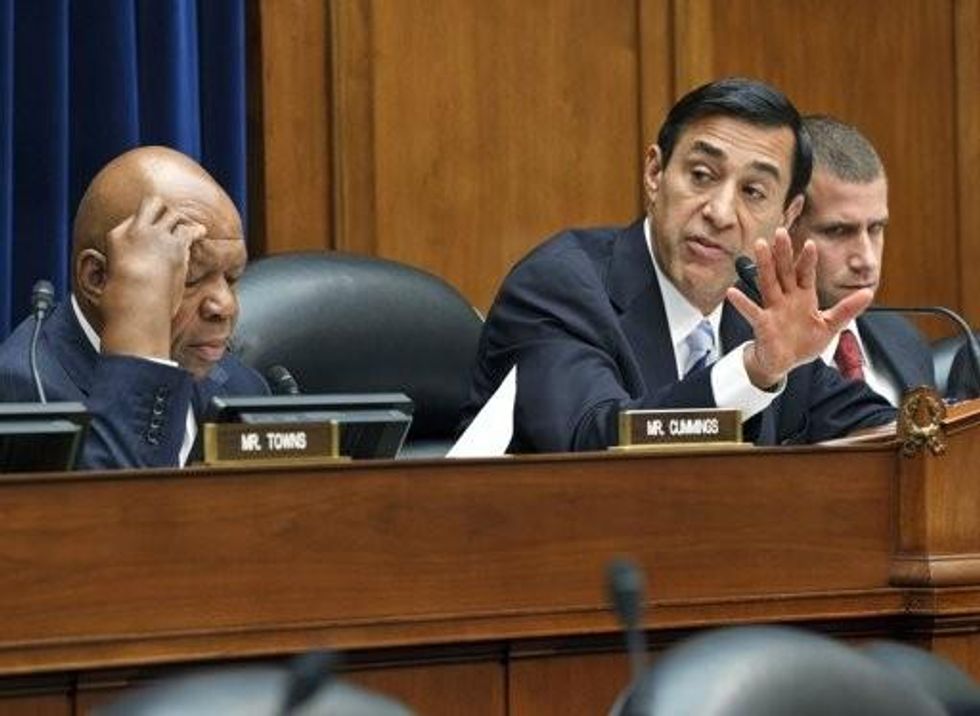
House Oversight and Government Reform Committee chairman Darrell Issa -- the headline-hungry California Republican who on Wednesday engineered a committee vote to hold Attorney General Eric Holder in contempt -- forgot that essential rule.
He failed to build a credible case or a credible coalition for his initiative. After a day of increasingly ridiculous posturing, Issa secured the contempt citation he sought. But it came on a straight party-line vote that rendered the decision all but meaningless.
The chairman's heavy-handed style invoted the reproach that the contempt vote was "nothing more than a political witch hunt," as People for the American Way president Michael Keegan termed it.
"To be sure, Congress has a legitimate interest in investigating Operation Fast and Furious, but Chairman Issa and Republican majority on the Committee appear to be more interested in scoring political points than in getting to the bottom of what happened," argued Keegan, who added that, "The hoops the Committee is demanding the Attorney General jump through illustrate that these contempt hearings are as partisan as they are extreme. Over the course of this 'investigation,' the Committee has ordered the A.G. to produce documents whose confidentiality is protected by federal law, has refused to subpoena Bush Administration officials to testify about their knowledge of the operation during their time in office, has refused to allow public testimony from officials whose testimony counters Issa's partisan narrative, and has repeatedly rejected the A.G.'s efforts to accommodate the committee, making compliance all but impossible."
Issa's actions undermined not just his own credibility but any sense that he and his allies might be acting in defense of -- or with any regard for -- the Constitution.
There is no reason to suggest that Holder is above criticism for his actions as Attorney General. He has been called out by Democrats as well as Republicans on a variety of issues. And he has not always managed his response to Issa's abuses well. Nor should anyone who vaiues transparency and government oversight be pleased when a president determines that it is necessary to invoke "executive privilege" in a fight with Congress, as Barack Obama has done to thwart Issa's demands.
But it is Issa whose actions have been contemptible. He is demanding deliberative documents that are ordinarily off-limits to Congress, a big ask, yet he has not built a credible coalition of supporters for the demand. And when the details of the documents and the issues involved are laid out--along with the offers by Holder to brief the committee--it quickly becomes evident that the committee chairman is so unwilling to compromise that he won't take "yes" for an answer.
Issa has failed to respect the House as an institution, or to make even the most basic moves to organize the chamber for a challenge to the executive branch. Instead, he's gone to hyper-partisan and divisive extreme, redesigning the Oversight Committee's website to look like a Fox News "alert"--with dubious images of Holder and headlines reading "Contempt" splashed all over the page.
Indeed, says Maryland Congressman Elijah Cummings, the committee's ranking Democrat, Issa has pursued Holder throughout the wrangling over the bungled "Fast and Furious" program with his "mind made up" to provoke. Cummings has argued that the tensions between the committee and the Department of Justice--which extend from Issa's demands for documents relating to the US Bureau of Alcohol, Tobacco, Firearms and Explosives in Arizona's approach to intercepting weapons believed to be illicitly purchased, as part of a scheme to track weapons to high-level arms traffickers--could have been resolved easily. Instead, he says, Issa has evidenced "no intention" of cooperating with the Department of Justice and the Obama administration to achieve a resolution.
Instead, argues Cummings, Issa has resorted to "partisan and inflammatory personal attacks."
For the partisan punditocracy, Cummings's comments will be dismissed as tit-for-tat politics. But that misses the point of Issa's responsibility as chairman of a key committee.
His first job was to get at least some Democrats to work with him, just as former House Judiciary Committee chairman Peter Rodino, D-New Jersey, organized Republican support for Democratic moves to hold President Nixon to account during the Watergate era; just as former House Judiciary Committee chairman James Sensenbrenner, R-Wisconsin, tried to get Democrats to back Republican attempts to challenge President Clinton in the 1990s.
Could Issa have built a bipartisan coalition in favor of transparency and accountability?
Absolutely.
The current Oversight and Government Reform Committee has many maverick Democrats, independent thinkers and straight shooters on its membership roll. Indeed, if ever there was a House Committee that was well-suited for a reasonable bipartisan push on behalf of White House accountability, this is it.
Several Democrats on the Committee have records of breaking with and criticizing the Obama administration when they disagree with the president and his appointees. Some, like Tennessee's Jim Cooper, have done so from the right. Others, like Vermont's Peter Welch, have done so from the left.
Then there is Ohio Congressman Dennis Kucinich, the most independent of House Democrats, a frequent critic of the current administration and a member with a long history of fighting for open government, transparency and checks on the executive branch. Kucinich, recently defeated for reelection in a Democratic primary but still highly engaged, was a natural ally for Issa, if the chairman's push was going to be a serious and legitimate challenge to executive overreach.
Kucinich has challenged Holder before, and he will do so again.
Yet, as tensions spiked Wednesday, Kucinich was not at Issa's side.
Instead, the Ohio Congressman was calling for postponement of any contempt vote.
"It would be a shame to produce a titanic contest between two branches of government," said Kucinich, who objected that there was no need for a contempt vote when it was so obvious that differences could be quickly and easily resolved.
The shame is on Issa. He knew full well that he was making a rare demand of an administration with which he has tangled before. He knows that to make such a demand, he needed to attract support from independent Democrats. He could have done so. But Issa chose instead to play purely partisan politics.
That's damaging to the committee's credibility.
That's damaging to Congress.
That's damaging to the Constitution, which establishes a system of checks and balances that is essential to the right functioning of the republic. If Issa respected Congress and the Constitution, he would have raised a credible challenge to the White House. Instead, he played politics. Badly.
The system of checks and balances works best when the separate branches of government are inherently and proudly adversarial toward one another. But that can't happen when partisanship defines when and how accountability moments play out.
House Oversight and Government Reform Committee chairman Darrell Issa -- the headline-hungry California Republican who on Wednesday engineered a committee vote to hold Attorney General Eric Holder in contempt -- forgot that essential rule.
He failed to build a credible case or a credible coalition for his initiative. After a day of increasingly ridiculous posturing, Issa secured the contempt citation he sought. But it came on a straight party-line vote that rendered the decision all but meaningless.
The chairman's heavy-handed style invoted the reproach that the contempt vote was "nothing more than a political witch hunt," as People for the American Way president Michael Keegan termed it.
"To be sure, Congress has a legitimate interest in investigating Operation Fast and Furious, but Chairman Issa and Republican majority on the Committee appear to be more interested in scoring political points than in getting to the bottom of what happened," argued Keegan, who added that, "The hoops the Committee is demanding the Attorney General jump through illustrate that these contempt hearings are as partisan as they are extreme. Over the course of this 'investigation,' the Committee has ordered the A.G. to produce documents whose confidentiality is protected by federal law, has refused to subpoena Bush Administration officials to testify about their knowledge of the operation during their time in office, has refused to allow public testimony from officials whose testimony counters Issa's partisan narrative, and has repeatedly rejected the A.G.'s efforts to accommodate the committee, making compliance all but impossible."
Issa's actions undermined not just his own credibility but any sense that he and his allies might be acting in defense of -- or with any regard for -- the Constitution.
There is no reason to suggest that Holder is above criticism for his actions as Attorney General. He has been called out by Democrats as well as Republicans on a variety of issues. And he has not always managed his response to Issa's abuses well. Nor should anyone who vaiues transparency and government oversight be pleased when a president determines that it is necessary to invoke "executive privilege" in a fight with Congress, as Barack Obama has done to thwart Issa's demands.
But it is Issa whose actions have been contemptible. He is demanding deliberative documents that are ordinarily off-limits to Congress, a big ask, yet he has not built a credible coalition of supporters for the demand. And when the details of the documents and the issues involved are laid out--along with the offers by Holder to brief the committee--it quickly becomes evident that the committee chairman is so unwilling to compromise that he won't take "yes" for an answer.
Issa has failed to respect the House as an institution, or to make even the most basic moves to organize the chamber for a challenge to the executive branch. Instead, he's gone to hyper-partisan and divisive extreme, redesigning the Oversight Committee's website to look like a Fox News "alert"--with dubious images of Holder and headlines reading "Contempt" splashed all over the page.
Indeed, says Maryland Congressman Elijah Cummings, the committee's ranking Democrat, Issa has pursued Holder throughout the wrangling over the bungled "Fast and Furious" program with his "mind made up" to provoke. Cummings has argued that the tensions between the committee and the Department of Justice--which extend from Issa's demands for documents relating to the US Bureau of Alcohol, Tobacco, Firearms and Explosives in Arizona's approach to intercepting weapons believed to be illicitly purchased, as part of a scheme to track weapons to high-level arms traffickers--could have been resolved easily. Instead, he says, Issa has evidenced "no intention" of cooperating with the Department of Justice and the Obama administration to achieve a resolution.
Instead, argues Cummings, Issa has resorted to "partisan and inflammatory personal attacks."
For the partisan punditocracy, Cummings's comments will be dismissed as tit-for-tat politics. But that misses the point of Issa's responsibility as chairman of a key committee.
His first job was to get at least some Democrats to work with him, just as former House Judiciary Committee chairman Peter Rodino, D-New Jersey, organized Republican support for Democratic moves to hold President Nixon to account during the Watergate era; just as former House Judiciary Committee chairman James Sensenbrenner, R-Wisconsin, tried to get Democrats to back Republican attempts to challenge President Clinton in the 1990s.
Could Issa have built a bipartisan coalition in favor of transparency and accountability?
Absolutely.
The current Oversight and Government Reform Committee has many maverick Democrats, independent thinkers and straight shooters on its membership roll. Indeed, if ever there was a House Committee that was well-suited for a reasonable bipartisan push on behalf of White House accountability, this is it.
Several Democrats on the Committee have records of breaking with and criticizing the Obama administration when they disagree with the president and his appointees. Some, like Tennessee's Jim Cooper, have done so from the right. Others, like Vermont's Peter Welch, have done so from the left.
Then there is Ohio Congressman Dennis Kucinich, the most independent of House Democrats, a frequent critic of the current administration and a member with a long history of fighting for open government, transparency and checks on the executive branch. Kucinich, recently defeated for reelection in a Democratic primary but still highly engaged, was a natural ally for Issa, if the chairman's push was going to be a serious and legitimate challenge to executive overreach.
Kucinich has challenged Holder before, and he will do so again.
Yet, as tensions spiked Wednesday, Kucinich was not at Issa's side.
Instead, the Ohio Congressman was calling for postponement of any contempt vote.
"It would be a shame to produce a titanic contest between two branches of government," said Kucinich, who objected that there was no need for a contempt vote when it was so obvious that differences could be quickly and easily resolved.
The shame is on Issa. He knew full well that he was making a rare demand of an administration with which he has tangled before. He knows that to make such a demand, he needed to attract support from independent Democrats. He could have done so. But Issa chose instead to play purely partisan politics.
That's damaging to the committee's credibility.
That's damaging to Congress.
That's damaging to the Constitution, which establishes a system of checks and balances that is essential to the right functioning of the republic. If Issa respected Congress and the Constitution, he would have raised a credible challenge to the White House. Instead, he played politics. Badly.
The system of checks and balances works best when the separate branches of government are inherently and proudly adversarial toward one another. But that can't happen when partisanship defines when and how accountability moments play out.
House Oversight and Government Reform Committee chairman Darrell Issa -- the headline-hungry California Republican who on Wednesday engineered a committee vote to hold Attorney General Eric Holder in contempt -- forgot that essential rule.
He failed to build a credible case or a credible coalition for his initiative. After a day of increasingly ridiculous posturing, Issa secured the contempt citation he sought. But it came on a straight party-line vote that rendered the decision all but meaningless.
The chairman's heavy-handed style invoted the reproach that the contempt vote was "nothing more than a political witch hunt," as People for the American Way president Michael Keegan termed it.
"To be sure, Congress has a legitimate interest in investigating Operation Fast and Furious, but Chairman Issa and Republican majority on the Committee appear to be more interested in scoring political points than in getting to the bottom of what happened," argued Keegan, who added that, "The hoops the Committee is demanding the Attorney General jump through illustrate that these contempt hearings are as partisan as they are extreme. Over the course of this 'investigation,' the Committee has ordered the A.G. to produce documents whose confidentiality is protected by federal law, has refused to subpoena Bush Administration officials to testify about their knowledge of the operation during their time in office, has refused to allow public testimony from officials whose testimony counters Issa's partisan narrative, and has repeatedly rejected the A.G.'s efforts to accommodate the committee, making compliance all but impossible."
Issa's actions undermined not just his own credibility but any sense that he and his allies might be acting in defense of -- or with any regard for -- the Constitution.
There is no reason to suggest that Holder is above criticism for his actions as Attorney General. He has been called out by Democrats as well as Republicans on a variety of issues. And he has not always managed his response to Issa's abuses well. Nor should anyone who vaiues transparency and government oversight be pleased when a president determines that it is necessary to invoke "executive privilege" in a fight with Congress, as Barack Obama has done to thwart Issa's demands.
But it is Issa whose actions have been contemptible. He is demanding deliberative documents that are ordinarily off-limits to Congress, a big ask, yet he has not built a credible coalition of supporters for the demand. And when the details of the documents and the issues involved are laid out--along with the offers by Holder to brief the committee--it quickly becomes evident that the committee chairman is so unwilling to compromise that he won't take "yes" for an answer.
Issa has failed to respect the House as an institution, or to make even the most basic moves to organize the chamber for a challenge to the executive branch. Instead, he's gone to hyper-partisan and divisive extreme, redesigning the Oversight Committee's website to look like a Fox News "alert"--with dubious images of Holder and headlines reading "Contempt" splashed all over the page.
Indeed, says Maryland Congressman Elijah Cummings, the committee's ranking Democrat, Issa has pursued Holder throughout the wrangling over the bungled "Fast and Furious" program with his "mind made up" to provoke. Cummings has argued that the tensions between the committee and the Department of Justice--which extend from Issa's demands for documents relating to the US Bureau of Alcohol, Tobacco, Firearms and Explosives in Arizona's approach to intercepting weapons believed to be illicitly purchased, as part of a scheme to track weapons to high-level arms traffickers--could have been resolved easily. Instead, he says, Issa has evidenced "no intention" of cooperating with the Department of Justice and the Obama administration to achieve a resolution.
Instead, argues Cummings, Issa has resorted to "partisan and inflammatory personal attacks."
For the partisan punditocracy, Cummings's comments will be dismissed as tit-for-tat politics. But that misses the point of Issa's responsibility as chairman of a key committee.
His first job was to get at least some Democrats to work with him, just as former House Judiciary Committee chairman Peter Rodino, D-New Jersey, organized Republican support for Democratic moves to hold President Nixon to account during the Watergate era; just as former House Judiciary Committee chairman James Sensenbrenner, R-Wisconsin, tried to get Democrats to back Republican attempts to challenge President Clinton in the 1990s.
Could Issa have built a bipartisan coalition in favor of transparency and accountability?
Absolutely.
The current Oversight and Government Reform Committee has many maverick Democrats, independent thinkers and straight shooters on its membership roll. Indeed, if ever there was a House Committee that was well-suited for a reasonable bipartisan push on behalf of White House accountability, this is it.
Several Democrats on the Committee have records of breaking with and criticizing the Obama administration when they disagree with the president and his appointees. Some, like Tennessee's Jim Cooper, have done so from the right. Others, like Vermont's Peter Welch, have done so from the left.
Then there is Ohio Congressman Dennis Kucinich, the most independent of House Democrats, a frequent critic of the current administration and a member with a long history of fighting for open government, transparency and checks on the executive branch. Kucinich, recently defeated for reelection in a Democratic primary but still highly engaged, was a natural ally for Issa, if the chairman's push was going to be a serious and legitimate challenge to executive overreach.
Kucinich has challenged Holder before, and he will do so again.
Yet, as tensions spiked Wednesday, Kucinich was not at Issa's side.
Instead, the Ohio Congressman was calling for postponement of any contempt vote.
"It would be a shame to produce a titanic contest between two branches of government," said Kucinich, who objected that there was no need for a contempt vote when it was so obvious that differences could be quickly and easily resolved.
The shame is on Issa. He knew full well that he was making a rare demand of an administration with which he has tangled before. He knows that to make such a demand, he needed to attract support from independent Democrats. He could have done so. But Issa chose instead to play purely partisan politics.
That's damaging to the committee's credibility.
That's damaging to Congress.
That's damaging to the Constitution, which establishes a system of checks and balances that is essential to the right functioning of the republic. If Issa respected Congress and the Constitution, he would have raised a credible challenge to the White House. Instead, he played politics. Badly.