SUBSCRIBE TO OUR FREE NEWSLETTER
Daily news & progressive opinion—funded by the people, not the corporations—delivered straight to your inbox.
5
#000000
#FFFFFF
To donate by check, phone, or other method, see our More Ways to Give page.
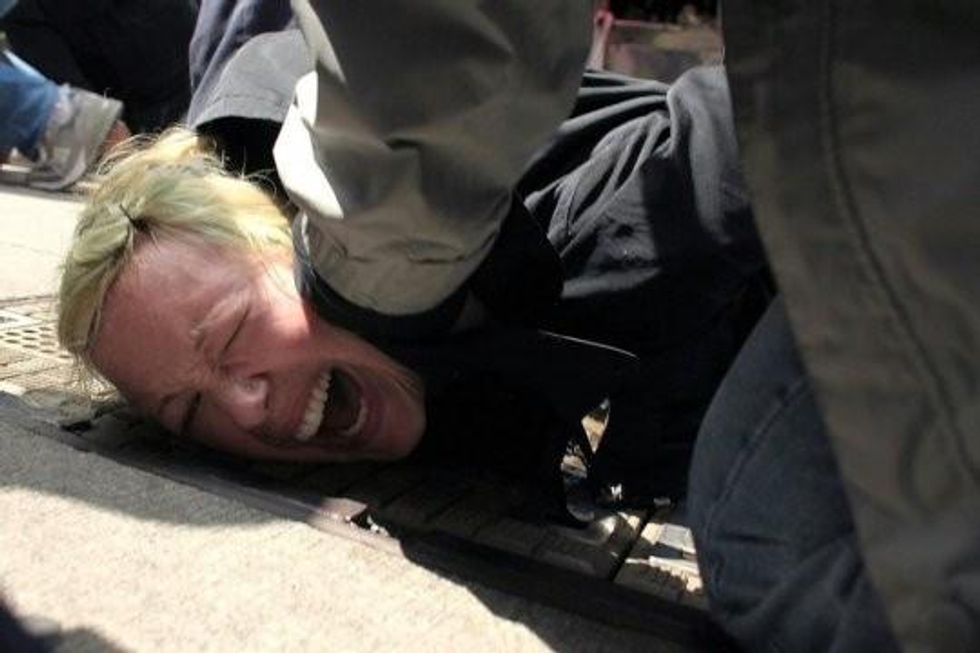
I did my own rough count on the largest of the Occupy protests that day. It left Union Square in the evening heading for the Wall Street area. I walked through the march front to back, figuring a couple of thousand loosely packed protesters to a block, and came up with a conservative estimate of 15,000 people. Maybe it wasn't the biggest protest of all time, but sizeable enough given that Occupy, an organization without strong structures but once strongly located, had been (quite literally) pushed or even beaten out of its camps in Zuccotti Park and elsewhere across the country and toward oblivion.
It's true that if you were checking out the Nation or Mother Jones, you would have gotten a more accurate sense of what was going on. Still, didn't the great protest movement of our American moment (on a planet still in upheaval) deserve better that day? And no matter what you read in the mainstream, here's what you would have known nothing about: this country is increasingly an armed camp and those marchers, remarkably relaxed and peaceable, were heading out into a concentration of police that was staggering and should have been startling.
Cops on motor scooters patrolled the edges of the march, which was hemmed in by the usual moveable metal barricades. Police helicopters buzzed us at rooftop level. The police managed to alter the actual path of the marchers partway along and the police turnout -- I estimated up to 75 cops, three deep on some street corners doing nothing but collecting overtime -- was little short of incomprehensible.
Though Occupy marchers used to chant, "Whose streets, our streets!" it was never so. The streets belong to the police. If this is the democracy and freedom to dissent that American officials constantly proclaim to the world as one of our core values, then pinch me. If most of it is even legal, I'd be surprised. But when it comes to legality, we're past all that. So any march on a sunny day is instantly imprisoned, and the protesters turned into a captive audience. When young people break out of the barricades and the serried ranks of cops and head in unexpected directions, it has the unmistakable feel of a jailbreak.
The fact is that, in a country whose security forces are up-armored to the teeth from the Mexican border to Union Square, just behind any set of marchers, you can feel the unease of those in power, edging up to fear. And no wonder. We remain in a "recovery" that's spinning on a dime. Let the Eurozone falter and begin to fall, the Chinese housing bubble pop, or the Persian Gulf go up in flames, and hold onto your signs. Like Bloomberg in the Big Apple, many mayors sent in their paramilitaries (with a helping hand from the Department of Homeland Security) to get rid of the "troublemakers." Only problem: their real problems run so much deeper and when the next "moment" comes, Occupy could look like a march in the park (which, in many inspirational ways, it largely was). In the meantime, the streets increasingly belong to the weaponized. Americans who protest blur into the "terrorists" who, since 9/11, have been the obsession of what passes for law enforcement.
If you want some sense of just what's lurking under the surface of all the police drones and helicopters and tanks and even mini-drone submarines, what underpins our fragile, edgy moment, then check out Noam Chomsky's latest, "Plutonomy and the Precariat."
I did my own rough count on the largest of the Occupy protests that day. It left Union Square in the evening heading for the Wall Street area. I walked through the march front to back, figuring a couple of thousand loosely packed protesters to a block, and came up with a conservative estimate of 15,000 people. Maybe it wasn't the biggest protest of all time, but sizeable enough given that Occupy, an organization without strong structures but once strongly located, had been (quite literally) pushed or even beaten out of its camps in Zuccotti Park and elsewhere across the country and toward oblivion.
It's true that if you were checking out the Nation or Mother Jones, you would have gotten a more accurate sense of what was going on. Still, didn't the great protest movement of our American moment (on a planet still in upheaval) deserve better that day? And no matter what you read in the mainstream, here's what you would have known nothing about: this country is increasingly an armed camp and those marchers, remarkably relaxed and peaceable, were heading out into a concentration of police that was staggering and should have been startling.
Cops on motor scooters patrolled the edges of the march, which was hemmed in by the usual moveable metal barricades. Police helicopters buzzed us at rooftop level. The police managed to alter the actual path of the marchers partway along and the police turnout -- I estimated up to 75 cops, three deep on some street corners doing nothing but collecting overtime -- was little short of incomprehensible.
Though Occupy marchers used to chant, "Whose streets, our streets!" it was never so. The streets belong to the police. If this is the democracy and freedom to dissent that American officials constantly proclaim to the world as one of our core values, then pinch me. If most of it is even legal, I'd be surprised. But when it comes to legality, we're past all that. So any march on a sunny day is instantly imprisoned, and the protesters turned into a captive audience. When young people break out of the barricades and the serried ranks of cops and head in unexpected directions, it has the unmistakable feel of a jailbreak.
The fact is that, in a country whose security forces are up-armored to the teeth from the Mexican border to Union Square, just behind any set of marchers, you can feel the unease of those in power, edging up to fear. And no wonder. We remain in a "recovery" that's spinning on a dime. Let the Eurozone falter and begin to fall, the Chinese housing bubble pop, or the Persian Gulf go up in flames, and hold onto your signs. Like Bloomberg in the Big Apple, many mayors sent in their paramilitaries (with a helping hand from the Department of Homeland Security) to get rid of the "troublemakers." Only problem: their real problems run so much deeper and when the next "moment" comes, Occupy could look like a march in the park (which, in many inspirational ways, it largely was). In the meantime, the streets increasingly belong to the weaponized. Americans who protest blur into the "terrorists" who, since 9/11, have been the obsession of what passes for law enforcement.
If you want some sense of just what's lurking under the surface of all the police drones and helicopters and tanks and even mini-drone submarines, what underpins our fragile, edgy moment, then check out Noam Chomsky's latest, "Plutonomy and the Precariat."
I did my own rough count on the largest of the Occupy protests that day. It left Union Square in the evening heading for the Wall Street area. I walked through the march front to back, figuring a couple of thousand loosely packed protesters to a block, and came up with a conservative estimate of 15,000 people. Maybe it wasn't the biggest protest of all time, but sizeable enough given that Occupy, an organization without strong structures but once strongly located, had been (quite literally) pushed or even beaten out of its camps in Zuccotti Park and elsewhere across the country and toward oblivion.
It's true that if you were checking out the Nation or Mother Jones, you would have gotten a more accurate sense of what was going on. Still, didn't the great protest movement of our American moment (on a planet still in upheaval) deserve better that day? And no matter what you read in the mainstream, here's what you would have known nothing about: this country is increasingly an armed camp and those marchers, remarkably relaxed and peaceable, were heading out into a concentration of police that was staggering and should have been startling.
Cops on motor scooters patrolled the edges of the march, which was hemmed in by the usual moveable metal barricades. Police helicopters buzzed us at rooftop level. The police managed to alter the actual path of the marchers partway along and the police turnout -- I estimated up to 75 cops, three deep on some street corners doing nothing but collecting overtime -- was little short of incomprehensible.
Though Occupy marchers used to chant, "Whose streets, our streets!" it was never so. The streets belong to the police. If this is the democracy and freedom to dissent that American officials constantly proclaim to the world as one of our core values, then pinch me. If most of it is even legal, I'd be surprised. But when it comes to legality, we're past all that. So any march on a sunny day is instantly imprisoned, and the protesters turned into a captive audience. When young people break out of the barricades and the serried ranks of cops and head in unexpected directions, it has the unmistakable feel of a jailbreak.
The fact is that, in a country whose security forces are up-armored to the teeth from the Mexican border to Union Square, just behind any set of marchers, you can feel the unease of those in power, edging up to fear. And no wonder. We remain in a "recovery" that's spinning on a dime. Let the Eurozone falter and begin to fall, the Chinese housing bubble pop, or the Persian Gulf go up in flames, and hold onto your signs. Like Bloomberg in the Big Apple, many mayors sent in their paramilitaries (with a helping hand from the Department of Homeland Security) to get rid of the "troublemakers." Only problem: their real problems run so much deeper and when the next "moment" comes, Occupy could look like a march in the park (which, in many inspirational ways, it largely was). In the meantime, the streets increasingly belong to the weaponized. Americans who protest blur into the "terrorists" who, since 9/11, have been the obsession of what passes for law enforcement.
If you want some sense of just what's lurking under the surface of all the police drones and helicopters and tanks and even mini-drone submarines, what underpins our fragile, edgy moment, then check out Noam Chomsky's latest, "Plutonomy and the Precariat."