SUBSCRIBE TO OUR FREE NEWSLETTER
Daily news & progressive opinion—funded by the people, not the corporations—delivered straight to your inbox.
5
#000000
#FFFFFF
To donate by check, phone, or other method, see our More Ways to Give page.
On April 15 - 18, in Washington, D.C., over 10,000 young people - and the young at heart, gathered in our nation's capital in an effort to amplify the voices of reason concerning the downward spiral of government and its intimate relationship with the fossil fuel industry. It was a beautiful event and was a great inspiration for many of us to DO SOMETHING.
Two of the memorable keynote speakers even spoke to the need of doing more than applauding the success of a well-attended conference as an effective tool for change, and challenged us to go further.
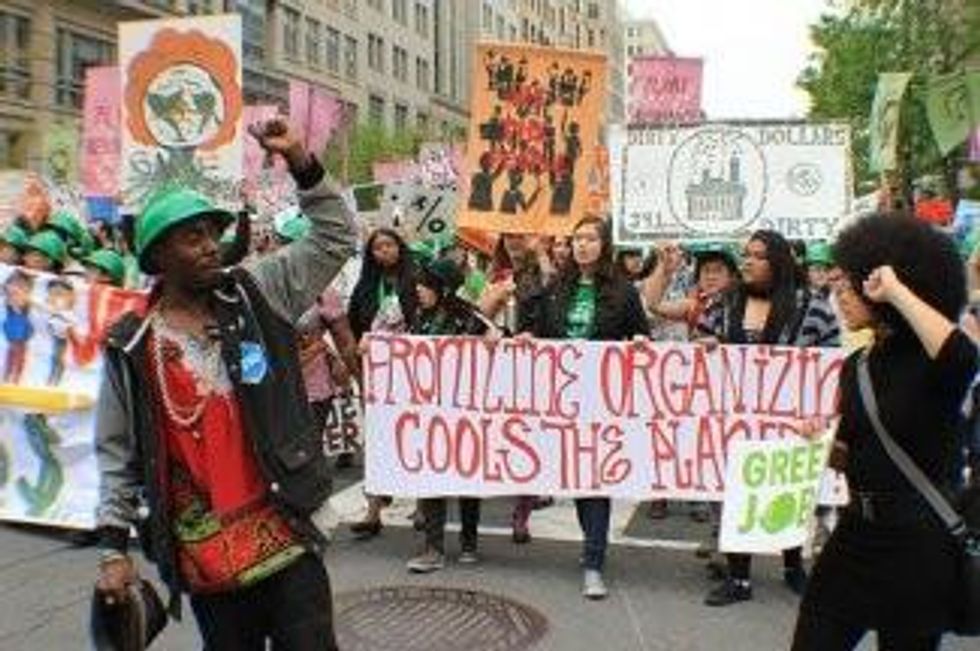
So I put on my green hard hat and joined the thousands of marchers on Monday. The organizers made a pit stop at BP's D.C. office to host an impromptu rally where residents of the Gulf spoke. While there I had the good fortune to meet Bob Edgar, President of Common Cause, and I asked him whether our actions today will truly influence the government. He said, "$1.5 billion has been cut from the EPA budget this year alone." Cutting the EPA's budget the year after the greatest oil spill in history answered my question.
The very next day, the Washington Post Express (the condensed free version of the Post that is distributed to commuters every weekday morning) featured the headline "Gulf's Health Improving." In complete AP fashion, the end of the article contained the more revealing elements of truth that completely contradicted the heading: "The surface looks as if nothing ever happened while potentially big problems are hidden below the surface. Some may not even be known for years."
We're going to take power back because it belongs to the people. But there was no mention of Power Shift in the Washington Post Express.
After 172 million gallons of oil and an untold amount of "dispersing chemicals" spewed into the Gulf, how is BP doing? While paying out to less than half the number of claims submitted, its stock has largely rebounded and the company is now pursuing new ventures from the Arctic to India while maintaining the largest leases on the Gulf itself.
According to Sam D'Angelo, a young activist from New Orleans, we are past the tipping point. Darren Martin, also from the Gulf Coast, had jars of tar balls he was trying to return to BP at the aforementioned rally. The jar came with toxic warnings and skulls and crossbones. It was then left on the doorstep of the main entrance but the security guards promptly returned it to him.
Again, the powers that be are not listening.
Well, they should be. We're going to take power back because it belongs to the people.
On April 15 - 18, in Washington, D.C., over 10,000 young people - and the young at heart, gathered in our nation's capital in an effort to amplify the voices of reason concerning the downward spiral of government and its intimate relationship with the fossil fuel industry. It was a beautiful event and was a great inspiration for many of us to DO SOMETHING.
Two of the memorable keynote speakers even spoke to the need of doing more than applauding the success of a well-attended conference as an effective tool for change, and challenged us to go further.
So I put on my green hard hat and joined the thousands of marchers on Monday. The organizers made a pit stop at BP's D.C. office to host an impromptu rally where residents of the Gulf spoke. While there I had the good fortune to meet Bob Edgar, President of Common Cause, and I asked him whether our actions today will truly influence the government. He said, "$1.5 billion has been cut from the EPA budget this year alone." Cutting the EPA's budget the year after the greatest oil spill in history answered my question.
The very next day, the Washington Post Express (the condensed free version of the Post that is distributed to commuters every weekday morning) featured the headline "Gulf's Health Improving." In complete AP fashion, the end of the article contained the more revealing elements of truth that completely contradicted the heading: "The surface looks as if nothing ever happened while potentially big problems are hidden below the surface. Some may not even be known for years."
We're going to take power back because it belongs to the people. But there was no mention of Power Shift in the Washington Post Express.
After 172 million gallons of oil and an untold amount of "dispersing chemicals" spewed into the Gulf, how is BP doing? While paying out to less than half the number of claims submitted, its stock has largely rebounded and the company is now pursuing new ventures from the Arctic to India while maintaining the largest leases on the Gulf itself.
According to Sam D'Angelo, a young activist from New Orleans, we are past the tipping point. Darren Martin, also from the Gulf Coast, had jars of tar balls he was trying to return to BP at the aforementioned rally. The jar came with toxic warnings and skulls and crossbones. It was then left on the doorstep of the main entrance but the security guards promptly returned it to him.
Again, the powers that be are not listening.
Well, they should be. We're going to take power back because it belongs to the people.
On April 15 - 18, in Washington, D.C., over 10,000 young people - and the young at heart, gathered in our nation's capital in an effort to amplify the voices of reason concerning the downward spiral of government and its intimate relationship with the fossil fuel industry. It was a beautiful event and was a great inspiration for many of us to DO SOMETHING.
Two of the memorable keynote speakers even spoke to the need of doing more than applauding the success of a well-attended conference as an effective tool for change, and challenged us to go further.
So I put on my green hard hat and joined the thousands of marchers on Monday. The organizers made a pit stop at BP's D.C. office to host an impromptu rally where residents of the Gulf spoke. While there I had the good fortune to meet Bob Edgar, President of Common Cause, and I asked him whether our actions today will truly influence the government. He said, "$1.5 billion has been cut from the EPA budget this year alone." Cutting the EPA's budget the year after the greatest oil spill in history answered my question.
The very next day, the Washington Post Express (the condensed free version of the Post that is distributed to commuters every weekday morning) featured the headline "Gulf's Health Improving." In complete AP fashion, the end of the article contained the more revealing elements of truth that completely contradicted the heading: "The surface looks as if nothing ever happened while potentially big problems are hidden below the surface. Some may not even be known for years."
We're going to take power back because it belongs to the people. But there was no mention of Power Shift in the Washington Post Express.
After 172 million gallons of oil and an untold amount of "dispersing chemicals" spewed into the Gulf, how is BP doing? While paying out to less than half the number of claims submitted, its stock has largely rebounded and the company is now pursuing new ventures from the Arctic to India while maintaining the largest leases on the Gulf itself.
According to Sam D'Angelo, a young activist from New Orleans, we are past the tipping point. Darren Martin, also from the Gulf Coast, had jars of tar balls he was trying to return to BP at the aforementioned rally. The jar came with toxic warnings and skulls and crossbones. It was then left on the doorstep of the main entrance but the security guards promptly returned it to him.
Again, the powers that be are not listening.
Well, they should be. We're going to take power back because it belongs to the people.