

SUBSCRIBE TO OUR FREE NEWSLETTER
Daily news & progressive opinion—funded by the people, not the corporations—delivered straight to your inbox.
5
#000000
#FFFFFF
To donate by check, phone, or other method, see our More Ways to Give page.
Fernando, who has been instrumental in helping the Drop the I-Word campaign gather "I Am" stories the past couple of months, tells his own story this week. Fernando is an organizer working with communities around the country. He refuses to be defined as a victim and calls for us to recognize that the human spirit does live in every one of us. He says, "As immigrants, there is a great sense of accomplishment in defeating our fears and a lot of the challenges and negative feelings that are caused by our status. It takes healing and inner work to reject those toxic messages and come to terms with the fact that we are just human like everyone else."
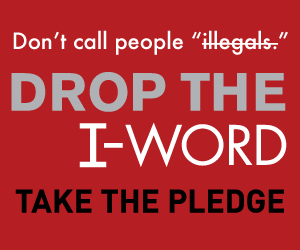
For the "I Am..." storytelling project, people from all walks of life relate experiences, demand respect and reject criminalizing language about immigrants. Stories are gathered in collaboration with our campaign partners. We are grateful to the Alliance for a Just Society and to Fernando for today's story.
+++
I am Fernando, I am a human being
Paulo Freire once said, "The greatest humanistic and historical task of the oppressed: to liberate themselves..." This rings true for me because like many immigrants, I have worked a lot to triumph over the emotional and spiritual baggage that comes with being undocumented in this country. I do not live in a state of victimhood. Illegal is not a state of being. There is no human being that is illegal. I am a human being, and deserve to be respected as such.
People should not be called "illegal" because it dehumanizes them and fails to acknowledge the real economic forces that push people to migrate. This word criminalizes immigrants. This rhetoric does not help fix the broken immigration system. Instead, it creates fear and division. We should focus on building stronger and healthier communities.
My father was the first of our family forced to leave Mexico and come to the U.S. in the 80s. I came to the U.S. from Mexico at the age of 16 in 2001. At that time I had a lot of fears and I was very angry. The police were very repressive and bullied the teens in my neighborhood a lot. I knew I had to leave or my anger would end up getting me in trouble. I wanted a better life and was motivated greatly to provide the same for my mother and sister.
Getting here was a struggle: two nights walking in pain and fear. As I walked in that darkness I thought about everything and everyone I was leaving behind. I spent my first Thanksgiving with 13 people in a single motel room in Tucson with no food. I traveled first to Florida to stay with my cousins and attend high school. The school wouldn't let me enroll. Without other options, I crossed the country to Idaho to join my father and start high school. My classmates referred to Mexicans as "illegals," and I couldn't say anything because I was afraid that my status would be disclosed.
I questioned my identity and my integrity as a human being. Still, I got serious about school, worked hard to learn English, and got good grades. I became involved with student organizations and in 2004 I came out as undocumented for the first time. It was tremendously liberating. It was then that I started doing community organizing. I'll never forget standing in front of nine Idaho state senators, arguing for in-state tuition and education for migrant students. It was tough. I presented the bill and answered questions and although the bill did not pass, we all made the best effort and grew from the experience.
With much sacrifice I have an undergrad degree in political science. I began studying for my masters in Latin American Studies at the University of New Mexico but due to financial hardship, I have not been able to finish. As immigrants, there is a great sense of accomplishment in defeating our fears and a lot of the challenges and negative feelings that are caused by our status. It takes healing and inner work to reject those toxic messages and come to terms with the fact that we are just human like everyone else. We are not defined by our immigrant status or by who is oppressing us. We love. We are loved. We strive to live our best lives, to be happy and to fight back to claim the dignity we deserve.
Fernando, who has been instrumental in helping the Drop the I-Word campaign gather "I Am" stories the past couple of months, tells his own story this week. Fernando is an organizer working with communities around the country. He refuses to be defined as a victim and calls for us to recognize that the human spirit does live in every one of us. He says, "As immigrants, there is a great sense of accomplishment in defeating our fears and a lot of the challenges and negative feelings that are caused by our status. It takes healing and inner work to reject those toxic messages and come to terms with the fact that we are just human like everyone else."
For the "I Am..." storytelling project, people from all walks of life relate experiences, demand respect and reject criminalizing language about immigrants. Stories are gathered in collaboration with our campaign partners. We are grateful to the Alliance for a Just Society and to Fernando for today's story.
+++
I am Fernando, I am a human being
Paulo Freire once said, "The greatest humanistic and historical task of the oppressed: to liberate themselves..." This rings true for me because like many immigrants, I have worked a lot to triumph over the emotional and spiritual baggage that comes with being undocumented in this country. I do not live in a state of victimhood. Illegal is not a state of being. There is no human being that is illegal. I am a human being, and deserve to be respected as such.
People should not be called "illegal" because it dehumanizes them and fails to acknowledge the real economic forces that push people to migrate. This word criminalizes immigrants. This rhetoric does not help fix the broken immigration system. Instead, it creates fear and division. We should focus on building stronger and healthier communities.
My father was the first of our family forced to leave Mexico and come to the U.S. in the 80s. I came to the U.S. from Mexico at the age of 16 in 2001. At that time I had a lot of fears and I was very angry. The police were very repressive and bullied the teens in my neighborhood a lot. I knew I had to leave or my anger would end up getting me in trouble. I wanted a better life and was motivated greatly to provide the same for my mother and sister.
Getting here was a struggle: two nights walking in pain and fear. As I walked in that darkness I thought about everything and everyone I was leaving behind. I spent my first Thanksgiving with 13 people in a single motel room in Tucson with no food. I traveled first to Florida to stay with my cousins and attend high school. The school wouldn't let me enroll. Without other options, I crossed the country to Idaho to join my father and start high school. My classmates referred to Mexicans as "illegals," and I couldn't say anything because I was afraid that my status would be disclosed.
I questioned my identity and my integrity as a human being. Still, I got serious about school, worked hard to learn English, and got good grades. I became involved with student organizations and in 2004 I came out as undocumented for the first time. It was tremendously liberating. It was then that I started doing community organizing. I'll never forget standing in front of nine Idaho state senators, arguing for in-state tuition and education for migrant students. It was tough. I presented the bill and answered questions and although the bill did not pass, we all made the best effort and grew from the experience.
With much sacrifice I have an undergrad degree in political science. I began studying for my masters in Latin American Studies at the University of New Mexico but due to financial hardship, I have not been able to finish. As immigrants, there is a great sense of accomplishment in defeating our fears and a lot of the challenges and negative feelings that are caused by our status. It takes healing and inner work to reject those toxic messages and come to terms with the fact that we are just human like everyone else. We are not defined by our immigrant status or by who is oppressing us. We love. We are loved. We strive to live our best lives, to be happy and to fight back to claim the dignity we deserve.
Fernando, who has been instrumental in helping the Drop the I-Word campaign gather "I Am" stories the past couple of months, tells his own story this week. Fernando is an organizer working with communities around the country. He refuses to be defined as a victim and calls for us to recognize that the human spirit does live in every one of us. He says, "As immigrants, there is a great sense of accomplishment in defeating our fears and a lot of the challenges and negative feelings that are caused by our status. It takes healing and inner work to reject those toxic messages and come to terms with the fact that we are just human like everyone else."
For the "I Am..." storytelling project, people from all walks of life relate experiences, demand respect and reject criminalizing language about immigrants. Stories are gathered in collaboration with our campaign partners. We are grateful to the Alliance for a Just Society and to Fernando for today's story.
+++
I am Fernando, I am a human being
Paulo Freire once said, "The greatest humanistic and historical task of the oppressed: to liberate themselves..." This rings true for me because like many immigrants, I have worked a lot to triumph over the emotional and spiritual baggage that comes with being undocumented in this country. I do not live in a state of victimhood. Illegal is not a state of being. There is no human being that is illegal. I am a human being, and deserve to be respected as such.
People should not be called "illegal" because it dehumanizes them and fails to acknowledge the real economic forces that push people to migrate. This word criminalizes immigrants. This rhetoric does not help fix the broken immigration system. Instead, it creates fear and division. We should focus on building stronger and healthier communities.
My father was the first of our family forced to leave Mexico and come to the U.S. in the 80s. I came to the U.S. from Mexico at the age of 16 in 2001. At that time I had a lot of fears and I was very angry. The police were very repressive and bullied the teens in my neighborhood a lot. I knew I had to leave or my anger would end up getting me in trouble. I wanted a better life and was motivated greatly to provide the same for my mother and sister.
Getting here was a struggle: two nights walking in pain and fear. As I walked in that darkness I thought about everything and everyone I was leaving behind. I spent my first Thanksgiving with 13 people in a single motel room in Tucson with no food. I traveled first to Florida to stay with my cousins and attend high school. The school wouldn't let me enroll. Without other options, I crossed the country to Idaho to join my father and start high school. My classmates referred to Mexicans as "illegals," and I couldn't say anything because I was afraid that my status would be disclosed.
I questioned my identity and my integrity as a human being. Still, I got serious about school, worked hard to learn English, and got good grades. I became involved with student organizations and in 2004 I came out as undocumented for the first time. It was tremendously liberating. It was then that I started doing community organizing. I'll never forget standing in front of nine Idaho state senators, arguing for in-state tuition and education for migrant students. It was tough. I presented the bill and answered questions and although the bill did not pass, we all made the best effort and grew from the experience.
With much sacrifice I have an undergrad degree in political science. I began studying for my masters in Latin American Studies at the University of New Mexico but due to financial hardship, I have not been able to finish. As immigrants, there is a great sense of accomplishment in defeating our fears and a lot of the challenges and negative feelings that are caused by our status. It takes healing and inner work to reject those toxic messages and come to terms with the fact that we are just human like everyone else. We are not defined by our immigrant status or by who is oppressing us. We love. We are loved. We strive to live our best lives, to be happy and to fight back to claim the dignity we deserve.

