SUBSCRIBE TO OUR FREE NEWSLETTER
Daily news & progressive opinion—funded by the people, not the corporations—delivered straight to your inbox.
5
#000000
#FFFFFF
To donate by check, phone, or other method, see our More Ways to Give page.
Daily news & progressive opinion—funded by the people, not the corporations—delivered straight to your inbox.
Only months after courting union voters with pro-worker campaign rhetoric, President Trump is on track to become the most anti-union president in modern American history.
During a 2024 campaign stop in Detroit, President Donald Trump energized the crowd by proclaiming: “I will protect what is ours. I will protect our workers. I will protect our jobs.” Then, asking the audience to look around at empty buildings and remember how they’ve been ripped off, Trump continued, “These pro-worker policies are among the many reasons I’ve been overwhelmingly endorsed by the rank-and-file membership of the Teamsters.”
Only months after courting union voters with pro-worker campaign rhetoric, President Trump is on track to become the most anti-union president in modern American history.
The President’s record is clear: Trump’s first Supreme Court appointee, Neil Gorsuch, cast the deciding vote in Janus v AFSCME, a “right-to-work” ruling Trump praised for allowing workers to opt out of union dues while freeriding off the benefits of collective bargaining provided by dues-paying members. The president’s two labor secretaries, Eugene Scalia and Lori Chavez-DeRemer, have vigorously peeled away protective regulations for workers. And following the unprecedented firing without cause of Gwen Wilcox, a member of the National Labor Relations Board (NLRB), the federal agency that addresses unfair labor practices and safeguards workers’ rights remains paralyzed by its inability to reach a quorum.
But what sets President Trump apart is his targeting of public sector unions.
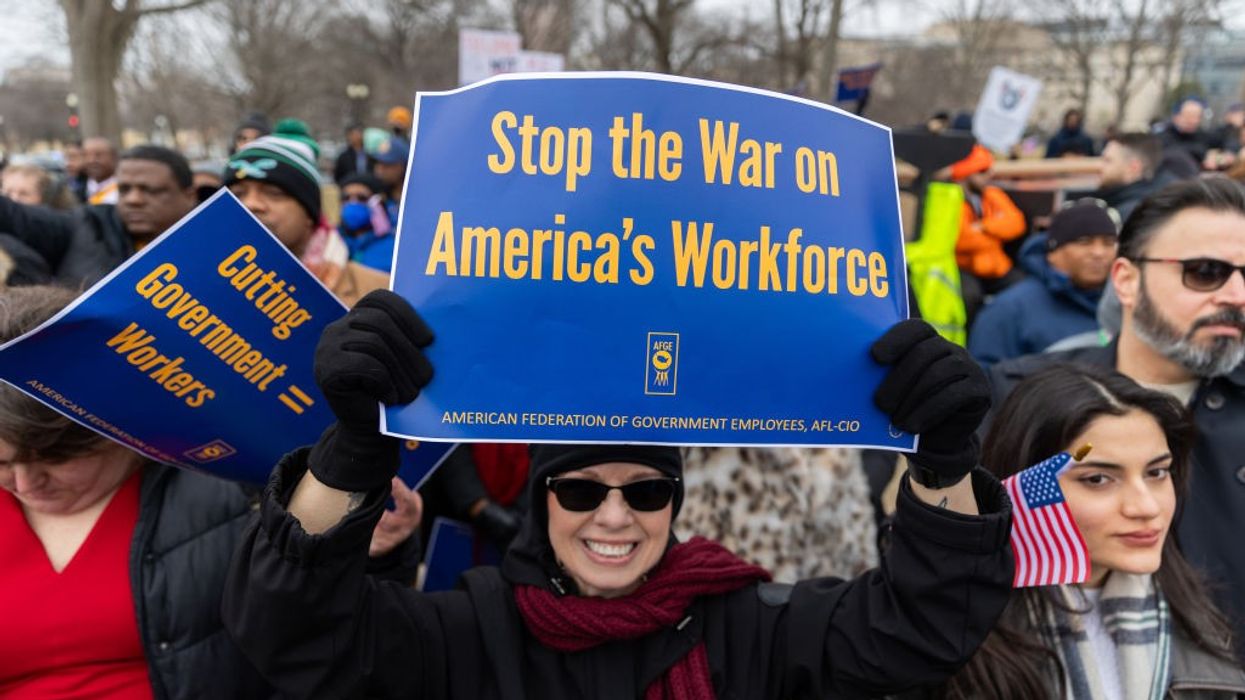
In early April, Representatives Jared Golden (D-Maine) and Ryan Fitzpatrick (R-Pa.) introduced bipartisan legislation, “The Protect America’s Workforce Act” (H.R. 2250), to overturn Trump’s executive order and restore all terminated collective bargaining agreements.
During his first term, President Trump issued executive orders targeting federal employee unions, aimed at “weakening their ability to bargain contracts and curtailing the amount of time union representatives can spend helping members with their complaints,” according to Andrea Hsu of NPR’s "Morning Edition." Union officials complained that their ability to file grievances was almost nonexistent.
The president then kicked off his second term with an anti-union executive order, called “Restoring Accountability to Policy-Influencing Positions Within the Federal Workforce,” that allows the reclassification of as many as 10,000 workers, making them at-will employees and stripping union protections. But to this point, no traditional “Schedule F” employees have been reclassified.
Perhaps that’s because President Trump has found an easier path to union busting.
In March, the President cited national security concerns as he directed 22 federal agencies to disregard collective bargaining contracts covering 950,000 federal employees. In late August, he signed a second order “stripping union rights” from 440,000 “employees at six additional agencies,” according to the New York Times. These employees represent the overwhelming majority of unionized federal workers.
Public sector unions have been a bulwark against declining labor power over the past half-century. While private sector unionization has withered to 5.9% (from 35% in the 1950s), unions still represent 32.2% of public employees, according to the latest Bureau of Labor Statistics report. But in only a few months, President Trump has removed union protections from more than a million federal workers, representing over 15% of the 7 million public-sector union members nationwide.
If the president’s moves survive legal challenges, he will be the single biggest union buster in American history, according to data from the Economic Policy Institute.
But there is hope.
In early April, Representatives Jared Golden (D-Maine) and Ryan Fitzpatrick (R-Pa.) introduced bipartisan legislation, “The Protect America’s Workforce Act” (H.R. 2250), to overturn Trump’s executive order and restore all terminated collective bargaining agreements. A companion bill that includes a repeal of the most recent executive order has since been introduced in the Senate.
The bill’s authors need 218 signatures to force a vote against the will of House leadership. As of September 17, it has 216 signatures, including 213 Democrats and 3 Republicans, according to the American Federation of Government Employees.
If passed in the House and Senate, the bill becomes law and overrides Trump’s union-busting executive orders, even if the courts uphold them. The president could then sign the bill into law or veto it and send the legislation back to Congress where an override requires a two-thirds majority in each chamber.
In either case, it remains possible to protect the collective bargaining rights of federal employees. So, call your representatives. Flood their inboxes. Let them know that we intend to stand up for our federal civil servants.
In an era of escalating climate threats, we need a stronger public sector with more resources to mitigate risks, help people weather storms, and adapt for the future.
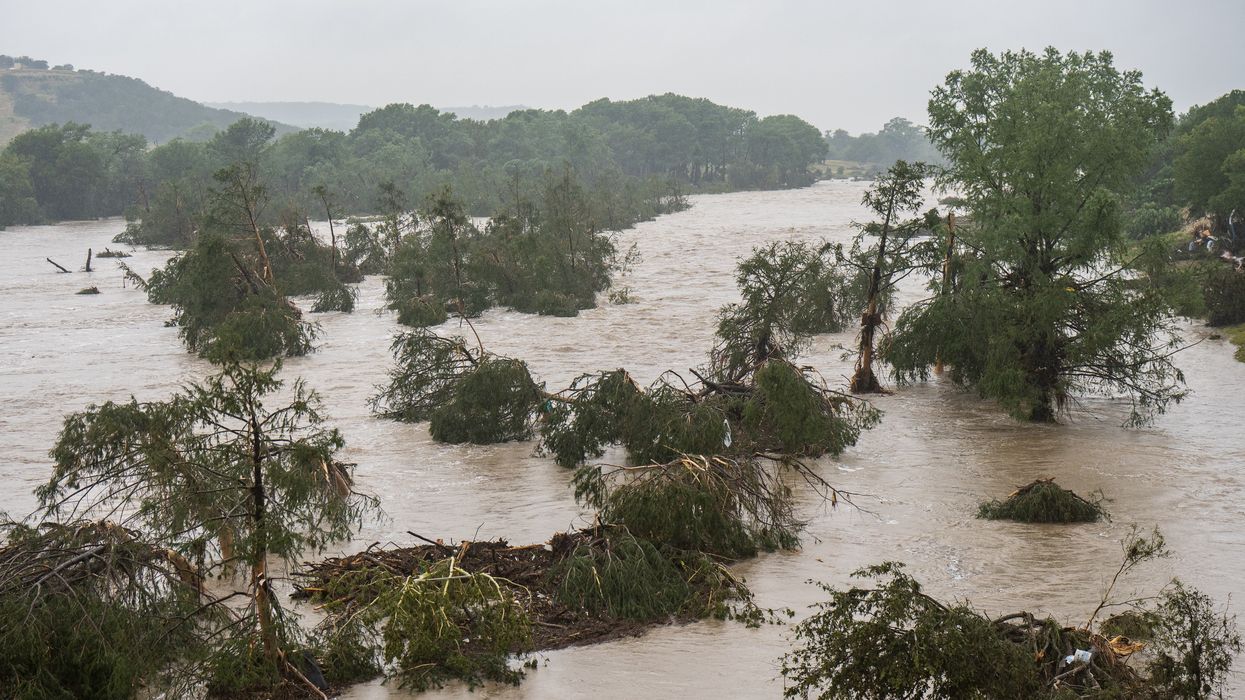
Since Friday, more than 80 people, including dozens of young summer camp attendees, have died in Central Texas from flooding intensified by the fossil fuel-driven climate crisis. With search-and-rescue operations ongoing and active flash flood warnings in the region, the death toll is expected to continue climbing.
Over the weekend, Texas officials quickly tried to blame the carnage on inadequate warnings from the National Weather Service (NWS), which has been gutted by the Trump administration. President Donald Trump himself lied about this, too. When asked if he thinks the federal government should rehire recently fired meteorologists, he erroneously claimed that “nobody expected” this flooding and that NWS staff “didn’t see it.”
However, NWS provided accurate forecasts and warnings despite everything that Trump and Elon Musk’s DOGE wrecking crew have been doing to impair the agency.
We sorely need a return to the Rooseveltian ideal of big government that works for working people, including by phasing out the fossil fuel industry and protecting us from increasingly frequent and severe storms, heatwaves, and wildfires.
That’s not to suggest that the Trump administration’s ill-advised cuts to the federal forecasting apparatus couldn’t have contributed to lethal havoc on the ground. Local NWS offices were missing key officials, which may have undermined swift and cohesive coordination between forecasters and local emergency managers.
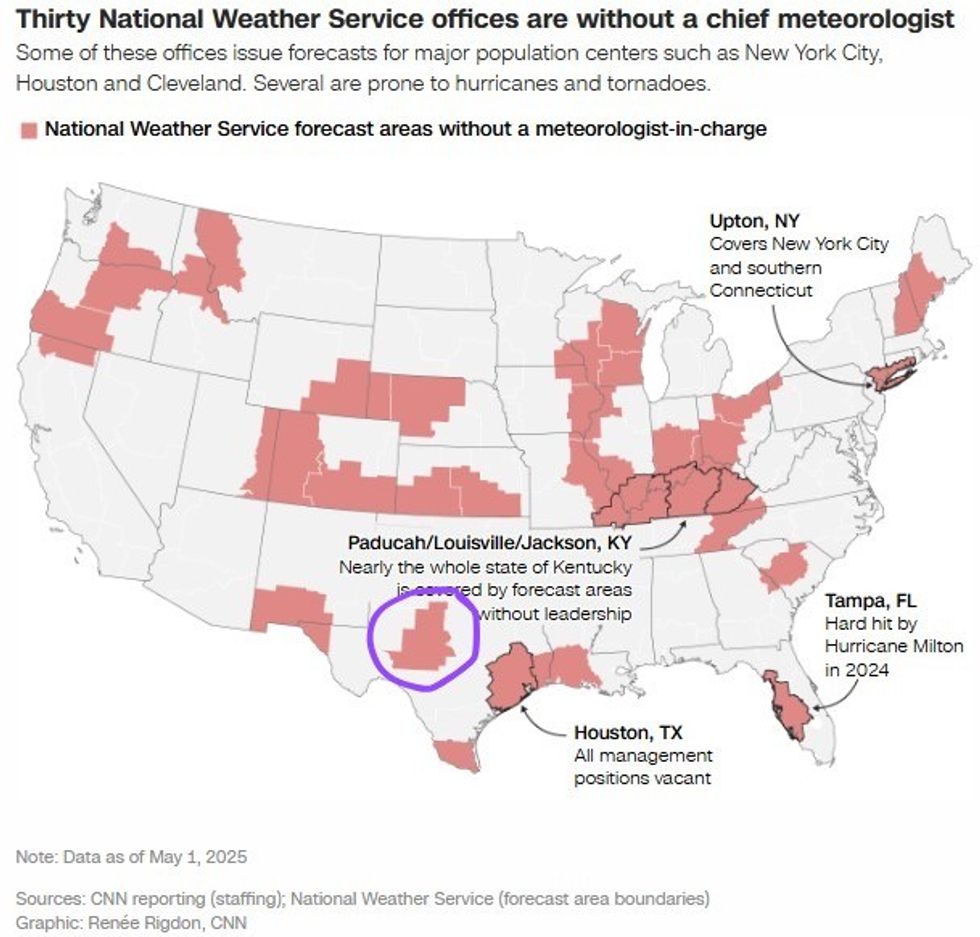
Tom Fahy, the legislative director for the National Weather Service Employees Organization (the union representing NWS workers), told The New York Times that the agency’s San Angelo office, which covers many of the hardest-hit areas, was missing a senior hydrologist, staff forecaster, and a meteorologist-in-charge.
The nearby NWS office in San Antonio “also had significant vacancies, including a warning coordination meteorologist and science officer,” the Times reported. “Staff members in those positions are meant to work with local emergency managers to plan for floods, including when and how to warn local residents and help them evacuate.” The warning coordination meteorologist reportedly left on April 30, accepting the Trump administration’s early retirement offer. This runs counter to Trump’s weekend claim that his policies didn’t lead to vacancies.
In early May, CNN reported that 30 of NWS’ 122 weather forecast offices around the country were missing a meteorologist-in-charge. Former and current agency personnel made clear that the absence of chief meteorologists and other leaders could jeopardize timely communications between forecasters, the media, and local emergency managers.
Making matters worse, Texas lawmakers earlier this year refused to pass a bill that would have improved local disaster warning systems. Rob Kelly, the top elected official in Kerr County, the flood-prone jurisdiction where most of the deaths have occurred, said that officials considered installing a warning system years ago but declined due to the purportedly high cost.
In the aftermath of increasingly common climate disasters, it becomes clear why, when someone asserts that investments in risk reduction are “expensive,” the response should be, “compared with what?”
According to The Guardian, “Questions are also being asked” about whether Kerr County officials “had approved development along the river bank that may have skirted rules issued by the Federal Emergency Management Agency (FEMA) that control where homes may be built in areas vulnerable to flooding.”
It should be noted here that advocates of the so-called abundance agenda, which we have warned is an attempt to launder unpopular neoliberal policies, have repeatedly held up Texas as a model to be emulated, implying that circumventing environmental regulations to build more housing is sound policy.
Amid the flooding on July 4, Trump signed into law the GOP’s budget reconciliation bill, which will curtail clean energy and expand the fossil fuel combustion that supercharges extreme weather. A few days earlier, the Trump administration submitted a budget request to Congress that would eliminate all climate research at the National Oceanic and Atmospheric Administration (NOAA), the parent agency of NWS.
On July 5, Trump approved Texas Gov. Greg Abbott’s (R) request for a major disaster declaration. While it remains to be seen, the federal response could be hobbled due to Trump and Musk’s ongoing war on FEMA.
In short, the Trump administration is simultaneously exacerbating climate change and eroding society’s ability to understand, prepare for, and respond to it. This is precisely the opposite of what should be happening right now.
The deadly Texas floods will not be the last manifestation of extreme weather turbocharged by fossil fuel pollution. In an era of escalating climate threats, we need a stronger public sector with more resources to mitigate risks, help people weather storms, and adapt for the future.
For too long, neoliberal Democrats have joined Republicans in bashing the government and calling for deregulation, austerity, and privatization. In February, Matthew Yglesias went so far as to encourage Democrats to “channel their inner DOGE,” portraying party elites’ abandonment of FDR’s New Deal politics—from Jimmy Carter to Bill Clinton to Barack Obama—as a step in the right direction.
In fact, we sorely need a return to the Rooseveltian ideal of big government that works for working people, including by phasing out the fossil fuel industry and protecting us from increasingly frequent and severe storms, heatwaves, and wildfires.
In the meantime, congressional Democrats must not neglect their oversight duties. They ought to launch investigations and ruthlessly question the Trump administration’s culpability in the Texas flooding disaster.

While total eclipses are not common, what is common are the governmental institutions that provide services to make us safer and healthier, offer and maintain green space, and allow us to make giant leaps in knowledge.
As most people know, there is a total solar eclipse arriving next week, Monday, April 8, 2024. The National Aeronautics and Space Administration tells us we won’t see another one in the contiguous United States for another two decades (August 23, 2045).
The eclipse will be visible in its totality in a broad band that stretches, in the United States, from Texas to Maine.
For those looking for a place to view the eclipse, there are literally thousands of public spaces available, many with special programs surrounding the event.
Unlike an eclipse, government is an everyday occurrence—ubiquitous and yet often invisible.
That includes the many National Parks and Forests in the path, such as the Solar Eclipse Festival on the National Mall, presented in conjunction with the Smithsonian’s National Air and Space Museum, and the National Science Foundation (NSF) in collaboration with the Smithsonian, NASA, NOAA, and the National Radio Astronomy Observatory. The NSF is also sponsoring “Sun, Moon, and You Solar Eclipse Viewing Event” in downtown Dallas (free, but you’ve got to register). The Mark Twain National Forest in Missouri offers a handy list of best viewing spots within the forest.
Additional locations include state parks along that path with viewing opportunities and programs, such as those of the Texas Parks and Wildlife Department, Missouri Department of Natural Resources, Arkansas State Parks, Tennessee Department of Environment and Conservation, Illinois Department of Natural Resources, Kentucky State Parks, Indiana Department of Natural Resources, Ohio Department of Natural Resources, Pennsylvania Department of Conservation and Natural Resources, New York State Office of Parks, Recreation, and Historic Preservation, Vermont Department of Forest, Parks, and Recreation, and New Hampshire Department of Natural and Cultural Resources.
Your local regional and municipal park might provide the perfect spot, close to home, and some are running programs in the days leading up to the eclipse, such as a ranger-led hike exploring how animals will react to the eclipse.
Of course, even those in the path of totality might have challenges seeing the eclipse clearly if there’s cloud cover. Luckily, the National Oceanic and Atmospheric Administration’s National Centers for Environmental Information has that covered with its interactive map.
If you’re planning to be above the clouds to see the eclipse in the skies, you might want to view this video produced by the Federal Aviation Administration and aimed at pilots, warning of larger than normal traffic of air craft and drones along the eclipse’s totality path, and limiting parking spots at runways.
Ground traffic and parking spots for cars can also slow eclipse viewers on their way to their viewing spots. For them, state and local officials have also provided portals for updates about ground traffic—spots for congestion and road closures to increase public safety.
You’ll want to keep it safe. NASA offers guidance on eye safety for viewing the eclipse, and state emergency management agencies are providing a wide range of tips to have a safe and enjoyable eclipse experience, with everything from taking care of pets to creating a family communications plan for those attending large events.
And even if you’re not in the path of totality, you still might get something out of the eclipse: NASA is launching sounding rockets to study disturbances in the ionosphere created when the moon eclipses the sun.
While total eclipses are not common, what is common are the governmental institutions and agencies at every level that provide services to make us safer and healthier, offer and maintain green space for mental health and recreation, and allow us to learn and make giant leaps in human knowledge.
We often rely on government, but we don’t always recognize its role. Unlike an eclipse, government is an everyday occurrence—ubiquitous and yet often invisible. But it is important, every now and then, to shed light on that role and remind us that government is—or at least should be—for and by all of us.
A new manifesto calls for building "a sustainable social pact for the 21st century" in which "our rights are guaranteed, not based on our ability to pay, or on whether a system produces profit, but on whether it enables all of us to live well together in peace and equality."
An international coalition made up of more than 200 trade unions and progressive advocacy groups on Thursday published the Santiago Declaration, a manifesto for "a complete overhaul of our global economic system."
The undeniably anti-neoliberal document proclaiming that "our future is public" is the product of a meeting held in Chile—the "laboratory of neoliberalism" where Milton Friedman and his University of Chicago acolytes' upwardly redistributive economic model was first imposed at gunpoint by Gen. Augusto Pinochet's military junta.
From November 29 to December 2, more than 1,000 organizers from over 100 countries gathered in Santiago and virtually to germinate a left-wing movement against "the dominant paradigm of growth, privatization, and commodification."
"Who owns our resources and our services is fundamental. A public future means ensuring that everything essential to dignified lives is out of private control."
"We are at a critical juncture," the manifesto begins. "At a time when the world faces a series of crises, from the environmental emergency to hunger and deepening inequalities, increasing armed conflicts, pandemics, rising extremism, and escalating inflation, a collective response is growing."
"Hundreds of organizations across socioeconomic justice and public services sectors—from education and health services, to care, energy, food, housing, water, transportation, and social protection—are coming together to address the harmful effects of commercializing public services, to reclaim democratic public control, and to reimagine a truly equal and human rights-oriented economy that works for people and the planet," reads the document. "We demand universal access to quality, gender-transformative, and equitable public services as the foundation of a fair and just society."
The Santiago Declaration continues:
The commercialization and privatization of public services and the commodification of all aspects of life have driven growing inequalities and entrenched power disparities, giving prominence to profit and corruption over people's rights and ecological and social well-being. It adversely affects workers, service users, and communities, with the costs and damages falling disproportionately on those who have historically been exploited.
The devaluation of public service workers' social status, the worsening of their working conditions, and attacks against their unions are some of the most worrying regressions of our times and a threat to our collective spaces. This is deeply linked with the patriarchal organization of society, where women as workers and carers are undervalued and absorb social and economic shocks. They are the first to suffer from public sector cuts, losing access to services and opportunities for decent work, and facing a rising burden of unpaid care work.
Austerity cuts in public sector budgets and wage bills are driven by an ideological mindset entrenched in the International Monetary Fund and many ministries of finance that serve the interests of corporations over people, perpetuating dependencies and unsustainable debts. Unfair tax rules, nationally and internationally, enable vast inequalities in the accumulation and concentration of income, wealth, and power within and between countries. The financialization of a wide range of public actions and decisions hands over power to shareholders and undermines democracy.
Against the heavily privatized status quo, "we commit to continue building an intersectional movement for a future that is public," the document says. "One where our rights are guaranteed, not based on our ability to pay, or on whether a system produces profit, but on whether it enables all of us to live well together in peace and equality: our buen vivir."
According to Global Justice Now, the Transnational Institute, and other signatories, the creation of an egalitarian and sustainable society hinges on ensuring universal access to life-sustaining public goods delivered by highly valued workers.
"We need to take back control of decision-making processes and institutions from the current forms of corporate capture to be able to decide for what, for whom, and how we provide."
"Who owns our resources and our services is fundamental," the manifesto argues. "A public future means ensuring that everything essential to dignified lives is out of private control, and under decolonial forms of collective, transparent, and democratic control."
As the Santiago Declaration explains:
A future that is public also means creating the conditions for enabling alternative production systems, including the prioritization of agroecology as an essential component of food sovereignty. To that end, we need to take back control of decision-making processes and institutions from the current forms of corporate capture to be able to decide for what, for whom, and how we provide, manage, and collectively own resources and public services.
The public future will not be possible without taking bold collective national action for ambitious, gender-transformative, and progressive fiscal and economic reforms, to massively expand financing of universal public services. These reforms must be complemented by major shifts in the international public finance architecture, including transformations in tax, debt, and trade governance.
Democratizing economic governance towards truly multilateral processes is critical to overhaul the power of dominant neoliberal organizations and reorient national and international financial institutions away from the racial, patriarchal, and colonial patterns of capitalism and towards socioeconomic justice, ecological sustainability, human rights, and public services. It is equally essential to enforce the climate and ecological debt of the Global North, to carry out an expedited reduction of energy and material resource use by wealthy economies, to hold big polluters liable for their generations-long infractions, to accelerate the phasing-out of fossil fuels, and to prioritize finance system change.
The call to build "a sustainable social pact for the 21st century," the coalition observes, "follows years of growing mobilization around the world."
It also comes as a complementary alliance convened by Progressive International meets in Havana, Cuba to map out an emancipatory "new international economic order."
During Friday's opening session, former Greek Finance Minister Yanis Varoufakis called for the establishment of a movement capable of dismantling "the existing, exploitative, catastrophically extractive imperialist international economic order so as to build a new one in its place... in which people and planet can breathe, live, and prosper together."
"There is no better use than spending the money on transformative investments that can restore the public sector and provide vital help to low-wage workers and their families," said one expert.
The American Rescue Plan Act of 2021 created a $350 billion fund to help state and local governments mitigate the Covid-19 pandemic and facilitate economic recovery. Nearly two years later, however, more than $150 billion remains unspent even as employment in the public sector and caring professions remains below pre-pandemic levels.
Dave Kamper, a researcher at the Economic Policy Institute (EPI) and 20-year veteran of the labor movement, argued Wednesday that states and cities should use tens of billions of dollars in untapped relief money to reconstruct the public sector and strengthen the care economy.
"The ARPA dollars earmarked as part of the State and Local Fiscal Recovery Fund (SLFRF) have fueled transformative investments across the country, but there's more to be done now," Kamper wrote in an EPI blog post.
"A return to the pre-pandemic status quo is not sufficient."
"As 2023 begins, state and local governments should prioritize spending relief funds on... rebuilding the public sector; expanding access to paid leave; and bolstering our systems of care through increasing access to quality childcare and eldercare, and supporting the workers who perform that work," Kamper continued. These are "three critical areas that are incredibly important for the welfare of children and families."
As shown in the map below, the 10 states with the lowest uptake of SLFRF dollars have each spent less than 7.5% of their allotted funds.
"It's not clear why those states have not yet made significant use of the money," wrote Kamper, though he noted that "all 10 states have Republican governors and Republican-controlled state legislatures."
"While private sector employment has exceeded pre-pandemic levels, public sector employment is still far below February 2020 levels," Kamper wrote. "In December, there were 452,000 fewer workers in the public sector than before the pandemic, and state and local governments in particular have 2.3% fewer workers than before than pandemic."
"Fully half those losses are in K-12 public education," he continued. "Not only are flourishing public schools necessary to the long-term well-being of children and communities, but it's also the case that parents can't easily reenter the workforce if safe and nurturing schools aren't available."
Noting that "state and local governments never fully recovered from the Great Recession of 2008-09" thanks to an ill-advised bipartisan austerity regime throughout the 2010s, Kamper stressed that "a return to the pre-pandemic status quo is not sufficient."
According to Kamper, "The shortfall in state and local government jobs is driven in large part by the inadequate wages paid to public sector workers."
As he explained:
Fully one-third of state and local government workers are paid less than $20 an hour, and 15% are paid less than $15 an hour. Black and Latinx employees are especially likely to be paid inadequate wages in the public sector, which also employs a disproportionate share of women workers. These workers need a raise, and state and local governments will need assistance in raising pay for their workers. Meanwhile, the teacher pay penalty has hit a new high: Teachers are now paid 23.5% less than comparable college-educated, non-teaching peers.
Fortunately, a solution is in sight, Kamper pointed out: Rather than continuing to sit on "substantial SLFRF dollars," policymakers "can and should" use these funds "to increase public sector pay and fill vacant jobs."
Kamper went on the make the case for investing idle SLFRF money to expand paid sick and family leave—a popular and lifesaving policy that is currently denied to most of the country's worst-paid private sector employees—and to boost care worker wages.
Low wages in the care economy, where "women and Black and Brown workers make up a disproportionate share of the workforce," are a key reason why "only 76% of the childcare service jobs lost during the pandemic have been recovered" and why there were nearly 300,000 fewer employees nursing and residential care facilities in November 2022 than in February 2020, Kamper observed.
"The needs of today demand action."
"It is unlikely that federal policymakers will enact significant new paid leave policies in 2023, nor can we expect substantial new federal investments in childcare, domestic healthcare, or long-term residential care" given the current makeup of Congress, Kamper wrote. "State and local governments can and should use SLFRF dollars to fill the gap, providing needed supports to working families and children."
"State and local governments, which spent so much of the Great Recession dealing with the consequences of austerity policies that ravaged public services, may very well be reluctant to spend down their still-ample SLFRF balances," he acknowledged. "There is, however, no better time than the present."
"The needs of today demand action," Kamper concluded. "State and local governments have more than $150 billion left to spend, and there is no better use than spending the money on transformative investments that can restore the public sector and provide vital help to low-wage workers and their families."