SUBSCRIBE TO OUR FREE NEWSLETTER
Daily news & progressive opinion—funded by the people, not the corporations—delivered straight to your inbox.
5
#000000
#FFFFFF
To donate by check, phone, or other method, see our More Ways to Give page.
Daily news & progressive opinion—funded by the people, not the corporations—delivered straight to your inbox.
"I work better under a deadline. It turns out that I live better under a deadline," the Pentagon Papers whistleblower quipped.
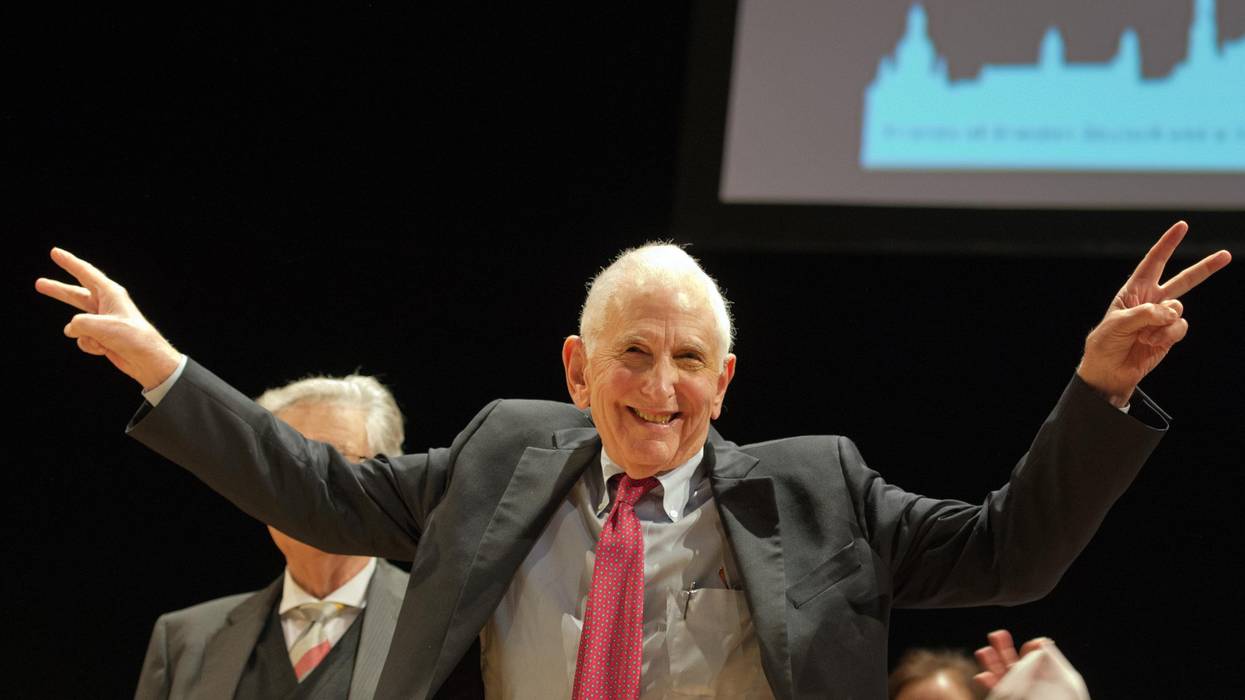
Daniel Ellsberg, whose leaking of the Pentagon Papers and decades of anti-war activity have inspired generations of whistleblowers and activists, said Wednesday that he has terminal cancer, but that there's "tons more" movement work for him to do before he's gone.
The former nuclear war planner-turned-disarmament campaigner, who is 91 years old, notified friends and supporters in an email Wednesday morning that he had "difficult news to impart":
On February 17, without much warning, I was diagnosed with inoperable pancreatic cancer on the basis of a CT scan and an MRI... I'm sorry to report to you that my doctors have given me three to six months to live. Of course, they emphasize that everyone's case is individual; it might be more, or less.
Ellsberg, who will not undergo chemotherapy—he says it "offers no promise"—wrote that he is "not in any physical pain."
"In fact, after my hip replacement surgery in late 2021, I feel better physically than I have in years," he said.
"As I just told my son Robert: He's long known (as my editor) that I work better under a deadline. It turns out that I live better under a deadline," he quipped.
Whistleblowers and activists hailed a man one anti-nuclear campaigner called "a change-maker, a disrupter, and an icon."
RootsAction co-founder and director Norman Solomon, a longtime friend and collaborator, told Common Dreams that "words can't really convey what Dan Ellsberg has meant to the world, and along the way what he has been wonderfully giving to countless people he has reached out to and who've reached out to him."
"In public, he has been a beacon of integrity and truth, willing to say and do what the warmakers and nuclear-holocaust planners find completely unacceptable," he added. "In private, his thoughtful kindness and daily commitment to humanity are central to his being. And I want to emphasize right now that nothing in the world is more important to read and heed than Dan's monumental book The Doomsday Machine."
"I want to emphasize right now that nothing in the world is more important to read and heed than Dan's monumental book The Doomsday Machine."
John Kiriakou, the former CIA case officer and analyst who was jailed after he revealed U.S. torture in the so-called War on Terror, wrote on his Substack that "after my arrest in 2012 after blowing the whistle on the CIA's torture program, it was Dan who talked sense to me and convinced me that I was stronger than I realized."
"It was thanks to him that I didn't do something drastic," he added. "And then when I was serving 23 months in prison, Dan wrote to me religiously, sent books, and offered his friendship and encouragement. I love the guy. This is a blow for all Americans."
When I copied the Pentagon Papers in 1969, I had every reason to think I would be spending the rest of my life behind bars. It was a fate I would gladly have accepted if it meant hastening the end of the Vietnam War, unlikely as that seemed (and was). Yet in the end, that action—in ways I could not have foreseen, due to [then-President Richard] Nixon's illegal responses—did have an impact on shortening the war. In addition, thanks to Nixon's crimes, I was spared the imprisonment I expected, and I was able to spend the last 50 years with Patricia and my family, and with you, my friends.
"What's more," he continued, "I was able to devote those years to doing everything I could think of to alert the world to the perils of nuclear war and wrongful interventions: lobbying, lecturing, writing, and joining with others in acts of protest and nonviolent resistance."
"I wish I could report greater success for our efforts," Ellsberg lamented. "As I write, 'modernization' of nuclear weapons is ongoing in all nine states that possess them (the U.S. most of all). Russia is making monstrous threats to initiate nuclear war to maintain its control over Crimea and the Donbas—like the dozens of equally illegitimate first-use threats that the U.S. government has made in the past to maintain its military presence in South Korea, Taiwan, South Vietnam, and (with the complicity of every member state then in NATO ) West Berlin."
"The current risk of nuclear war, over Ukraine, is as great as the world has ever seen," he emphasized just over a year into Russia's invasion.
"It is long past time—but not too late!—for the world's publics at last to challenge and resist the willed moral blindness of their past and current leaders," Ellsberg argued. "I will continue, as long as I'm able, to help these efforts.
Indeed, Ellsberg is scheduled to speak Thursday with Noam Chomsky at a Nuclear Age Peace Foundation webinar about the dangers of nuclear war during Russia's invasion of Ukraine
"There's tons more to say about Ukraine and nuclear policy, of course," Ellsberg added, "and you'll be hearing from me as long as I'm here."
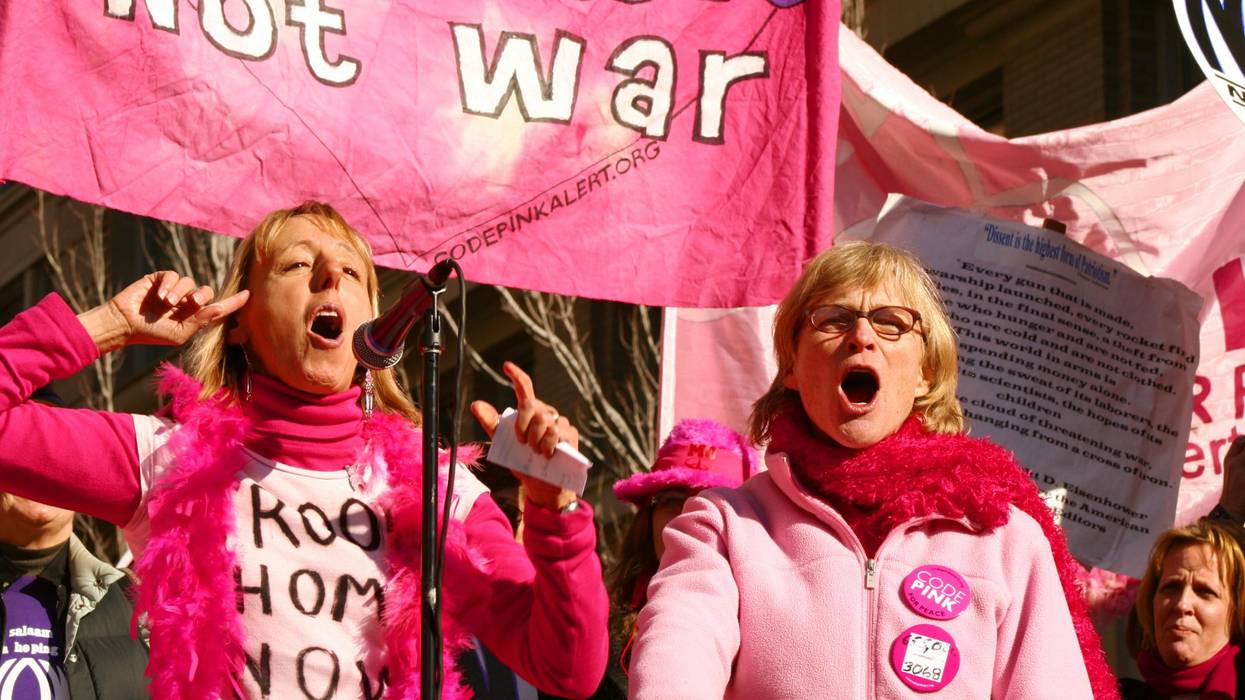
As the United States prepares to commemorate the 20th anniversary of the September 11, 2001 attacks on Saturday, the women-led peace group CodePink is set to launch a new campaign this weekend featuring a webinar and White House rally "to reflect on the lessons of 9/11" and the so-called War on Terror that followed--and continues to this day.
On Saturday at 3:00 pm ET, CodePink and Massachusetts Peace Action will host "Never Forget: 9/11 and the 20-Year War on Terror," a webinar examining how "9/11 fundamentally altered the culture of the United States and its relationship with the rest of the world."
Scheduled webinar speakers include CodePink co-founders Medea Benjamin and Jodie Evans, War on Terror whistleblowers John Kiriakou and Col. Lawrence Wilkerson, anti-war veterans Matthew Hoh and Danny Sjursen, RootsAction national director Norman Solomon, authors Vijay Prashad and Moustafa Bayoumi, and others.
CodePink writes:
In the name of freedom, and of vengeance, the United States invaded and occupied Afghanistan. We stayed for 20 years. With lies of 'weapons of mass destruction' a majority of the country was convinced to invade and occupy Iraq, the worst foreign policy decision of the modern era. The executive branch was given sweeping authority to make war across borders and without limits.
The conflict in the Middle East expanded under both Republican and Democratic presidents, leading to U.S. wars in Libya, Syria, Yemen, Pakistan, Somalia, and more. Trillions of dollars were spent. Millions of lives were lost. We created the greatest migration and refugee crisis since World War II.
9/11 was also used as an excuse to change the relationship of the U.S. government to its citizens. In the name of safety the national security state was given expansive surveillance powers, threatening privacy and civil liberties. The Department of Homeland Security was created and with it ICE, Immigration and Customs Enforcement. Words like 'enhanced interrogation,' a euphemism for torture, entered the American lexicon and the Bill of Rights was tossed aside.
On Sunday, CodePink, Food Not Bombs, and other partners will rally outside the White House at 3:00 pm ET to launch a new 100-day national campaign to Cut the Pentagon for the People, Planet, Peace, and a Future, featuring a teach-in and the cutting and sharing of a Pentagon-shaped cake and Ben & Jerry's ice cream. Participants will then march to McPherson Square to feed unhoused residents "from the cuttings off the Pentagon."
"Just like CodePink's first vigil in front of the White House in 2002, we'll use this event to begin to organize the movement we need to take on the war profiteers who oppose us at every turn," Evans said in a statement. "When we cut the Pentagon cake and feed our community in front of the White House, we'll be enacting the peace economy we want to create. By nourishing ourselves and everyone around us we'll be modeling the exact opposite of a destructive and extractive war economy."
"While war profiteers might have the money, we have the people power."
--Carley Towne, CodePink
CodePink national director Carley Towne said that "while war profiteers might have the money, we have the people power. Starting on September 12, we will be in the streets building an intersectional movement to cut the Pentagon budget and begin holding our congressional representatives accountable for pouring trillions of dollars into war while neglecting the needs of the people."
Benjamin noted that "after spending two decades and $21 trillion on the United States' so-called 'War on Terror,' people are waking up to what we've been saying all along: We can't continue down the path of deadly, destructive, and costly U.S. militarism."
"Peace activists," she added, "need to use this moment to rally around a simple yet powerful demand that cuts across all movements for social justice: Cut the Pentagon for people, planet, and peace."
Press freedom, peace, and human rights advocates are rallying behind Daniel Hale, the former intelligence analyst who blew the whistle on the U.S. government's drone assassination program, and who pleaded guilty Wednesday in federal court to violating the Espionage Act.
"The U.S. government's policy of punishing people who provide journalists with information in the public interest is a profound threat to free speech, free press, and a healthy democracy."
--Jesselyn Radack,
Hale's attorney
The Washington Post reports Hale, who was set to go on trial next week, pleaded guilty to a single count of violating the 1917 law that has been used to target whistleblowers including Julian Assange, John Kiriakou, Chelsea Manning, Edward Snowden, Jeffrey Sterling, Reality Winner, and others.
Hale was charged in 2019 during the Trump administration after he leaked classified information on the U.S. government's targeted assassination program to a reporter, who according to court documents, matches the description of The Intercept founding editor Jeremy Scahill. He is the first person to face sentencing for an Espionage Act offense during the administration of President Joe Biden.
As vice president under President Barack Obama, Biden contributed to the creation of whistleblower protections in the Dodd-Frank Wall Street Reform and Consumer Protection Act, while simultaneously serving in an administration that, while promising "a new era of open government," relentlessly targeted individuals who revealed U.S. war crimes and other classified information.
Kiriakou--a former CIA agent who under Obama was sentenced to 30 months' imprisonment for exposing U.S. torture--told Kevin Gosztola that he is "dissapointed that Daniel Hale's case was continued in the Biden Justice Department."
"I had hopes that Biden's Justice Department appointee would recognize the public service that Daniel Hale provided when he revealed illegality and abuse in the drone program," said Kiriakou.
Hale, who was an intelligence analyst for the U.S. Air Force before moving on to the National Security Agency and then the National Geospatial-Intelligence Agency, "knowingly took highly classified documents and disclosed them without authorization, thereby violating his solemn obligations to our country," according to a statement from Raj Parekh, the acting U.S. attorney for the Eastern District of Virginia.
According to Gosztola, Hale's whistleblowing led to the revelation by The Intercept that "nearly half of the people on the U.S. government's widely shared database of terrorist suspects are not connected to any known terrorist group," details on how the Obama administration approved targeted assassinations, and information about Bilal el-Berjawi, a Briton "who was stripped of his citizenship before being killed in a U.S. drone strike in 2012."
The Post reports that Hale admitted in court to writing an anonymous chapter in Scahill's 2016 book, The Assassination Complex: Inside the Government's Secret Drone Warfare Program, which divulged information taken from top-secret documents about drone strike protocols, civilian casualties, and Pentagon officials' debate about the accuracy of intelligence.
"These documents detailed a secret, unaccountable process for targeting and killing people around the world, including U.S. citizens, through drone strikes," Betsy Reed, editor-in-chief of The Intercept, said after Hale's indictment. "They are of vital public importance, and activity related to their disclosure is protected by the First Amendment."
Hale had initially centered his defense on First Amendment grounds, and his numerous defenders condemned his prosecution as a violation of press freedom and freedom of speech. His lawyer, Jesselyn Radack, issued a statement saying "the U.S. government's policy of punishing people who provide journalists with information in the public interest is a profound threat to free speech, free press, and a healthy democracy."
"Classified information is published in the press every day; in fact, the biggest leaker of classified information is the U.S. government," wrote Radack. "However, the Espionage Act is used uniquely to punish those sources who give journalists information that embarrasses the government or exposes its lies."
"Every whistleblower jailed under the Espionage Act is a threat to the work of national security journalists and the sources they rely upon to hold the government accountable," she added.
Medea Benjamin, co-founder of the women-led peace group CodePink, tweeted that it's "outrageous that drone whistleblower Daniel Hale will be going to prison for exposing the drone murders by the U.S. military. Why don't the murderers go to jail? Or the ones who ok the murders? Or the ones who make the killer drones and profit from murder?"
Hale's sentencing is scheduled for July 13. He faces up to 10 years behind bars. Kiriakou told Gosztola that he hopes the judge "recognizes the good in what Daniel Hale has done and gives him the lightest possible sentence."
Survivors of torture by U.S. or proxy forces and their advocates on Monday issued an open letter urging President-elect Joe Biden not to nominate torture apologist Michael Morell for CIA director, and calling on the Senate to reject the nomination of Avril Haines for director of national intelligence.
"The new administration must show the American people and the world that it acknowledges past disturbing U.S. conduct and will ensure that such abuses never recur."
--Anti-torture advocates' letter
The letter--which was also sent to members of the Senate Intelligence Committee as well as to Biden and Vice President-elect Kamala Harris--was organized by Marcy Winograd of Progressive Democrats of America, Medea Benjamin of CodePink, and Jeremy Varon of Witness Against Torture.
In addition to those three activists, signatories to the letter include:
"We believe that the record of Morell and Haines disqualifies them from directing intelligence agencies," assert the letter's signers, who in addition to those mentioned above include some two dozen other activists and advocates. "Their appointment would undermine the rule of law and U.S. credibility around the world. It would be a callous rebuke to people like ourselves and all those who care about human rights and the protection of basic dignity."
"Morell, a CIA analyst under Bush and both deputy and acting CIA director under Obama, has defended the agency's 'enhanced interrogation' (pdf) practices," the letter notes. "These included waterboarding, physical beatings, sleep deprivation, stress positions, and sexual humiliation."
The letter also opposes the confirmation of Biden DNI nominee Haines, who "overruled the CIA inspector general by choosing not to punish agency personnel accused of hacking into the Senate Intelligence Committee's computers during their investigation into the CIA's use of torture."
"In addition, Haines was part of the team that redacted the Senate Intelligence Committee's landmark 6,000-page report on torture, reducing the public portion to a 500-page summary," the authors write. They add:
Haines also supported Trump's nomination of Gina Haspel for CIA director. Supervising a CIA black site in Thailand in 2002, Haspel was directly implicated in CIA torture. She later drafted the memo authorizing the destruction of the CIA videotapes. Like Morell, Haines has worked both to defend torture and surpress evidence of it. She too, is incompatible with the stated aim of the Biden-Harris administration to restore integrity and respect for the rule of law to government.
"The new administration must show the American people and the world that it acknowledges past disturbing U.S. conduct and will ensure that such abuses never recur," the letter states. "To do that, it needs intelligence leaders who have neither condoned torture nor whitewashed the CIA's ugly record of using torture."
"That is why we urge President-elect Biden not to nominate Mike Morell for director of the CIA and the Senate to reject the nomination of Avril Haines for director of national intelligence," it concludes. "The people of the United States and the world deserve better."
The Senate's top Democrat is not calling on his fellow party members to oppose President Donald Trump's nominee for secretary of state--torture-praising Mike Pompeo--or his nominee to lead the CIA--"actual torturer" Gina Haspel.
Senate Minority Leader Charles Schumer of New York made his stance clear to reporters on Tuesday.
Schumer said Pompeo and Haspel face "lots of outstanding questions," but hoped that if Pompeo is confirmed, he "will turn over a new leaf and will start toughening up our policies towards Russia and Putin."
Currently the CIA Director, Pompeo was picked to be the nation's top diplomat following the "twouster" of Rex Tillerson. Trump chose CIA deputy director Haspel to fill Pompeo's shoes at the agency. Both nominations drew criticism from a broad range of groups.
Greenpeace USA Climate Director Naomi Ages, for example, said, "In addition to being a climate denier, like his predecessor, Pompeo is the Koch brothers' shill who will denigrate the United States' reputation abroad and make us vulnerable to threats at home."
Pompeo has also indicated he is open to the reauthorization of torture, and referred to CIA staff who waterboarded detainees as "patriots."
Haspel, meanwhile, is facing renewed scrutiny by progressive voices, if not by the top Democrat.
According to Vincent Warren, executive director of the Center for Constitutional Rights (CCR), Haspel "should be prosecuted not promoted." Toronto Star columnist Heather Mallick writes that Haspel's "office skill set includes overseeing torture and taunting victims as they lie gasping and near death."
Among those shining a critical light on her background is Jeremy Scahill, author and co-founder of The Intercept. In interview on Democracy Now! Wednesday, Scahill said that "in addition to being involved with the outright torture of people," Haspel was "involved with the destruction of videotapes that were filmed at these black sites that showed, we understand, torture."
Torture whislteblower John Kiriakou told the outlet Wednesday that he and others at the agency called her "Bloody Gina." He explained:
Gina was always very quick and very willing to use force. You know, there was a group of officers in the CIA's Counterterrorism Center, when I was--when I was serving there, who--I hate to even make the accusation out loud, but I'm going to say it: who enjoyed using force. Yeah, everybody knew that torture didn't work. That's not even the issue. Lots of different things work. Was it moral, and was it ethical, and was it legal? I think the answers to those questions are very clearly no. But Gina and people like Gina did it, I think, because they enjoyed doing it. They tortured just for the sake of torture, not for the sake of gathering information.
As Pompeo and Haspel await their confirmation hearings, it's notable that Pompeo ultimately received the backing of 14 Democrats last year when he was nominated to head the CIA.
The new confirmations, the Washington Post reports, are "likely to be hampered but not stymied."
"Haspel's record is unlikely to destroy her chances of confirmation," the Post continues.
Though some Democratic senators, such as Sen. Ron Wyden (D-Ore.), said Haspel's past makes her "unsuitable to serve as CIA director," Sen. Dianne Feinstein (D-Calif.), author of the report that exposed the extent of the CIA's interrogation programs, appeared to defend her.
"She has been, I believe, a good deputy director," Feinstein said, stressing that the interrogation [torture] techniques employed on Haspel's watch were not, at the time, explicitly illegal. "Fortunately the law, thanks to Senator McCain, has been changed, and torture is now illegal in the United States," Feinstein said. "That's with specificity, and I think that's important. So it's a different day."
The Post also notes that "Pompeo's hard-line positions on Iran are also more in lockstep with Trump."
According to CounterPunch editor Jeffrey St. Clair, that gets to why Schumer isn't actively encouraging his party members to oppose Pompeo's nomination:
Pompeo's confirmation hearing will take place at some point in April; the date for Haspel's confirmation is not yet know.
The CIA agent who was jailed for blowing the whistle on the United States' illegal torture program has made a statement about what the nation's electorate must demand from White House hopefuls this election season.
The whistleblower, John Kiriakou, was sentenced to 30 months in prison in 2013 after pleading guilty to releasing the name of an officer implicated in a CIA torture program to the media and violating the Intelligence Identities Protection Act.
"Our country is in crisis, whether it is because of our apparently seamless escalation into a permanent wartime economy, our inability to wage peace in the Middle East and South Asia, or our national compulsion to prosecute and humiliate national security whistleblowers," he said in a statement.
"The quest for peace must be a part of our presidential election. Instead of arguing which candidate would be more likely to use drones, more likely to bomb our enemies, real or perceived, or more likely to use the stick, rather than the carrot, we must demand that those candidates commit themselves to the pursuit of peace both here and abroad.
"Without peace, we will continue down the long road toward anarchy and hatred," he added.
Kiriakou made the statement ahead of receiving on Sunday the Sam Adams Associates for Integrity in Intelligence (SAAII) award.
SAAII said in a statement that the whistleblower "was the first U.S. government official to confirm (during a national news interview in December 2007) that waterboarding--which he described as torture--was used to interrogate al Qaeda prisoners. Kiriakou also stated that he found U.S. 'enhanced interrogation techniques' immoral, and that Americans are 'better than that.'"
Kiriakou has previously said that "the entire torture program was approved by the president himself," and that he doubts the U.S. government "would ever have the guts to charge someone at the level of a Dick Cheney or of a CIA director ... with crimes against humanity."
Decrying his conviction and prison sentence as "an outrageous miscarriage of justice," the wife of CIA whistleblower Jeffrey Sterling was joined Wednesday by prominent activists and transparency advocates in calling for Sterling's immediate pardon and release.
"My husband Jeffrey Sterling is a former CIA operative and an innocent man who was convicted of seven counts of espionage on January 26, 2015--for merely communicating with New York Times journalist James Risen," Holly Sterling writes in a petition that she hand-delivered to the White House on Wednesday morning. "He's now serving a 3.5-year sentence in a federal correctional facility in Colorado."
Sterling is accused of handing classified material to Risen detailing the CIA's covert Operation Merlin, which was carried out under the administration of former President Bill Clinton to give the Iranian government false information about nuclear technology to delay its alleged nuclear weapons program. A federal court sentenced Sterling to prison after he was convicted of nine felony charges, including seven counts of espionage. He began serving his sentence eight months ago.
The petition, which has garnered more than 150,000 signatures since it launched in December, continues: "An innocent man who dedicated his life to serving the United States has been wrongfully jailed under President Obama's watch. This is his opportunity to show Jeffrey, our country, and the world what it means to be a true leader by acknowledging and making amends for a grave injustice that has been done. This can only be accomplished by granting Jeffrey Alexander Sterling an immediate pardon."
The Obama administration acknowledged receipt of Holly Sterling's petition, which she dropped off following a morning news conference organized by ExposeFacts, Reporters Without Borders, and RootsAction.org. Civil rights activist and scholar Cornel West, CIA whistleblower John Kiriakou, and renowned human rights attorney Jesselyn Radack spoke at the event. They accompanied Sterling to the White House gate.
Radack tweeted highlights from the press conference:
A report published in November 2015 found that the U.S. government is not doing enough to protect national security whistleblowers, leaving those who expose corruption vulnerable to prosecution and allowing government abuses to run rampant.
The U.S. government is not doing enough to protect national security whistleblowers, leaving those who expose corruption vulnerable to prosecution, undermining valuable information exchange for journalists and the public, and allowing government abuse to run rampant, a new report by a free speech advocacy group published Tuesday has found.
In its report, Secret Sources: Whistleblowers, National Security, and Free Expression (pdf), PEN American Center analyzed government policies and discovered while there are "at least 57 U.S. federal laws with whistleblower or witness protection provisions," these laws "are not consistent" in terms of who they apply to and protect.
Moreover, public debate over high-profile leaks--such as the National Security Agency (NSA) files released in 2013 by former contractor Edward Snowden--is stymied by policymakers and public officials who claim whistleblower protections are stronger than they really are, as Hillary Clinton did during the Democratic presidential debate in October, when she stated of Snowden that he "could have been a whistleblower. He could have gotten all of the protections of being a whistleblower. He could have raised all the issues that he has raised. And I think there would have been a positive response to that."
But the report--and the government's own track record--proves otherwise.
"As a government contractor, Snowden had few, if any protections under whistleblower provisions compared to intelligence employees who are hired directly by the U.S. government," the report states.
Under President Barack Obama's administration, intelligence workers who leak information to the public are likely to be tried under the Espionage Act of 1917, the same law that was used to prosecute whistleblowers including Chelsea Manning, Jeffrey Sterling, Thomas Drake, John Kiriakou, Stephen Jin-Woo Kim, Shamai Leibowitz, James Hitselberger, and Donald Sachtleben. Snowden also faces charges under the Espionage Act if he returns home.
The law is "a broad, vague charge not easily defended against," the report states. In fact, most of the non-government experts PEN interviewed for the report, including lawyers, journalists, and activists, said the Espionage Act "had been used inappropriately in leak cases that have a public interest component."
The report continues:
Experts described it as "too blunt an instrument," "aggressive, broad and suppressive," a "tool of intimidation," chilling of free speech, and a "poor vehicle for prosecuting leakers and whistleblowers."
[....] It is extremely difficult for a leaker to defend him or herself from Espionage Act charges. There is no public interest defense to the Act, and courts have ruled that a defendant is not allowed to argue that the leaks were in the public interest nor can they mention the reforms that happened as a result. The courts have also found that the leaker's intent is irrelevant--at least until sentencing--and that the government "need not show" that the leaked information "could damage U.S. national security or benefit a foreign power, even potentially." In addition, the courts have rejected the "improper classification" defense, so defendants cannot challenge whether or not documents should have been classified in the first place.
"Although whistleblower protections are widely recognized as essential to check government malfeasance, the system fragments when it comes to the national security sector, the largest and most secretive part of our government," said PEN American Center director Suzanne Nossel. "While most Americans believe that genuine whistleblowers deserve reliable protection, our law doesn't achieve that when it comes to hundreds of thousands of workers who deal in matters of national security."
As a presidential candidate in 2008, then-Senator Obama promised to strengthen whistleblower protections for federal workers by allowing them jury trials and due process. And he has--just not for the intelligence community.
The Whistleblower Protection Enhancement Act of 2012 "specifically exempts workers of agencies or units that conduct foreign intelligence or counterintelligence activities, including the Federal Bureau of Investigation, Central Intelligence Agency, National Security Agency, Defense Intelligence Agency, National Geospatial-Intelligence Agency, Office of the Director of National Intelligence, and National Reconnaissance Office," PEN's report continues.
As Elizabeth Goitein, co-director of the Brennan Center for Justice's Liberty and National Security Program, told PEN, "The whistleblower laws for intelligence community members pretend that there's no such thing as agency level misconduct and we know that that's not the case... If what you're talking about is official misconduct that has been sanctioned by the agency, then obviously reporting that misconduct to that agency is not going to help."
"So internal channels are useless for things like torture, warrantless wiretapping, any of those major systemic abuses, like the ones we saw after 9/11," Goitein said.
Dan Meyer, the government's executive director for intelligence whistleblowing, told PEN, "If Snowden could have come to me I would have said 'that's nice you think it's unconstitutional, but staking your career on your hypothetical opinion about constitutionality is very dangerous.'"
PEN's report calls on the government to stop prosecuting whistleblowers under the Espionage Act and on Congress to add a "public interest" clause to the law. Doing so would honor the values Obama claimed to espouse in a 2011 speech, when he said, "we must support those basic rights to speak your mind and access information.... In the 21st Century, information is power; the truth cannot be hidden; and the legitimacy of governments will ultimately depend on active and informed citizens."
What is it about whistleblowers that the powers that be can't stand?
When I blew the whistle on the CIA's illegal torture program, I was derided in many quarters as a traitor. My detractors in the government attacked me for violating my secrecy agreement, even as they ignored the oath we'd all taken to protect and defend the Constitution.
All of this happened despite the fact that the torture I helped expose is illegal in the United States. Torture also violates a number of international laws and treaties to which our country is signatory -- some of which the United States itself was the driving force in drafting.
I was charged with three counts of espionage, all of which were eventually dropped when I took a plea to a lesser count. I had to choose between spending up to 30 months in prison and rolling the dice to risk a 45-year sentence. With five kids, and three of them under the age of 10, I took the plea.
Tom Drake -- the NSA whistleblower who went through the agency's chain of command to report its illegal program to spy on American citizens -- was thanked for his honesty and hard work by being charged with 10 felonies, including five counts of espionage. The government eventually dropped the charges, but not before Drake had suffered terrible financial, professional, and personal distress.
This is an ongoing theme, especially in government.
Chelsea Manning is serving 35 years in prison for her disclosure of State Department and military cable traffic showing American military crimes in Iraq and beyond. And Edward Snowden, who told Americans about the extent to which our government is spying on us, faces life in prison if he ever returns to the country.
The list goes on and on.
Baltimore Police Department whistleblower Joe Crystal knew what he was getting into when he reported an incident of police brutality to his superiors after witnessing two colleagues brutally beat a suspect. Crystal immediately became known as a "rat cop" and a "snitch."
He finally resigned from the department after receiving credible death threats.
It's not just government employees either. Whistleblowers first brought attention to wrongdoing at Enron, Lehman Brothers, Stanford International Bank, and elsewhere.
And what's their reward? Across the board, whistleblowers are investigated, harassed, fired, and in some cases prosecuted.
That's the conclusion of author Eyal Press, whose book Beautiful Souls: The Courage and Conscience of Ordinary People in Extraordinary Times documents the struggles of whistleblowers throughout history. Press's whistleblowers never recover financially or professionally from their actions. History seems to smile on them, but during their lifetimes they remain outcasts.
This is a tragedy. Blowing the whistle on wrongdoing should be the norm, not the exception.
I recently visited Greece to help the government there draft a whistleblower protection law. The Greek word for "whistleblower" translates as "guardian of the public trust." I wish our own government's treatment of whistleblowers could reflect that understanding.
Yet even legal guarantees of protection from prosecution and persecution aren't enough -- especially if, as in the case of existing law, national security employees are exempt from these safeguards.
Instead, society must start seeing things differently. Like the Greeks, all of us need to start treating whistleblowers as guardians, not traitors. And if we value what freedoms we have left, we should demand that our government do the same.
Barack Obama was, in 2008, the anti-torture candidate.
It's a sad comment on the state of U.S. democracy that such a thing ever existed. After all, it would be startling to hear appeals from a pro-oxygen or an anti-apocalypse candidate (though, of course, if the Republicans field a climate-change denier who uses the Book of Revelations as a policy guide, such a future scenario is not entirely beyond the realm of possibility).
Still, it was refreshing in 2008, after eight years on the "dark side," to hear a presidential aspirant make a clear moral statement. "We need a commander in chief who has never wavered on whether or not it is acceptable for America to torture, because it is never acceptable," Obama said in a back-and-forth with Hillary Clinton during the primary.
Obama also promised to end extraordinary rendition (sending suspects to countries that specialize in torture), close the Guantanamo detention facility, and rebuild America's international reputation.
At first, it seemed as though the new president was fully prepared to take the high road. He immediately signed an executive order banning torture and detention by the CIA. This move effectively shuttered the secret prisons the CIA was running to conduct its own foreign policy. And, with a stroke of the pen, he closed Guantanamo, the very not-secret place where all manner of abuses have taken place.
Unfortunately, Congress pushed back against the Guantanamo closure, forcing the administration to opt for Plan B by releasing the detainees in dribs and drabs. The Senate eventually voted to ban torture earlier this year, codifying the president's order. But because the president didn't fully repudiate the legal memorandum that authorized the torture programs -- the "gloves come off" Memorandum of Notification (MON) of September 17, 2001 -- he left open the possibility that the United States could again use such extreme tactics.
Indeed, the administration hasn't revised or removed Appendix M, which authorizes a variety of abusive techniques and which the Bush administration added to the Army's interrogation manual. Also, exploiting the same arguments used in the notorious MON, the administration expanded drone strikes, which eliminated the need for torture by eliminating the suspects altogether.
Plus, given the secrecy enshrouding the national security complex, no one could be entirely certain -- including our elected representatives -- whether the intelligence agencies were complying with these orders. In 2011, for instance, the administration authorized the secret detention and interrogation of a suspected Somali terrorist on a U.S. vessel in international waters. We'll just have to take Washington's word that the interrogators went by the book (the U.S. Army Field Manual, in this case). There were also reports of the United States handing over detainees to Afghan authorities despite evidence of human rights abuses.
But one of the most perplexing paradoxes of the administration has been its attitude toward whistleblowers. Surely if Obama the candidate was willing to take these moral positions on torture and secrecy, he would embrace all the people in government who risked their livelihoods to do the right thing.
And yet the Obama administration has been ruthless in its prosecution of whistleblowers. I recently had an opportunity to ask a trio of America's bravest whistleblowers -- John Kiriakou, Jesselyn Radack, and Tom Drake -- to explain why the president came into office like a civil liberties lion and has behaved instead like a national security sheep (albeit one with very sharp teeth). Their responses were both revealing and depressing.
Airbrushing the Past
All governments engage in leaks. They do it to control how the media reports a story. For the same reason, all governments hate unauthorized leaks, because suddenly they lose control of the story.
There's a crucial difference between a whistleblower and a leaker. A whistleblower identifies a problem-- an act of questionable legality -- notifies a supervisor of the impropriety, and only provides information to Congress or the press if going through the normal chain of command fails to rectify the problem.
John Kiriakou, Jesselyn Radack, and Tom Drake all tried to address impropriety through the proper channels. John Kiriakou raised his concerns about torture within the CIA, Tom Drake alerted higher-ups within the NSA about illegal surveillance, and Jesselyn Radack communicated her discomfort about the interrogation of the "American Taliban" John Walker Lindh to her supervisor at the Justice Department. Frustrated by the lack of response -- or, rather, by the very negative response -- of the institutions where they worked, they risked everything to expose the misconduct.
As the powerful 2014 documentary Silenced reveals, all three whistleblowers paid very high prices for their courage. They lost their jobs. They found it extremely difficult to get new ones. They were threatened with legal action.
Kiriakou and Drake were even charged under the 1917 Espionage Act. Of the 10 cases of people charged under this act in U.S. history, the Obama administration is responsible for seven of them (including Edward Snowden and Chelsea Manning). The charges against Drake were eventually dropped. Kiriakou went to prison for more than two years after taking a plea bargain on a lesser charge. (He didn't want to agree to the plea, but the prospect of a longer prison term was just too daunting, particularly for someone with three young children.) He is now one of my colleagues at the Institute for Policy Studies.
What's particularly disturbing about these cases is that the people responsible for the illegalities -- the torturers and the officials who authorized illegal surveillance -- have not been charged with anything.
Shortly after taking office, as journalist Glenn Greenwald pointed out, Obama "decreed absolute immunity for any official involved in torture provided that it comported with the permission slips produced by Bush Department of Justice lawyers which authorized certain techniques."
As for those who went beyond the lax rules of the DOJ lawyers, and who were responsible for the deaths of as many as 100 detainees, they too would eventually receive absolution. In 2012, the Justice Department wrapped up two last cases involving torture, involving the death of an Afghan detainee at a CIA prison near Kabul in one instance and an Iraqi detainee at Guantanamo in the other, without any convictions. Instead of throwing the book at the torturers and the handlers who enabled them, the Justice Department closed the book on the legal proceedings.
In May 2015, meanwhile, a federal court ruled that the NSA metadata collection was illegal. Thanks to Edward Snowden and subsequent revelations, we know that the extent of NSA surveillance goes well beyond metadata to truly mind-boggling operations, from TREASUREMAP's mapping of the Internet connections of everyone on the planet to the agency's depositing of malware in more than 50,000 locations around the world. But not a single person engaged in the violation of the civil rights of Americans in these programs has been punished.
The Obama administration justified this effective amnesty of all government officials involved in the "dark side" -- from George W. Bush and Dick Cheney all the way down to the guys who did the waterboarding and administered the illegal data collection -- as a way to focus on the future and not the past.
The amnesty is morally questionable. But for the sake of argument, let's say that the administration was right about closing the chapter on a divisive issue. Even in this case, the administration should have been generous to both malefactor and whistleblower.
But it's gone after the messengers with a vengeance. Why?
The Deep State
John Kiriakou, Jesselyn Radack, and Tom Drake were all on hand for a screening of Silenced at the Goethe Institut in Washington, DC last week. That's when I had an opportunity to ask them about the apparent paradox of the Obama administration's permissiveness toward government officials who committed crimes and vindictiveness toward the civil servants who called them out on it.
They explained that the Barack Obama who ran for president was a different person than the one who occupied the Oval Office. As soon as he entered the White House and received his first top-secret briefing, the president was ushered into a new fraternity. He was dazzled by the potential of raw executive power, the godlike ability to determine life and death, as when the president conducts a weekly meeting to review the "kill list" of drone targets.
The president, in other words, was initiated into what amounts to a cult of national security. The first rule of this cult is to preserve its existence at all costs. Those who threaten the cult are, like any apostates, to be dealt with as ruthlessly as possible. After all, cult members who break the law are still acting according to the principles of the cult; apostates, however, challenge the very legitimacy of the cult.
The world of checks-and-balances, of an executive branch bounded by Congress and the court system, is meaningless to the national security state. This "deep state" remains impervious to elections, partisan passions, congressional inquiries, and legal challenges. It's not a conspiracy any more than the Vatican is a conspiracy. It's simply an institution with an imperative: to survive.
Obama's commitment to the preservation of the national security state can be seen in his approach to secrecy in general. "Despite Barack Obama's promises of a more transparent government, 76.7 million documents were classified in 2010, compared with 8.6 million in 2001 and 23.4 million in 2008, the first and last years of George W. Bush's administration," writes Andy Greenberg in his book This Machine Kills Secrets.
Obama's cult membership explains his fiscal commitment to keeping the national security state flush with a trillion dollars of annual funding. The administration has upped the "black budget" for non-military intelligence agencies from $50.4 billion in 2015 to a proposed $53.9 billion for 2016. It would be nice to be able to tell you how that money is apportioned to the NSA, the CIA, and so on. But the Obama administration has refused to disclose that information.
It also explains why the Obama administration has not only gone after whistleblowers but also the press. It targeted both James Rosen and James Risen, attempted to smear USA Today journalists digging into Pentagon propaganda, and spied on a variety of reporters.
Members of the cult who have committed chargeable offenses but have not turned apostate have gotten off with a slap on the wrist. Former general David Petraeus, who shared top-secret information with a reporter that just happened to be his lover as well, received a sentence of two years probation and a fine of $100,000 (more than twice what the Justice Department pursued). He continues to receive a $220,000 pension, has had no difficulty getting a job at a top investment firm, and has been invited to join various elite institutions, including Harvard.
As for the whistleblowers, their suffering serves as a warning to all potential apostates. Edward Snowden remains in Moscow. Julian Assange is still holed up in the Ecuadoran embassy in London. Chelsea Manning is in prison, serving a 35-year sentence. Jeremy Hammond, Jeffrey Sterling, and Barrett Brown all face years of jail time. Indeed, under Obama, whistleblowers face a total of 751 months behind bars -- compared to 24 months for all other whistleblowers combined since the American Revolution.
As Barack Obama tries to nail down his legacy in the next year, he'll make many references to foreign policy victories like the deal with Iran and the opening with Cuba. He'll hold up domestic successes like the Affordable Care Act.
But in basement offices in Washington, DC, secure locations in northern Virginia, and listening posts in suburban Maryland, the high priests and priestesses of a secretive cult are quietly toasting the president for a very different legacy: his fierce defense of a lawless and destructive fraternity that has only grown more powerful on his watch.