SUBSCRIBE TO OUR FREE NEWSLETTER
Daily news & progressive opinion—funded by the people, not the corporations—delivered straight to your inbox.
5
#000000
#FFFFFF
To donate by check, phone, or other method, see our More Ways to Give page.
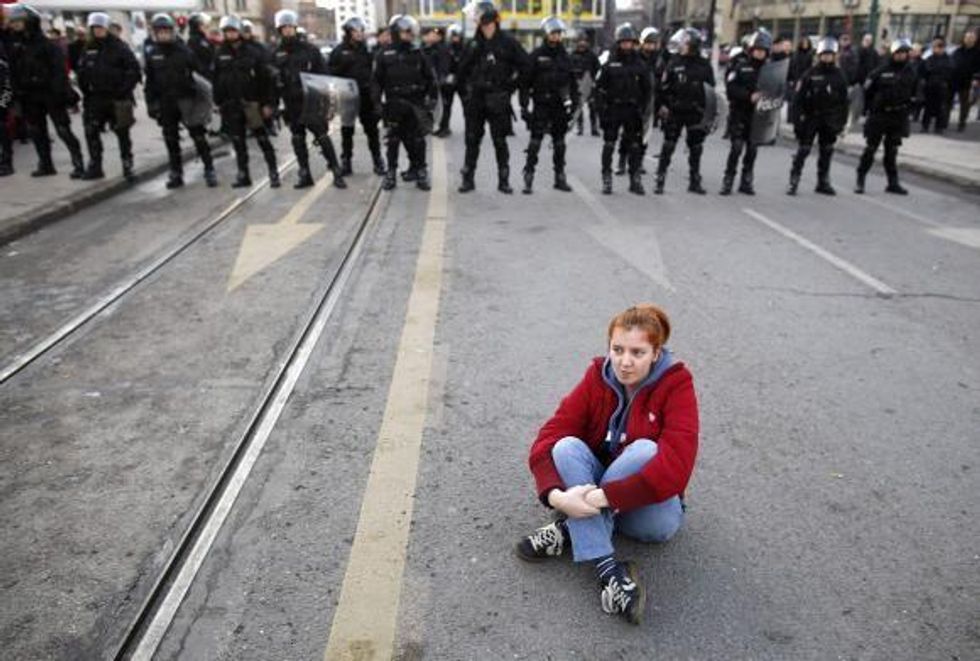
A localized protest movement against the failed privatization of key state-owned companies in Bosnia appears to be growing across the country as anger spreads over workers were left unpaid when the new owners declared bankruptcy and closed their doors.
What began in the city of Tuzla earlier this week as a small-scale protest by workers angered about their lost jobs and wages is now spreading, according to reports, as the anger aimed at the ruling government over its economic and social policies has seemingly catalyzed a brewing resentment among the people.
As EuroNews reports:
Tuzla is the third largest city in the former Yugoslav republic and the industrial heart of the north. But many of its once thriving chemical factories halted production after being privatised, leaving hundreds of workers without jobs.
With unemployment sky-high and tension building, one of the hundreds of protesters in the city said: "This is the start of the Bosnian Spring."
Watch the video:
Factory closures trigger clashes in BosniaThe closure of factories and firms has sparked clashes in Bosnia, as economic and social woes deepen almost 20 years since the ...
According to Associated Press coverage:
Residents of buildings in Tuzla yelled insults and threw buckets of water at the officers who passed by in full riot gear. Elderly neighbors were seen banging cooking pots on their windows and balconies.
The four former state-owned companies, which included furniture and washing powder factories, employed most of the population of Tuzla. After they were privatized, contracts obliged them to invest in them and make them profitable. But the owners sold the assets, stopped paying workers and filed for bankruptcy between 2000 and 2008.
The leader of the Tuzla region, Sead Causevic, told Bosnian state TV that the "rip-off privatization" was already concluded when his government took power and that the workers' demands are legitimate. He blamed the courts for obstructing justice, saying the workers have turned to them years ago, but no judgment has ever been passed.
And as Reuters adds, the protests appear to be spreading:
Hundreds of people turned out in solidarity in the capital Sarajevo, the central town of Zenica and Bihac in the west. Teenagers threw eggs and stones at a government building and fought with police. Four officers were taken to hospital, officials said.
Some of the Sarajevo protesters were heard chanting "Killers!" and "Revolution!"
"It was our government that sold state assets for peanuts and left the people without pensions, jobs or health insurance," said 24-year-old Hana Obradovic, an unemployed graduate. "Their families have nothing to eat while (the politicians) sit in the institutions and steal from the people."
A localized protest movement against the failed privatization of key state-owned companies in Bosnia appears to be growing across the country as anger spreads over workers were left unpaid when the new owners declared bankruptcy and closed their doors.
What began in the city of Tuzla earlier this week as a small-scale protest by workers angered about their lost jobs and wages is now spreading, according to reports, as the anger aimed at the ruling government over its economic and social policies has seemingly catalyzed a brewing resentment among the people.
As EuroNews reports:
Tuzla is the third largest city in the former Yugoslav republic and the industrial heart of the north. But many of its once thriving chemical factories halted production after being privatised, leaving hundreds of workers without jobs.
With unemployment sky-high and tension building, one of the hundreds of protesters in the city said: "This is the start of the Bosnian Spring."
Watch the video:
Factory closures trigger clashes in BosniaThe closure of factories and firms has sparked clashes in Bosnia, as economic and social woes deepen almost 20 years since the ...
According to Associated Press coverage:
Residents of buildings in Tuzla yelled insults and threw buckets of water at the officers who passed by in full riot gear. Elderly neighbors were seen banging cooking pots on their windows and balconies.
The four former state-owned companies, which included furniture and washing powder factories, employed most of the population of Tuzla. After they were privatized, contracts obliged them to invest in them and make them profitable. But the owners sold the assets, stopped paying workers and filed for bankruptcy between 2000 and 2008.
The leader of the Tuzla region, Sead Causevic, told Bosnian state TV that the "rip-off privatization" was already concluded when his government took power and that the workers' demands are legitimate. He blamed the courts for obstructing justice, saying the workers have turned to them years ago, but no judgment has ever been passed.
And as Reuters adds, the protests appear to be spreading:
Hundreds of people turned out in solidarity in the capital Sarajevo, the central town of Zenica and Bihac in the west. Teenagers threw eggs and stones at a government building and fought with police. Four officers were taken to hospital, officials said.
Some of the Sarajevo protesters were heard chanting "Killers!" and "Revolution!"
"It was our government that sold state assets for peanuts and left the people without pensions, jobs or health insurance," said 24-year-old Hana Obradovic, an unemployed graduate. "Their families have nothing to eat while (the politicians) sit in the institutions and steal from the people."
A localized protest movement against the failed privatization of key state-owned companies in Bosnia appears to be growing across the country as anger spreads over workers were left unpaid when the new owners declared bankruptcy and closed their doors.
What began in the city of Tuzla earlier this week as a small-scale protest by workers angered about their lost jobs and wages is now spreading, according to reports, as the anger aimed at the ruling government over its economic and social policies has seemingly catalyzed a brewing resentment among the people.
As EuroNews reports:
Tuzla is the third largest city in the former Yugoslav republic and the industrial heart of the north. But many of its once thriving chemical factories halted production after being privatised, leaving hundreds of workers without jobs.
With unemployment sky-high and tension building, one of the hundreds of protesters in the city said: "This is the start of the Bosnian Spring."
Watch the video:
Factory closures trigger clashes in BosniaThe closure of factories and firms has sparked clashes in Bosnia, as economic and social woes deepen almost 20 years since the ...
According to Associated Press coverage:
Residents of buildings in Tuzla yelled insults and threw buckets of water at the officers who passed by in full riot gear. Elderly neighbors were seen banging cooking pots on their windows and balconies.
The four former state-owned companies, which included furniture and washing powder factories, employed most of the population of Tuzla. After they were privatized, contracts obliged them to invest in them and make them profitable. But the owners sold the assets, stopped paying workers and filed for bankruptcy between 2000 and 2008.
The leader of the Tuzla region, Sead Causevic, told Bosnian state TV that the "rip-off privatization" was already concluded when his government took power and that the workers' demands are legitimate. He blamed the courts for obstructing justice, saying the workers have turned to them years ago, but no judgment has ever been passed.
And as Reuters adds, the protests appear to be spreading:
Hundreds of people turned out in solidarity in the capital Sarajevo, the central town of Zenica and Bihac in the west. Teenagers threw eggs and stones at a government building and fought with police. Four officers were taken to hospital, officials said.
Some of the Sarajevo protesters were heard chanting "Killers!" and "Revolution!"
"It was our government that sold state assets for peanuts and left the people without pensions, jobs or health insurance," said 24-year-old Hana Obradovic, an unemployed graduate. "Their families have nothing to eat while (the politicians) sit in the institutions and steal from the people."