SUBSCRIBE TO OUR FREE NEWSLETTER
Daily news & progressive opinion—funded by the people, not the corporations—delivered straight to your inbox.
5
#000000
#FFFFFF
To donate by check, phone, or other method, see our More Ways to Give page.

Daily news & progressive opinion—funded by the people, not the corporations—delivered straight to your inbox.
The Democratic primaries are heating up, and dozens of candidates representing all manner of political positions have entered the ring hoping to be the party's 2020 presidential nominee. One notable feature of the race is the strong presence of progressive candidates, a sign of the rising influence of the left in the party.
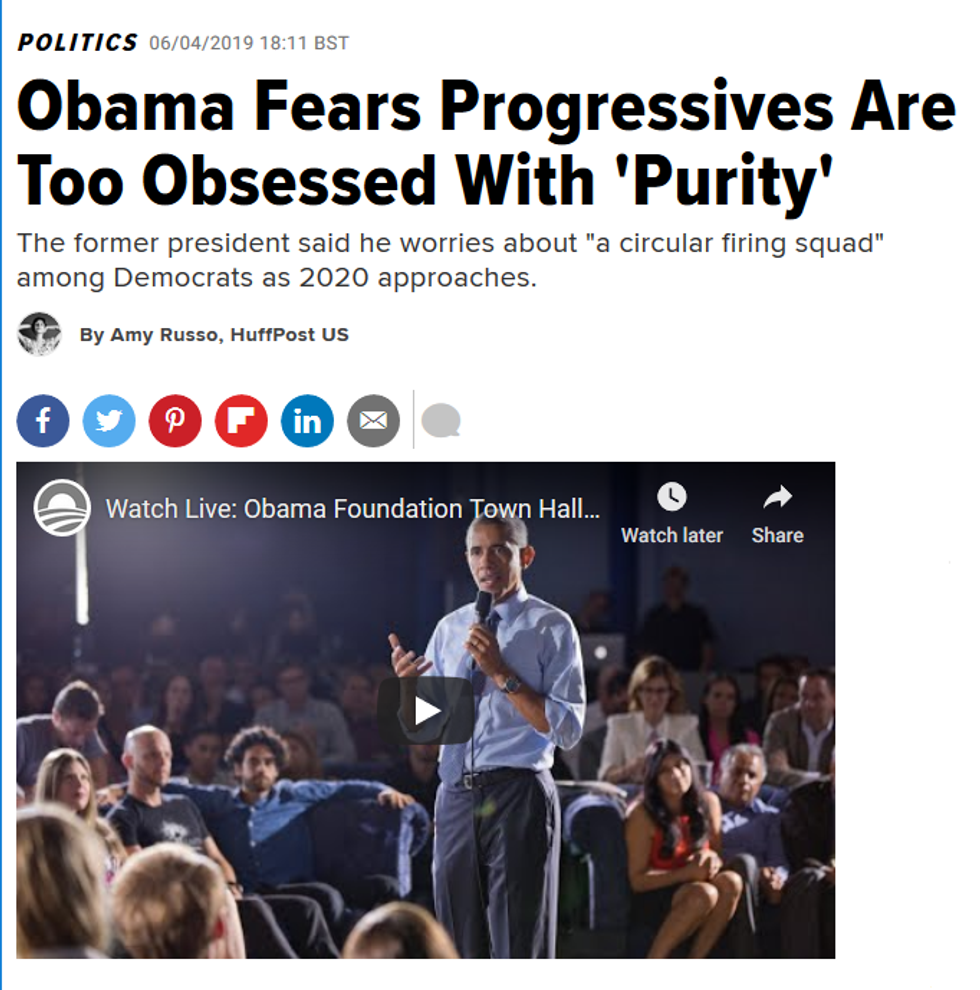
This phenomenon has many in the establishment wing of the party worried. Barack Obama, the most recent Democratic president, recently decried the "purity tests" of the left, which he called an "obsessive" ideological fanaticism that is setting the party up for failure. Obama told an audience in Berlin, Germany (HuffPost, 6/4/19):
One of the things I do worry about sometimes among progressives in the United States...is a certain kind of rigidity where we say, "I'm sorry, this is how it's going to be," and then we start sometimes creating what's called a circular firing squad, where you start shooting at your allies because one of them is straying from purity on the issues, and when that happens, typically the overall effort and movement weakens.
In the political world, the term "purity test" has a very specific meaning, largely used by elites to chastise and attack the left, or to gaslight them into supporting more centrist or right-wing policies. Boston Globe columnist Joan Vennochi (4/24/17), for example, bemoaned the ideological "activists" infiltrating the Democratic Party, undermining "more pragmatic party leaders everywhere" with their "purity tests." She highlighted the supposed "danger" in "pushing the party too far to the left and imposing rigid orthodoxy," warning that they are creating a "one-size party suitable only for zealots."
An example Vennochi gave of an intolerable and self-defeating purity test was leftists' pressure on Sen. Elizabeth Warren to change her mind about supporting Trump nominee Ben Carson to lead the Department of Housing and Urban Development. Apparently opposing one of Trump's most stridently right-wing appointees constitutes a "demand for ideological purity."
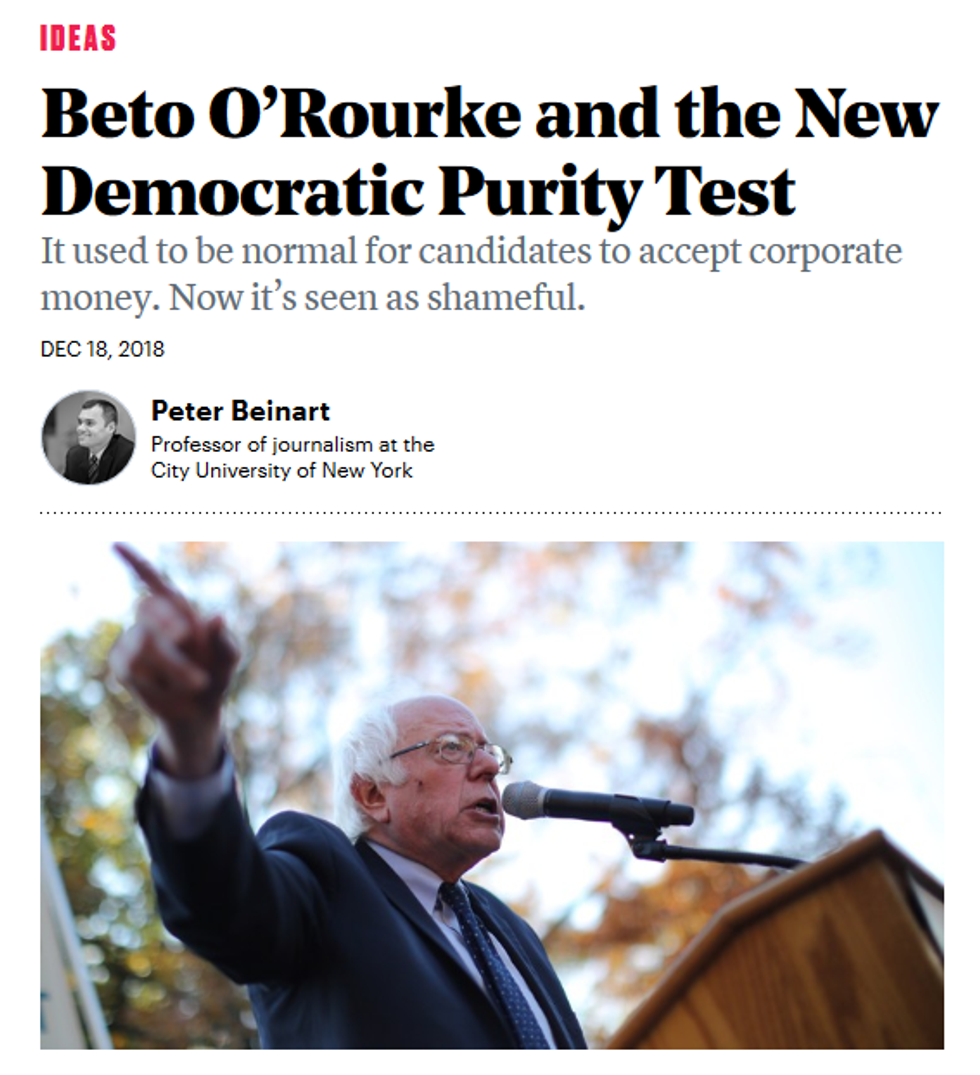
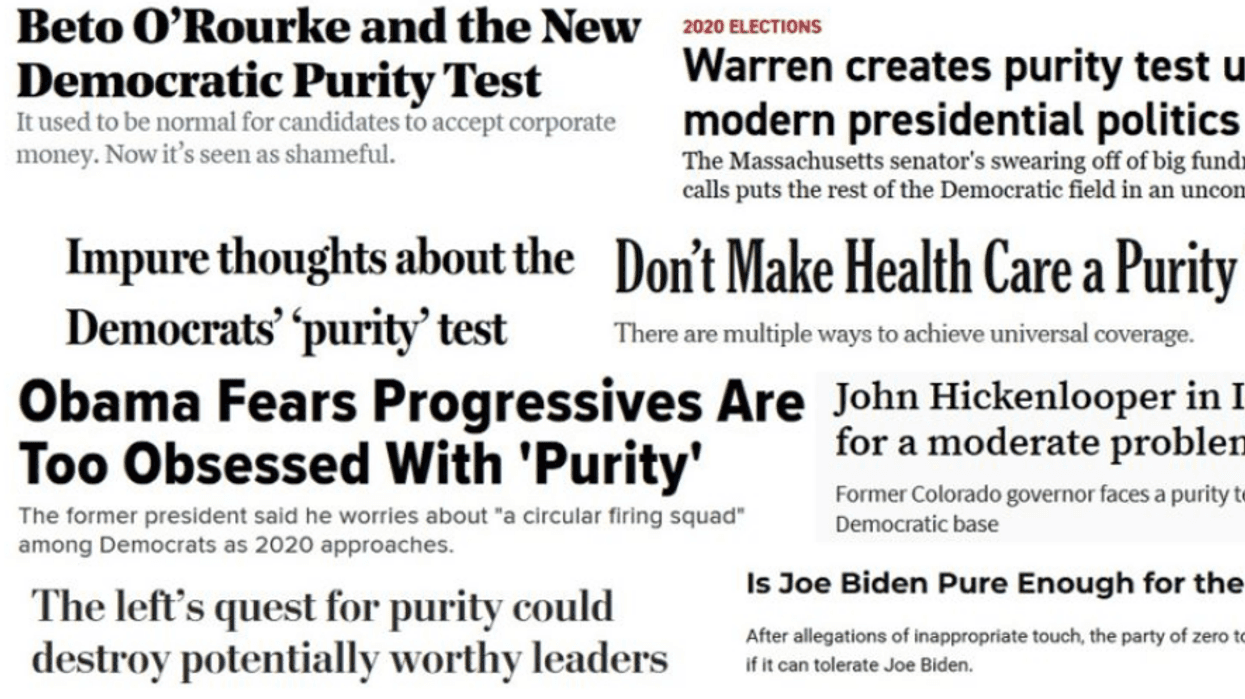
Much has been written about Warren and Sen. Bernie Sanders' refusal to accept corporate donations for their presidential campaigns, with many outlets (Atlantic, 12/18/18; 3/5/19; Politico, 2/25/19; The Hill, 8/24/17) describing this as a new Democratic "purity test" to establish progressive credentials.
2016 presidential candidate Hillary Clinton (CNBC, 2/5/16) scorned Sanders' test, claiming, "Under his definition, President Obama is not a progressive because he took donations from Wall Street!" Some might argue that is accurate, particularly as Obama describes himself as a 1980s-style "moderate Republican."
Another key issue in the primaries is healthcare. A lack of health coverage kills around 45,000 Americans yearly, and hospital bills drive the large majority of bankruptcies in America. Many Democratic candidates, including Warren and Sanders, support a European-style Medicare for All system. But corporate media have been resistant, even hostile.
Writing in the New York Times (3/21/19), Paul Krugman demanded that we "don't make healthcare a purity test," warning that Democrats who do not support a single-payer system may not be seen as progressive, or be viewed as a corrupt "shill" for the pharmaceutical industry. According to Krugman, this would be inaccurate. The Washington Post (2/11/19) was more scathing of the Medicare for All "purity test," attacking the leftist "cranks" using "empty slogans instead of evidence-based policy."
It is often made explicit that "purity test" is merely code for the Democratic base wanting more leftist policies, and being disgruntled with politicians who block them. The Denver Post (1/31/19) described Democratic presidential candidate John Hickenlooper as a progressive, pragmatic and "moderate problem-solver" in favor of "bipartisanship," under attack from the "hard-core" left who demand "drastic" change. Their "purity test," wrote the Post, will destroy a candidate with perhaps the most "credible" chance to beat Trump.
In contrast, behavior or policies imposed on the left from establishment Democrats are rarely if ever framed as a "purity test." For example, Sanders appointed Briahna Joy Gray as his press secretary, who had previously declared she voted for the Green Party's Jill Stein in 2016. Instead of this being seen as the party expanding its appeal to third-party voters, it produced a scandal among liberals on social media. For many, it was proof, as they had been saying all along, that Bernie was not a real Democrat--in other words, it was an opportunity for them to excommunicate an ally for being insufficiently orthodox.
On this story, New York magazine (3/20/19) described Sanders' campaign as an "irrational cult" of "left-wing factionalists" that were attempting to "split the party" by "intentionally misleading" voters. These kind of attacks are not seen as "purity tests," however.
Neither was the anger generated by the decision of candidates like Sanders, Warren, Sen. Kamala Harris and former Rep. Beto O'Rourke not to attend the AIPAC conference presented as such a test. Nor were corporate media demands that the left embrace Trump's regime change strategy in Venezuela lest they be accused of supporting a "dictator" (FAIR.org, 3/5/19). When these things are imposed on the base from the top down, they are not framed as purity tests.
Instead, the left is browbeaten and cajoled into supporting business-friendly right-wing Democrats, and told their preferred policies are either unrealistic or unpopular. The Hill (8/24/17) warns us, "If Democrats want to destroy any chances of winning national office, establishing purity tests is the quickest way to do it."
But this is demonstrably not the case. Seventy-five percent of Americans (and nearly two-thirds of Republicans) support Medicare for all. Three-quarters of the population support higher taxes on the wealthy, while tuition-free public college is popular even among Tea Party supporters. One can make a strong case that these policies would tend to attract rather than repel Trump voters to the Democratic cause.
The dichotomy between credible, pragmatic centrists and the fanatical, inward-looking left demanding ideological purity is a framing generally made in bad faith to shield corporate-backed candidates from criticism. FAIR (2/26/19) has already highlighted the "Republican best friend" trope, where Republicans offer supposedly selfless advice to the left on how to win next time--which turns out to be by doing and saying exactly what the right wants.
"Purity test" is a common talking point for these fake friends. The Associated Press (2/21/19) published an article from a Republican consultant who warned that applying "intense" leftist purity tests to "pragmatic" candidates capable of beating Trump was self-defeating: "As the Democratic presidential candidates move further to the left, it will make President Trump's path to re-election clearer."
Meanwhile, writing in Yahoo! News (3/19/19), conservative National Review writer David French claimed it would take a "brave person" to withstand the "attack" of the "vicious," "scornful" and "toxic" left and their destructive purity tests. Proposing free healthcare, a Green New Deal or other popular left-wing policies would surely lead to Trump's victory in 2020, he advised Democrats.
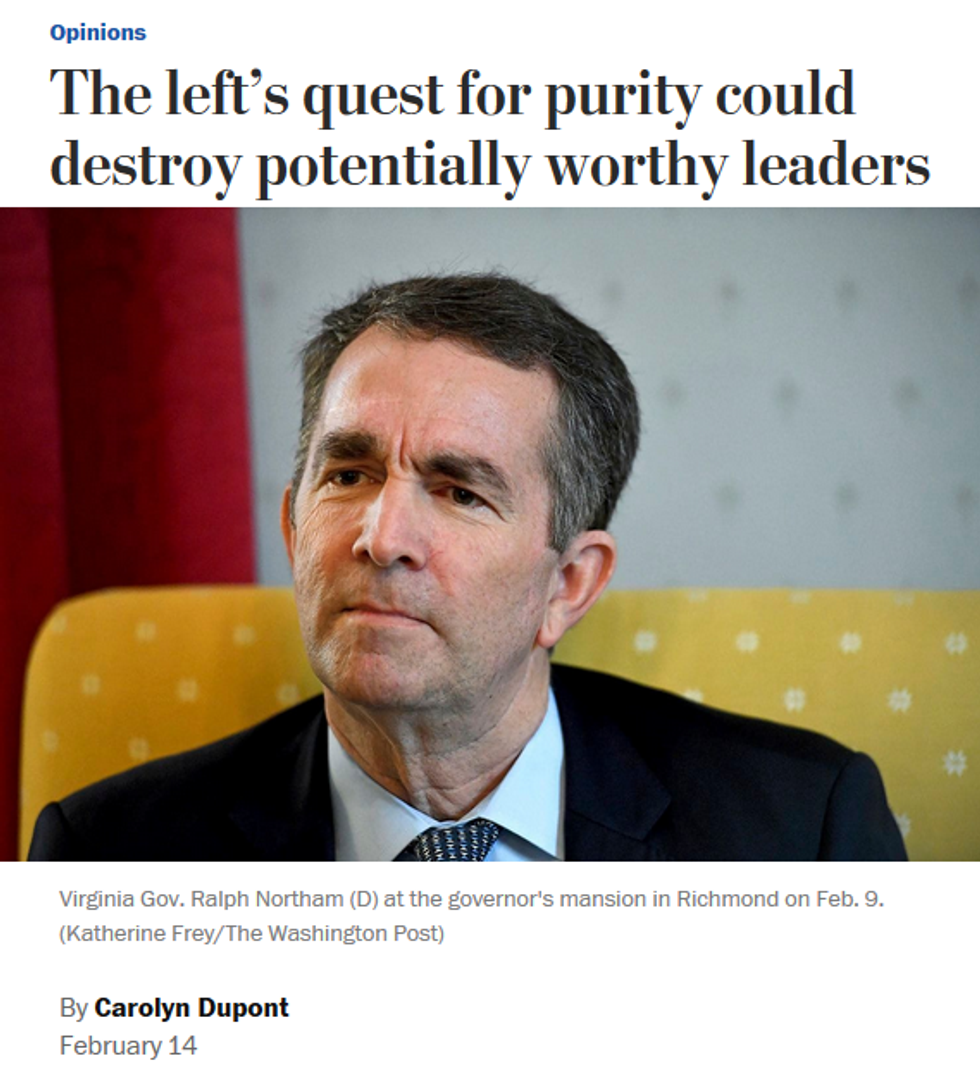
This purity test trope is so blatantly used to defend anyone in power it sometimes stretches credulity to the breaking point. In a Washington Post op-ed (2/14/19) headlined "The Left's Quest for Purity Could Destroy Potentially Worthy Leaders," Carolyn Dupont bemoaned the purity tests of the "rigid, self-righteous and blind" left after Virginia Gov. Ralph Northam was criticized for wearing blackface. The column compared this censure to the guillotines of the French Revolution that killed many "righteous" politicians for "small blemishes on their ideological purity," describing Northam's blackface as a "moment of imperfection." The desire to have policies affecting people's lives crafted by people who haven't ritually ridiculed and devalued them, apparently, is another purity test.
Democrat Bill O'Neill, an Ohio Supreme Court justice, also made headlines after defending politicians Roy Moore and Al Franken (Cleveland Plain Dealer, 11/17/17). O'Neill decried the unreasonable "purity tests" for "sexual indiscretions" (multiple sexual assault charges, in Moore's case, from some as young as 14) . He claimed those calling for Franken's resignation were "dogs" involved in a "feeding frenzy," chasing out good politicians (USA Today, 11/18/17).
The term is used much less frequently in reference to the right wing, but when it is, it is used in the same manner: to describe policies supported by a party's base that corporate media disagree with. Many outlets (New York Times, 11/23/09; Wall Street Journal, 11/24/09; US News, 12/23/09) described the attempt to get party officials to endorse a ten-point bill, including opposition to abortion and firearms regulation, as a "purity test."
When you hear the phrase "purity test" in the media, be on the alert. The phrase is code for elites being pressured in ways they don't like, and is often a shield against legitimate criticism of corruption or dependence on corporate power.
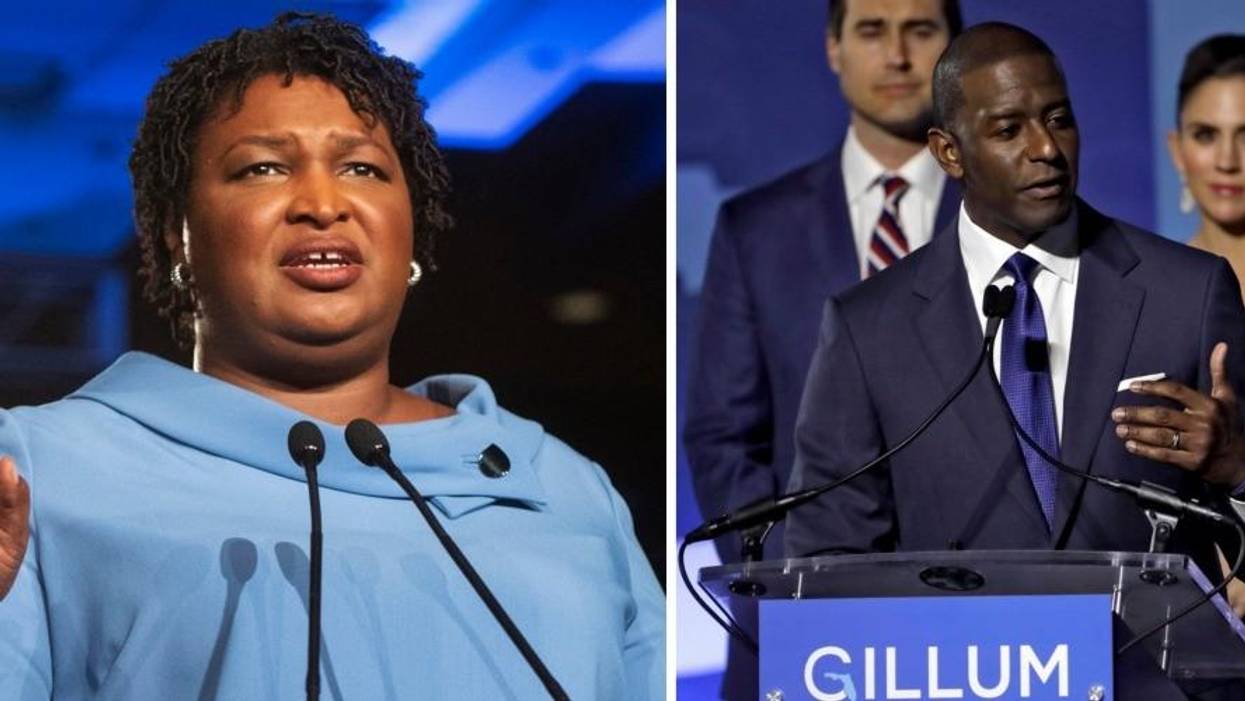
Unresolved races for governor and U.S. Senate in Florida and Georgia were heading into uncharted territory Friday, as ballot submission deadlines, candidate lawsuits and preparations for recounts--or runoffs--all converged.
By the close of business on Friday, all 2018 midterm ballots to be counted, or information required from voters to ensure their ballot would count, is due in both states. Unless otherwise ordered by courts, Friday's deadline is the cutoff that comes before county election offices report their final numbers early next week, to be followed by state announcements of the official winners.
In both states, however, legal and administrative actions are unfolding that are likely to interfere with this progression to the midterm's finish line. (A federal court on Friday ordered that certification be postponed in Georgia's Dougherty County until ballot-processing issues were resolved.)
In short, voters in these two states, and across America, will soon see how elections are fairly or unfairly administered, and how election technology is falling short or performing well--which very much translates into public confidence about electoral outcomes.
Florida
In Florida, Democratic gubernatorial candidate Andrew Gillum, who conceded on Tuesday, is now saying he will await the results of a statewide recount (to which he is entitled because Republican Ron DeSantis leads by 36,000 votes, less than 0.5 percent of the votes cast). Gillum walked back his concession after learning that many thousands of votes had not been counted. What were these emerging ballots?
Apparently, a widely used paper ballot scanning tabulation system by ES&S, one of the largest voting machines companies, has not been reading a sizable number of mailed-in absentee ballots--which all get processed in the county election offices, according to a contractor involved in this process. Thus, many counties have been forced to manually re-create the "unreadable" ballots. That process is slow, as the correct local ballot must be reprinted, and then filled in with observers present to ensure it is done accurately.
But that's not the only challenge facing Florida election officials. State law requires a full manual hand count of all paper ballots must be done when the unofficial victory margin is less than .25 percent--as it now is in the U.S. Senate race. Beyond the lawsuits this week filed by Republican Gov. Rick Scott, whose lead in the Senate race has fallen to 15,000 votes out of 8 million cast, a logistical nightmare awaits local election officials.
That nightmare consists of having multiple recounts to run--some by scanners and some by hand--for these top statewide and local races. Thus, the stored paper ballots will have to be retrieved and handled many times, which presents ballot custody challenges and is a scenario for potentially damaging the paper records. Thus, Floridians will soon see the pluses and minuses of using every voting system out there--from paper ballots to a spectrum of newer and older electronics processing the count.
Georgia
In Georgia, a different verification scenario is unfolding. In that state, the votes cast on electronic machines cannot be audited for accuracy; they are whatever was recorded on computer memory cards. What can be examined, however, and is the subject of ongoing and prospective litigation--including likely federal court action on Friday by Democratic gubernatorial candidate Stacey Abrams--concerns a small but significant number of votes cast on paper in the 2018 midterms.
Georgia's paper ballots fall into two categories. The first is provisional ballots, which are given to voters who are not on local precinct voter rolls or lack required ID. (They were also given out on Tuesday after some aging electronic voting machines failed.) To count, election officials must verify that these ballots were cast by eligible and registered voters. The second category is absentee ballots that are mailed in or dropped off at county offices. These are paper ballots submitted inside sealed envelopes.
The big picture is the Abrams campaign, which trails Republican Brian Kemp--who Thursday resigned as the state's top election administrator--by 63,000 votes, needs to add 26,000 votes to her tally to prompt a runoff election. Twenty-three thousand more votes could force a recount, which would cast Kemp's oversight of the election in a larger spotlight.
The Abrams campaign has been challenging how provisional and absentee ballots are being examined, validated and, in some cases, disproportionately rejected. In several suburban counties outside Atlanta, there are thousands of provisional ballots in each jurisdiction. Many are believed to be voters who showed up at the wrong precinct, which means they are votes that will count. Others are voters who need to return to the county election office by the close of business on Friday with additional ID, so their registration information is validated and ballot can be counted.
Since Wednesday, the campaign has been chasing these provisional voters--literally following up with people who called the Democratic Party's election protection hotline, as some counties will not release lists of these voters.
The Abrams campaign is expected to file a federal lawsuit as soon as Friday concerning absentee ballots, which have been disqualified in large numbers in some counties under a range of arcane technicalities. In some cases, the local election officials have reportedly identified the voters are legal, but apparently they did not correctly sign the ballot envelopes.
The campaign's hope is that a court will require these counties to retrieve the rejected--but unopened--absentee ballot envelopes, so these ballots could then be counted. In Minnesota's 2008 Senate race, Democrat Al Franken was able to retrieve rejected absentee ballots, which helped him win a recount. Together, by validating provisional ballots and counting rejected absentee ballots, Abrams hopes to get a wider recount or a runoff in December.
The timetable in Georgia is similar to Florida: all ballots and voter information must be submitted by late Friday. On Tuesday, Georgia counties are to submit their totals to the state, which will declare the official winners on Wednesday. The Abrams campaign obviously hopes to extend and open up this process.
National Stakes
In both states, these developments are unfolding rapidly and with unforeseen consequences. There is a political dimension and a technology dimension to this narrative. Like after the 2000 presidential election in Florida, the nation will soon see how voting and vote counts are handled in two neighboring states--with implications for the rest of the country, as a majority of states are poised to replace voting systems by 2020.
While Georgia may be showcasing modern voter suppression, Florida will be showcasing whether today's spectrum of voting technologies can handle close elections that move to recounts--without breakdowns undermining public confidence in the outcomes.
This article was produced by Voting Booth, a project of the Independent Media Institute.
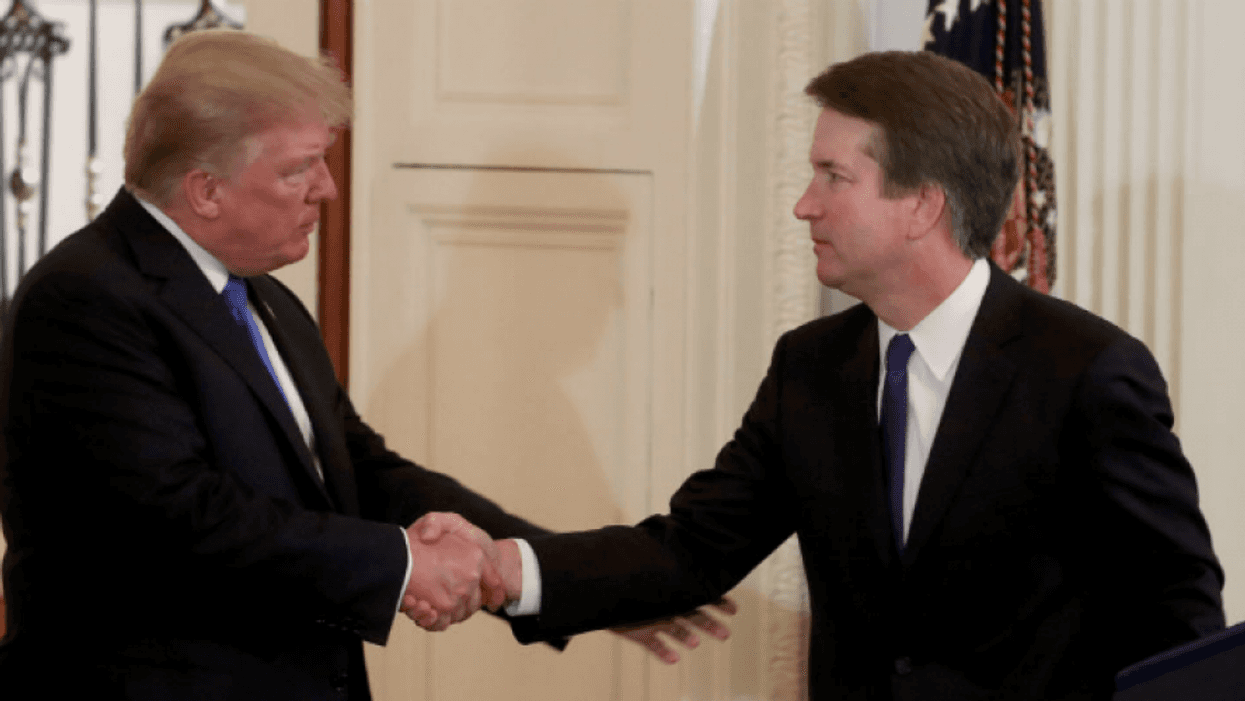
Brett Kavanaugh's hellish Supreme Court fraternity pledge week offered many lessons, but the most powerful, if least noted, was about the raising of boys in America -- all boys, not just the groomed Georgetown elite from which the judge emerged. Too many boys are raised in packs, whether they're called fraternities, sports teams, or gangs, all of which offer brotherhood in return for loyalty, obedience, and a dedicated contempt for the Other -- anyone, that is, who isn't a member, above all women. Kavanaugh was raised (and raised up) by just such packs.
Frats, teams, and gangs have their differences, often involving social class and skill sets, but there's one great similarity: the sense, often nurtured and reinforced by booze, battle, and group sex, that you are part of a special brotherhood. The promise of that brotherhood is to defend boys against a supposedly hostile environment by isolating them from the rest of their world and indoctrinating them with a set of tribal values that must be upheld beyond reason.
For most boys, as was true for young Brett, it starts with making the sports team (or not), being discarded -- "cut" -- (or not), as a pyramid of talent narrows to travel teams, all-stars, and elite leagues in middle school, high school, college, and finally the pros. The prime lesson is always the same: winning is everything and doing so in a dominating way by crushing the opposition is the best of all. In the process, finding an edge by working the refs, purposely injuring opponents, taking drugs, or protecting bad boys become standard tactics in the quest for victory. As Kavanaugh reminded us often enough, being captain of his Georgetown Prep high school basketball team and a member of the football team made him the proudest of proud jocks.
Naturally, fraternities prize such products of Jock Culture, boys growing to manhood who are already popular, trained to take orders, and used to hanging out with their own while excluding others. Frats, in turn, offer the same rewards as teams do, especially a set of brothers who will have your back, no matter what kind of a "puker" you are -- as long as you're loyal. At Yale, Kavanaugh pledged Delta Kappa Epsilon (or Deke), then well known as a hard-drinking frat for jocks, whose many famous members once included Presidents Gerald Ford and that father-and-son team, George H.W. and George W. Bush. Kavanaugh's Deke connections may even have brought him to the attention of the younger Bush as he headed into his presidency and landed Brett his various jobs in that administration. Perhaps it also helped recommend him to one of the country's most notorious and dangerous gangs of conservatives, the Federalist Society.
For the past four decades, much like gangs in minority neighborhoods drafting tough and vulnerable teenagers, the conservative Federalists have been recruiting ambitious students and lawyers with the potential to become judges. Their success reached a peak with Kavanaugh's recent confirmation, a victory with a Trumpian touch. The judge's diatribe about the Clintons and the rest of the left-wing conspiracy to take him out should have evoked the president's pitch on the viciousness of MS-13, a gang of mostly young Central Americans that originated in Los Angeles and has spread into immigrant communities across the country.
Boys Will Be You Know What
Team, frat, or gang, the macho sensibility of the pack will never die as long as it's applauded or at least tolerated in the culture at large as a boys-will-be-boys phenomenon -- as long as it's a given that we need such boys raised up strong and straight, prepared to fight our wars, man (never woman) our teams, and of course run our country. If you are a boy and an outsider, you are likely to play along to avoid trouble. Growing up bookish in Queens, The Donald's borough, so many years ago, I found myself feigning more interest than I had in New York's major league baseball teams and didn't protest too much when other boys misinterpreted a platonic relationship with a girl as something steamier. It kept my image on the male track, reasonably protected from the bullies who went after boys like me.
I was in a college fraternity, saw plenty of alcoholic aggression and sexual misbehavior, but never quite connected that to the code of the pack. Yes, there were drunk guys, horny guys, screwed-up guys, maybe even a few truly bad guys, but I didn't grasp that it was all meant to be a brotherhood against the rest of the world (especially women). My teaching moment came at 24, a lesson (appropriately enough) directly from the locker room.
It was 1962. I was then a rookie baseball reporter for the New York Times, covering the Yankees on the road. The older sportswriters were, at best, warily sociable. Would I, they wondered, disrupt their easy lives with some kind of unexpected reporting? The ballplayers were subtly hostile, especially stars like Mickey Mantle. Would I violate the covenant of the trade: that what happens on the road stays on the road? I felt like an interloper, outside the little bubble they were all traveling in. I was disconnected, lonely, and anxious that such social relations would affect my job, that mine would turn out to be a brief career in sports writing.
Then, one hot morning before a night game in Los Angeles, I met, chatted up, and took a swim in the hotel pool with a young female guest. I suggested lunch. As it was getting too hot for a poolside meal and we were hardly dressed for a restaurant, we left together for my room to order from room service, as some sportswriters and a few ballplayers hanging out at poolside nodded approvingly. No alcohol was ordered and nothing happened. We had lunch and that was that, but several Yankees saw her leave my room and smirked.
And lo and behold, I was in. The press box and the locker room were welcoming that evening. A winking word or two, a nod and a smile confirmed my acceptance. It took me a little while to figure it all out. Suddenly, I was one of them or at least nobody to worry about anymore because I had just marked myself as another frat brother following his dick. It was as easy and stupid as that. I was one of the guys.
Bystanders and Accomplices
I didn't stay on the baseball beat long enough to see if my new brotherhood would pay off in scoops, but the lesson learned could make access easier when it came to reporting on other sports, the cops, city politics, more or less anything else I covered. The rule was simple enough: walk like a bad boy and don't police bad-boy behavior or even point it out. That's no way of making friends. Most in the brotherhood were then and probably still are simply bystanders, as I was at the time. Some, of course, are accomplices, while the bad boys all too often are the stars whom all the other boys in the pack both resent and admire as heroes.
I've been thinking about this for years, but Brett Kavanaugh, that quintessential frat-boy jock-bully, brought it all up in my throat again like so much bile. His belligerent, bleating, entitled, prevaricating, smart-ass Jock Culture posturing reminded me of the boys I had been trying to dodge all my life and, in the end, couldn't help writing about. Now, to imagine the quintessential version of such a figure sitting in judgment on the rest of our lives for the rest of his life is chilling.
And here's the sick joke of it all: by Jock Culture's twisted standards, the judge was a loser. He struck out. He spent parties "holding up the walls" because he was too soused to play. The drunken braggart was disrespectful to women because he never got the girl, even the one everyone else supposedly got -- and what did it matter that they didn't either? Decades later, when it was finally in his interest, he admitted the truth: that he was a virgin all those years. And in that lies a deeper truth: having sex back then was never as important as the guys thinking you did.
And now for that infamous 1985 bar fight, that quintessential test of manhood. As it happened, he didn't clean out the joint with his fists, he threw ice cubes. He was an instigator, endangering his pals, including Chris Dudley, the 6'-11" Yale basketball player who took the fall and was evidently arrested. There is no evidence that Dudley suffered more than a brief detention, which tends to be standard treatment for a college jock near campus, even for far worse transgressions. Usually, some old white guys clean up afterward. In any case, Dudley went on to spend 16 years in the National Basketball Association and run unsuccessfully for governor of Oregon.
The Duke
Once cornered by Dr. Christine Blasey Ford's testimony, Brett Kavanaugh turned in a performance that any frat boy would describe with the worst of pack put-downs: "acting like a little girl." Whatever happened to the steady and stoic John Wayne-style "don't complain, don't explain" guy? Not for him, the classic football player's mantra, "Suck it up, be a man."
John Wayne, the Duke, that on-screen ultimate cowboy, was a movie fixture of my time and Donald Trump's, too. I often get the feeling that the president is trying to channel Wayne with that rolling waddle of his and his pseudo-tough declarative sentences. Even as the Senate struggled with the confirmation of an accused sexual predator, he was out there mocking Al Franken, the former Democratic senator driven to resign by far less devastating (but still insufferable) charges, accusing him of weakness. "He was wacky," Mr. Trump said at a campaign rally in Minnesota. "Boy, did he fold up like a wet rag, huh? Man. Man. He was gone so fast, O.K.?" Then, he added, "Oh, he did something. 'Oh, oh, oh, I resign, I quit.' I don't want to mention Al Franken's name, so I won't mention [it]."
In that nightmarish display of the power of the pack in Congress recently, if there was some semblance of a Republican manly man, it seemed to be, however briefly, Arizona Senator Jeff Flake, who was willing to be open to two women he did not know when they confronted him in an elevator in the Capitol and so made a rare Republican compromise with the Other. He even demurred when the gang leader himself, Trump, mocked Dr. Ford's pain. In the end, of course, Flake folded like a wet rag in the face of ultimate pack power and voted to confirm Kavanaugh, whose ascension will help normalize the kind of thuggish behavior that has long kept so many boys in thrall.
Loud and aggressive, fueled and excused by alcohol -- what a commercial for the mellowness of pot is Brother Brett! -- the frat-jock gang tries to push everyone else to the margins, drown out all discourse but theirs, and move the goal posts or, if necessary, simply tear them down. And they are so often cheered on by the bystanders, vicariously enjoying the violence, like the audience in a sports arena. It makes me think of extreme sports fandom, a form of tribalism that has given a pass to dozens of sexually predatory athletes over the years. Most recently and sadly typical of our never-ending moment, Ohio State suspended its winning coach, Urban Meyer, for just three games for his mishandling of repeated sexual assault claims by the wife of an assistant coach and friend.
And talk about mishandling: call them a frat or a gang, but the aging white male Republicans on the Senate Judiciary Committee moved Kavanaugh through his initiation with remarkable determination and then helped Trump cow the rest of the tribe into voting him onto the bench. The only shock in all of this was its blatancy. Otherwise it should have seemed beyond familiar to us all. In winning yet again, the big boys made their male tribalism transparent beyond question. It's beyond question that they believe bipartisanship, cooperation, common decency, and peace are antithetical to the brotherhood of the pack.
In fact, just one question remains: Will this finally mobilize a resistance movement or will it just further confirm the dominance of the pack?
The only appropriate four-letter word in all of this, of course, is VOTE, but even kicking the bullies out won't be enough for the long game. The manipulation of male tribalism occurs on many levels, but since we know where it starts for boys, isn't it time to begin reforming the world of sports teams, get rid of those fraternities, and alleviate the conditions that breed gangs? It's that or roll over forever for Brett and the pack.
As sexual harassment scandals roil every industry from Capitol Hill to Hollywood, there are many factors for why we are where we are.
Power. Sexual harassment is about power. Those who have the most power--whether famous TV anchors, rich Hollywood moguls, judges, Members of Congress or the president of the United States--must decide how to exert that power; for corruption or for good. Many believe that their power and fame put them above any rules, including around sexual harassment.
Accomplices. Those around the powerful men who harass play a critical role in aiding and abetting. There is no scenario in which staffers, friends or colleagues did not see or know about the kinds of harassment being reported. But men and women stood by, turned a blind eye, laughed along or even facilitated the behavior. This is partly because the norms of our culture are deeply embedded. When women are told that sexual harassment is "part of the job" or when assistants of both sexes enable harassing behavior, they have bought into the culture that says such behavior is not just permissible, it is a desirable expression of power.
Distrust. No one ever wants to believe that someone they like and respect would abuse his power to harm and harass. We believe those we think we know. There's also sometimes a striking inability to hold two truths simultaneously, but the truth is that good men can also do terrible things. Civil rights icons, famous journalists, big time movie producers may all have credits to their name that we can recognize and be grateful for, but their record of good works cannot excuse their harassment of women. On top of that, sexism colors everything. Women just aren't generally believed. Period.
The gray area. Even more complicated is that sexual harassment is extremely difficult to prove in any court of law. Often, it involves two people in a room with no witnesses. We have to recognize that our efforts to stop harassment will require us to become more comfortable in those gray areas. Women will come forward and men will deny. The question is: What is society's response? To truly change norms and cultures, society must start believing women from the get-go.
The game. Our culture has tolerated, condoned and promoted a sexualized portrait of women that plays into the idea that sexual harassment is acceptable and even a part of "the game" in power situations. When bosses, leaders and powerful men and women ignore or deny the accounts of harassment victims, they reinforce the idea that harassers are playing the game as they should, and that the rest of us should fall in line. This behavior signals that victims' voices don't matter and allows predatory behavior to thrive.
"If we fail to act boldly, consistently and expeditiously... that watershed can turn into a trickle that hurts women even more than it helps."
It has been said that we are at a watershed moment where, finally, the country seems to be waking up and realizing we need to have a zero tolerance policy toward sexual harassment. We may be at that moment. But if we fail to act boldly, consistently and expeditiously -- including toward those who we have seen as heroes and champions in their own right -- that watershed can turn into a trickle that hurts women even more than it helps. Once again, women will be sent the message that you can't bring down powerful men, no matter how many women come forward.
The most trying moments -- and the ones that require the most courage from us -- are the ones that are hard. Not Roy Moore, but someone who has been a civil rights icon like Rep. John Conyers or progressive champion Sen. Al Franken. If, in the cases of those we like, we stop thinking that women should be believed, we stand to repeat exactly the behavior that led to Harvey Weinstein's disgusting and repetitive abuse of women. The cases coming forward now are, unfortunately, the tip of the iceberg. We should get used to the idea that we are going to be tested and that the calls we will have to make will be difficult.
We cannot pick and choose. Republicans cannot simply disavow Roy Moore and then turn a blind eye to Donald Trump. Democrats cannot lambaste Trump and Moore, and then turn a blind eye to our own who face credible charges against them. In fact, we lose all moral authority to call out the abominable behavior of Moore and Trump if we refuse to call it out on our own side.
This does not mean we should not look practically at each case, as not every one is exactly the same. The preponderance of stories matters. How many women have come forward to tell the same story? Who or what -- whether it is friends they told or general knowledge to avoid someone at the mall, alone in an elevator or on some quiet "creep" list -- backs up those accounts? What other elements exist, such as lawsuits or settlements, that show something definitely happened? The response to accusations is also critically important. A strong defense and denial that something happened runs into the very tricky quicksand of victim blaming and the same old power dynamics that lead us to believe powerful men over their victims. Finally, to say "We should believe women" but to then do nothing to act for immediate accountability, or to counter everything women have said, is insulting and more of the same.
Democrats are missing an enormous opportunity to provide leadership for the tidal wave of women, silenced for too long, but now courageously speaking out. Referring an investigation to the House Committee on Ethics is the system we have currently, but it is deeply flawed. At present, the committee rules stipulate that the committee can only investigate alleged incidents that occurred in the last three terms of a Member's tenure. Anything that happens before it virtually cannot be investigated. Additionally, the committee may not be appropriately staffed to look at the actual claim of harassment itself and make a determination. These grueling investigations can also drag on sometimes for more than a year.
We passed legislation for mandatory training for all congressional offices this week in Congress -- and that is important -- but it is far from sufficient. We need to pass legislation that takes down barriers for reporting, brings transparency to sexual harassment settlements made by members of Congress, changes the way those settlements are paid out, and ensures there is a quick and fair process to address harassment charges.
In the end, though, the real court is the court of public opinion. Those in leadership and those of us with any degree of power have a chance to influence the ways in which our society deals with these cases. As a Democratic party, we should embrace this challenge and honor the courage of the women who are coming forward -- even when the accused is beloved to us, even when it is difficult -- by speaking out quickly and boldly, not hiding behind committees and not holding ourselves to a lower standard than other workplaces.
It must also be more than the women who speak out, take the toughest stands and demand real consequences. In this moment, it is particularly men who should bear the burden of leading. If you care about safety in the workplace for women, if you pride yourself on being a feminist, if you believe in common human decency, then step up. We need your leadership now more than ever. Don't leave your women colleagues to fight this battle on our own -- it's just not right.
As elected leaders, we should be holding ourselves to a higher standard and acting on our morals, no matter how difficult the circumstance may seem. For justice to be done in cases with sufficient evidence, a simple denial is not enough. We should call on those who have a credible pattern of abusing power to relinquish that power. We must listen to women and stand up for their rights. And when we claim to believe these women who speak out, making that claim is not enough. It is imperative that we act on our convictions and move swiftly to protect the powerless, not the powerful.
Imagine the end of the United States.
"Disruption" is an important word to add to a discussion of ending colonialism.
It could happen like this: California secedes over a Trump-era order that is a total affront to the state's citizens. Perhaps people would take to the streets after the federal government sends teams from the Justice Department to close the new marijuana stores and to impound the cash. And by "teams," I mean a military force. Think Standing Rock a thousand times over. Or, the people rise up after a deadly immigration clash, a brutal roundup of human beings that is offensive to every Californian. So many things could spark action: an intractable fight over water, women's health, oil and gas, and on and on. And what if the Trump administration figures California has a right to go? The nationalists have done the math and know that without California's electoral votes, the 2020 election will not be a contest. President Donald J. Trump wins re-election.
That's not just fantasy. It's a possibility because we are so divided by our thinking on religion, diversity, immigration, education, work, and, especially, what to do about climate change. And stoking those differences is our nation's "colonial" mentality, a political domination by the most wealthy, their companies, and their government. The result is white male rule at a time when the country is demographically more diverse than ever. So the logical result is for people on both sides of that divide to say "enough" and go their own ways.
An interesting question remains: Would the end of the United States end colonization and our current oppression of people of color? Or would another version of superiority just take over, one more chapter in a long-running story about power and race?
Consider how short each wave of colonial hegemony generally is: a few hundred years. That's only an instant.
Rome was arguably the first global empire. It lasted five centuries until it collapsed from divisions from both within and outside. Every empire thereafter thought it was fine-tuning the use of power and its treatment of Indigenous people for advantage.
Spain conquered the Americas and tapped unbelievable resources only to unravel in two centuries. Internal critics such as Bartolome de las Casas witnessed and wrote about the genocide and cultural rot that infects a conquering power. He described how the 16th-century native population of Hispaniola (the island that is now Haiti and the Dominican Republic) dropped from some 3 million people to a couple hundred. And for what purpose? Land and resources for cheap.
The British Empire later did the Spanish better, adding white superiority and a rigid class structure to the concept. The Americans learned from the British.
Greed and superiority go together in what we think of as colonialism.
It's that presumed white superiority that is the rot that undermines American democracy. It is why Puerto Rico's 3.4 million people do not get a say, a vote, in that process. The 690,000 people living in the District of Columbia have no representation. These are American citizens by law and second-class citizens in practice. Yet only 585,000 citizens of Wyoming get two senators and the power over the lives of others that comes with that representation.
What happens the day Californians wake up to that contradiction? It's not just Wyoming. You would have to total 22 of the smallest states to match California's population; reasonably, its population should result in a total of 44 votes in the powerful Senate compared to two. I know the argument is that the United States is not a democracy but a republic. Regardless, a 22:1 voting ratio is not defensible in any conversation about self-governing.
So after a California exit, who might leave next? Why not neighboring allies Washington and Oregon? States in the Northeast?
It could happen fast. The end of the Soviet Union (only 74 years old) was a political shift so sudden that historians now describe the sequence of events as an instant. But the fissures were present long before the collapse. The disruption should have been expected.
"Disruption" is an important word to add to a discussion of ending colonialism. It explains the sudden--and not-so-sudden shifts in history--in a way that "decolonization" alone does not. Disruption is what we need to free ourselves from the economic, racial, and cultural oppression that is colonialism's legacy.
Of course, colonialism has many names. In the United States, "manifest destiny" works as a stand-in for the political, economic, and cultural exploitation and dominance over Indigenous people. And "colonialism" gets messy when you consider the rise of Spanish-speaking people in the Americas. Some of that history stems from colonialism, but there also has been an incorporation of diverse thinking that includes Native language and concepts. For example, food. Authentic Mexican food is largely Indigenous, not Spanish.
Colonialism, manifest destiny, and hegemony largely chronicle the push and pull between the rich and the poor. "Disruption," on the other hand, does not have an ideology. It's simply a sudden and dramatic shift from what was considered the norm.
Colonialism, manifest destiny, and hegemony largely chronicle the push and pull between the rich and the poor.
The Indigenous people of North America have experience with great disruptions.
There is growing evidence that my ancestors hunted mastodon in the Great Basin some 14,000 years ago. When the massive animals went extinct, the people had to adapt. Later my Shoshone and Bannock people hunted buffalo. And salmon. Disruption was followed by innovation.
A similar story is found starting around 1100 in today's Southwest, where Ancient Pueblos built extraordinary cities, some on the sides of sandstone cliffs. But there was a disruption of some kind. And by the 1400s, the people had moved to the Rio Grande region. An entire civilization, tens of thousands of people, moved and built a remarkable trading network. The Pueblo trade expanded greatly because of their new geography. Disruption. Innovation.
So it was an existing 1,800-mile trade route linking the Rio Grande Valley to Mexico City that the Spanish just tapped when they arrived. The world changed, of course, when the Spanish claimed credit for that trade and appropriated just about every other Indigenous idea from food to place names. The success of colonialism required superiority; therefore, the white story goes like this: There is no way that Indigenous people could have successfully managed that disruption and innovation. The very nature of colonialism requires the erasing of the real story of 10,000 years of strength and resilience, forcing invisibility on Native people.
But deception like that only works when a colonial framework is seen as invincible. The entire system falls apart when the folks running things can no longer pretend they know what they are doing, even with military force to back them up.
For me, that explains Standing Rock.
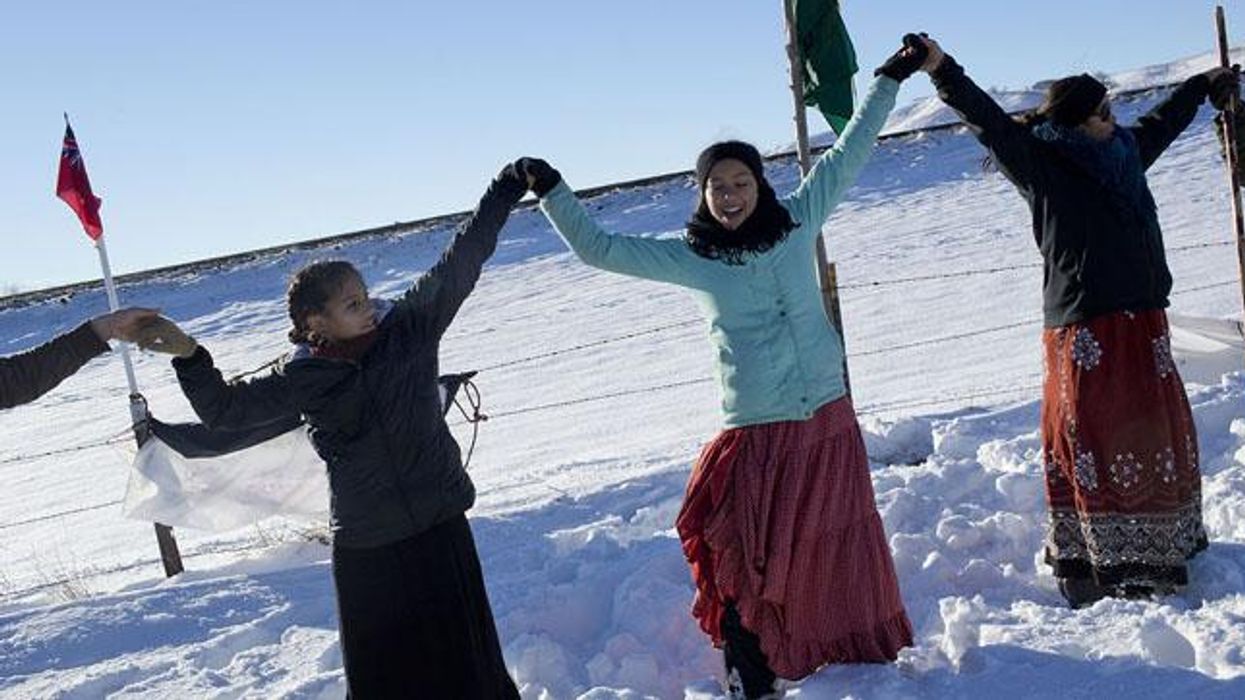
That disruption story began without much notice and with only a few people. The Sacred Stone Camp was established as a place of prayer by LaDonna Brave Bull Allard in April 2016. Then a 500-mile run organized by young people let the Army Corps of Engineers know that Natives did not want the Dakota Access oil pipeline constructed across their lands and water. When that didn't work, those young people ran 2,000 miles to Washington, D.C., and the idea of stopping the pipeline, the idea of disruption, grew quickly.
By summer, thousands of people across the country felt compelled to travel to the camps near the Missouri and Cannonball rivers. Many stayed for weeks and months and participated in small Native-led communities. There was a moment, one that will be carried forward, where people there and people watching wondered, "Why can't the world be like this?"
The hashtag #StandwithStandingRock was more than a social media meme. It was an idea that connected the world to a story about the end of colonialism. It was a call for a new world.
The colonial reaction was swift and violent because of that. The police state was an expression clinging to the status quo. Oil now flows through that pipeline, and much of the world has moved on. Those in government and industry, enriched by colonialism's requisite white supremacy and subjugation, remain disconnected from the millions that seek a more just framework.
That disconnection cannot last, not with climate change.
The disruption that is global warming is something that politicians can only pretend to ignore. Every day, headlines reveal the new world.
The disruption that is global warming is something that politicians can only pretend to ignore. Every day, headlines reveal the new world. Some are seemingly benign, such as winters on the Bering Sea where the sea ice arrives later in the season and remains thin. One elder told me he almost lost his son when he fell through ice while hunting. Other headlines are more obvious: monster hurricanes, December wildfires, flooding on a scale that's nearly incomprehensible. Some 600,000 people displaced in Bangladesh, India, and Nepal.
The scale of migration that is ahead, and inevitable, will be the current version of the Ancient Pueblos' move to the Rio Grande. Residents of entire cities, islands, regions will be forced to find new ground.
How will the world's people come together to meet the challenge of climate change? It's a global problem, and the possible solutions will require a kind of cooperation colonial states are not equipped for.
Recently, headlines have focused on colonialism's social failings, its patriarchy.
Well-dressed and high-powered sexual predators are not new. Hollywood studio executive Darryl Zanuck was infamous for his casting couch in the 1930s. And in politics there was a collective look-the-other-way for men like Clarence Thomas or Bill Clinton. It was acceptable (even if unfathomable) to have a secret fund that used tax dollars to settle with victims.
The world in which powerful and wealthy men live by special rules is falling apart. The December resignation of Sen. Al Franken, who has been on the right side of most gender issues, says a lot about this changing narrative. Apologies are no longer enough. Actions will be judged. As New York Sen. Kirsten Gillibrand said: "Enough is enough."
Perhaps we can extend that idea beyond punishing sexual exploitation, to changing dramatically who leads us. White men have run things for a long, long time. What if disruption of colonialism brings about a new governance, where women lead at least as often as men?
Clearly the colonial system, which is white-male-centric, is incapable of the leadership we need for our species to confront climate change. We need collaboration, not command and control. We need a variety of voices. We need new thinking. We need her.
We need collaboration, not command and control. We need a variety of voices. We need new thinking.
After one of the resignations of a powerful media figure--Mike Oreskes? Matt Lauer? It's hard to remember which one now because there have been so many--I took to Twitter to suggest that the media be recreated without the patriarchy. What if women of color finally got their turn? Disruption.
Indigenous knowledge is essential for the innovation that follows disruption. Our people have a history that is rich with stories about survival. We have been tested on conquest, the loss of our lands, our foods, our languages, our ways, and yet we are still here.
Even American ideas of democracy come from Indigenous knowledge. There was no such political affiliation of "states" in the 17th century. That was something learned from the Iroquois Confederacy. The first Europeans noted Indigenous political processes were mostly decentralized, consensus-based, and inclusive. Of course, colonizers warped that idea. Instead of a confederacy of equality, the United States opted for a system that preserved colonial power. Instead of a democracy where every citizen has a say, the American model favored the economic power of the few.
But disruption is happening.
The Alaska village once called Barrow is now called Utqiagvik, thanks to an initiative led by Inupiaq young people. The name change for the place where people gather roots was first voted on by the people in the community and has since been codified by the state. (According to the Anchorage Daily News, "Say it this way, with guttural back-of-the-throat sounds for the representative "k" and hard "g" in the middle: oot--kay-ahg--vik.") The paper pointed out that Nunapitchuk, formerly Akolmiut, changed its name back in 1983, and in 2000 the village Nunam Iqua replaced Sheldon Point.
My Facebook feed is full of people reclaiming their own traditional names, reflecting Dine, Shoshone, Hopi, Lakota, Tlingit, Haida, Athabascan. I see morning greetings in Bannock. I see social media finding a way to say there is a world that should be.
The food sovereignty movement is another story of reclamation. The Navajo Nation enforces a soda tax and works to end food deserts. Tribes such as the Tohono O'odham and the Blackfeet have turned to traditional diets to fight obesity and diabetes. Chefs such as Sean Sherman in Minneapolis are reinterpreting Indigenous foods to pre-reservation times. (Forget frybread--it's a colonial feel-good.) Sherman's new book, The Sioux Chef's Indigenous Kitchen, promotes the idea of "free groceries," where Indigenous foods are accessible and everywhere. Nuts, berries, wild rice, maple, rabbit, duck, goose, bison, venison, turkey, quail, walleye, trout. Other culinary advocates serve ancient lines of corn, kernels that are deep blue or red.
I don't mean to be overly optimistic.
Are we the generation that will end colonialism? And what does that look like?
Even as colonial systems are failing, people in power will not give up easily. They are rushing to develop and drill and extract in Alaska, in the oceans, on federal reserves and near national parks, even near the Ancient Pueblo villages. Their urgency is a reflection of will. The colonialists know their time is up. That is why the excesses of the Trump administration reflect a parody of intellectual discourse. But here's the thing: The more Trump and the colonial mindset bully the rest of the population, the more likely people will revolt.
Are we the generation that will end colonialism? And what does that look like?
Perhaps that means a new country. Or perhaps it's time for a global structure that recognizes a planetary crisis. We do know this: Colonialism is ill-suited for this challenge. We need democratic institutions that share power among diverse people and reflect the range of life on Earth. We need disruption and innovation.
A year ago, on January 20, President Trump took office. The whiplash of right-wing assaults is sobering, but it can't be demobilizing. Now is an opportune time to reflect on our tactics.
Last week Trump called Haiti, El Salvador, and every single country in Africa a "shithole," digging his heels in against extending Temporary Protected Status.
Trump's comments reflect an ascendant white supremacy that Trump condoned, in August 12 in Charlottesville, placing blame on "both sides." White supremacists again mobilized in another Southern college town, Gainesville, in October.
After many missteps, Trump's so-called "Muslim Ban" was finally blessed by the Supreme Court during the first week of December, on the heels of the Senate's razor-thin passage of his tax reform, the greatest upward redistribution of wealth in the history of the country.
Trump pardoned unapologetic racist, former Sheriff Joe Arpaio, running for U.S. Senate following the retirement of Jeff Flake, who voted yes for Trump's tax bill in exchange for negotiating for the rights of millions of undocumented individuals, including Deferred Action for Childhood Arrivals (DACA). Republican intransigence on this issue led to a government shutdown, disproportionately affecting the most vulnerable and marginalized.
Trump's single-minded refusal to acknowledge the role of climate change was undeterred by last year's hurricane season, with three category-four-or-higher storms. In Puerto Rico, rather than provide aid, he threw paper towels at a crowd while starting a Twitter war with San Juan Mayor Carmen Yulin Cruz, keeping shipping routes closed to benefit his wealthy friends. In the wake of Hurricane Irma, Trump reversed Obama's policy on Cuba, escalating a war of words.
Other wars are escalating, and as a species we are facing nuclear annihilation, with Trump bragging that his "nuclear button" is bigger than North Korea's.
Progressive forces hope that 2018 will be the year that things will change. A record number of Republican lawmakers are retiring, following a string of victories for Democrats in 2017, including a razor-thin margin of victory against Roy Moore facing multiple charges of sexual misconduct. Moore was even banned from a local mall because of his stalking of teenage girls.
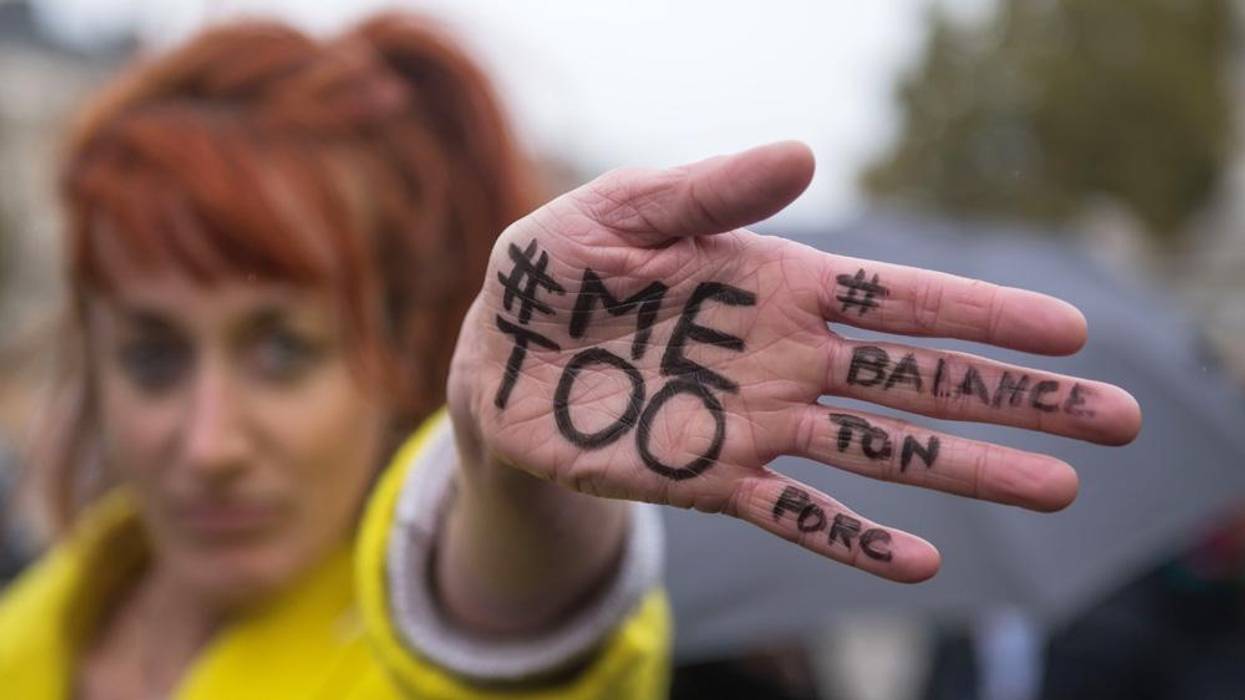
One ray of hope in 2017 was the wave of standing up to endemic sexual harassment, shorthanded as #MeToo. What began as a courageous series of acts against powerful Hollywood producer Harvey Weinstein has become a movement, bringing down individuals in entertainment, and even Minnesota Senator Al Franken. Some have called this a new "wave" of feminism, unfinished business from candidate Trump's bragging that he grabbed women by their genitalia. Angry, in what was described as the biggest demonstration in U.S. history, 2.6 million women and men marched on January 21, the day after the inauguration.
Will things actually change in 2018?
What would it take?
The relative success of #MeToo given the torrent of right-wing policies invites progressives to examine our tactics. Is electoral politics, supporting the Democrats in our two-party system, enough? Is public protest, particularly in Washington?
Elizabeth Currans, Associate Professor Women's and Gender Studies at Eastern Michigan University, addresses many of these questions in her recently-published book, Marching Dykes, Liberated Sluts, and Concerned Mothers: Women Transforming Public Space. Currans recommends that people think about their goals. "Taking a controversial stand can draw attention to issues and people who are often neglected. However, sometimes coming together in large numbers despite differences may be more important either to demonstrate numbers or to help participants feel support from large numbers of similarly-minded people. Different tactics are also better suited to different goals."
Demonstrating in the streets can exclude the most marginalized people. Currans continues, "Police brutality disproportionately targeting people of color means that some people of color are not going to attend protests no matter how inclusive an event's platform and how effectively organizers have done outreach. Non-citizens, documented and undocumented, often find protests too risky."
This question about who is excluded from protests, and the impacts on local communities, was discussed by a panel organized by author and professor Bianca Williams bringing together DC organizers, Black Lives Matter DMV April Goggans and Erika Totten, director of the Marsha P. Johnson Institute Elle Hearns, and NY organizer with Black Alliance for Just Immigration Nisrin Abdelrahman, also a PhD candidate at Stanford, in a panel, "Until We Are All Free: Black Feminist Leadership in the Movement for Black Lives" at the American Anthropological Association meeting, also in Washington.
Williams explained her reasons for organizing the panel: "Since the election of the current president, the violence and threats against the organizers in this movement has intensified. I wanted to highlight the effective strategies and resulting victories Black people--particularly women and LGTBQ+--have generated even in the face of extreme hate. Many times, in media and academic conferences, we don't get to hear from the organizers themselves. Their die-ins, disruptions, and organizing campaigns have shifted national discussions on race, gender, and police violence; galvanized people around local initiatives for restorative and transformative justice, and prison abolition; and increased attention to the structural inequities that impact Black people's health and wellness."
The discussion covered a range of topics, including power, self-care, what Goggins called "internalized capitalism, measuring your self-worth by what you produce for others," centering Black feminist leadership, and necessary mechanisms for self-critique and accountability.
The DC activists implored guests to think about the impacts of our actions in the nation's capital. Totten emphatically called upon us to stop trying to colonize DC activists with our issues. Marching on the Capitol means little to DC residents since they don't have representation. She called this approach "Columbusing," noting that "we are fighting to be citizens."
One particular lightning rod was the Women's March, which took away resources from local organizing. One example was all the port-o-potties in a 75-mile radius. Goggans pointed out that "80% of city workers are Black in this city. Who do you think was picking up trash, and cleaning up the s*** after you all leave?" Worse, Hearns continued, "Let's look at the police that the Women's March brought in and welcomed. Who will that impact when you all leave? On us."
Acknowledging the multiple, differential layers of privilege and power, local organizations have drafted DC Community Organizing Principles and ask us outsiders to respect them.
This decolonizing work begins with each of us. First, we all have to work on ourselves, "to own our own s***."
And frankly, just to do the work.
In "Speaking Justice to Power," organized by the Association for Political and Legal Anthropology at Busboys and Poets, where more people had to be turned away than can be seated, American University anthropologist Orisanmi Burton recommended that we engage movements as participants, not as anthropologists [or other scholars]: to build trust by doing the regular work as people first.
2018 will only be a pivotal year if we are prepared to do the work.
Al Franken the serial groper. Al Franken the scapegoat.
History proceeds clumsily. Innocent people -- or "innocently guilty" people, like the junior senator from Minnesota -- often get unfairly hung out to dry. Should he have to resign? As far as I can tell, his alleged sexual wrongdoings over the years consist of three butt grabs, several uninvited kisses, a breast grope and a waist squeeze.
There may be more, of course, and they add up to something beyond what could be called innocent mistakes or misunderstandings. An adolescent sense of entitlement seems to be at work here, but . . . this is the moral standard of a Congress open for purchase by corporate lobbyists? Who among us (Roy? Donald?) hasn't committed transgressions worse than the above? And shouldn't a person's positive achievements be factored into the severity of his punishment, at least when no permanent damage has occurred?
Yet . . . yet . . .
I get the outrage, which is a release of decades -- centuries -- of the hopeless despair of so many women, who have been powerless even to stop, let alone get justice for, sexual abuse, harassment, assault. We live in a deeply problematic and unfair world, but suddenly social awareness has solidified around the wrongness of sexual abuse, so much so that powerful men are feeling the sting of accountability for stupid and cruel behavior that until recently seemed consequence-free.
I get that Sen. Kirsten Gillibrand of New York, who has long stood up courageously against the sexual assault that permeates the U.S. military, led the way in calling for Franken to resign and calling for zero tolerance of all forms of sexual harassment.
But I also get the counter-outrage: the support for Franken (including "feminists for Franken"); the calls for him to reconsider his resignation; the outcry that zero tolerance for minor transgressions, sexual or otherwise, is morally simplistic and can quickly devolve into destructive self-righteousness that only makes matters worse; and the demand for some sort of due process, e.g., convening the Senate Ethics Committee to consider the accusations against Franken.
What's clear is that this is a moment of social change. I believe we should value everyone who is a participant in it, willingly or otherwise. Real social change leaves no one out.
So . . . should Al Franken resign?
As Masha Gessen wrote last month in the New Yorker, "maybe 'Should Al Franken resign?' is the wrong question.
"The question frames the conversation in terms of retribution, but it is not possible to hold to account every man who has ever behaved disrespectfully and disgustingly toward a woman. Nor even every senator, or every comedian. And, even if it were possible to punish every single one of them, what would be accomplished? Punishment, especially when it is delayed, is not a very effective deterrent.
". . . the real issue here," she goes on to point out, is "the power imbalance that allows some men to take women hostage using sex. Franken, from what we know, was not such a man."
Harvey Weinstein, on the other hand, held women sexually hostage with the power he wielded over their careers. So did Roger Ailes -- and so many others. But even they, and all those who preceded them in such behavior, and worse, weren't acting simply as bad individuals. They were acting in a social context. a.k.a., the patriarchy, in which male sexuality mattered more than female humanity.
Rape, indeed, was once a property crime. "The idea that rape is a crime against a woman, and specifically a crime against a woman's body, is relatively new," writes Emily Crockett at Vox. "For most of human history, rape has been treated as a property crime against a woman's husband or father, since they effectively owned her."
This is the horrific social context that has suddenly stopped coddling the tainted celebrities of the 21st century, some of whom have lost their careers because accusers have finally felt empowered to tell their stories. But for the most part the national conversation about it has not moved beyond the bad behavior of individual men and the need to punish them for what they did. I keep believing that we can move more deeply into the matter.
Consider, for instance, how the tiny indigenous village of Hollow Water, Manitoba, confronted, back in the 1980s, its own long-festering sex abuse problem, as described in Rupert Ross's book Returning to the Teachings. The sex abuse was the hidden part of the problem, which manifested in alcoholism and various forms of violence, as well as the profound alienation of the community's teenagers.
Inflicting punishment on the perpetrators of various crimes, the Western way, did nothing but further destabilize this fragile community. The situation became so desperate that a group of community members finally came together and started talking.
Several years ago, after I heard Ross and Burma Bushie, a resident of Hollow Water, speak at Des Moines University, I wrote: "And at the core of it all was the circle: the whole. They sat with one another in peace circles and talked with raw honesty. They sat with the injured and those who caused harm. As Ross put it, 'Their definition of justice sounded more like our definition of healing.' It was about healing, about reconnecting people with one another and their surroundings. The Hollow Water team had made lifelong commitments to heal their community and supplant the Western replacement legacy of punishment-based justice and welfare bureaucracies, which only intensified the wreckage."
The global restorative justice movement emerged from indigenous communities, such as Hollow Water, beginning the process of healing themselves by reclaiming the tribal circle, which included truth-telling and forgiveness. Accountability is a far more difficult process to undergo than punishment, but it empowers everyone, both victim and perpetrator. Indeed, claiming accountability turns perpetrators into healers.
All of which brings me back to Al Franken, and why his resignation seems to accomplish little more than fueling the momentum of revenge. It further splinters the political culture but does nothing to set free its collective secrets.
And as long as punishment rules, the patriarchy remains intact.
It's an odd day when Democrats have Alabama to thank for their better fortune. Winning a U.S. senate seat in the state that gave Donald Trump a 62 percent victory margin, narrowing the Republican-Democratic split in the Senate to one and scoring a victory for minorities, women's dignity and gay rights, in Alabama, is no small thing. I dusted off my old Alabama Greatest Hits CD this morning and listened to "My Home's In Alabama" with freakish pride. But Democrats are overstating the victory.
Doug Jones should have won by 30 points. He won by one and a half percentage points, a difference of 21,000 votes out of 1.35 million cast in a state with 3.33 million registered voters. Moore won 42 of Alabama's 68 counties, winning 17 of them with 70 percent of the vote or more. In two of them, he won with 80 percent or more. (That would be Blount and Winston counties, where whites make up 87 and 89 percent of the electorate.) Turnout was 40 percent, about right for an off-year election two weeks from Christmas. Calling it a harbinger of next year's mid-terms is wishful at this point.
And look at what it took to beat a Republican. Moore is no ordinary barbarian, even for Alabama. Before you get to his teen-addled and mall-rat lechery there were the more civil scandals of his tenure posing as a judge but acting like Mullah Omar's Christian doppelganger. This is the judge who defied several state and federal court rulings with his Ten Commandment displays and illegally used proceeds from films about the controversy to pay his legal expenses. He was twice removed from the bench for breaking the law, the second time for ordering Alabama's equivalent of our clerks of court not to issue marriage licenses to same-sex couples.
He was-he is-not just a bigot, but a cliche of bigotry. Think of anything or anyone non-white, non-evangelical and you're pretty much on his shit list, though Muslims, gays and transgender people get him particularly excited. He thinks homosexuality is an American export, like Boeing jets and George Lucas movies. His idea of women is stuck somewhere in the backwoods of Winston County, predators being predisposed misogynists. Of course he thought Barack Obama was an East African Muslim impostor. Still does. Confederate monuments are his civic centerfolds, Donald Trump and Vladimir Putin his post-Confederate heroes.
That was before the allegations of his pedophiliac interests. And until then, he was cruising to victory in his Senate race.
So that's what it takes for a Democrat to defeat a Republican anymore. A Republican opponent's racism, love of violence, hatred of anything not hetero, predatory pussy-grabbing and inability to tell the truth isn't enough, as Trump triumphantly reminds us. The opponent must also have lusted after children. That crosses the line, if barely so, at least in an off-year election not too many days removed from the arrival of Baby Jesus. That's a pretty damn low bar to clear for Republicans. It essentially adds up to this: Be breathing and keep your hands out of the knickers of kids and you should be fine. If you have any doubts, look to the White House as every Republican wiseguy's North Star.

Not that Republicans should give up on pedophiles just yet. There were a couple of twists in this race that could have saved Moore's candidacy. Trump miscalculated when he went ahead with another one of his white-man's-burden rallies, that one in Pensacola a few days ago, not fooling anyone that it was a big ad for Moore smack in the middle of one of Alabama's most important media markets. (Ron DeSantis, allegedly the congressman who represents Flagler County, lent his face and contralto voice to the pro-Moore orgy but managed not to mention the guy's name. The appearance was message enough.) It was a shove too far. And Democrats, in a rare flash of strategic savvy-it reminded me of those parts of "Awakenings" when Robert DeNiro's character comes out of his catatonic state for a while-managed to get Sen. Al Franken and his wandering hands booted off just in time to make it count against Moorland. Discount those two factors and we might have had a sequel to Charlottesville's Unite the Right rally in the guise of Moore's victory party.
His loss may also be Democrats' bigger loss in the long run. In Jones they win an additional but still irrelevant seat in the Senate, where Republicans still control the majority. In not having Moore to kick around, they lose what would have been the most potent demolition charge under Trump's rickety Republican Party in the run-up to the mid-terms. The fact that congressional Republicans are celebrating Moore's loss at least as much as Democrats should tell you all you need to know.
Sanity won the day. It may even have won Alabama, that old cradle of civil rights and prophet of the occasional mockingbird song. Sanity is not winning elsewhere. Not by any measure.
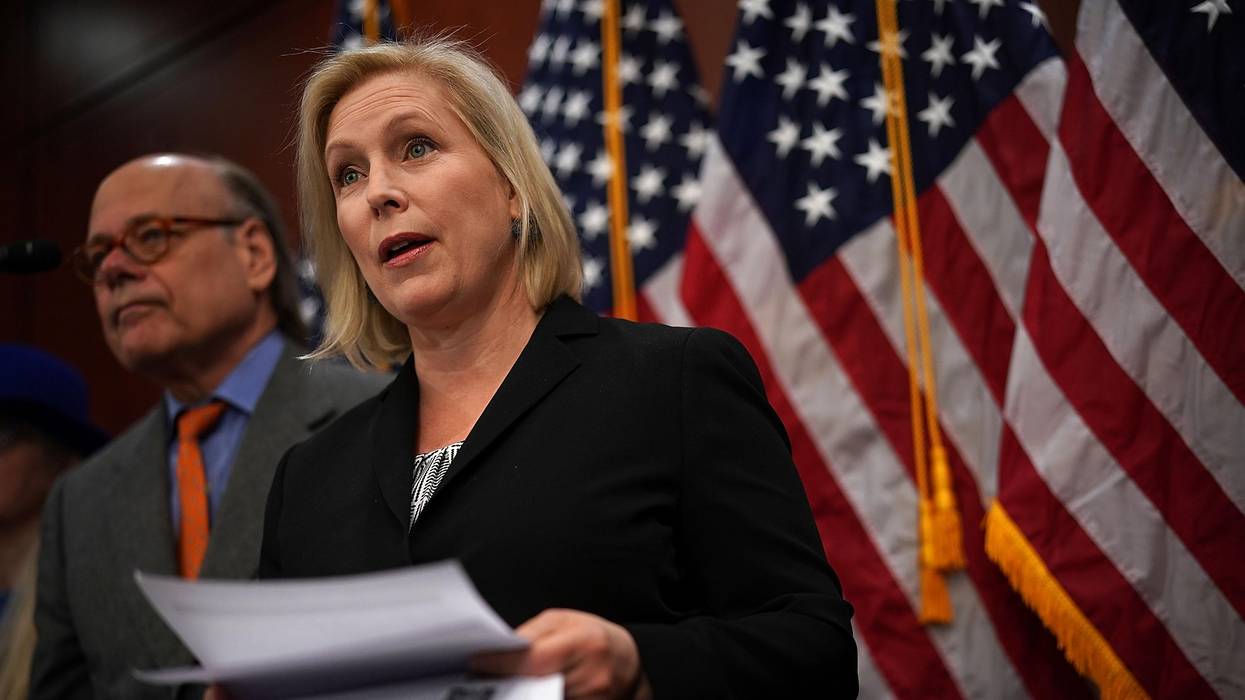
Sen. Kirsten Gillibrand (D-N.Y.) quickly fired back at President Donald Trump on Tuesday after he posted a crude tweet about her, attacking the lawmaker amid calls for Congress to investigate the president's history of sexual harassment and assault and her suggestion that he resign.
With as many as 19 separate allegations aimed at the president, Gillibrand has been leading the charge in the Senate against Trump and recently called for his resignation.
In his tweet Tuesday morning, Trump lashed out by calling the senator a "lightweight" and then suggested that Gillibrand "would do anything for" his donations before he ran for office.
After responding on social media, the senator held a press conference, calling Trump's tweet a "sexist smear."
Gillibrand has become a leading voice in calls to hold Trump accountable for his sexual misconduct--including behavior that he openly admitted to in an audio recording that was circulated during the 2016 campaign--just as Democratic lawmakers Rep. John Conyers (D-Mich.) and Sen. Al Franken (D-Minn.) have been called to account for allegations against them.
The #TrumpToo movement has taken off in recent days, weeks after the #MeToo social media campaign flooded Facebook and Twitter feeds. Supporters want Congress and the Justice Department to open an inquiry into reports that Trump grabbed, forcibly kissed, and harassed women at various times during his career.
As of Tuesday, 277,845 people had signed a MoveOn.org petition calling for an investigation.
Trump has denied the allegations, despite his statement last year that the audio recording in which he bragged about sexually assaulting a woman, was authentic. White House Press Secretary Sarah Huckabee Sanders said Monday that the allegations took place "long before he was elected president" while also claiming they were untrue.
Speaking to reporters, Sen. Mazie Hirono (D-Hawaii) strongly condemned the president's remarks about Gillibrand, saying, "He's a misogynist and admitted sexual predator and a liar. The only thing that will stop him from attacking us, because nobody is safe, is his resignation."
On social media, Trump critics and supporters of #TrumpToo also jumped to Gillibrand's defense and expressed shock at his comments about the senator, which many said qualified as a new incident of sexual harassment.
To be clear: Trump sexually harassed Gillibrand in his tweet by strongly implying she'd have sex for campaign contributions.
-- Pe Resists (@4everNeverTrump) December 12, 2017
While women who have accused President Donald Trump of sexual misconduct gathered in New York City on Monday to publicly share their stories, nearly 60 female Democratic lawmakers sent a letter to the House oversight committee demanding an investigation into the allegations.
"The American people deserve a full inquiry into the truth of these allegations," members of the Democratic Women's Working Group write in a letter (pdf) to Reps. Trey Gowdy (R-S.C.) and Elijah Cummings (D-Md.), who respectively serve as the chairman and ranking member of House Committee on Oversight & Government Reform.
Multiple news outlets have published various detailed lists of women who have publicly accused Trump of sexual harassment or assault--including Brave New Films, which hosted the New York City press conference and published a video featuring several accusers--but the letter names 17 women, and details some of their allegations.
"Natasha Stoynoff recounted how the president pushed her against a wall and forced his tongue down her throat," the letter states, while "Kristin Anderson detailed how the president touched her genitals through her underwear."
While the lawmakers acknowledge Trump "should be allowed to present evidence in his own defense," they also note how "the president's own remarks appear to back up the allegations" even though he has "called all his accusers liars."
Tuesday morning, Trump took to Twitter to deem the allegations "fake news" constructed as attacks by his Democratic opponents:
Trump also attacked Sen. Kirsten Gillibrand (D-N.Y.)--tweeting that she "would come to my office 'begging' for campaign contributions not so long ago (and would do anything for them)"--and reiterated his support for U.S. Senate candidate Roy Moore, who has been accused of sexually abusing multiple teenagers while he was in his 30s.
However, in this growing movement for increased accountability that is sweeping the nation--with men across numerous industries being held to account for violating women--the female lawmakers seem hopeful that their demand could be met with an investigation into Trump's behavior.
NBC News reports that three of the lawmakers leading the effort--Reps. Lois Frankel (D-Fla.), Brenda Lawrence (D-Mich.), and Jackie Speier (D-Calif.)--will discuss the call for action in a news conference on Tuesday.
"In the time of 'Me Too,' women across the country are coming forward with their own harrowing stories of sexual harassment and assault," the lawmakers write, noting that multiple members of Congress recently have been accused of sexual misconduct, over which three have retired or resigned.
The letter gives the oversight committee chairman and ranking member 10 days to respond with a decision, and declares, "We cannot ignore the multitude of women who have come forward with accusations against Mr. Trump."