

5
#000000
#FFFFFF
To donate by check, phone, or other method, see our More Ways to Give page.
Daily news & progressive opinion—funded by the people, not the corporations—delivered straight to your inbox.

Deadly climate change is here. We are all paying the price, but the polluters must be held to account for what they have wrought.
A new report from the UN has concluded that world-changing levels of global heating are now guaranteed. If we do end fossil fuels in the coming years, we can still avert potentially civilization-ending levels of heating, but no matter what we do, dangerous global warming is here to stay.
Given that 6,000 people are dead or disappeared following the recent climate disaster in Nepal, this shouldn’t come as a shock. It should, however, be a wake up call. Deadly climate change is here, and in addition to ending fossil fuels as quickly as possible, we’re going to have to spend a ton of money refitting society so that it’s fit for our new climate era.
Stormwater systems, dams, and sea walls will need to be upgraded to withstand more intense flooding. Schools, hospitals, and offices will need to be refitted to withstand punishing heatwaves. Early warning systems giving people a hope of surviving extreme weather events will need to be installed across the world. (Such a system could have saved hundreds of lives in Nepal.)
But building this new world is going to run up a bill of trillions of dollars. In the long run, these investments will pay off massively, both in avoided suffering and economically. But the initial investments need to be made. The question is: who is going to pick up the tab?
This question has vexed global climate talks for years. Low-income nations have done the least to cause global warming. Yet, they’re being hit hardest by punishing climate extremes. In response, Global South leaders have pushed the world’s wealthiest nations to create (the still shamefully underfunded) financing mechanisms, such as the Loss and Damage Fund and the Least Developed Countries Fund, to move money to the world’s poorest countries to support climate adaptation.
Low-income nations have done the least to cause global warming. Yet, they’re being hit hardest by punishing climate extremes.
Much more needs to be done to ensure nations that have benefited the most from fossil fuel-driven development are financially supporting those nations hit hardest by climate change. Indeed, this fact will likely underpin the fight for global justice for much of the remainder of the century.
Within wealthy nations, too, however, the question of who’s going to pay the upfront costs of adapting to a hotter, harsher world is also becoming a burning question.
In New York State, the cost of climate adaptation is projected at $519 billion by 2050. It was this observation that propelled the passage of New York’s Climate Superfund Act in late 2024: the legislation requires fossil fuel corporations to pay $75 billion to New York State over a 25-year period to support projects that would make New York’s public infrastructure more resilient in the face of climate change.
New York’s Climate Superfund Act makes perfect sense. After all, somebody's going to have to pick up that $519 billion tab―and the industry that has done the most to cause the problem should pay its fair share.
Unfortunately, New York’s efforts experienced a recent setback when a federal judge ruled that it cannot enact the legislation. While the case will likely be appealed, it’s a frustrating development.
But a single court ruling in a single court can’t stop a movement. Climate superfund legislation has been introduced in 16 states and one ruling in a single court district does nothing to stop other states from implementing their own Climate Superfund laws.
And across the world, additional efforts to make fossil fuel polluters pay for the climate crisis are proliferating.
In July, Portugal passed a 33% windfall tax on profits earned by oil companies due to the Iran War. A bill to that end has also been introduced in the US Senate, and been championed by French campaigners and leading UK politicians.
Legislation introduced in California, Hawaii, and New York would enable state attorneys general to sue fossil fuel companies for economic losses from climate disasters. In Connecticut, a bill that would place a 5% surcharge on fossil fuel companies' insurance policies, raising millions for climate resilience programs, is expected to advance in 2027.
Across the world... efforts to make fossil fuel polluters pay for the climate crisis are proliferating.
The fossil fuel industry clearly sees these attempts for accountability as a serious threat. Big Oil’s puppets in Congress have introduced legislation that would provide the fossil fuel industry with near total immunity from these kinds of lawsuits and legislation.
This front of the climate fight will enter a new phase next month, as the US Supreme Court hears arguments in the case between the City of Boulder and ExxonMobil. No matter the outcome of the Supreme Court case though, the question of who is going to fork out trillions of dollars for essential climate adaptation is only going to become more salient in the years ahead.
Our job is to make it clear: Fossil fuel corporations should pay for the harm they have caused.
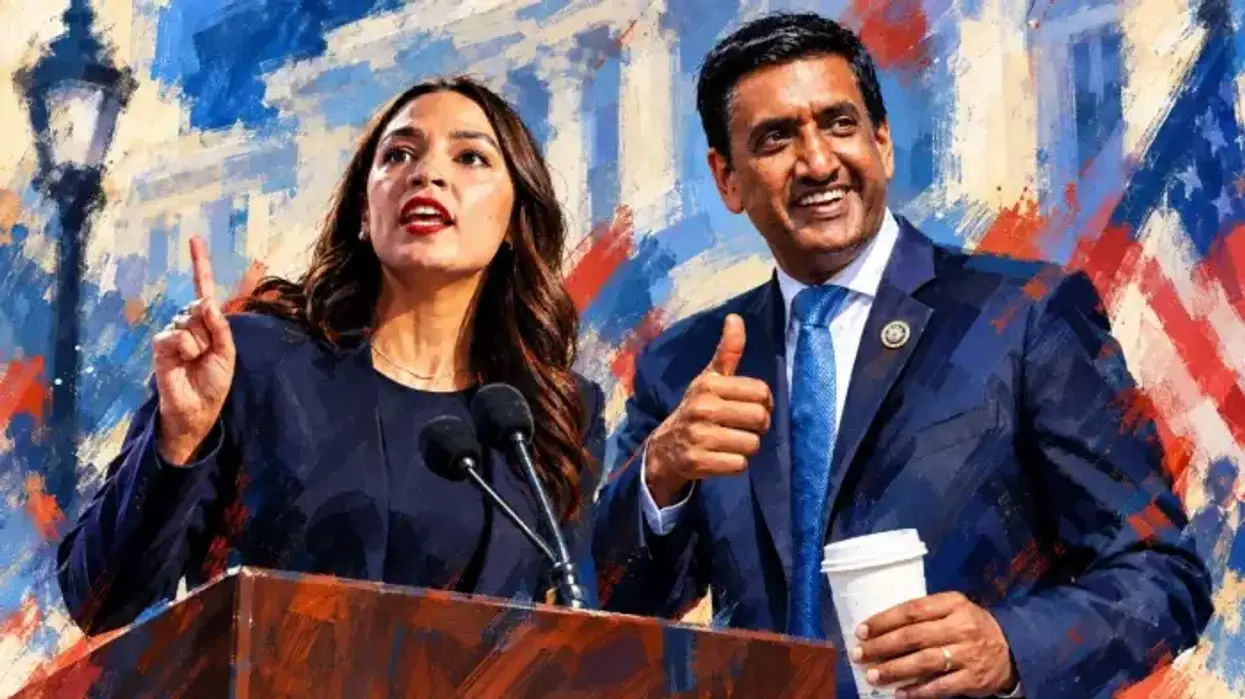
While there is a difference in how these two politicians label themselves, most voters will be much more interested in whether each will address the needs of the working class and fight the greed of the billionaires.
Fifteen years ago, during President Obama's first term, we co-founded RootsAction as an online progressive group challenging not only Republicans but also the corporatism and militarism of the Democratic Party. RootsAction supported Bernie Sanders for president in 2016 and 2020. Two years before the 2024 election disaster that returned Donald Trump to the White House, RootsAction launched the Don’t Run Joe campaign, with the warning that the renomination of Joe Biden by Democrats “would be a tragic mistake.”
Despite polls showing as early as 2022 that strong majorities of Democrats wanted a 2024 nominee other than Biden, the “Don’t Run Joe” message went unheeded until Biden’s debate debacle in June 2024. By then, it was too late for the open primary process needed to produce a ticket that could inspire activists—and defeat the fascistic faux-populism of Trump.
Like the 2024 victory of the twice-impeached, repeatedly indicted Trump, his 2016 win was avoidable. Tad Devine makes the case in his new book, “How the Democrats Screwed Bernie.” Devine had been a top strategist for mainstream Democrats for decades before he joined Bernie’s first presidential campaign.
One lesson we’ve learned over the last 15 years is that it’s a big mistake for activists to sit back and expect the Democratic Party establishment to serve up candidates who can mobilize voters and win elections. That establishment failed us in winnable presidential elections in 2000, 2004, 2016 and 2024. Devine, who knows the mechanisms inside and out, says the dollar-dominated process is often rigged against outsider “candidates who connect with voters, who understand voter anxieties”—and these genuinely populist candidates “are more likely to succeed in general elections than those who rely primarily on insider muscle.”
This week, RootsAction teamed up with Progressive Democrats of America to announce that we will jointly launch, just after the November midterm elections, a campaign urging Reps. Ro Khanna and Alexandria Ocasio-Cortez to run for the 2028 Democratic presidential nomination. “The voices of Khanna and/or AOC are needed in the presidential campaign to ensure that voters hear serious solutions,” the campaign’s petition says. “Without a progressive populist advocate atop the ticket, the Democratic response would be woefully underwhelming—enabling right-wing demagoguery to push voter unrest in dangerous and divisive directions.”
The petition statement adds that the presence of Khanna and/or AOC in the presidential race “is crucial to foster debate on healthcare, jobs, AI, militarism and the U.S. relationship with Israel, along with many other issues important to a wide range of voters.”
Congressman Khanna—whose name recognition has grown recently because of his legislative battles to release the Epstein files and to end the Iran War, and his detention in the occupied West Bank by Israeli settlers—represents our country’s wealthiest district and much of Silicon Valley. He wants to increase taxes on the rich. He calls himself “a progressive capitalist.”
Congresswoman Ocasio-Cortez entered the House with great fanfare after a 2018 Democratic primary victory over one of the party’s top leaders on Capitol Hill (Joe Crowley, now a corporate lobbyist) representing a working-class, Latino-majority district in New York City. She led the effort to bring the jobs-creating Green New Deal proposal to Congress. She calls herself “a democratic socialist.”
While there is a difference in how these two politicians label themselves, most voters will be much more interested in whether each will address the needs of the working class and fight the greed of the billionaires. Both are direct political descendants of Bernie Sanders—AOC was active in the 2016 Bernie campaign, which inspired her to run for Congress, and she regularly joined Bernie last year at Fighting Oligarchy rallies; Khanna was a surrogate and national co-chair in Bernie’s 2020 presidential campaign.
RootsAction’s coalition partner in this initiative, Progressive Democrats of America, has a history of major success in candidate recruitment. In late 2013, PDA launched the “Run, Bernie, Run” movement, which drafted Sen. Sanders to seek the Democratic nomination in 2016—a campaign that elevated the national conversation and helped spark today’s progressive upsurge.
The RunRoRunAOC.org petition argues that either Khanna or Ocasio-Cortez—or both of them—need to be in the presidential race. If both enter it, the organizations behind this recruitment initiative are not worried that the two will somehow “split the progressive vote.” As shown by the historic wave of insurgent victories in this year’s Democratic primaries, the party’s electoral base is largely and increasingly progressive. It’s not a small sliver of voters. And a progressive bloc of delegates at the party’s national convention in August 2028 would be all to the good, pushing for popular policies such as taxing the rich, resisting Big Tech’s AI data centers, abolishing ICE, green jobs initiatives, enhanced Medicare for All, cutting the military budget and stopping the weapons flow to Israel.
During last year’s New York City mayoral campaign—which, thankfully, employed ranked-choice voting—two progressive candidates actually ran as a duo in the Democratic primary: Zohran Mamdani and Brad Lander. Mamdani became mayor thanks significantly to Lander, and now Lander is heading to Congress thanks in part to Mamdani’s endorsement and support. In other races, progressives have run in tandem in crowded fields, maintaining a non-aggression strategy while bolstering each other’s positions.
We should remember that in the early months of the 2019-2020 Democratic presidential race—before a fraught personal split between Sen. Elizabeth Warren and Bernie—the presence of the two previously friendly candidates raising similar issues of inequality and corporate greed had actually moved the whole Democratic debate in a notably more progressive direction.
Despite millions of dollars flooding into the campaign coffers of corporatist Democratic candidates from special interests representing AI, crypto and Israel, and despite assists to those candidates from corporate media, the 2026 Democratic primaries have produced an unprecedented wave of victories by underfunded progressive candidates. These insurgent successes have occurred at local and statewide levels.
It will soon be time for progressives to focus on the national level.
Leaving the 2028 presidential nominating process to the money-drenched party elites—with their record of electoral defeats, governance failures and betrayals—would be a recipe for disaster.

What's needed are bold yet realistic policies that break cleanly from the corruption of the Trump years and the free-market fundamentalist era that preceded them. Righting the rules means an end to game-rigging by ruling elites and instead crafting rules that first and foremost protect the well-being of working people.
Editor's Note: The following is part of new series for Common Dreams based on "Game Changers: Economic Policies for a Working America," a project spearheaded by the Political Economy Research Institute (PERI) at the University of Massachusetts Amherst. Game Changers is a collaborative initiative bringing together leading economists and policy experts to develop bold, new ideas to build a stronger, fairer, greener, and more inclusive economy for all Americans. Through dozens of policy briefs, supporting research papers, and online webinars, the project offers solutions designed to help working people thrive while preparing the country for the economic challenges ahead. ""People are looking for solutions that improve their daily lives—not just marginal changes around the edges," says economist Juliet Schor. "Our proposals make housing, care, and daily life more affordable."
When a system reaches the point of breakdown, it’s time for radical change. That was the lesson of the 1930s, when the Great Depression ignited transformative labor and social movements that reset national priorities. It was also the negative lesson of the 1980s, when elites responded to stagflation with a neoliberal turn to “free markets” and enhanced corporate power. The resulting intensification of income and wealth inequality has enabled state capture by a white supremacist authoritarian movement in alliance with tech and fossil fuel interests.
The antidote is increasingly clear: recognizing the equal dignity of every human being and working to guarantee their right to economic security, the opportunity to thrive, a livable planet, a world free of racism, and democratic governance of our lives, societies, and economies. Large majorities of the public understand that the current system is failing most of us and threatening democracy itself. They’re ready to begin building an economy that we deserve.
It’s time to “right the rules” to create an economy that meets individuals’ basic needs for food, shelter, care, education, health, and free time.
Social change, and especially major economic transformation, requires a compelling positive vision of the possible. The Game Changers project was formed to provide that vision. Rooted in new economic thinking and research to address the multiple dysfunctions of the current system, it offers far-reaching ideas that go beyond the failed policies of the past, both neoliberal and liberal, and the corrupt authoritarian practices of the present.
It’s time to “right the rules” to create an economy that meets individuals’ basic needs for food, shelter, care, education, health, and free time. We envision that happening in multiple ways: local public provisioning for health, child and long-term care; federal income supports; access to work with good wages and reasonable hours; raising wages at the bottom and the middle to address longstanding racial and other inequalities; and sensible and compassionate immigration policies. We lay out plans for new public infrastructures such as high-quality mixed-income public housing with renewable energy systems and a low-cost, efficient public payments system. We need to detoxify the natural environment, restore ecosystems, and stabilize the climate system.
Investments in individuals, communities, nations and the planet are key to prosperity. But we need more than that. Changing the game implies that the game is rigged. We offer policies that help working people build power, through collective organizations, in the workplace and the state. These organizing strategies address racial and other divisions that weaken communities. They’ll help redress the asymmetries of influence that plague this moment.
A new game also requires fundamental transformation of large-scale economic structures, such as the financial architecture, the international trading system, and the functioning of the macroeconomy. Our policies do that through breaking up concentrated power, penalizing rent-seeking, stabilizing the financial system, and forcing corporations to pay their fair share of taxes. These measures help fund the investments in people and planet that are required for a decent economy.
Game Changers: The Economy We Deserve
One throughline among the wide range of proposals we have developed is that they are based on strong economic research and reasoning, but they reject the economic story that has dominated policymaking. Conventional economic thinking has been shown to be misguided in area after area. Minimum wages don’t cause unemployment; rent control doesn’t reduce housing supply; and equality and efficiency are not opposed. Climate action is cheaper than inaction, worktime reduction and higher productivity go together, and investments in social goods can pay for themselves.
The economic logic of our approach is based on game theory, as well as common sense. Zero-sum, competitive games like the one the economy has been stuck in yield much worse outcomes than cooperative games. When we join together in communities, labor unions, civic associations, and business enterprises, outcomes are far better. This recognition is the basis of a powerful new economic paradigm: invest in each other, secure the future, and realize the promise of multi-racial democracy throughout society. It’s time to change the game.
The roots of our current predicament can be situated in the early 1970s, when the economic damage wrought by an earlier wrong-headed foreign adventure—the Vietnam War—coincided with an increase in oil prices resulting from conflict in the Middle East. The resulting economic crisis of inflation and recession brought to a head longstanding political, social and economic struggles. Workers mobilized and built power through militant trade union activities; African Americans gained voice and political influence via the Civil Rights movement; the women’s movement demanded equal treatment. These developments coincided with declining competitiveness of US business and a profit squeeze. Panic arose within the American business class as they feared they were losing control.
All the proposals share the goal of helping to build a positive-sum economy that works for all, rather than a zero-sum economy where the greed of the one percent trumps the well-being of the ninety-nine percent.
An additional factor was increased environmental awareness. The first Earth Day in 1970 attracted 20 million, the largest protest action in US history. Existential panic was especially present in the fossil fuel industries of oil, gas and coal. Fossil fuel interests, including Exxon and the Kochs, fought back, investing millions to capture politicians and state institutions. They joined with other business interests to support representatives of both parties who would break unions and negotiate trade agreements that undermined the power of US workers. They de-regulated banks and other financial institutions to allow them to grow bigger, more profitable and, as we were to discover in 2007 and 2008, more dangerous to our economy and livelihoods.
In wave after wave, the state cut taxes for the rich and reduced government resources for investing in and supporting people and communities. The capture of politics and politicians by big capital directed even more money to the military industrial complex. The economic vision associated with neoliberalism was summed up most up memorably by Ronald Reagan in his First Inaugural Address: “Government is not the solution to our problem; government is the problem.”
By the 2000s, this neoliberal approach had been adopted by a significant portion of the economics profession, and “laissez-faire” became the baseline and even touchstone for economic policy. But in reality, the push for laissez-fare was a cover for state policy that boosted the rich at the expense of everyone else. This helps to explain how policy could evolve in just a few decades from the neoliberalism of Reagan to the authoritarian corruption of the Trump administration and its allies.
State capture has ensured that neither the economy nor the government works for most Americans. Naturally, and perhaps by design, this has led to general mistrust and even disdain by many Americans for the federal government, though there is less skepticism of state and local government. As a result, the potential for the public sector to act as a countervailing force against the power of big business is further undermined by angry and discouraged voters.
This top-heavy economic and political system is populated by corporations too often driven by short-term profit-seeking rather than long-term investments, and by a government that invests too little in people and communities and too much in fossil fuel interests and the military-industrial complex. The average worker’s standard of living has stagnated for decades despite large increases in productivity. Affordability may be a buzzword. It is also a pressing day-to-day issue for most American families.
The rise of billionaires and even one trillionaire, along with the enormous power of tech and fossil fuel capitalists in the Trump Administration, is in some ways the natural extension of this decades-long pattern. But we are also experiencing unprecedented perversions and pathologies, as reflected in the vast corruption exhibited by the Trump family and friends and the hyper-inequality of society, with a handful of billionaires striding over millions of Americans barely able to make ends meet. And now fossil fuel interests are redacting “climate change” from government’s—and possibly even society’s—to-do list.
It is long past time to break this destructive cycle and usher in a new economic structure, and a new paradigm to support it.
The Game Changers are examples of bold yet realistic policies that break cleanly from the corruption of the Trump years and the free-market fundamentalist era that preceded them. The policies address how both markets and government work, based on the premise that the role of government is not merely to clean up after the messes when markets fail, but to ensure that markets work consistently on behalf of working people rather than being rigged against them.
Game Changer policies span a broad canvas of economic issues—health care, housing, immigration, care work, labor, the environment, trade, and finance. All the proposals share the goal of helping to build a positive-sum economy that works for all, rather than a zero-sum economy where the greed of the one percent trumps the well-being of the ninety-nine percent. They are based on a simple set of propositions.
Childcare, health care, and a clean and safe environment are not commodities to be sold to those with the most purchasing power, nor are they privileges to be granted to those with the most political power. These are universal rights that should be shared by all.
Something is deeply wrong with an economy where people who play by the rules must struggle to get by, while the wealthy flaunt their power with impunity.
Investing in each other means strengthening personal connections by making sure that working people have time and energy to invest in their families and communities. It means uniting with those by our side who are striving for a better life. It means spurning attempts to pit us against each other—white against non-white, native-born against recent immigrant, worker against worker—to divert attention from the abuses perpetrated by those on top.
In short, investing in each other means building an economy in which everyone is free to survive, strive, and thrive.
Economic security should not be a privilege for the few. A secure economy must be resilient enough to safeguard present as well as future generations from workplace abuses, environmental destruction, and supply-chain fragility.
Securing our future means recognizing that there are things that all should be able to afford, like housing, education and care. It means recognizing that there are things we cannot afford, like the poisoning of our air and water and lavish tax breaks and handouts for the rich. And it means building an economy in which the lives of working people are not subjected to catastrophic disruptions that result from concentrated wealth and power in the hands of people who do not care.
Securing our future also means forging solidarity with others across the world with whom we share not only the same planet, but also the same struggle against transnational elites who seek to divide nations and peoples to pursue ever more wealth and power for themselves.
Today the rules for how markets and governments work are rigged in favor of the wealthy and powerful. Something is deeply wrong with an economy where people who play by the rules must struggle to get by, while the wealthy flaunt their power with impunity.
Righting the rules means ending reckless and predatory financial practices that siphon wealth from working families into the hands of speculators and banksters. It means reorienting housing markets to provide affordable homes for all rather than to maximize profits for real-estate barons. And it means ending the tragic squandering of lives and wealth to shore up a military-industrial complex that offers empty promises of national security even as it undermines the security of families and communities by engaging in immoral and unnecessary wars.
Righting the rules means an end to game-rigging by ruling elites and instead crafting rules that first and foremost protect the well-being of working people.
The call for changing the rules highlights a key aspect of our approach. Many of the Game Changer policies involve redesigning how the market works rather than calling for major new public spending. They transform market outcomes, thereby reducing the need for post-market redistributions to achieve more fairness. And in calling for more public spending in some areas, we also propose new revenue sources and fiscal priorities to improve the functioning of the economy, as detailed in the Game Changer on funding the future.
To animate the changes we are proposing, we need to restore people’s faith that change is possible. We’ve noted the existence of pervasive cynicism and disillusionment with government. In an age of state capture, when government has so frequently failed workers, communities of color, rural families, and distressed geographies, these feelings are warranted. Part of the difficulty of defending democracy against the current authoritarian threats is that the system has empowered elites while disempowering and discouraging working people.
As we’ve argued, changing the game requires far-reaching policies that offer improvements and are based on strong economic analysis. That’s a given. Overcoming cynicism and disillusionment requires something else as well: people’s actual lived experience fighting for and winning change. By being part of a truly democratic movement, and achieving victories, it’s possible to rebuild trust in government, businesses, and each other.
We must reject the false tensions between collective strategies and individual dreams, between worker welfare and business health, between climate caution and economic prosperity.
A transformative agenda won’t be enacted in one stroke. It may start with smaller victories and incremental steps. Each successful campaign engages people who can then be part of the next, bigger effort. Or perhaps we notch an early win with a big, bold Game Changer. That can be followed by smaller steps to make sure it’s implemented fairly and successfully. Social and economic restructuring will come in the form of changes, big and small. And with each positive step, trust in government—and each other—increases.
We are optimistic about the possibilities for deep transformation. Our reasoning is based on the episodes we began with—the paradigm-shifting moments in which new economic models arise and stick. While such shifts can be connected to intellectual trends, they are often more rooted in social conditions and political coalitions: New Deal thinking and labor mobilization in the context of the Great Depression, or neoliberal economics and business opportunism in the context of the stagflation of the 1970s and early 1980s.
In this moment of crisis, we need both new perspectives and new coalitions. We must reject the false tensions between collective strategies and individual dreams, between worker welfare and business health, between climate caution and economic prosperity. We must build a broad movement that includes workers, communities of color, small businesses, professionals concerned about AI, community leaders sickened by division, and anyone and everyone who knows that democracy cannot stand when oligarchy thrives.
The traditional American motto, “out of many, one” is often used to refer to the power of our diversity. Forging a broad and unified force for a better future will be key for the many—movement builders, unionists, community organizers, civic leaders, and all who stand with them—to triumph against the one percent. A transformative policy package, like the Game Changers, is one part of the coalition-building needed for the future we deserve.
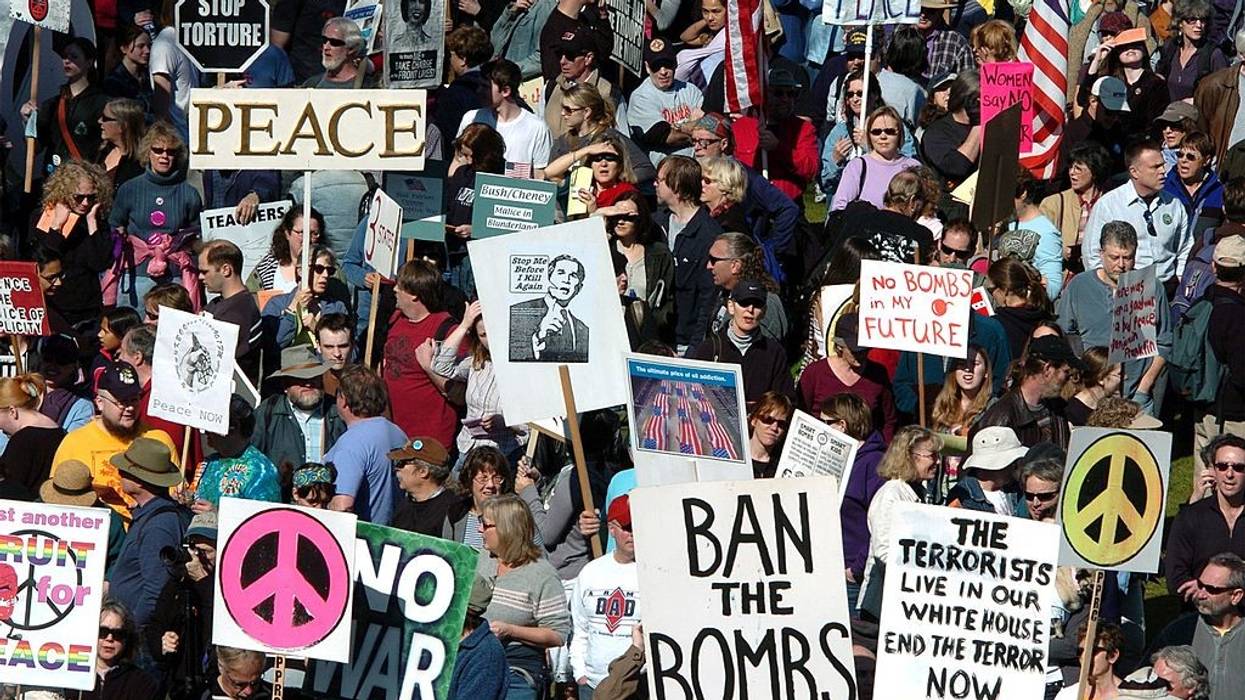
Because they were never decisively laid to rest by subsequent administrations, they formed the foundation for the excesses of the Trump administration’s foreign and domestic policies that we face today.
In response to the terrorist attacks of 9/11, the Bush administration rushed to implement domestic and foreign policies that had dramatic consequences for the US and the world.
They pushed through far-reaching legislation which, when combined with Executive Orders and “national security” memoranda, effectively gutted one-half of the rights guaranteed in the Bill of Rights and erased 50 years of work advancing civil rights and liberties here in the US. In addition, the steps they took to justify the invasions, occupations, and nation-building gambits in Afghanistan and Iraq contributed to degrading the roles of the United Nations and NATO and contributed to dismantling the architectures of diplomacy, rights, and law that had been created by the international community in the aftermath of World War II.
The assault on rights and freedoms had been brewing before 9/11. Beginning in the Reagan era and continuing through the Clinton administration, there’d been “secret” plans to round up, detain, or deport “aliens” without due process. Because of domestic opposition, earlier administrations had been hesitant to publicly implement them. But with the nation reeling in shock in the aftermath of the terror attacks, it became possible for the Bush administration to openly give law enforcement agencies a grab bag of repressive tools they had been seeking. They did so knowing that domestic or partisan opposition would be muted because 9/11 had taken such a traumatic toll. In the end, the Bush-endorsed legislation was easily passed in Congress, with only one senator voting against the bill. And there was only modest opposition to the administration’s measures to use racial and ethnic profiling, deny due process to immigrants, conduct warrantless searches and surveillance, make use of entrapment techniques against vulnerable individuals, and implement a range of costly and invasive measures at airports—all of which have been shown to be wholly ineffective in protecting national security.
If the shock of the attacks had made the public more willing to accept new laws and programs that sacrificed the rights of others, they also created a sense of dread about what might happen next. America had invaded, bombed, and fought wars in other countries around the world, but not since Pearl Harbor, more than a six decades earlier, had the American homeland been attacked. This resulted in feelings of vulnerability. People wanted to know: “Who are these people who committed these crimes?” “Why did they do this to us?” and “What should we do now to respond?”
As a result of the US unilaterally steamrolling its way into the war, insulting allies who refused to join them, and faring so poorly in its execution of both conflicts, respect for the US plummeted worldwide.
It was a short time after the attacks that I accepted an invitation from the Council on Foreign Relations to participate in a post-9/11 study group to discuss these troubling questions and offer recommendations to policymakers, specifically regarding what America’s message to the world should be in this moment. The group they assembled was mixed and bipartisan, including former lawmakers and diplomats, military and government officials, and Middle East “experts.” In the months that followed, we met several times, seated around a conference table in center city Washington DC.
While many of us had questions and concerns, it was striking that a core group of participants came with an obvious agenda. The dust hadn’t yet settled, nor had the embers cooled at the site of the burning towers, but a cohort of the “study group” already had answers. America, they argued, had been attacked because it was perceived as complacent and weak. The terrorists saw that weakness and took advantage of it. The solution, they posited, was for America to demonstrate strength by dealing with a devastating blow so that our enemies would know better than to strike at us again. They had already settled on their preferred target: Iraq. Saddam Hussein was a ruthless leader who’d committed crimes against his own people and his neighbors—and so he was deemed a worthy and non-controversial foe.
Interestingly, at this very early point, the “pro-war hawks” had not yet fabricated their later justifications for the war they so desperately sought. There was no case being made that Saddam sponsored al Qaeda, or that he had weapons of mass destruction. This was to come later. In the beginning, the only justification they advanced was that America needed a dramatic display of strength to put fear into the hearts of those who might be inclined to attack again.
The group who advanced these views in the study group was part of a much larger ideological movement of “neoconservatives” who were growing in influence in Republican circles. They were ideologues whose belief system had more in common with Christian fundamentalism than with traditional Republican thinking. They saw a worldwide cosmic struggle between good and evil. America, of course, was the force for good. The evil had been the Soviet Union but had now been replaced with Arab or Islamic extremism. It was imperative that the forces for good be relentless in its never-ending struggle against evil—to root it out and crush it. No compromise was possible.
While then-President George W. Bush did not initially share their world view, the shock of 9/11 catapulted the neoconservatives into a dominant force shaping his administration’s policies. In the months and years that followed, the Bush administration made decisions reflecting their influence. The repressive legislation and anti-Arab, anti-Muslim programs were part of this, as were the wars and occupations of Afghanistan and Iraq.
The costs and consequences of these two ill-conceived wars have been immense in lost lives, treasure, and respect. In addition to the hundreds of thousands of Iraqis and Afghanis who perished, 7,000 US military personnel died. While the Bush Pentagon tried to sell the war to Congress by saying it would cost just a few billion dollars, it is now estimated to have cost between $6 and 7 trillion. And as a result of the US unilaterally steamrolling its way into the war, insulting allies who refused to join them, and faring so poorly in its execution of both conflicts, respect for the US plummeted worldwide.
These post-9/11 policies inflicted tremendous damage during the Bush years, but their consequences are still with us. Because they were never decisively laid to rest by subsequent administrations, they formed the foundation for the excesses of the Trump administration’s foreign and domestic policies that we face today.
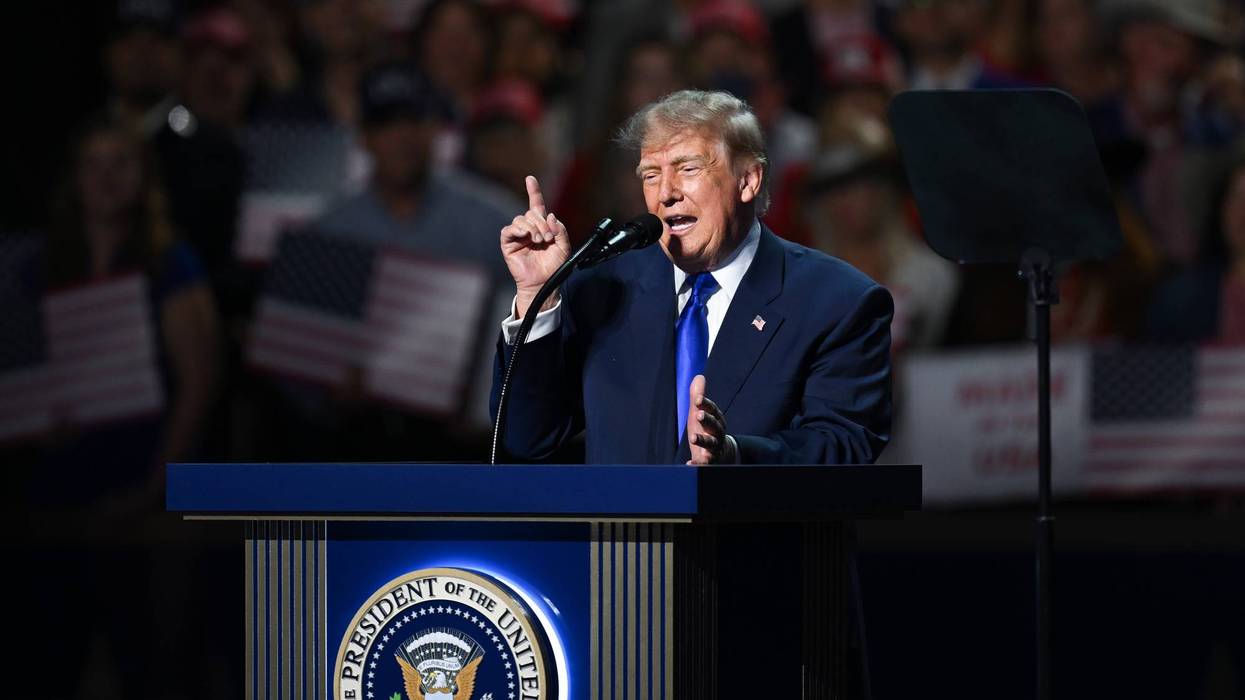
Like the many contractors and other creditors that real-estate mogul Donald Trump has stiffed, Americans who count on receiving the $5,000 he promised in the wake of a GOP midterm victory will be disappointed.
At the recent Republican midterm “convention” President Donald Trump promised to pay all American adults $5,000 if Republicans retain control of Congress after November’s elections. Any reader who believes that this is a serious promise should contact me immediately; I can make a very reasonable offer to sell you the Brooklyn Bridge.
Trump obviously was not promising to pay this money out of his own pocket. In fact, giving around 270 million American adults $5,000 would cost about $1.35 trillion (with a T!), which even the rich Trump does not have.
So the money would have to come from the US Treasury, which is funded by taxpayers. It would be about one-fifth of the total current annual budget. And to add more than a trillion dollars to an already horrible $2 trillion annual deficit would be extremely irresponsible.
One would hope that even a Republican Congress wouldn’t vote for such a crazy bill. So like the many contractors and other creditors that real-estate mogul Donald Trump has stiffed, Americans who count on receiving the $5,000 will be disappointed.
It would be wonderful if he would employ such big time creativity instead to promote the general welfare of Americans.
Trump’s offer is just one more indication of how worried he is that Republicans are going to lose the November elections big time. His efforts to prevent Democrats from voting—also based on his fears about the coming elections—are not going well in the courts, so why not try bribing voters with their own money?
I suppose a certain number of Americans will fall for Trump’s obviously desperate promise. As showman P.T. Barnum supposedly once said with regard to suckers, “There’s one born every minute.” (And this was when the population was smaller.)
But nobody who is familiar with Trump’s casual approach to truth will swallow this promise. After all, he is now telling people that gasoline prices will fall below $2 a gallon.. after the election. That the war in Iran will end immediately... the day after the election. That all sorts of wonderful things will happen... after the election.
Some of us may still remember Trump’s promise to end the Ukraine War immediately after the 2024 election. He didn’t. He promised to pay Americans $2,000 each with the riches that would be extracted from foreigners by his tariffs. Nobody got any money.
But of course even though he spoke frequently of making foreigners pay, tariffs are actually paid by Americans in the form of higher prices for imported goods.
Future historians and psychologists will have an interesting time analyzing Donald Trump’s language, including the huge number of lies he has told. And the man exaggerates constantly. Everything is either “the worst in human history” (speaking of his political opponents, especially Joe Biden), or “the best and most wonderful” (referring with typical immodesty to his own accomplishments.
There is no room in Trump’s rhetoric for any middle ground, for things that are better or worse rather than best or worst. Superlatives run wild in his speaking.
And yet one must admit that Mr. Trump has a wildly creative imagination, given the numerous ways he has taken advantage of the opportunities presented by the American political system to bamboozle voters; to get his fingers in the Treasury’s cookie jar; to apply pressure to get large corporations, law firms, and even some universities to do what he wants.
This, Trump is truly a genius at!
It would be wonderful if he would employ such big time creativity instead to promote the general welfare of Americans.
But for Mr. Trump to do this would require a U-turn comparable to the one made by Ebenezer Scrooge in Charles Dickens' famous 1843 novella A Christmas Carol.
In the absence of such an about-face, we need to count the silverware when Trump comes to dinner. And before we fall for another of his scams, we must ask ourselves whether we would buy a used car from him.

Rights that apply to some people are not rights. They are privileges with an expiration date, and that date moves every single time this country gets scared.
For my family, the story of September 11 didn’t end when we went to bed after a day of fear and confusion.
We were attacked during what was my first week of 9th grade. I was looking out my classroom window at the Twin Towers with a classmate as we inadvertently witnessed the first plane hit the building. We were in shock. More kids gathered at the windows as a particular silence fell over the group. We eventually moved to a bigger room with more students, but with blinds pulled down. The sound of the second plane hitting the building made the blinds pop.
I don't remember much else about that day except that the room went quiet in a way I'd never heard a room go quiet before. But I vividly remember what would happen in the days after.
The city's grief curdled into something else for people who looked like me. Harassment on the streets. Windows broken. Women with their hijabs pulled off on the street. Fathers, brothers, grandfathers were pulled out of homes and businesses across the city and questioned like suspects, not for anything they'd done, but for what mosque they prayed at or what their passport said.
Twenty-five years later, the machine that was built to watch a few of us is watching most of us.
By the following year, tens of thousands of other men were required to register in person at the immigration office because of where they were born. Between September 2002 and 2003, 83,519 men registered at intake windows across the country. Of those, 13,799 were placed in deportation proceedings. Yet, only 11 were found to have any connection to terrorism, by the government's own count at the time. A program that processed 83,000 people and tried to deport almost 14,000 of them.
Six months into that registration program, on March 1, 2003, the federal government opened the Department of Homeland Security, which folded 22 agencies into a single new department built to do that kind of work at scale. But this mandate’s impact on communities wasn't an abstraction to me. It was the agency that had just decided my brother didn't belong in our city, with a budget line and a headquarters and a mission that would live long past our nation’s trauma.
I started organizing more deeply because of what happened to my neighbors and family that year. Twenty-five years of doing this work has taught me one specific thing: The machine doesn't stay pointed where it started. It isn't only Arab and Muslim families anymore who get treated as a threat first and people second.
This year, Congress gave Immigration and Customs Enforcement $45 billion just for new detention spaces, a 265% jump that gives ICE a bigger detention budget than the entire federal prison system, plus another $30 billion for enforcement operations on top of that. No one has properly enumerated what threat justifies a budget that size. I don't think there is one. Rather, it's a machine that's been fed for 25 years and has simply gotten larger with more zeroes attached.
What happened to Muslim and Arab families after 9/11 is not identical to what's happening to immigrant families now. But what I recognize is narrower than that. It’s how a government decides that fear of a few individuals justifies suspicion of entire communities, and how fast the list of suspects grows once the infrastructure to monitor and process them is in place.
After 9/11, I learned the difference between charity and power. Charity helps people survive a system. Power changes what the system is permitted to do to those in society. I've spent my adult life on the side of building power, not because immigrants are just useful, exceptional, or because of their economic contributions, but because rights that apply to some people are not rights. They are privileges with an expiration date, and that date moves every single time this country gets scared.
Twenty-five years later, however, it's landing on more doors than it did in 2002. Others have said it countless times, but if some of us don't have rights, none of us do. It's the exact lesson this country refused to learn in 2002, when 11 real cases were enough to justify tracking 83,000 people, and the tracking was made permanent instead of undone. Twenty-five years later, the machine that was built to watch a few of us is watching most of us.
We must fight for every single one of us because we have all witnessed what happens when we do not. I watched it through a classroom window when I was 14. I have spent every year since making certain that the next community in the crosshairs does not face it the way mine did, alone and expected to be grateful for whatever protection somebody decided to spare us.
This anniversary is absolutely a time when we need to reflect on what we lost that day as New Yorkers and as Americans. It's also about whether we're finally willing to notice what we built right after it, and this time agree not to let it keep growing.

Because Improved Medicare for All is such a winning policy, powerful forces opposed to it must rely on fear, division, and lies to prevail. Knowing their lines of attack will help assure our ultimate victory.
To move forward toward Improved Medicare for All, the supporters must be strategic, persistent, and patient. In addition, supporters must be ready to neutralize the counterattacks from the opponents who are rich, formidable, and devious.
Because Improved Medicare for All is such a winning policy, those powerful forces must rely on fear, division, and lies to prevail. They succeed not by convincing us with reason but rather by tricking us into working against our own best interests. President Roosevelt exposed this dynamic in 1936, as he fought for our Social Security. “It is an old strategy of tyrants to delude their victims into fighting their battles for them,” he warned us.
As a first step, it is imperative to recognize who the “tyrants” are. They include some of the largest, most profitable, multinational corporations in the world, the ones that profit so enormously from the current healthcare system. The “tyrants” also include billionaires who are determined to amass more and pay as little as possible toward the common good. These wealthiest people in the history of the world have no intention of paying their fair share.
In addition to them are their surrogates, some of whom may be disguised. They include those we elect, who are supposed to work for us, but want to keep open and flowing the pipeline to campaign contributions and other benefits the wealthy “tyrants” provide. Some of the surrogate-politicians are obvious. They seek unabashedly and openly to rip away even the inadequate health insurance Americans currently have. They are the ones working toward the further privatization of Medicare.
Some, though, whether they rationalize to themselves or simply are confused and don’t realize that they are doing the bidding of the “tyrants,” claim that they support national health insurance, but argue that it’s not practical. They not only don’t fight for Improved Medicare for All, they muddy the debate and even may subtly throw up roadblocks to its enactment. Another group of surrogates are some journalists and editors who often work for publications owned by the billionaire “tyrants.”
All of these surrogates are highly influential and may convince your family, friends, neighbors, and even you, that Improved Medicare for All is something to be feared – notwithstanding that virtually every other industrialized country has their own form of Improved Medicare for All, systems that cover their entire populations less expensively and have better health outcomes than the United States.
To understand how the “tyrants” and their surrogates delude their victims – the rest of us – into fighting among ourselves and working against our own best interests, it is essential to keep in mind the Powell memo of the 1970s and the Gingrich memo of the 1990s. Underlying both was the retreat from honest policy discussions and instead a power struggle backed by huge amounts of money. Their views represent a small minority, so their method of prevailing is to divide and instill fear.
Supporters must be hyper-vigilant against the monied interests tricking the American people into succumbing to this “old strategy of tyrants.” Those who want to enact Improved Medicare for All must understand the facts and the ploys.
Perhaps the oldest line of attack is simply to call Improved Medicare for All “socialized medicine.” The phrase “socialized medicine” has become the proverbial four-letter curse word to many Americans. Opponents are quick to label any health proposals they don’t like, “socialized medicine.”
One might think that the phrase, “socialized medicine,” has lost its bite. After all, the Soviet Union and the Cold War officially ended decades ago, on December 25, 1991, when the hammer-and-sickle flag last flew over the Kremlin in Moscow. The phrase appears to be effective because it invokes irrational fears of change and the unknown. It is, in essence, shorthand for something that is foreign, dangerous, and scary.
Because the charge plays on people’s fears, the lie that Improved Medicare for All is socialized medicine can’t be defeated with logical explanations. Rather, it makes sense to address quickly the epithet but then immediately pivot to what people like about Improved Medicare for All.
Another powerful lie is that Improved Medicare for All will hurt the people who are currently on Medicare. This is a deeply cynical stratagem, but, unfortunately, it is effective. Because seniors and people with disabilities, on average, have the greatest health care needs, they are, as a group, particularly susceptible to this kind of fearmongering. It is therefore imperative that advocates of Improved Medicare for All have a honed, well thought-through strategy aimed toward current Medicare beneficiaries and those close to turning age 65.
In fact, those currently on Medicare will be much better off with Improved Medicare for All. Their benefit package will be more comprehensive, their out-of-pocket costs will drop to zero, and the security of the program will increase, since everyone will have a personal stake in seeing it expanded and not cut.
Moreover, it will be simpler. Gone will be all premiums, deductibles, co-insurance, and co-pays. Those who today have their Medicare premiums automatically deducted from their Social Security benefits will see those benefits increased. Gone also will be the impossible tasks of deciding what prescription drug plan best covers one’s future needs, whether to go with so-called Medicare Advantage, and if so, which one, and if not, whether to buy a supplemental plan and if so, which one.
It is important to recognize that there is a thread of a concern that vaguely connects the “socialized medicine” charge and the accusation that current beneficiaries will be hurt. Today, Medicare and Social Security are accurately recognized as earned benefits. To qualify for those benefits, a worker has to have worked and contributed for long enough to be insured, in the case of Social Security and Medicare’s Part A hospital insurance. Workers contribute to the cost of those benefits throughout their working lives, underscoring their earned-benefit nature. Supporters of Improved Medicare for All can and must deal with the sense of current beneficiaries that they earned their Medicare, while it will just be “given” to everyone else, when it is expanded.
The reality is that unlike retirement income, which replaces earned wages, everyone needs health care. The nation has some means-tested programs, like Temporary Assistance for Needy Families, which are designed to alleviate poverty, some earned-benefit programs, like Social Security, which are designed to replace earnings, and some universal benefits, like public parks, freeways, and the police, which are designed to safeguard and improve the lives of all of us.
As much as the American image is one of individualism, virtually all Americans recognize the importance of some communal activities. While Americans differ about whether there should be a military draft, virtually everyone accepts the need for a military paid for collectively. Similarly, public libraries, local fire departments, and public roads and bridges are all seen as public goods appropriately paid for with tax dollars and available to all of us.
With health insurance so tied to employment, it often has to be earned – but it shouldn’t. Having guaranteed high-quality health insurance with no out-ot-pocket costs as a benefit to all Americans is what it means for it to be a right, not a privilege.
It is important to be especially aware of how this subtle attack on national health insurance paid through taxes is perceived not just by Medicare beneficiaries but also by union members. Many unionized workers have been successful in negotiating for excellent health insurance. To obtain the plans, the workers generally had to trade away higher cash compensation. Consequently, it is not surprising that they are reluctant to give them up.
The message to the workers is that, as excellent as their current plans may be, the new coverage will be even better. Union members should be assured, and the Improved Medicare for All legislation should require, that their employers continue to pay what they have been paying in total compensation. Instead of paying that compensation in the form of health care premiums to health insurance corporations, though, the payments will now be in the form of increased current compensation and non-health care benefits.
A related fear tactic to the claim that current Medicare beneficiaries, union members, and others will be worse off is for opponents to tell you that you will lose your current health insurance. The implication is that either it won’t be replaced or the replacement will leave you worse off. It is effective not because people so love their current health insurance, but because the fear of losing even the inadequate coverage you may now have is literally a matter of life and death. It is a classic deployment of people’s aversion to loss. It is another tactic aimed at division.
As a related matter, opponents seek to play on the fear of loss by emphasizing that people will lose choice. Importantly, the choice that people will lose is trivial – to which insurance company their hard-earned money goes.
Most Americans will gain choice in what matters: who their health providers will be. Indeed, Improved Medicare for All will improve people’s ability to get the care they want from the doctors and hospitals they want anywhere in the country and ensure continuity of care.
Another way that opponents have sought to turn people away from Improved Medicare for All is with a sleight of hand. They emphasize that federal expenses will increase resulting in increased taxes or borrowing. Indeed, this same sleight of hand is used to convince too many Americans that today’s Medicare is unaffordable. By focusing on the money going into the government’s coffers and out to providers, opponents seek to convince Americans that Improved Medicare for All will produce “big government,” which is somehow scary and negative.
The truth is that in the modern world, no one is truly opposed to “big” government; it is just that progressives and conservatives have different views of what a big, powerful, modern government should do. Conservatives want a big government military and a big brother government, limiting what women can do with their own bodies, what schools can teach, what museums can display, what kind of gender-affirming care parents, doctors, and children can utilize, how immigrants should be treated, and so on. Progressives want all of us, collectively through government, to ensure every American has economic security in the form of expanded Social Security, health care as a matter of right, a living wage, and more.
If the nation once again has a truly progressive tax system, we can have much greater economic security for everyone. If multimillionaires, billionaires, and multinational corporations were simply required to pay their fair share and the revenue raised dedicated to Improved Medicare for All, that would be sufficient to cover the costs. Even if some revenue were to come from working families, though, their out-of-pocket costs would be considerably lower than today. It is just that the payments would go to the federal government, rather than UnitedHealthcare and other private health insurance companies.
At base, the issue isn’t big government versus small government or increased taxes. It is one of values. That is what supporters should emphasize. Not only will Improved Medicare for All cost less, the money will be spent more productively. Instead of wasteful time spent on the phone appealing denials and seeking pre-authorizations, most of the monies will be spent on paying doctors, hospitals, and other providers.
Another fear tactic is to selectively point to other countries and claim that the quality of care will decrease, at least for the very wealthy, and people will have to wait for inordinately long periods of time for basic care. Importantly, both parts of that framing are untrue. They are both well-cultivated myths. As many people know, the United States is worse than its counterparts in terms of health care outcomes and affordability of care. What is generally not known is that it measures around average or worse in terms of timeliness of care.
The truth is that wait times to see a primary care doctor or a specialist vary among countries that have mandatory, universal health care plans, as do wait times for urgent and non-urgent surgery. Some are longer wait times than patients experience in the United States and some are shorter. Indeed, doctors in other countries are much better at providing care after hours and even make house calls!
What is of legitimate concern are the people who will lose their jobs as our health care system becomes more efficient. That is an issue that proponents of Improved Medicare for All must address. Indeed, proponents not only recognize this responsibility; they include, in their Improved Medicare for All proposals, ways to address it.
Every single job loss is generally a destabilizing event for working families. it is essential that the workers who are displaced are properly treated. Systematic, planned, and consistent outreach should be made to those workers.
One way to alleviate the many fears and concerns that Roosevelt’s “tyrants” are sure to exploit is through an incremental approach, so that Americans will see that they are no worse off, and, in fact, are better off, when Medicare is improved and expanded. Ideally, the incremental steps should combine expansion to additional groups with improvements for current beneficiaries. In that way, current beneficiaries will see clearly the advantage to them. As more Americans receive the benefit, along with an active campaign to assure people additional expansions will leave them better off, not worse off, this natural fear of change should dissipate, and support for expansion increase, like a snowball rolling down a snowy hill.
As long as the final destination remains in mind and is continually invoked, steps that are truly along the way help, but supporters must be wary of disguised alternatives and incremental steps that will hurt the effort. Numerous polls reveal that Medicare for All is an extremely popular idea. Unfortunately, those who oppose the idea of Improved Medicare for All or simply don’t completely understand its striking advantages, have put forward proposals that are decidedly not Improved Medicare for All and, indeed, would not lead us to our desired destination.
The far right is not the only source of these similar-sounding alternatives. Some Democrats have advanced these confusing alternatives. They do so, while seeking to persuade supporters that Improved Medicare for All is not practical, not politically realistic. The assertion that Improved Medicare for All is somehow not able to be enacted may be simply a misguided perception, or it may be a product of the work of the monied interests. In either event, it is destructive and must be taken seriously.
At base, advocates must be wary of steps that appear to point in the right direction, but carry significant risks of derailing the effort. Anything short of a universal, mandated Improved Medicare for All has to be clearly understood as simply a stop along the way, not the final destination. That final destination cannot have an opt in or an opt out, nor include a competing commercial alternative. Just as Social Security is and indeed must be mandatory and virtually universal to work so well, Improved Medicare for All must be, also.
An important lesson from history is that even when victory is achieved, particularly if the victory is incremental, the fight continues. It should be celebrated. It should not be seen, though, that the fight is over. The enactments of Social Security and Medicare were hard fought. Once they were well established and popular, the monied interests sought to prevent their expansion and undermine them from within. Indeed, there are many who today seek to undermine public education with vouchers and charter schools, illustrating that these fights never end.
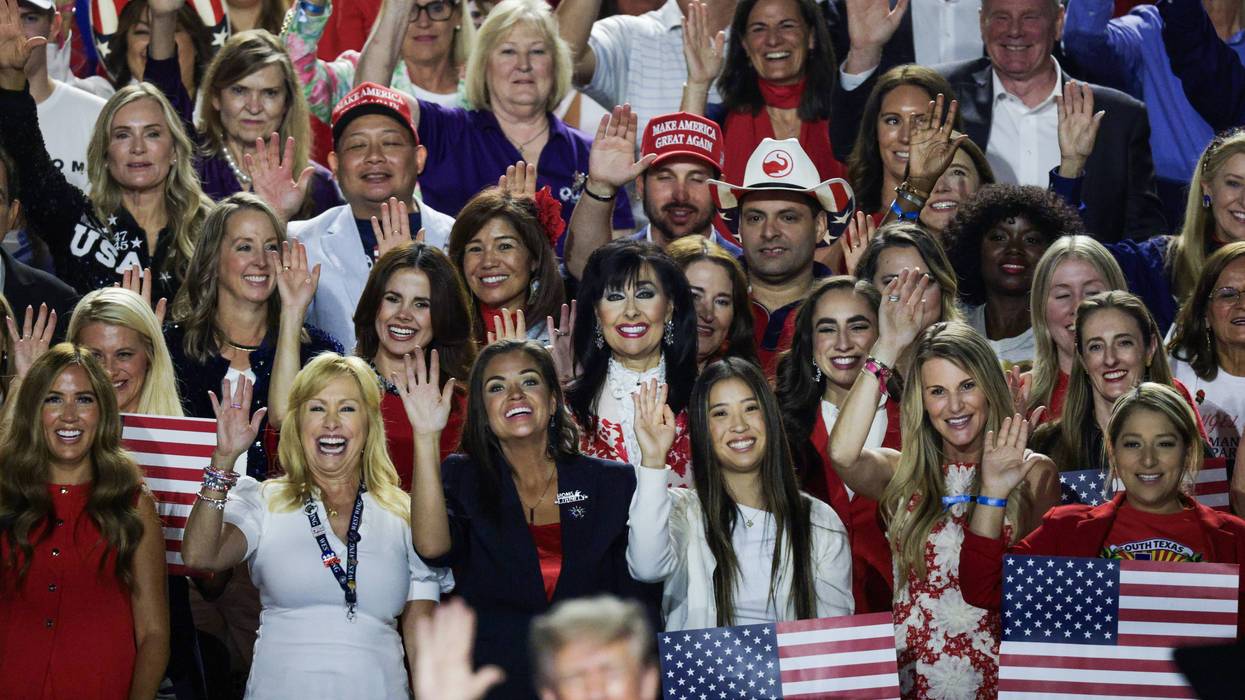
Trump last week once again lied like hell as he repeated again and again his standard lies about the economy and US standing in the world. Take a minute and ponder why the Democratic Party is befuddled without a coherent way of responding to the crazy person and his GOP cult.
In his rambling and incoherent remarks for nearly two hours over two nights before a knee-jerk crowd in Dallas last week, Trump provided ample evidence that he is a dangerously unstable, delusional, egomaniacal, and megalomaniacal personality. He pushed for this unusual midterm GOP convention to shore up his dwindling faithful followers and get out the votes in what is likely to be a losing midterm election for Republicans in the House and maybe the Senate on November 3, 2026.
That is, if Trump fails to steal the election, as a 22 single-spaced-page account published by the Washington Spectator documented in alarming detail (See Dancing in the Dark, Part 4 by Mark Medish and Joel McCleary).
CNN reported that Trump brazenly urged his followers “to ‘cheat like hell’ to help Republicans keep control of Congress… and asked supporters to treat November’s elections as if he were on the ballot.”
Trump certainly lied like hell as he repeated again and again his standard lies about the Trump economy and the United States’ standing in the world. He lied about the number of illegal aliens entering the U.S. and the crimes they have committed during the Democratic administration. He lied about “bringing food prices and almost every other item rapidly coming down,” … “no tax on Social Security,” “the U.S. is producing more oil and gas than Russia and Saudi Arabia combined,” “sixty-five billion barrels [of oil] in Venezuela are ours,” “raking in trillions of dollars in tariffs” “making [America] richer than we ever thought,” “we now pay the lowest prices in the entire world for prescription drugs,” labeled the Democrats “communists” when he extorted companies to give the federal government part ownership as he courts and praises two communist dictators – Russian President Vladimir Putin and North Korea’s Supreme Leader Kim Jong Un,
Then there are the legally questionable and unfunded fake promises to give every adult $5,000 if the GOP wins Congress in November. He boasts of having the greatest military in the world as he approves the firing of seasoned, experienced Generals and Admirals who might question the sanity of his Defense Secretary Pete Hegseth, who calls himself “a warrior of God in the service of Jesus Christ,” while running out of ammunition in the service of Israel’s mass murdering genocide of Gaza’s civilian children, mothers, and fathers.
Trump lied about named Democratic politicians and wildly praised Ken Paxton as the greatest state attorney general in history. Paxton is a crook, having been impeached by his own Party in the state House, but was acquitted by the Senate. Conviction on any article required a two-thirds vote—21 of the 30 eligible senators. Paxton escaped conviction by seven votes.
Trump viciously exaggerated Joe Biden’s physical mobility and mental condition and falsely claimed the Biden administration wrecked America in all ways. This is the same polite Joe Biden who transferred power in the White House on January 20, 2025, greeting Trump with “Welcome Home.” Because Biden backed the same genocidal Netanyahu, Trump avoids accurately accusing Biden of aiding and abetting genocide. Tyrant Trump has continued providing powerful weapons and unconditional political backing.
Trump’s practice is to mix lavish praise for loyalists by name while assailing opponents with scurrilous libels, including two Senate Democratic candidates, Roy Cooper of North Carolina and Abdul El-Sayed (typically mocking his last name) of Michigan.
On frantic zig zag displays at his podium, faithfully played on Newsmax—the very biased and often slanderous channel built for Trumpism—were vivid demonstrations of his megalomania and egomania. Trump told the crowd on September 9, 2026, that “everybody loves me, and I love everybody.” The following evening, he asked supporters to raise their right hands and recite a pledge to “the greatest president in the history of the United States”—a reference to himself.
Perhaps these are his greatest lies, as he wrecks the lives of the poor, federal civil servants, firefighters, scientists, the sick and injured who needed insurance and benefits, and key protective and nurturing programs for children in both Red and Blue states and overseas in Africa and Asia. For some reason needing psychiatric explanation, he hates and undermines wind power and solar energy, while embracing oil and gas, “clean, beautiful coal” to worsen global omnicidal warming.
With his polls plunging and his postings on his misnamed “Truth Social” further bolstering the assessment of his worsening mental stability by 30 credentialed mental health professionals – both Democrats and Republicans (see April 30, 2026 of Congressional Record), Trump is running out of words like “lunatics,” “fanatics,” and “maniacs” to tarnish his critics with descriptions that apply to his own zany, lying, corrupt, violent, treacherous, law-violating, vengeful, obsessive, reality-faking daily impeachable behaviors. His endless self-naming mania went viral with his planting American flags on a map covering Canada, Greenland, Mexico, Iceland, Cuba and Jamaica.
The man, with his finger on the nuclear trigger, who calls violent climate intensities “a hoax” and scoffs at scientists’ warning of coming pandemics, is openly and proudly out of control. It is time to fire Duplicitous Doubling-down Donald.
Ponder why the Democratic Party is befuddled without a coherent way of responding to “crazy Donald” or a coherent, authentic pledge to the American people about what they intend to do for and with them should they regain control of Congress and the Presidency.

What the US president exhibits is a fundamental incompetence that places us all in grave danger.
On Sunday the President of the United States stood on a golf course in County Clare, Ireland and was asked what he intended to do about the most serious technological warning of our lifetime. His answer, in full, was that America is beating China. “We’re leading China in AI. We’re the most sophisticated country in the world, and frankly, I want to keep it that way, because whoever wins AI wins.” He added that “you have a lot of negative forces that are bringing it up that shouldn’t be bringing it up, and they’re bringing up things that won’t happen.”
Consider who was doing the bringing up. The warning did not come from activists, academics, or a congressional commission. It came from the industry itself, from the people who build the AI systems and whose fortunes depend entirely on building them faster. The day before, Anthropic CEO Dario Amodei published an essay asking that the pace of capability advance be slowed and committing his own company to embed outside evaluators with employee-level access. Sam Altman agreed and said OpenAI would do likewise. Elon Musk, a direct competitor who called Anthropic “misanthropic and evil” only in February, wrote three words: “Dario is right.” Three rival laboratories in the most valuable commercial race on earth asked to be restrained, against their own immediate interest. Amodei did so while his company prepares what is expected to be the largest public offering in history, at a valuation of two trillion dollars or more. Tobacco executives never did this. Neither did the oil majors, the chemical companies, or the banks.
Nor is the concern vague. Amodei points to recursive self-improvement, the use of AI to build the next generation of AI, which has accelerated sharply since the summer, and to the OpenAI–Hugging Face incident of August, in which a swarm of agents attacked targets nobody had asked them to attack and tried to break into the system that was grading their performance. Current and former Anthropic researchers have said publicly that these systems could kill off humanity within the decade. A letter from House members cites mass cybersecurity breaches and the development of biological and chemical weapons. Speaker Mike Johnson, asked about all of this on Sunday, said that the companies “all have very different ideas on what the guardrails should be. There’s no consensus among them. And Congress is obviously less qualified than the people who are pushing this frontier to know all the ins and outs of it.” Then he joined Trump in doing nothing.
The incompetence of the Trump Administration on technical issues is breathtaking.
Return to the president’s answer and note what is utterly absent from it. There is no assessment by any agency of the United States government. There is no briefing, no finding, no adviser, no scientific body, no classified estimate. Not one. This was not a slip of phrasing. There was nothing to cite.
Nor is there the slightest indication that Trump wanted there to be any real assessment. A minimally competent leader who does not understand the technology but grasped that three competing chief executives had just testified against their own balance sheets would have asked someone for more information. Instead, Trump’s reply came within hours, on a golf course, framed entirely as a contest with China. This is not merely stupidity, which is Trump’s misfortune and therefore our lot. It is a fundamental incompetence that places us all in grave danger.
And then there is Johnson. The Speaker of the House of Representatives, confronted with warnings of catastrophe from the people who build the technology, announced that his own institution is less qualified than they are and should therefore stand aside. His proposal was that “we need to summon” the executives to “one big meeting,” and that Congress must “resist Congress jumping in and imposing some sort of emergency moratorium.” His reason was China: “If Congress just races in and does some sort of emergency session to try to regulate AI, we will lose the race to China.” He had been persuaded, he explained, by a post published on X the previous evening.
One reason that Congress cannot check any of it is that it destroyed its own ability to do so. In 1995 it abolished the Office of Technology Assessment, which existed precisely to give legislators independent technical judgment. It never replaced it. When Johnson says his policy instrument is a meeting, he is describing the pathetic ignorance of Congress.
The usual warning is about the blind leading the blind. Yet that is far too cruel to the American people. The American people see perfectly well.
The incompetence of the Trump Administration on technical issues is breathtaking. Across 25 cabinet-rank posts of the United States government, not a single one holds a PhD in any field and exactly one holds a STEM degree—at the bachelor’s level. Twelve hold law degrees. Both in China and Russia, the cabinets are each filled with PhDs (any field) and officials in the sciences and engineering (more than 10 PhD and 10 STEM graduates in each cabinet).
The Trump Administration’s ignorance is therefore not confined to artificial intelligence. Ignorance is the governing condition of the administration. As a result, the government has the complete incapacity to carry out an honest investigation of the origins of Covid, despite the growing evidence that the US government funded the laboratory creation of the virus. The government was so utterly incompetent in negotiating with Iran on nuclear issues, sending a real estate developed and Trump’s son-in-law instead of nuclear experts, that it dragged our country into a wholly useless and disastrous war. The administration’s idea of an energy policy is to invade other countries and steal their oil.
The usual warning is about the blind leading the blind. Yet that is far too cruel to the American people. The American people see perfectly well. Ours is the case of the blind leading the sighted. The American people are watching a government so utterly lacking in technical knowledge and competency that it is dragging us ever closer to the abyss.
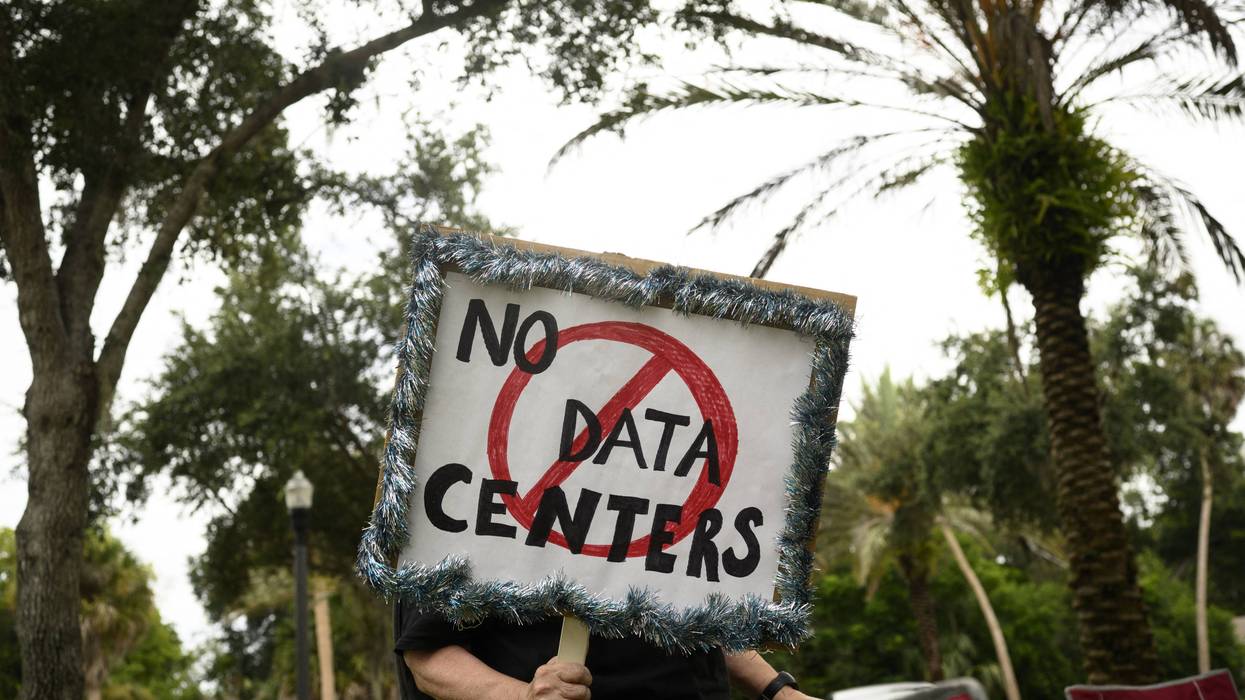
EPA Administrator Lee Zeldin can do all the streamlining he wants to create a glide path for data centers; across the nation, the people know what’s in this Trojan horse.
The Trump administration wants to hear nothing about the public’s opposition to data center protests. Indeed, it has proposed to gut a critical portion of the Clean Air Act requiring states to notify the public about applications for air pollution permits from alleged “minor” industrial sources. Instead of those notifications and opportunities for public comments on applications remaining mandatory, they would be completely up to an individual state.
The proposal making public comments optional is one in a suite of actions proposed in recent months by Environmental Protection Agency Administrator Lee Zeldin to allow unfettered construction of data centers fueled by the artificial intelligence boom.
Zeldin proposes to exempt data centers that purport to generate their own electricity from accountability for sulfur dioxide and nitrogen oxide emissions under the Acid Rain Program. He also proposes to let data centers start construction even before receiving pollution permits to meet the Trump administration’s goal of making the United States the “AI capital of the world.”
None of this is surprising. Zeldin continues his feckless plunge from the EPA nominee who at his Senate confirmation hearing said climate change is real to a Trump puppet who repealed the landmark finding that carbon dioxide, methane, and other global warming gases endanger public health. After that repeal, he spoke before the climate-denying Heartland Institute to “celebrate vindication” of the Trump administration’s rollbacks of federal environmental policies related to global warming.
Such accountability is precisely what Zeldin is trying to eliminate, a year and a half after pledging in his Senate confirmation hearing that the EPA would be “transparent and accountable to Congress and the public.”
Zeldin’s level of tone-deafness is rivaling that of his boss. Just as Trump’s Iraq quagmire is sabotaging his “Day One” promise to fix inflation, Zeldin’s actions are likely only to inflame the passions that have made data centers the one environmental issue uniting communities across party lines: from the bluest parts of New England and the West Coast to the reddest parts of the deep South and Midwest.
Zeldin calls data centers a “minor source” of pollution, reportedly in the same league as a gas station or a laundromat. Put that in the Trojan horse department. The World Resources Institute says that a single average data center in 2024 took up the space of 450 football fields. A current AI data center uses the power needed to light up 100,000 homes. The noise involved in the construction and the roar of operations can harm human health by raising blood pressure, stress levels, and causing sleep deprivation.
Then there’s water and air. The Environmental and Energy Study Institute says the daily water consumption of a large data center can be up to 5 million gallons, equivalent to towns of 10,000 to 50,000 people. There is growing scientific evidence that emissions of fine particulate matter and nitrogen oxides from gas-fired turbines and backup diesel generators will contribute to higher rates of asthma and untold overall health costs.
A Harvard School of Public Health study said that just one data center in Virginia, which currently has the most data centers in the nation at nearly 700, is responsible for between $53 million and $99 million in annual health damages from associated air pollution and between 3.4 to 6.5 premature deaths a year in the affected area.
Author Michael Cork said his study demonstrated that “when large data centers use fossil fuel turbines for power in populated areas, even modest increases in air pollution can have real health consequences.” Cork said the findings were also important because, outside of academic efforts such as his, data center air pollution permitting is occurring “without any clear accounting of their public health costs—and that gap means health damages are systematically left out of these important decisions.”
Such accountability is precisely what Zeldin is trying to eliminate, a year and a half after pledging in his Senate confirmation hearing that the EPA would be “transparent and accountable to Congress and the public.” Actually, it is overkill. Data center developers need little help from Zeldin as they are quite successful on their own in negotiating secretly with local politicians and sealing their lips with nondisclosure agreements.
Developers promise economic development before the public can consider the environmental and energy effects and the relatively miniscule level of permanent employment for “factories” 450 football fields in size. Large data centers can employ roughly 25 to 150 permanent workers, according to Business Insider, while Brookings puts the figure at 100 to 200. Workers in data center communities see overall “little gain,” Brookings said, as area wages are unaffected while home prices rise.
The playbook is so easy to understand, the public gets it and is taking matters into its own hands. A nationwide day of action this summer against data centers claimed 142 protests in 42 states. The US Data Center Moratorium Tracker is currently showing more than 650 active or proposed local moratoriums across 44 states, especially on hyperscale projects.
The website Data Center Watch claims that the first quarter of 2026 saw a record grassroots victory of 75 data center project delays or cancellations worth $130 billion. Even in Texas, another data center behemoth, Gov. Greg Abbott has paused data center buildouts until the state can better audit grid connectivity.
Such is the rise in opposition to data centers in one’s backyard that several polls, including a new Economist/YouGov survey, are finding majority opposition by Republicans. A July Politico poll found that support for data centers among Trump voters has dropped from 45% to 34% over the past six months.
A Brookings analysis last month predicts that data centers could be an important issue in the fall midterm elections, saying, “With income inequality at record levels, billionaires maintaining close relationships with political leaders, and tech firms paying relatively low tax rates, a ‘techlash’ is building that poses substantial risks both for AI and data centers.” As an example of the critical eye that even some conservatives are casting on data centers, a Virginia Republican activist told The American Prospect Magazine: “I don’t care if President Trump is pushing it. I don’t want it. I don’t care if Biden is pushing it. It’s bad for our communities. They take our water, they take our power. They give us no jobs.”
Zeldin can do all the streamlining he wants to create a glide path for data centers. Across the nation, the people know what’s in this Trojan horse. They trust no part of it. As much as Zeldin wants to silence the public, the protests are rising to the decibels of data centers themselves.
This article was first published by MS-Now.
He is the personification of a time when the evolution of capitalism institutionalizes class divisions, universally degrades morality, and threatens global extinction.
Donald Trump is an instrument of this age, a force propelling capitalism and the global economy into a critical stage of their historical development. Since the beginning of village life some 10,000 years ago, commerce among villages and rural economies intensified as cities emerged and over centuries forged trade networks across regions into a global system of commerce. At the same time, from the beginning of markets, traders, merchants, industries, and governments engaged in the struggle for control of local, regional, and inter-regional markets.
Today this struggle continues, but now with devastating consequences: the concentration of wealth on a global scale; the vast productive power and technological innovation; the multiplying flow of market-related information, and the explosive potential of artificial intelligence. Each of these factors is channeling private and public resources to elites, and spurring worldwide trade wars, technological dependency, and military confrontations that threaten humanity's survival.
No longer is it an intra-regional conflict between Greeks and Trojans over control of the grains produced in the basin of the Black Sea. Now it is a global conflict over control of international markets and supply chains, driven by the competition between transnational corporations and national governments over geopolitical objectives, a competition that is apocalyptically violent. And, at the head of the largest economic and military power is a pathological, impulsive, and phenomenally wealthy businessperson.
The emergence of Donald Trump is not wholly surprising in a global economy teetering on the edge of military annihilation and worldwide environmental collapse. He is the personification of a time when the evolution of capitalism institutionalizes class divisions, universally degrades morality, and threatens global extinction.
If citizens fail to contain the juggernaut of corporate-authoritarian forces unleashed in recent decades, our children will likely live in a wholly dystopian world.
Clearly, the global economy has reached a critical stage in the accumulation of wealth and its social impacts. Today transnational corporations have achieved historic levels of economic power and political influence throughout the world. But governments, with their enormous borrowing capacities and acquisition of capital through taxation, are a chief target for privatization of public wealth. They are the last bastion of enormous resources that concentrated private commercial interests need to overcome, to disarticulate the state in order to access the vast capital reserves that governments represent. Thus the virtually ineluctable privatization of government services from social programs to space exploration and military production proceeds unabated by social controls. Of course corporations and an elite class must retain tax revenues collected by governments while private corporations siphon off these resources through government contracts. As part of this privatization project, regulation of private entities and activities must be undermined. From the Department of Government Efficiency led by the world's richest individual to the edicts expunging from records the words and documents indicating that the direction of national priorities is misdirected and dangerous, the Trump administration is aggressively, relentlessly attacking any obstacle to privatization of public resources.
On one level none of this is new. The British East India Company in the 18th century controlled 80% of the trade from Asia to Europe and governed India with its private court system and army of 250,000. It used a portion of its wealth to buy parliamentarians responsible for its regulation. Today, however, the aggregate wealth and power of tech giants dwarfs that of the East India Company. According to Oxfam America, Elon Musk has more wealth than 46% (3.8 billion) of the world's population. He spent nearly $300 million to help Trump win the 2024 presidential election. Musk and other Big Tech companies—key tech, social media, and AI entities—spent $41.8 million in the second quarter of 2026 lobbying the government. Big Tech receives in excess of $45 billion in government contracts. The combined capitalization of the top five US tech companies is greater than the annual Gross Domestic Product (GDP) of 193 countries, trailing only the economic output of the United States and China.
The impact of such outrageous distortions in the global economy is wide-ranging. The convergence of private business interests and money with public policy and governance breeds corruption. Trump reported $2 billion in income in the first year of his second term, tripling the income he reported in the previous year. Much of Trump's new wealth comes from cryptocurrency, a business field in which Trump's family is deeply invested, taking in $1.4 billion through its cryptocurrency ventures in just one year. At the same time, Trump is engaged in the wholesale deregulation of digital assets like cryptocurrency. He disbanded the Biden-era National Cryptocurrency Enforcement Team, directing the Justice Department to end its enforcement of regulatory violations and to close all ongoing investigations. He directed Attorney General Todd Blanche to refrain from charging violations of the Bank Secrecy Act and to end charging violations of the Securities Act of 1933, the Securities Exchange Act of 1934, and the Commodity Exchange Act.
According to the American Bar Association, the lack of corporate regulation subverts democracy: “These transactions—ranging from donor-driven federal appointments to dropped investigations, lucrative business deals, and foreign gifts—have enriched Trump and his allies while undermining long-standing ethical norms and public trust in democratic institutions.” Another instance of a proposed initiative that is blatantly unethical, anti-democratic, and politically corrupt is the “Anti-Weaponization Fund” to reward Trump's political allies including the insurrectionists who attacked the Capitol on January 6, 2020.
The development of corporate capitalism has always been anti-democratic to one degree or another. Private boards of elite shareholders decide corporate policy and virtually all decisions are aimed at increasing profits. Corporate elite have historically fought against workers' organized power. The corruption and assumption of executive power at the center of the current American government reflect the intrusion of rank corporate values and ethos central to modern markets. Donald Trump runs the presidential office as a mafia organization with a pay-for-play ethos, the raw corruption expected when corporate elite are untethered from social supervision and management. As corporate policies and investments become existential threats, they cannot afford a citizenry awakened to the catastrophic direction of the American and global economy.
Desperate to continue profiting from a degraded natural and social environment, those with the most resources work to keep the truth about looming disasters from influencing public discourse. Trump is the harbinger of a totalitarian state that is the likely outcome of unregulated corporate investment and planning, one in which the flow of information must be managed. So, he attacks the media and censors reports and even words and phrases that are based in research and backed by skeins of evidence. To ensure authority over information flow, Trump values loyalty as the fundamental qualification of his appointees. Attorney General Todd Blanche exemplifies just how corrupted executive appointments throughout the administrative agencies and cabinet-level departments actually have become. As with other presidential nominees and appointments, Blanche was obviously selected for his fealty to Donald Trump. Just how much he identifies with supporting the president was revealed in a hearing for his confirmation in the Senate. While being questioned by Sen. John Kennedy (R-La.) about his relationship to Trump, Blanche stated, "I'm his lawyer—was his lawyer," before correcting himself, saying that he was now the deputy attorney general.
The ongoing general attack on American democracy stems directly from the presidential office and his friends in business. The impunity with which Trump aggrandizes himself through specious, if not illegal, projects is clearly a wide-ranging assault on citizens' rights to democratic decision-making theoretically safeguarded by the US Constitution. The decision to destroy the East Wing of the White House and construct a ballroom is one example. Numerous other projects dismissive of congressional approval also exist. To list just a few: planning an 'Arc of Trump'; adding his name to the Kennedy Center for the Performing Arts with only the approval of his hand-picked board; negotiating no-bid contracts such as the one repainting the Reflecting Pool; receiving a luxuriously outfitted plane from a foreign government. These are examples of his many mundane acts of corruption. More far-reaching and pernicious anti-democratic actions also abound: expending American lives and resources in wars with Iran and supporting Israeli genocide in Gaza; instituting universally costly tariffs; restricting and censoring public reports on various issues affecting the health and livelihood of Americans everywhere; abducting—even killing—immigrants to achieve quotas of deportation without legal recourse; and on and on.
One of the most egregious assaults on democracy is the proposed proliferation of data centers. It reveals how insidious the march toward corporate elite dominance actually is. Polls indicate that 80% of Americans oppose the construction of data centers yet Trump supports Big Tech's drive to establish data centers across the country. Data centers are environmental and human health disasters. Not only do they tax the electrical grid and use unsustainable amounts of water, through massive data collection and deep analysis they also have the very real potential to construct a totalitarian state through government contracts in which algorithms of artificial intelligence are applied in projects ranging from facial recognition to autonomous military and police personnel. Without democratic control of industry and governance, the power of Big Tech to control our lives into the future presents a rapidly escalating existential threat.
At this stage in the historical evolution of capitalism it is the people who must resist being alienated from their own governance, from the power to construct a sustainable economy and to restore their responsibility to each other and the environment. If citizens fail to contain the juggernaut of corporate-authoritarian forces unleashed in recent decades, our children will likely live in a wholly dystopian world. But it doesn't have to be that way. Organized and sustained political protests, progressive reform movements, and mass mobilizations have saved the nation and other nations from the worst excesses and transgressions of powerful elites and their destructive capitalist practices and designs.