SUBSCRIBE TO OUR FREE NEWSLETTER
Daily news & progressive opinion—funded by the people, not the corporations—delivered straight to your inbox.
5
#000000
#FFFFFF
To donate by check, phone, or other method, see our More Ways to Give page.
Daily news & progressive opinion—funded by the people, not the corporations—delivered straight to your inbox.
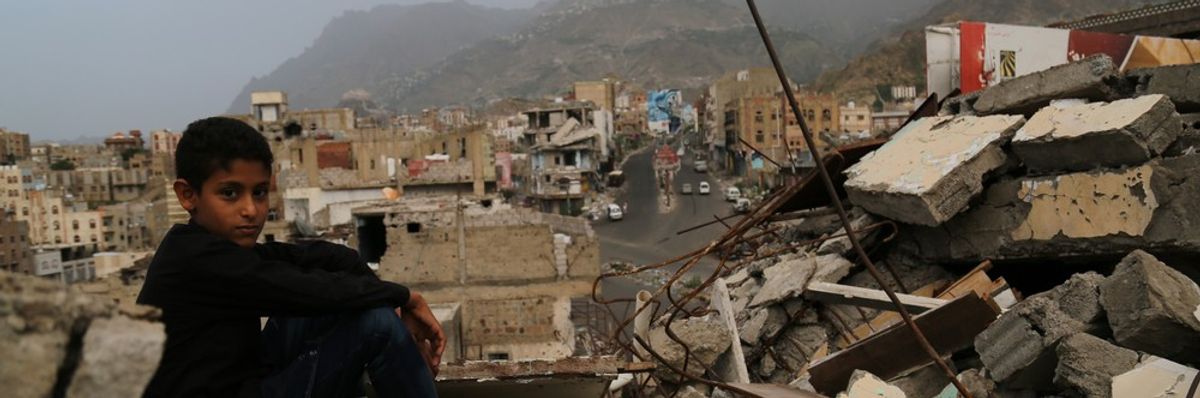
A child sits in the rubble of his ruined home in Taiz, Yemen in 2016.
The news that Saudi officials, who have been leading a bombing campaign in Yemen for eight years, met with the Houthi officials who control much of the country on April 9 to possibly renew a truce that ended in October is positive. But a renewed truce that does not address the harm that warring parties have caused to Yemen’s civilians will not be sustainable without accountability.
The talks come weeks after reports that Iranian officials might stop sending arms to the Houthis and that Saudi Arabia, which has ostensibly been involved in the conflict on behalf of the country’s ousted government, are looking for a way out. This has led international actors — including the UN Yemen mediator — to express optimism about the possibility of a truce, or even an official end to the war.
The absence of Yemenis civilians from these discussions demonstrates the lack of agency Yemenis have had in determining their own circumstances throughout the conflict. It also demonstrates international actors’ willingness to end the war without discussion of justice and accountability for the widespread harm that civilians have suffered.
The warring parties have caused nearly 20,000 civilian casualties and carried out widespread violations of international humanitarian law and human rights law. Today, two-thirds of the Yemeni population needs humanitarian assistance.
The conflict in Yemen has been marked by the involvement of a multitude of foreign actors.
While the full extent and nature of Iran’s relationship with the Houthis is not clear, Iran has provided the Houthis with large quantities of weapons, as well as political support.
Saudi Arabia and the United Arab Emirates (UAE) became parties to the conflict in March 2015, leading a coalition of countries in the region that has launched airstrikes against the Houthis. The coalition has received significant support from powerful Western countries in the form of arms sales, especially by the United States, the United Kingdom, Germany, and France.
From 2015 to 2020, U.S. weapons agreements with Saudi Arabia amounted to over $64.1 billion, while the UK has sold over $23 billion in weapons to the country since the start of the war. The U.S. has also provided the coalition with in-air refueling and tactical support, while the UK has provided coalition forces with training. The U.S. has separately carried out airstrikes against Al Qaeda in the Arabian Peninsula in Yemen, also making it a party to the conflict.
The coalition’s airstrikes have caused most of the war’s accounted civilian casualties. They have destroyed and damaged civilian infrastructure, including homes, medical facilities, schools, markets, and water and food sources and infrastructure. Some of the coalition’s airstrikes may amount to war crimes. Human Rights Watch and other groups have documented cases of torture, enforced disappearance, and arbitrary detention by coalition forces, particularly by Saudi Arabia and UAE forces, and as well as Yemeni forces backed by the UAE.
The Houthis have fired mortars, rockets, and missiles into densely populated areas both in Yemen and in Saudi Arabia which have killed and wounded civilians, constituting other possible war crimes. They have also laid landmines in civilian areas across the country — including internationally banned antipersonnel landmines. The UN Group of Eminent Experts also detailed the Houthis’ widespread use of torture.
Both the coalition and the Houthis have blocked and impeded access to humanitarian aid. During the last truce, the Houthis refused to reopen the roads to Taiz, which have been blocked since 2015, to allow in critical humanitarian aid, despite a proposal from the UN special envoy.
Despite the severity and pervasiveness of the violations, there has been almost no accountability or reparations to victims or their families. On the contrary, Saudi Arabia successfully lobbied member countries of the Human Rights Council in 2021 not to extend its Group of Eminent Experts investigation — the only independent monitoring and reporting mechanism that had previously existed for Yemen.
Calls for a new and more robust investigative mechanism at the Human Rights Council since then have been largely ignored, including by powerful countries with major arms sales to Saudi Arabia, such as the U.S. and the UK.
Other countries have pointed to the Yemeni government’s National Commission of Inquiry, an ineffective domestic investigative body that lacks independence, to avoid establishing a much-needed investigation. Meanwhile warring parties’ promises to provide reparations for the civilian harm they’ve caused have been almost entirely unrealized.
Last fall, five months into the six-month truce, 50 civil society organizations wrote a joint letter stating that even with the truce in place, parties to the conflict had made “little to no progress… to address ongoing and widespread violations and abuses of international human rights and humanitarian law or remedy the harm they have inflicted on civilians throughout the conflict.”
The letter called on the international community to “not stand by and allow” the vote to disband the monitoring group “to be the last word on accountability efforts for large scale human rights abuses and war crimes in Yemen.”
For there to be long-term peace in Yemen, the international community should advocate for the establishment of an effective, impartial, and independent investigative mechanism. And we must ensure that any truce includes a comprehensive transitional justice process that includes civil society, and reparations by warring parties to victims.
Dear Common Dreams reader, It’s been nearly 30 years since I co-founded Common Dreams with my late wife, Lina Newhouser. We had the radical notion that journalism should serve the public good, not corporate profits. It was clear to us from the outset what it would take to build such a project. No paid advertisements. No corporate sponsors. No millionaire publisher telling us what to think or do. Many people said we wouldn't last a year, but we proved those doubters wrong. Together with a tremendous team of journalists and dedicated staff, we built an independent media outlet free from the constraints of profits and corporate control. Our mission has always been simple: To inform. To inspire. To ignite change for the common good. Building Common Dreams was not easy. Our survival was never guaranteed. When you take on the most powerful forces—Wall Street greed, fossil fuel industry destruction, Big Tech lobbyists, and uber-rich oligarchs who have spent billions upon billions rigging the economy and democracy in their favor—the only bulwark you have is supporters who believe in your work. But here’s the urgent message from me today. It's never been this bad out there. And it's never been this hard to keep us going. At the very moment Common Dreams is most needed, the threats we face are intensifying. We need your support now more than ever. We don't accept corporate advertising and never will. We don't have a paywall because we don't think people should be blocked from critical news based on their ability to pay. Everything we do is funded by the donations of readers like you. When everyone does the little they can afford, we are strong. But if that support retreats or dries up, so do we. Will you donate now to make sure Common Dreams not only survives but thrives? —Craig Brown, Co-founder |
The news that Saudi officials, who have been leading a bombing campaign in Yemen for eight years, met with the Houthi officials who control much of the country on April 9 to possibly renew a truce that ended in October is positive. But a renewed truce that does not address the harm that warring parties have caused to Yemen’s civilians will not be sustainable without accountability.
The talks come weeks after reports that Iranian officials might stop sending arms to the Houthis and that Saudi Arabia, which has ostensibly been involved in the conflict on behalf of the country’s ousted government, are looking for a way out. This has led international actors — including the UN Yemen mediator — to express optimism about the possibility of a truce, or even an official end to the war.
The absence of Yemenis civilians from these discussions demonstrates the lack of agency Yemenis have had in determining their own circumstances throughout the conflict. It also demonstrates international actors’ willingness to end the war without discussion of justice and accountability for the widespread harm that civilians have suffered.
The warring parties have caused nearly 20,000 civilian casualties and carried out widespread violations of international humanitarian law and human rights law. Today, two-thirds of the Yemeni population needs humanitarian assistance.
The conflict in Yemen has been marked by the involvement of a multitude of foreign actors.
While the full extent and nature of Iran’s relationship with the Houthis is not clear, Iran has provided the Houthis with large quantities of weapons, as well as political support.
Saudi Arabia and the United Arab Emirates (UAE) became parties to the conflict in March 2015, leading a coalition of countries in the region that has launched airstrikes against the Houthis. The coalition has received significant support from powerful Western countries in the form of arms sales, especially by the United States, the United Kingdom, Germany, and France.
From 2015 to 2020, U.S. weapons agreements with Saudi Arabia amounted to over $64.1 billion, while the UK has sold over $23 billion in weapons to the country since the start of the war. The U.S. has also provided the coalition with in-air refueling and tactical support, while the UK has provided coalition forces with training. The U.S. has separately carried out airstrikes against Al Qaeda in the Arabian Peninsula in Yemen, also making it a party to the conflict.
The coalition’s airstrikes have caused most of the war’s accounted civilian casualties. They have destroyed and damaged civilian infrastructure, including homes, medical facilities, schools, markets, and water and food sources and infrastructure. Some of the coalition’s airstrikes may amount to war crimes. Human Rights Watch and other groups have documented cases of torture, enforced disappearance, and arbitrary detention by coalition forces, particularly by Saudi Arabia and UAE forces, and as well as Yemeni forces backed by the UAE.
The Houthis have fired mortars, rockets, and missiles into densely populated areas both in Yemen and in Saudi Arabia which have killed and wounded civilians, constituting other possible war crimes. They have also laid landmines in civilian areas across the country — including internationally banned antipersonnel landmines. The UN Group of Eminent Experts also detailed the Houthis’ widespread use of torture.
Both the coalition and the Houthis have blocked and impeded access to humanitarian aid. During the last truce, the Houthis refused to reopen the roads to Taiz, which have been blocked since 2015, to allow in critical humanitarian aid, despite a proposal from the UN special envoy.
Despite the severity and pervasiveness of the violations, there has been almost no accountability or reparations to victims or their families. On the contrary, Saudi Arabia successfully lobbied member countries of the Human Rights Council in 2021 not to extend its Group of Eminent Experts investigation — the only independent monitoring and reporting mechanism that had previously existed for Yemen.
Calls for a new and more robust investigative mechanism at the Human Rights Council since then have been largely ignored, including by powerful countries with major arms sales to Saudi Arabia, such as the U.S. and the UK.
Other countries have pointed to the Yemeni government’s National Commission of Inquiry, an ineffective domestic investigative body that lacks independence, to avoid establishing a much-needed investigation. Meanwhile warring parties’ promises to provide reparations for the civilian harm they’ve caused have been almost entirely unrealized.
Last fall, five months into the six-month truce, 50 civil society organizations wrote a joint letter stating that even with the truce in place, parties to the conflict had made “little to no progress… to address ongoing and widespread violations and abuses of international human rights and humanitarian law or remedy the harm they have inflicted on civilians throughout the conflict.”
The letter called on the international community to “not stand by and allow” the vote to disband the monitoring group “to be the last word on accountability efforts for large scale human rights abuses and war crimes in Yemen.”
For there to be long-term peace in Yemen, the international community should advocate for the establishment of an effective, impartial, and independent investigative mechanism. And we must ensure that any truce includes a comprehensive transitional justice process that includes civil society, and reparations by warring parties to victims.
The news that Saudi officials, who have been leading a bombing campaign in Yemen for eight years, met with the Houthi officials who control much of the country on April 9 to possibly renew a truce that ended in October is positive. But a renewed truce that does not address the harm that warring parties have caused to Yemen’s civilians will not be sustainable without accountability.
The talks come weeks after reports that Iranian officials might stop sending arms to the Houthis and that Saudi Arabia, which has ostensibly been involved in the conflict on behalf of the country’s ousted government, are looking for a way out. This has led international actors — including the UN Yemen mediator — to express optimism about the possibility of a truce, or even an official end to the war.
The absence of Yemenis civilians from these discussions demonstrates the lack of agency Yemenis have had in determining their own circumstances throughout the conflict. It also demonstrates international actors’ willingness to end the war without discussion of justice and accountability for the widespread harm that civilians have suffered.
The warring parties have caused nearly 20,000 civilian casualties and carried out widespread violations of international humanitarian law and human rights law. Today, two-thirds of the Yemeni population needs humanitarian assistance.
The conflict in Yemen has been marked by the involvement of a multitude of foreign actors.
While the full extent and nature of Iran’s relationship with the Houthis is not clear, Iran has provided the Houthis with large quantities of weapons, as well as political support.
Saudi Arabia and the United Arab Emirates (UAE) became parties to the conflict in March 2015, leading a coalition of countries in the region that has launched airstrikes against the Houthis. The coalition has received significant support from powerful Western countries in the form of arms sales, especially by the United States, the United Kingdom, Germany, and France.
From 2015 to 2020, U.S. weapons agreements with Saudi Arabia amounted to over $64.1 billion, while the UK has sold over $23 billion in weapons to the country since the start of the war. The U.S. has also provided the coalition with in-air refueling and tactical support, while the UK has provided coalition forces with training. The U.S. has separately carried out airstrikes against Al Qaeda in the Arabian Peninsula in Yemen, also making it a party to the conflict.
The coalition’s airstrikes have caused most of the war’s accounted civilian casualties. They have destroyed and damaged civilian infrastructure, including homes, medical facilities, schools, markets, and water and food sources and infrastructure. Some of the coalition’s airstrikes may amount to war crimes. Human Rights Watch and other groups have documented cases of torture, enforced disappearance, and arbitrary detention by coalition forces, particularly by Saudi Arabia and UAE forces, and as well as Yemeni forces backed by the UAE.
The Houthis have fired mortars, rockets, and missiles into densely populated areas both in Yemen and in Saudi Arabia which have killed and wounded civilians, constituting other possible war crimes. They have also laid landmines in civilian areas across the country — including internationally banned antipersonnel landmines. The UN Group of Eminent Experts also detailed the Houthis’ widespread use of torture.
Both the coalition and the Houthis have blocked and impeded access to humanitarian aid. During the last truce, the Houthis refused to reopen the roads to Taiz, which have been blocked since 2015, to allow in critical humanitarian aid, despite a proposal from the UN special envoy.
Despite the severity and pervasiveness of the violations, there has been almost no accountability or reparations to victims or their families. On the contrary, Saudi Arabia successfully lobbied member countries of the Human Rights Council in 2021 not to extend its Group of Eminent Experts investigation — the only independent monitoring and reporting mechanism that had previously existed for Yemen.
Calls for a new and more robust investigative mechanism at the Human Rights Council since then have been largely ignored, including by powerful countries with major arms sales to Saudi Arabia, such as the U.S. and the UK.
Other countries have pointed to the Yemeni government’s National Commission of Inquiry, an ineffective domestic investigative body that lacks independence, to avoid establishing a much-needed investigation. Meanwhile warring parties’ promises to provide reparations for the civilian harm they’ve caused have been almost entirely unrealized.
Last fall, five months into the six-month truce, 50 civil society organizations wrote a joint letter stating that even with the truce in place, parties to the conflict had made “little to no progress… to address ongoing and widespread violations and abuses of international human rights and humanitarian law or remedy the harm they have inflicted on civilians throughout the conflict.”
The letter called on the international community to “not stand by and allow” the vote to disband the monitoring group “to be the last word on accountability efforts for large scale human rights abuses and war crimes in Yemen.”
For there to be long-term peace in Yemen, the international community should advocate for the establishment of an effective, impartial, and independent investigative mechanism. And we must ensure that any truce includes a comprehensive transitional justice process that includes civil society, and reparations by warring parties to victims.