
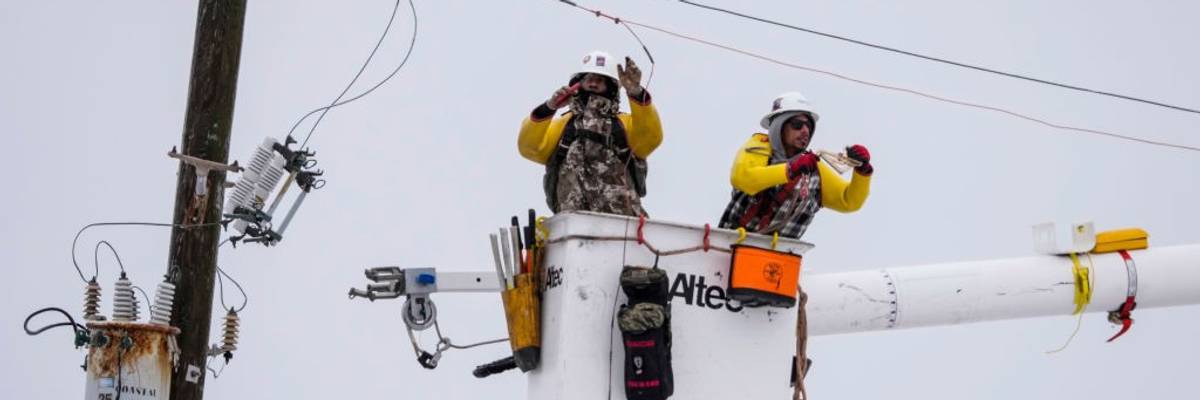
Electrical lineman work on power lines during an icy winter storm on Tuesday, Jan. 21, 2025 in Galveston.
We Need a Shared Working-Class Agenda to Overcome Economic Hardship and Defeat Trump
If we resist getting caught up in the endless drama, divisions, and distractions—and work together to further our own slate of issues—we have the power to create meaningful change.
As Trump creates crisis and chaos, testing the limits of his authority and driving the news cycle, it’s critical we keep returning to what matters most to the American people. By focusing on our shared priorities and working together, we can stay grounded during the turmoil and build the power to drive positive change.
At the top of Americans' concerns is economic hardship and inequality. Ninety percent of voters told Gallup the economy was a top influence on their 2024 votes. The rising cost of housing and everyday expenses was cited as the most critical issue by both Trump voters (79 percent) and the broader electorate (56 percent).
These concerns reflect real struggles. According to the Federal Reserve, more than one-third of American adults lack the resources to handle a $400 emergency without borrowing. Families face crushing costs—median childcare runs $1,100 monthly, matching typical rent payments. Natural disasters have financially impacted nearly one in five adults.
By focusing on the issues that affect the lives of millions of Americans, we can build common ground for organizing and advocacy.
The ALICE framework helps us understand this crisis. These Asset Limited, Income Constrained, Employed families—now 42 percent of all U.S. households—often work multiple jobs yet still struggle to cover basics. They are our neighbors, many of them working nearby in businesses, medical facilities, and factories living paycheck to paycheck, while caring for children and elders. Many are forced to choose between rent, food, gas for the car, and paying the power bill.
Millionaire and Vice President JD Vance said at the recent “March for Life” rally in Washington, D.C., that he wished more young people would have children. Yet over half of parents surveyed said that they suffer anxiety due to not having enough money to support their family.
It is not unusual to find people living in their cars or in tent encampments, going to work at multiple jobs but unable to afford rent. The numbers of these ALICE families have grown by 23 percent since 2010 and now make up 42 percent of American households.
Meanwhile, America's billionaire class has accumulated unprecedented wealth—$6.72 trillion among 813 individuals, growing by $1 trillion in just that last nine months of 2024, according to the Institute for Policy Studies. This concentration of wealth translates directly into political power that even many wealthy Americans recognize as wrong. The Patriotic Millionaires group, representing 500 wealthy individuals, has called for higher taxes on the ultra-wealthy, warning that extreme wealth concentration is corroding democracy.
In spite of his populist language, the Trump administration’s millionaires and billionaires show few signs of being interested in addressing the economic hardship of American families. The president’s true priorities were on display as the billionaires lined up to kiss the royal ring with large donations for the inauguration and were seated in the most prestigious seats at the events.
What can be done? How can ordinary people build sufficient power to put the wellbeing of ordinary families first?
The American people understand these challenges and 89 percent of them recognize that excessive political influence by the wealthy drives inequality, according to the Pew Research Center. Two-thirds believe our economic system needs major reform. Even wealthy Americans largely share these concerns, polling just 9 points lower in their worry about inequality.
With MAGA Republicans dominating Congress and the Executive Branch, national reform is tough. But if we resist getting caught up in the endless drama and distractions, and work together to further our own agenda. we have the power to create change.
- We can remind elected officials at all levels of government that their constituents expect support for child care, healthcare, education, minimum wage increases, and housing policies for working families;
- We can support state and local initiatives to tax wealth and invest in communities;
- We can keep economic hardship and inequality at the center of public discourse; and
- We can join organizations, like the Working Families Party, and build coalitions around shared economic concerns.
By focusing on the issues that affect the lives of millions of Americans, we can build common ground for organizing and advocacy. Instead of being distracted, divided, and overwhelmed, we can set our own agenda, build power together for positive change, and insist that our elected leaders act on our shared priorities.
We are at a crossroads
This country and this world are at a monumental crossroads. In a few short weeks, US voters will have an opportunity to beat back the forces of fascism and confront the billionaires who are rigging the economy, our media system, and our democracy, making it increasingly impossible for ordinary people to get by. We’re not just talking about the election. We’re talking about what must be done once these fascist elements are vanquished from power. We need a bolder set of solutions than what either major party has so far been willing to offer and a working-class movement ready to fight like hell for it. Trump didn't emerge from nowhere. The conditions that fueled MAGA authoritarianism were created by decades of radical neoliberal economic policies and a corrupt political system dominated by corporate interests. They slashed taxes on the super-rich, promising that the benefits would trickle down. They said giveaways to the corporate titans would make life more affordable for the rest of us. It was all bullshit. And when a bitter, betrayed populace searches for someone to blame, right-wing demagogues have little trouble finding scapegoats. People know when they're being lied to, but you won't hear any of this from the corporate media. Only independent journalism—powered and funded by people who believe in building a better world—can deliver truly trustworthy daily news. Our Fall Campaign is underway, and we need your help. To power our newsroom through the rest of the year, we need to raise $125,000 by midnight on October 31. So if you share our vision, please contribute whatever you can to sustain our work. |
As Trump creates crisis and chaos, testing the limits of his authority and driving the news cycle, it’s critical we keep returning to what matters most to the American people. By focusing on our shared priorities and working together, we can stay grounded during the turmoil and build the power to drive positive change.
At the top of Americans' concerns is economic hardship and inequality. Ninety percent of voters told Gallup the economy was a top influence on their 2024 votes. The rising cost of housing and everyday expenses was cited as the most critical issue by both Trump voters (79 percent) and the broader electorate (56 percent).
These concerns reflect real struggles. According to the Federal Reserve, more than one-third of American adults lack the resources to handle a $400 emergency without borrowing. Families face crushing costs—median childcare runs $1,100 monthly, matching typical rent payments. Natural disasters have financially impacted nearly one in five adults.
By focusing on the issues that affect the lives of millions of Americans, we can build common ground for organizing and advocacy.
The ALICE framework helps us understand this crisis. These Asset Limited, Income Constrained, Employed families—now 42 percent of all U.S. households—often work multiple jobs yet still struggle to cover basics. They are our neighbors, many of them working nearby in businesses, medical facilities, and factories living paycheck to paycheck, while caring for children and elders. Many are forced to choose between rent, food, gas for the car, and paying the power bill.
Millionaire and Vice President JD Vance said at the recent “March for Life” rally in Washington, D.C., that he wished more young people would have children. Yet over half of parents surveyed said that they suffer anxiety due to not having enough money to support their family.
It is not unusual to find people living in their cars or in tent encampments, going to work at multiple jobs but unable to afford rent. The numbers of these ALICE families have grown by 23 percent since 2010 and now make up 42 percent of American households.
Meanwhile, America's billionaire class has accumulated unprecedented wealth—$6.72 trillion among 813 individuals, growing by $1 trillion in just that last nine months of 2024, according to the Institute for Policy Studies. This concentration of wealth translates directly into political power that even many wealthy Americans recognize as wrong. The Patriotic Millionaires group, representing 500 wealthy individuals, has called for higher taxes on the ultra-wealthy, warning that extreme wealth concentration is corroding democracy.
In spite of his populist language, the Trump administration’s millionaires and billionaires show few signs of being interested in addressing the economic hardship of American families. The president’s true priorities were on display as the billionaires lined up to kiss the royal ring with large donations for the inauguration and were seated in the most prestigious seats at the events.
What can be done? How can ordinary people build sufficient power to put the wellbeing of ordinary families first?
The American people understand these challenges and 89 percent of them recognize that excessive political influence by the wealthy drives inequality, according to the Pew Research Center. Two-thirds believe our economic system needs major reform. Even wealthy Americans largely share these concerns, polling just 9 points lower in their worry about inequality.
With MAGA Republicans dominating Congress and the Executive Branch, national reform is tough. But if we resist getting caught up in the endless drama and distractions, and work together to further our own agenda. we have the power to create change.
- We can remind elected officials at all levels of government that their constituents expect support for child care, healthcare, education, minimum wage increases, and housing policies for working families;
- We can support state and local initiatives to tax wealth and invest in communities;
- We can keep economic hardship and inequality at the center of public discourse; and
- We can join organizations, like the Working Families Party, and build coalitions around shared economic concerns.
By focusing on the issues that affect the lives of millions of Americans, we can build common ground for organizing and advocacy. Instead of being distracted, divided, and overwhelmed, we can set our own agenda, build power together for positive change, and insist that our elected leaders act on our shared priorities.
- On Labor Day, Champions of Working Class Vow to Defeat Trump ›
- Democrats' Working-Class Failures, Analysis Finds, Are 'Why Trump Beat Harris' ›
- Trump Allies Launch $20 Million Effort to Convince Working Class to Back Tax Scam 2.0 ›
- The Democratic Party Is Toast If It Doesn’t Earn Back the Trust of the Working Class ›
- 5 Ways Trump's Labor Secretary Pick Can Prove She's Really Pro-Worker ›
- Opinion | Working People Must Recognize the Basis of Class Struggle | Common Dreams ›
As Trump creates crisis and chaos, testing the limits of his authority and driving the news cycle, it’s critical we keep returning to what matters most to the American people. By focusing on our shared priorities and working together, we can stay grounded during the turmoil and build the power to drive positive change.
At the top of Americans' concerns is economic hardship and inequality. Ninety percent of voters told Gallup the economy was a top influence on their 2024 votes. The rising cost of housing and everyday expenses was cited as the most critical issue by both Trump voters (79 percent) and the broader electorate (56 percent).
These concerns reflect real struggles. According to the Federal Reserve, more than one-third of American adults lack the resources to handle a $400 emergency without borrowing. Families face crushing costs—median childcare runs $1,100 monthly, matching typical rent payments. Natural disasters have financially impacted nearly one in five adults.
By focusing on the issues that affect the lives of millions of Americans, we can build common ground for organizing and advocacy.
The ALICE framework helps us understand this crisis. These Asset Limited, Income Constrained, Employed families—now 42 percent of all U.S. households—often work multiple jobs yet still struggle to cover basics. They are our neighbors, many of them working nearby in businesses, medical facilities, and factories living paycheck to paycheck, while caring for children and elders. Many are forced to choose between rent, food, gas for the car, and paying the power bill.
Millionaire and Vice President JD Vance said at the recent “March for Life” rally in Washington, D.C., that he wished more young people would have children. Yet over half of parents surveyed said that they suffer anxiety due to not having enough money to support their family.
It is not unusual to find people living in their cars or in tent encampments, going to work at multiple jobs but unable to afford rent. The numbers of these ALICE families have grown by 23 percent since 2010 and now make up 42 percent of American households.
Meanwhile, America's billionaire class has accumulated unprecedented wealth—$6.72 trillion among 813 individuals, growing by $1 trillion in just that last nine months of 2024, according to the Institute for Policy Studies. This concentration of wealth translates directly into political power that even many wealthy Americans recognize as wrong. The Patriotic Millionaires group, representing 500 wealthy individuals, has called for higher taxes on the ultra-wealthy, warning that extreme wealth concentration is corroding democracy.
In spite of his populist language, the Trump administration’s millionaires and billionaires show few signs of being interested in addressing the economic hardship of American families. The president’s true priorities were on display as the billionaires lined up to kiss the royal ring with large donations for the inauguration and were seated in the most prestigious seats at the events.
What can be done? How can ordinary people build sufficient power to put the wellbeing of ordinary families first?
The American people understand these challenges and 89 percent of them recognize that excessive political influence by the wealthy drives inequality, according to the Pew Research Center. Two-thirds believe our economic system needs major reform. Even wealthy Americans largely share these concerns, polling just 9 points lower in their worry about inequality.
With MAGA Republicans dominating Congress and the Executive Branch, national reform is tough. But if we resist getting caught up in the endless drama and distractions, and work together to further our own agenda. we have the power to create change.
- We can remind elected officials at all levels of government that their constituents expect support for child care, healthcare, education, minimum wage increases, and housing policies for working families;
- We can support state and local initiatives to tax wealth and invest in communities;
- We can keep economic hardship and inequality at the center of public discourse; and
- We can join organizations, like the Working Families Party, and build coalitions around shared economic concerns.
By focusing on the issues that affect the lives of millions of Americans, we can build common ground for organizing and advocacy. Instead of being distracted, divided, and overwhelmed, we can set our own agenda, build power together for positive change, and insist that our elected leaders act on our shared priorities.
- On Labor Day, Champions of Working Class Vow to Defeat Trump ›
- Democrats' Working-Class Failures, Analysis Finds, Are 'Why Trump Beat Harris' ›
- Trump Allies Launch $20 Million Effort to Convince Working Class to Back Tax Scam 2.0 ›
- The Democratic Party Is Toast If It Doesn’t Earn Back the Trust of the Working Class ›
- 5 Ways Trump's Labor Secretary Pick Can Prove She's Really Pro-Worker ›
- Opinion | Working People Must Recognize the Basis of Class Struggle | Common Dreams ›