5
#000000
#FFFFFF
To donate by check, phone, or other method, see our More Ways to Give page.
From my living room window, I can see the yellow gate.
It stands on the main road linking several villages west of Bethlehem to the rest of the West Bank. To an outsider, it may look like an ordinary metal barrier. To those who live here, it has become something far more significant: a daily source of uncertainty that shapes routines, decisions, livelihoods, and even childhood memories.
My house sits beside the road. Every day, I watch people approach the gate not knowing what they will find. Will it be open? Closed? Will there be a checkpoint? Will they be delayed for minutes, hours, or forced to turn back altogether?
For many families, the first question of the morning is no longer about work, school schedules, or the weather. It is simple: "Is the gate open today?"
No child should become so familiar with a barrier that it earns a permanent place in his imagination.
Entire WhatsApp groups have emerged around that question alone. Residents exchange updates throughout the day. Someone reports that traffic is moving. Another warns of delays. A third shares a photo showing the road blocked.
These groups were not created to discuss politics. They exist because people need to know whether they can get to work, attend university classes, reach medical appointments, or visit relatives.
The gate has become a permanent presence in people's minds. When it closes completely, the scene changes instantly.
The drivers park their cars along the roadside and continue on foot. Students hurry toward schools and universities. Workers walk to avoid losing a day's wages. People carrying groceries, bags, or small children cross the distance that vehicles can no longer cover.
In the evening, many return the same way—tired, frustrated, and uncertain whether they will find the road open when it is time to go home.
Sometimes people ask permission to leave their cars near our house because they do not know when they will be able to retrieve them. On more than one occasion, I have watched strangers park, shoulder their belongings, and continue their journey on foot because there was no other option.
The visible inconvenience is easy to describe. The invisible burden is harder to measure.
What does it mean to organize your life around uncertainty? What happens when a routine trip to work, school, or a medical appointment becomes a daily calculation involving alternate routes, unexpected delays, and the possibility that the road ahead may suddenly close?
Over time, uncertainty settles into people's lives. It affects productivity, family plans, social commitments, and mental well-being. Conversations become dominated by road conditions and access restrictions. Schedules remain tentative. Even celebrations, weddings, and family gatherings are planned with the possibility of disruption in mind.
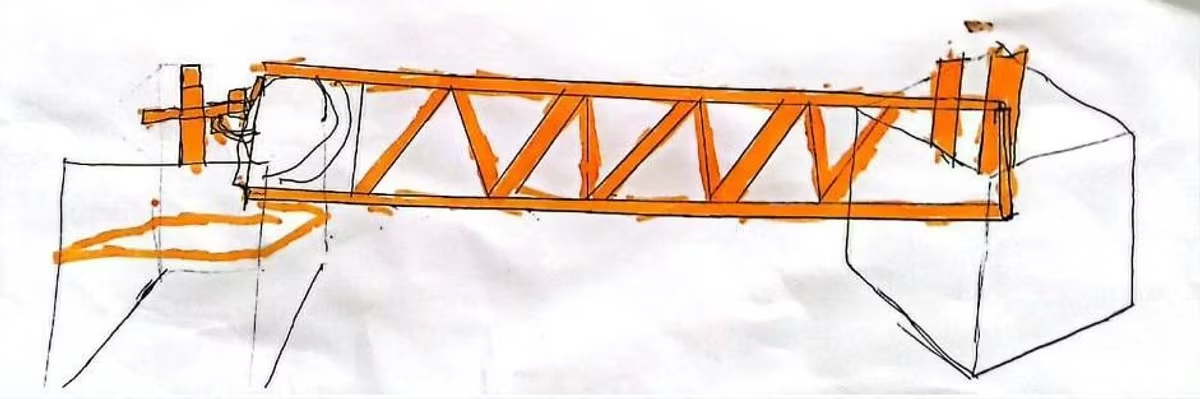
The impact extends far beyond transportation. It reshapes the way people think. And perhaps nowhere is that impact more visible than in the way children absorb the world around them. My son is 8 years old. Over the past months, he has drawn the gate more than 30 times. No one asked him to do so. No teacher assigned it. Yet the yellow gate keeps appearing in his drawings. Sometimes it is closed. Sometimes cars are waiting in front of it. Sometimes people are walking around it. Occasionally, there are figures standing nearby, watching.
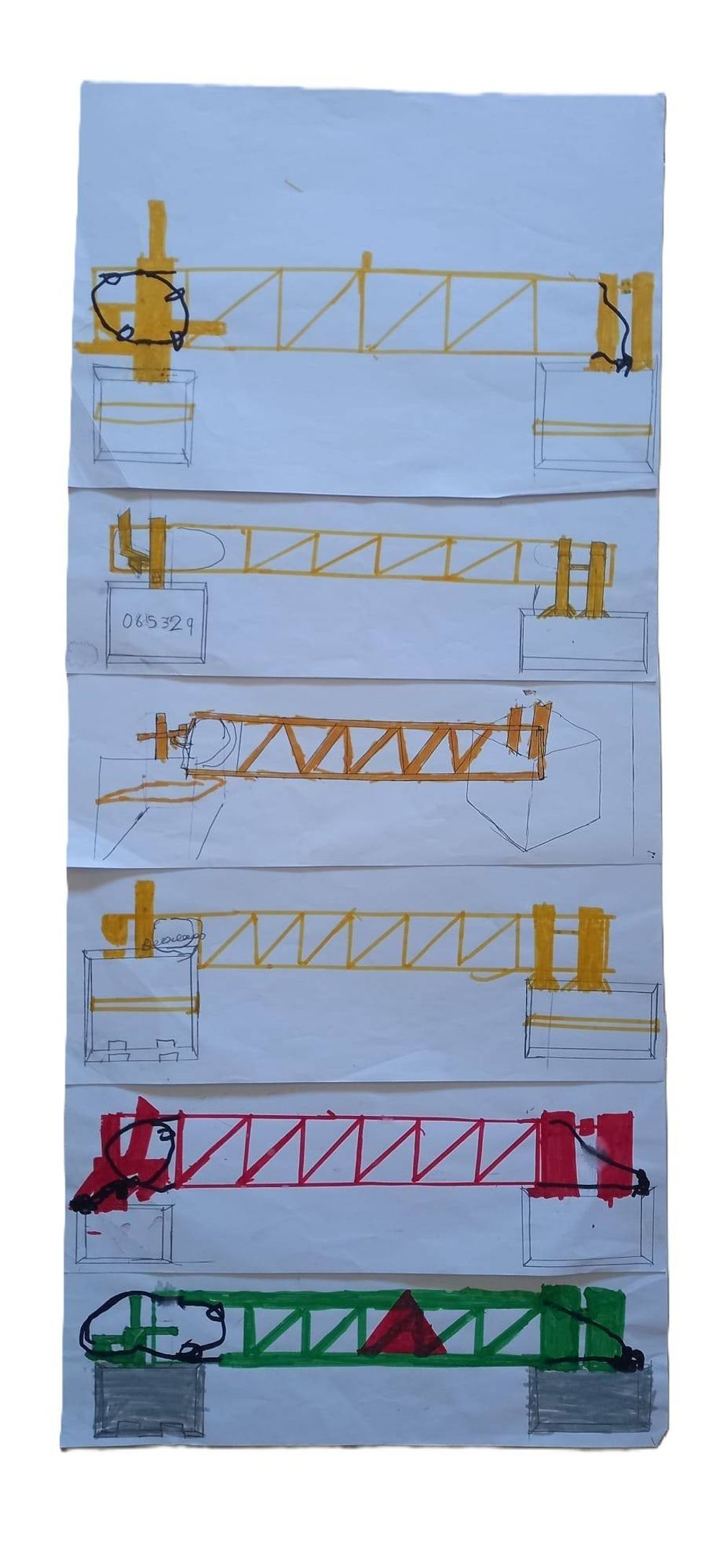 Some of the drawings done by Mahmoud Ibrahim's son are shown.
At first, I barely noticed. Children draw what they see. But as the drawings accumulated, I began to pay attention. The same image returned again and again. A gate. A road. Waiting.
Children are supposed to fill their notebooks with football fields, superheroes, animals, friends, dreams, and imaginary adventures. Yet among my son's drawings, the gate had secured a permanent place. That realization stayed with me.
The true cost of restrictions is often discussed in terms of economics, mobility, or security. Those discussions matter. But there is another cost that receives far less attention: the amount of mental space occupied by obstacles that become part of everyday life.
When adults constantly discuss whether a road is open or closed, children listen. When plans are interrupted repeatedly, children notice. When uncertainty becomes normal, children absorb it as part of their understanding of how the world works.
The gate outside my window is made of metal. Yet its influence reaches far beyond the road it controls. It enters conversations around dinner tables. It dominates community WhatsApp groups. It influences work schedules, school attendance, and family visits. And, in my son's case, it appears repeatedly on sheets of paper scattered around our home.
Recently, I gathered several of his drawings and laid them side by side. There it was again: the yellow gate. In one picture it was closed. In another it stood across the road while cars waited. In a third, people walked around it.
I found myself asking a simple question: What would my son be drawing if the gate were not there? I do not know the answer. But I do know that no child should become so familiar with a barrier that it earns a permanent place in his imagination.
That is why I am writing this.
Not simply about a gate on a road near Bethlehem, but about how uncertainty seeps into daily life, settles into communities, and quietly shapes the memories of a generation growing up in its shadow.
From my living room window, I can see the yellow gate.
It stands on the main road linking several villages west of Bethlehem to the rest of the West Bank. To an outsider, it may look like an ordinary metal barrier. To those who live here, it has become something far more significant: a daily source of uncertainty that shapes routines, decisions, livelihoods, and even childhood memories.
My house sits beside the road. Every day, I watch people approach the gate not knowing what they will find. Will it be open? Closed? Will there be a checkpoint? Will they be delayed for minutes, hours, or forced to turn back altogether?
For many families, the first question of the morning is no longer about work, school schedules, or the weather. It is simple: "Is the gate open today?"
No child should become so familiar with a barrier that it earns a permanent place in his imagination.
Entire WhatsApp groups have emerged around that question alone. Residents exchange updates throughout the day. Someone reports that traffic is moving. Another warns of delays. A third shares a photo showing the road blocked.
These groups were not created to discuss politics. They exist because people need to know whether they can get to work, attend university classes, reach medical appointments, or visit relatives.
The gate has become a permanent presence in people's minds. When it closes completely, the scene changes instantly.
The drivers park their cars along the roadside and continue on foot. Students hurry toward schools and universities. Workers walk to avoid losing a day's wages. People carrying groceries, bags, or small children cross the distance that vehicles can no longer cover.
In the evening, many return the same way—tired, frustrated, and uncertain whether they will find the road open when it is time to go home.
Sometimes people ask permission to leave their cars near our house because they do not know when they will be able to retrieve them. On more than one occasion, I have watched strangers park, shoulder their belongings, and continue their journey on foot because there was no other option.
The visible inconvenience is easy to describe. The invisible burden is harder to measure.
What does it mean to organize your life around uncertainty? What happens when a routine trip to work, school, or a medical appointment becomes a daily calculation involving alternate routes, unexpected delays, and the possibility that the road ahead may suddenly close?
Over time, uncertainty settles into people's lives. It affects productivity, family plans, social commitments, and mental well-being. Conversations become dominated by road conditions and access restrictions. Schedules remain tentative. Even celebrations, weddings, and family gatherings are planned with the possibility of disruption in mind.
The impact extends far beyond transportation. It reshapes the way people think. And perhaps nowhere is that impact more visible than in the way children absorb the world around them. My son is 8 years old. Over the past months, he has drawn the gate more than 30 times. No one asked him to do so. No teacher assigned it. Yet the yellow gate keeps appearing in his drawings. Sometimes it is closed. Sometimes cars are waiting in front of it. Sometimes people are walking around it. Occasionally, there are figures standing nearby, watching.
Some of the drawings done by Mahmoud Ibrahim's son are shown.
At first, I barely noticed. Children draw what they see. But as the drawings accumulated, I began to pay attention. The same image returned again and again. A gate. A road. Waiting.
Children are supposed to fill their notebooks with football fields, superheroes, animals, friends, dreams, and imaginary adventures. Yet among my son's drawings, the gate had secured a permanent place. That realization stayed with me.
The true cost of restrictions is often discussed in terms of economics, mobility, or security. Those discussions matter. But there is another cost that receives far less attention: the amount of mental space occupied by obstacles that become part of everyday life.
When adults constantly discuss whether a road is open or closed, children listen. When plans are interrupted repeatedly, children notice. When uncertainty becomes normal, children absorb it as part of their understanding of how the world works.
The gate outside my window is made of metal. Yet its influence reaches far beyond the road it controls. It enters conversations around dinner tables. It dominates community WhatsApp groups. It influences work schedules, school attendance, and family visits. And, in my son's case, it appears repeatedly on sheets of paper scattered around our home.
Recently, I gathered several of his drawings and laid them side by side. There it was again: the yellow gate. In one picture it was closed. In another it stood across the road while cars waited. In a third, people walked around it.
I found myself asking a simple question: What would my son be drawing if the gate were not there? I do not know the answer. But I do know that no child should become so familiar with a barrier that it earns a permanent place in his imagination.
That is why I am writing this.
Not simply about a gate on a road near Bethlehem, but about how uncertainty seeps into daily life, settles into communities, and quietly shapes the memories of a generation growing up in its shadow.
From my living room window, I can see the yellow gate.
It stands on the main road linking several villages west of Bethlehem to the rest of the West Bank. To an outsider, it may look like an ordinary metal barrier. To those who live here, it has become something far more significant: a daily source of uncertainty that shapes routines, decisions, livelihoods, and even childhood memories.
My house sits beside the road. Every day, I watch people approach the gate not knowing what they will find. Will it be open? Closed? Will there be a checkpoint? Will they be delayed for minutes, hours, or forced to turn back altogether?
For many families, the first question of the morning is no longer about work, school schedules, or the weather. It is simple: "Is the gate open today?"
No child should become so familiar with a barrier that it earns a permanent place in his imagination.
Entire WhatsApp groups have emerged around that question alone. Residents exchange updates throughout the day. Someone reports that traffic is moving. Another warns of delays. A third shares a photo showing the road blocked.
These groups were not created to discuss politics. They exist because people need to know whether they can get to work, attend university classes, reach medical appointments, or visit relatives.
The gate has become a permanent presence in people's minds. When it closes completely, the scene changes instantly.
The drivers park their cars along the roadside and continue on foot. Students hurry toward schools and universities. Workers walk to avoid losing a day's wages. People carrying groceries, bags, or small children cross the distance that vehicles can no longer cover.
In the evening, many return the same way—tired, frustrated, and uncertain whether they will find the road open when it is time to go home.
Sometimes people ask permission to leave their cars near our house because they do not know when they will be able to retrieve them. On more than one occasion, I have watched strangers park, shoulder their belongings, and continue their journey on foot because there was no other option.
The visible inconvenience is easy to describe. The invisible burden is harder to measure.
What does it mean to organize your life around uncertainty? What happens when a routine trip to work, school, or a medical appointment becomes a daily calculation involving alternate routes, unexpected delays, and the possibility that the road ahead may suddenly close?
Over time, uncertainty settles into people's lives. It affects productivity, family plans, social commitments, and mental well-being. Conversations become dominated by road conditions and access restrictions. Schedules remain tentative. Even celebrations, weddings, and family gatherings are planned with the possibility of disruption in mind.
The impact extends far beyond transportation. It reshapes the way people think. And perhaps nowhere is that impact more visible than in the way children absorb the world around them. My son is 8 years old. Over the past months, he has drawn the gate more than 30 times. No one asked him to do so. No teacher assigned it. Yet the yellow gate keeps appearing in his drawings. Sometimes it is closed. Sometimes cars are waiting in front of it. Sometimes people are walking around it. Occasionally, there are figures standing nearby, watching.
Some of the drawings done by Mahmoud Ibrahim's son are shown.
At first, I barely noticed. Children draw what they see. But as the drawings accumulated, I began to pay attention. The same image returned again and again. A gate. A road. Waiting.
Children are supposed to fill their notebooks with football fields, superheroes, animals, friends, dreams, and imaginary adventures. Yet among my son's drawings, the gate had secured a permanent place. That realization stayed with me.
The true cost of restrictions is often discussed in terms of economics, mobility, or security. Those discussions matter. But there is another cost that receives far less attention: the amount of mental space occupied by obstacles that become part of everyday life.
When adults constantly discuss whether a road is open or closed, children listen. When plans are interrupted repeatedly, children notice. When uncertainty becomes normal, children absorb it as part of their understanding of how the world works.
The gate outside my window is made of metal. Yet its influence reaches far beyond the road it controls. It enters conversations around dinner tables. It dominates community WhatsApp groups. It influences work schedules, school attendance, and family visits. And, in my son's case, it appears repeatedly on sheets of paper scattered around our home.
Recently, I gathered several of his drawings and laid them side by side. There it was again: the yellow gate. In one picture it was closed. In another it stood across the road while cars waited. In a third, people walked around it.
I found myself asking a simple question: What would my son be drawing if the gate were not there? I do not know the answer. But I do know that no child should become so familiar with a barrier that it earns a permanent place in his imagination.
That is why I am writing this.
Not simply about a gate on a road near Bethlehem, but about how uncertainty seeps into daily life, settles into communities, and quietly shapes the memories of a generation growing up in its shadow.