SUBSCRIBE TO OUR FREE NEWSLETTER
Daily news & progressive opinion—funded by the people, not the corporations—delivered straight to your inbox.
5
#000000
#FFFFFF
To donate by check, phone, or other method, see our More Ways to Give page.
A recent analysis from the Tax Foundation argues that the US federal income tax system remains solidly progressive. Citing new Internal Revenue Service data for tax year 2023, the group is emphasizing that high-income taxpayers pay the highest average tax rates and account for a large share of total income taxes paid. On its face, that claim sounds reassuring—a sign that our tax code must surely be doing its job.
But this framing leaves out a critical part of the story. Yes, the wealthy pay more in taxes than everyone else. The real question: whether they’re paying enough, their fair share relative to their rapidly growing share of our nation’s income and wealth. By that measure, the answer must be a clear no. The US tax system, the underlying data show, remains far less progressive than it once was—and far less effective at counteracting inequality than it needs to be.
The Tax Foundation is claiming that the top 1%’s share of the nation’s adjusted gross income, AGI, “fluctuates with the business cycle” while the share of the taxes these rich pay has been “generally increasing.” But, in fact, these two indicators track each other rather closely over time. By placing income share and tax share on separate graphs, the Tax Foundation obscures how close this tracking has been.
Graphed together, the obvious correspondence of these two measures becomes unmistakably clear: As the top 1%’s share of income rises, so does the top 1%’s share of taxes. In other words, the increase in the tax dollars these rich are paying largely reflects the larger slice of total national income these rich are pocketing, not that the tax system has somehow become meaningfully more progressive. The top 1% tax share is rising because the top 1% income share is rising, not because our most affluent are facing a heavier tax burden on their gains.
A truly progressive system should meaningfully reduce inequality by redistributing income and wealth and curbing the concentration of economic power at the top. By that standard, the US tax system falls short.
By characterizing the top 1%’s income share as “fluctuating with the business cycle” while characterizing its tax share as “generally increasing”—and separating the graphic presentation of these two trends—the Tax Foundation is playing fast and loose with our core tax reality.
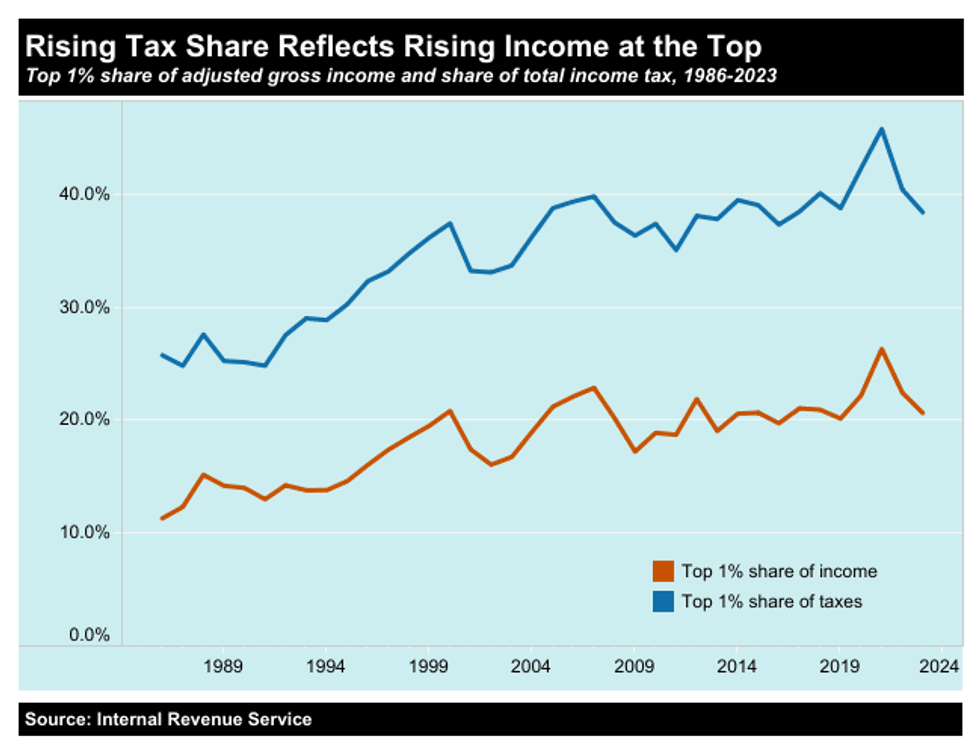
The time frame of the Tax Foundation’s analysis further muddies the waters. By starting in 2001, the Tax Foundation misses the longer arc of rising inequality in the United States. Looking back to the 1980s, the trend is unmistakable: The top 1%’s share of income has climbed substantially, from 11.3% in 1986 to 20.6% in 2023. The tax share of these rich has risen as well, from 25.8% in 1986 to 38.4% in 2023. Meanwhile their average effective tax rate has actually declined over the same period, from 33.1% to 26.3%, according to IRS data.
Even more importantly, focusing solely on income ignores the explosion of wealth at the top. Adjusted gross income (AGI) itself is a limited and often misleading measure—an arbitrary definition used for tax purposes that fails to capture total economic income, and completely misses the scale of wealth accumulation. Over the past several decades, our nation’s richest households have accumulated an outsized share of the nation’s wealth, with that wealth share far outpacing the top 1%'s growing share of national income. Yet the tax system does relatively little to address this imbalance.
Wealth remains lightly taxed compared to income, and many forms of capital income, to make matters worse, enjoy low preferential tax rates or taxes that can be deferred indefinitely. The end result: The overall tax burden on America’s richest is failing to keep pace with their expanding economic power.
The distortions become even clearer when we look beyond the top 1% to the tippy top of our wealth distribution, the top 0.01%. These ultra-wealthy households have seen extraordinary gains in both income and wealth over time. But their tax contributions have not kept up proportionally.
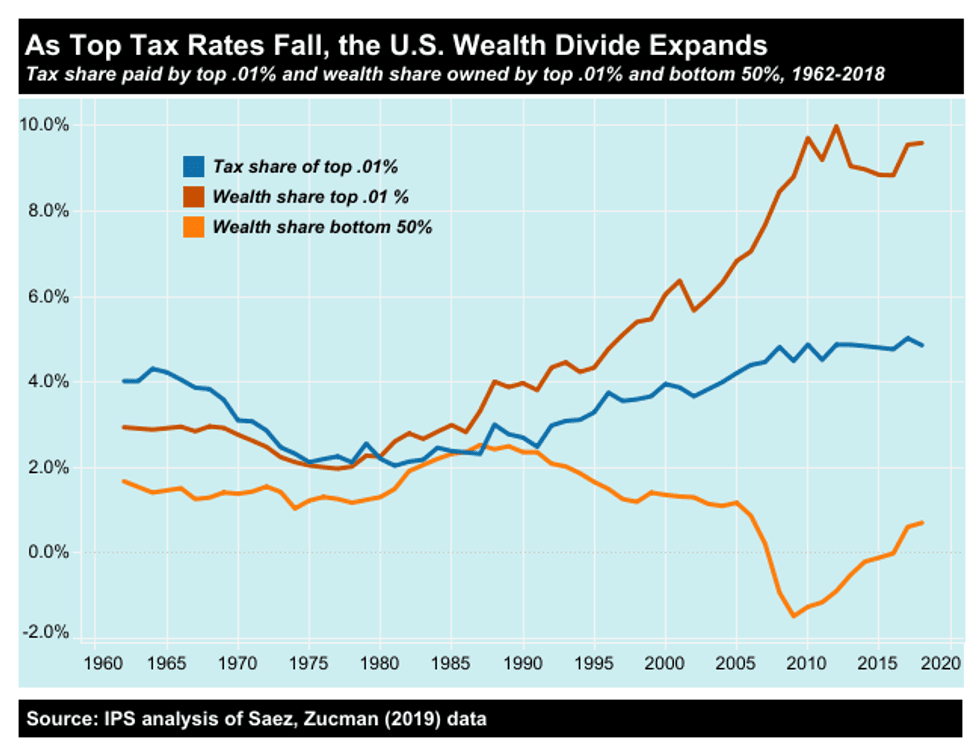
An Institute for Policy Studies analysis of data collected by economists Emmanuel Saez and Gabriel Zucman shows that our top 0.01% more than tripled their share of the nation’s wealth between 1962 and 2018. Yet their share of US taxes paid in 2018 hovered only slightly higher than their share of taxes paid in 1962.
All of this raises a fundamental question: What makes a tax system “progressive”? Just somewhat higher tax rates on higher earners? No. A truly progressive system should meaningfully reduce inequality by redistributing income and wealth and curbing the concentration of economic power at the top. By that standard, the US tax system falls short.
Our current tax system largely mirrors our nation’s underlying distribution of income rather than reshaping that distribution. The rich pay more because they have more. But they don’t pay more at levels sufficient to counterbalance their outsized gains. In 2023, the top 1% captured about 20.6% of pre-tax income and still held roughly 17.7% after federal income taxes, only a modest reduction. That after-tax share is still higher than their 17.4% share of pre-tax income in 2001, underscoring how little the tax system has done to curb the growing concentration of income at the top.
Reversing these trends will require more than modest tweaks to the tax code. It will take a more ambitious approach, one that directly addresses both income and wealth concentration at the very top. Until then, claims that the tax system is adequately progressive risk obscuring a deeper reality: Inequality continues to widen, and the tax code is doing too little to stop it.
A recent analysis from the Tax Foundation argues that the US federal income tax system remains solidly progressive. Citing new Internal Revenue Service data for tax year 2023, the group is emphasizing that high-income taxpayers pay the highest average tax rates and account for a large share of total income taxes paid. On its face, that claim sounds reassuring—a sign that our tax code must surely be doing its job.
But this framing leaves out a critical part of the story. Yes, the wealthy pay more in taxes than everyone else. The real question: whether they’re paying enough, their fair share relative to their rapidly growing share of our nation’s income and wealth. By that measure, the answer must be a clear no. The US tax system, the underlying data show, remains far less progressive than it once was—and far less effective at counteracting inequality than it needs to be.
The Tax Foundation is claiming that the top 1%’s share of the nation’s adjusted gross income, AGI, “fluctuates with the business cycle” while the share of the taxes these rich pay has been “generally increasing.” But, in fact, these two indicators track each other rather closely over time. By placing income share and tax share on separate graphs, the Tax Foundation obscures how close this tracking has been.
Graphed together, the obvious correspondence of these two measures becomes unmistakably clear: As the top 1%’s share of income rises, so does the top 1%’s share of taxes. In other words, the increase in the tax dollars these rich are paying largely reflects the larger slice of total national income these rich are pocketing, not that the tax system has somehow become meaningfully more progressive. The top 1% tax share is rising because the top 1% income share is rising, not because our most affluent are facing a heavier tax burden on their gains.
A truly progressive system should meaningfully reduce inequality by redistributing income and wealth and curbing the concentration of economic power at the top. By that standard, the US tax system falls short.
By characterizing the top 1%’s income share as “fluctuating with the business cycle” while characterizing its tax share as “generally increasing”—and separating the graphic presentation of these two trends—the Tax Foundation is playing fast and loose with our core tax reality.
The time frame of the Tax Foundation’s analysis further muddies the waters. By starting in 2001, the Tax Foundation misses the longer arc of rising inequality in the United States. Looking back to the 1980s, the trend is unmistakable: The top 1%’s share of income has climbed substantially, from 11.3% in 1986 to 20.6% in 2023. The tax share of these rich has risen as well, from 25.8% in 1986 to 38.4% in 2023. Meanwhile their average effective tax rate has actually declined over the same period, from 33.1% to 26.3%, according to IRS data.
Even more importantly, focusing solely on income ignores the explosion of wealth at the top. Adjusted gross income (AGI) itself is a limited and often misleading measure—an arbitrary definition used for tax purposes that fails to capture total economic income, and completely misses the scale of wealth accumulation. Over the past several decades, our nation’s richest households have accumulated an outsized share of the nation’s wealth, with that wealth share far outpacing the top 1%'s growing share of national income. Yet the tax system does relatively little to address this imbalance.
Wealth remains lightly taxed compared to income, and many forms of capital income, to make matters worse, enjoy low preferential tax rates or taxes that can be deferred indefinitely. The end result: The overall tax burden on America’s richest is failing to keep pace with their expanding economic power.
The distortions become even clearer when we look beyond the top 1% to the tippy top of our wealth distribution, the top 0.01%. These ultra-wealthy households have seen extraordinary gains in both income and wealth over time. But their tax contributions have not kept up proportionally.
An Institute for Policy Studies analysis of data collected by economists Emmanuel Saez and Gabriel Zucman shows that our top 0.01% more than tripled their share of the nation’s wealth between 1962 and 2018. Yet their share of US taxes paid in 2018 hovered only slightly higher than their share of taxes paid in 1962.
All of this raises a fundamental question: What makes a tax system “progressive”? Just somewhat higher tax rates on higher earners? No. A truly progressive system should meaningfully reduce inequality by redistributing income and wealth and curbing the concentration of economic power at the top. By that standard, the US tax system falls short.
Our current tax system largely mirrors our nation’s underlying distribution of income rather than reshaping that distribution. The rich pay more because they have more. But they don’t pay more at levels sufficient to counterbalance their outsized gains. In 2023, the top 1% captured about 20.6% of pre-tax income and still held roughly 17.7% after federal income taxes, only a modest reduction. That after-tax share is still higher than their 17.4% share of pre-tax income in 2001, underscoring how little the tax system has done to curb the growing concentration of income at the top.
Reversing these trends will require more than modest tweaks to the tax code. It will take a more ambitious approach, one that directly addresses both income and wealth concentration at the very top. Until then, claims that the tax system is adequately progressive risk obscuring a deeper reality: Inequality continues to widen, and the tax code is doing too little to stop it.
A recent analysis from the Tax Foundation argues that the US federal income tax system remains solidly progressive. Citing new Internal Revenue Service data for tax year 2023, the group is emphasizing that high-income taxpayers pay the highest average tax rates and account for a large share of total income taxes paid. On its face, that claim sounds reassuring—a sign that our tax code must surely be doing its job.
But this framing leaves out a critical part of the story. Yes, the wealthy pay more in taxes than everyone else. The real question: whether they’re paying enough, their fair share relative to their rapidly growing share of our nation’s income and wealth. By that measure, the answer must be a clear no. The US tax system, the underlying data show, remains far less progressive than it once was—and far less effective at counteracting inequality than it needs to be.
The Tax Foundation is claiming that the top 1%’s share of the nation’s adjusted gross income, AGI, “fluctuates with the business cycle” while the share of the taxes these rich pay has been “generally increasing.” But, in fact, these two indicators track each other rather closely over time. By placing income share and tax share on separate graphs, the Tax Foundation obscures how close this tracking has been.
Graphed together, the obvious correspondence of these two measures becomes unmistakably clear: As the top 1%’s share of income rises, so does the top 1%’s share of taxes. In other words, the increase in the tax dollars these rich are paying largely reflects the larger slice of total national income these rich are pocketing, not that the tax system has somehow become meaningfully more progressive. The top 1% tax share is rising because the top 1% income share is rising, not because our most affluent are facing a heavier tax burden on their gains.
A truly progressive system should meaningfully reduce inequality by redistributing income and wealth and curbing the concentration of economic power at the top. By that standard, the US tax system falls short.
By characterizing the top 1%’s income share as “fluctuating with the business cycle” while characterizing its tax share as “generally increasing”—and separating the graphic presentation of these two trends—the Tax Foundation is playing fast and loose with our core tax reality.
The time frame of the Tax Foundation’s analysis further muddies the waters. By starting in 2001, the Tax Foundation misses the longer arc of rising inequality in the United States. Looking back to the 1980s, the trend is unmistakable: The top 1%’s share of income has climbed substantially, from 11.3% in 1986 to 20.6% in 2023. The tax share of these rich has risen as well, from 25.8% in 1986 to 38.4% in 2023. Meanwhile their average effective tax rate has actually declined over the same period, from 33.1% to 26.3%, according to IRS data.
Even more importantly, focusing solely on income ignores the explosion of wealth at the top. Adjusted gross income (AGI) itself is a limited and often misleading measure—an arbitrary definition used for tax purposes that fails to capture total economic income, and completely misses the scale of wealth accumulation. Over the past several decades, our nation’s richest households have accumulated an outsized share of the nation’s wealth, with that wealth share far outpacing the top 1%'s growing share of national income. Yet the tax system does relatively little to address this imbalance.
Wealth remains lightly taxed compared to income, and many forms of capital income, to make matters worse, enjoy low preferential tax rates or taxes that can be deferred indefinitely. The end result: The overall tax burden on America’s richest is failing to keep pace with their expanding economic power.
The distortions become even clearer when we look beyond the top 1% to the tippy top of our wealth distribution, the top 0.01%. These ultra-wealthy households have seen extraordinary gains in both income and wealth over time. But their tax contributions have not kept up proportionally.
An Institute for Policy Studies analysis of data collected by economists Emmanuel Saez and Gabriel Zucman shows that our top 0.01% more than tripled their share of the nation’s wealth between 1962 and 2018. Yet their share of US taxes paid in 2018 hovered only slightly higher than their share of taxes paid in 1962.
All of this raises a fundamental question: What makes a tax system “progressive”? Just somewhat higher tax rates on higher earners? No. A truly progressive system should meaningfully reduce inequality by redistributing income and wealth and curbing the concentration of economic power at the top. By that standard, the US tax system falls short.
Our current tax system largely mirrors our nation’s underlying distribution of income rather than reshaping that distribution. The rich pay more because they have more. But they don’t pay more at levels sufficient to counterbalance their outsized gains. In 2023, the top 1% captured about 20.6% of pre-tax income and still held roughly 17.7% after federal income taxes, only a modest reduction. That after-tax share is still higher than their 17.4% share of pre-tax income in 2001, underscoring how little the tax system has done to curb the growing concentration of income at the top.
Reversing these trends will require more than modest tweaks to the tax code. It will take a more ambitious approach, one that directly addresses both income and wealth concentration at the very top. Until then, claims that the tax system is adequately progressive risk obscuring a deeper reality: Inequality continues to widen, and the tax code is doing too little to stop it.