SUBSCRIBE TO OUR FREE NEWSLETTER
Daily news & progressive opinion—funded by the people, not the corporations—delivered straight to your inbox.
5
#000000
#FFFFFF
To donate by check, phone, or other method, see our More Ways to Give page.
Daily news & progressive opinion—funded by the people, not the corporations—delivered straight to your inbox.
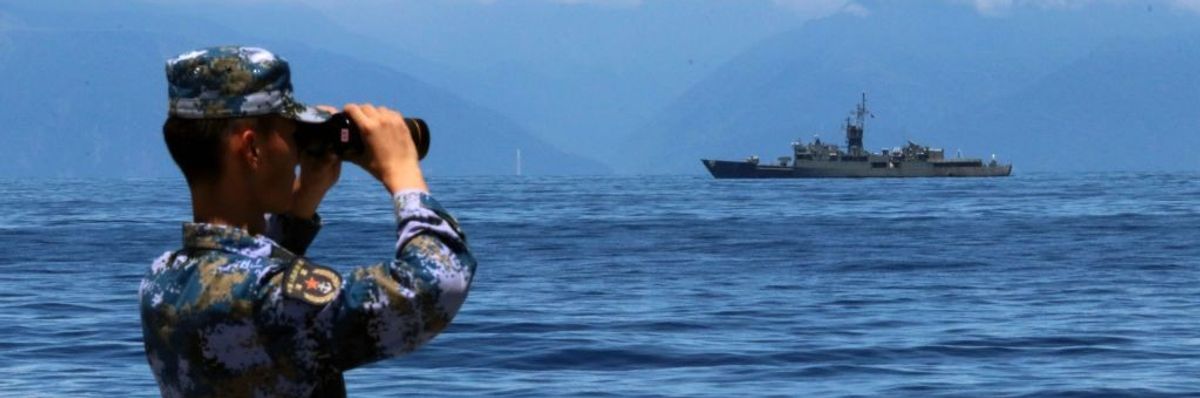
A soldier looks through binoculars during combat exercises and training of the navy of the Eastern Theater Command of the Chinese People's Liberation Army in the waters around the Taiwan Island, Aug. 5, 2022.
A recent NBC Nightly News segment perfectly illustrates the media’s usefulness in the hawks’ endeavor to seek a more confrontational relationship with the rising superpower.
As the United States tries to navigate a new world order in which China has emerged as its primary competitor and at times rival, hawks in Washington, the weapons industry, and other financially or politically interested parties are seeking to base that relationship on fear, confrontation, and animosity rather than healthy competition and cooperation.
A seemingly unwitting ally in that pursuit is the U.S. mainstream media, and a recent NBC Nightly News segment perfectly illustrates its usefulness in the hawks’ endeavor.
The story focused on a recent joint Chinese-Russian naval exercise near the Alaska coast and it had all the elements to lead one to the conclusion that only a more militaristic and confrontational posture would be the most appropriate response.
Quincy Institute Research Fellow Jake Werner, whose expertise focuses on U.S.-China relations, called the NBC story “an unusually glaring example of ostensibly independent U.S. media uncritically adopting” a militaristic approach to the world.
First, hype the threat. Anchor Peter Alexander set the story up as “just the latest close call” between Russia and China and the U.S. without saying exactly what the close call was.
NBC reporter Aaron Gilchrist then said the military exercises were “being called an incursion” without saying just who was saying that, and later he referred to the drill as an “aggressive maneuver” without describing what was aggressive about it. In fact, Gilchrist even acknowledged that the Russian and Chinese navies “never entered U.S. waters.”
Second, the segment completely ignored the wider context and the complexities of U.S.-China and U.S.-Russia relations, which could have helped to explain Russian and Chinese motives for conducting these drills so close to American territory, including the possibility that they were responding to similar U.S. military activity close to their own respective countries.
And lastly, this all led to the idea that more money for the Pentagon is in order. “Alaska senators today (are) renewing calls for increased investment in military power in Alaska,” Gilcrhist said—without any examination of whether that is even necessary.
A spokesman for U.S. Northern Command said that U.S. military assets were deployed “to assure the defense of the United States and Canada” and that the Russian and Chinese patrol “remained in international waters and was not considered a threat.” That description of events stands in stark contrast to NBC’s Alexander and Gilchrist calling it a “close call,” “an incursion,” and an “aggressive maneuver.” And NORTHCOM’s statement in no way implies that the military needs more assets to address the issue.
(This also isn’t the first time Russian and Chinese naval vessels have patrolled the region and it isn’t the first time NBC Nightly News has hyped the China threat.)
Quincy Institute Research Fellow Jake Werner, whose expertise focuses on U.S.-China relations, called the NBC story “an unusually glaring example of ostensibly independent U.S. media uncritically adopting” a militaristic approach to the world.
“An even-handed approach would have noted that the U.S. is doing the same thing (with greater frequency) and that China doing so is part of an escalatory action-reaction dynamic to which the U.S. is very much also contributing,” Werner told RS. “Instead, China’s action is an ‘aggressive maneuver,’ while examples of the U.S. doing the same thing are actually featured—but without the necessary context and only to make the claim that China is aggressive.”
Indeed, Blake Herzinger, a research fellow at the United States Studies Center in Australia, agrees. According to CNN, he echoed NORTHCOM’s assessment that the Chinese and Russian naval exercise was not a threat and that they “acted according to international law just as U.S. Navy vessels do when operating off the Chinese or Russian coasts.”
But, he added, “Chinese responses to similar [American-led] operations in the Indo-Pacific… hype up imagined threats and broadcast their military response as efforts to eject invaders from their waters.”
So while both sides are threat-hyping these respective naval exercises, on the American side, it appears that the U.S. mainstream media is the one doing all the heavy lifting.
Dear Common Dreams reader, It’s been nearly 30 years since I co-founded Common Dreams with my late wife, Lina Newhouser. We had the radical notion that journalism should serve the public good, not corporate profits. It was clear to us from the outset what it would take to build such a project. No paid advertisements. No corporate sponsors. No millionaire publisher telling us what to think or do. Many people said we wouldn't last a year, but we proved those doubters wrong. Together with a tremendous team of journalists and dedicated staff, we built an independent media outlet free from the constraints of profits and corporate control. Our mission has always been simple: To inform. To inspire. To ignite change for the common good. Building Common Dreams was not easy. Our survival was never guaranteed. When you take on the most powerful forces—Wall Street greed, fossil fuel industry destruction, Big Tech lobbyists, and uber-rich oligarchs who have spent billions upon billions rigging the economy and democracy in their favor—the only bulwark you have is supporters who believe in your work. But here’s the urgent message from me today. It's never been this bad out there. And it's never been this hard to keep us going. At the very moment Common Dreams is most needed, the threats we face are intensifying. We need your support now more than ever. We don't accept corporate advertising and never will. We don't have a paywall because we don't think people should be blocked from critical news based on their ability to pay. Everything we do is funded by the donations of readers like you. When everyone does the little they can afford, we are strong. But if that support retreats or dries up, so do we. Will you donate now to make sure Common Dreams not only survives but thrives? —Craig Brown, Co-founder |
As the United States tries to navigate a new world order in which China has emerged as its primary competitor and at times rival, hawks in Washington, the weapons industry, and other financially or politically interested parties are seeking to base that relationship on fear, confrontation, and animosity rather than healthy competition and cooperation.
A seemingly unwitting ally in that pursuit is the U.S. mainstream media, and a recent NBC Nightly News segment perfectly illustrates its usefulness in the hawks’ endeavor.
The story focused on a recent joint Chinese-Russian naval exercise near the Alaska coast and it had all the elements to lead one to the conclusion that only a more militaristic and confrontational posture would be the most appropriate response.
Quincy Institute Research Fellow Jake Werner, whose expertise focuses on U.S.-China relations, called the NBC story “an unusually glaring example of ostensibly independent U.S. media uncritically adopting” a militaristic approach to the world.
First, hype the threat. Anchor Peter Alexander set the story up as “just the latest close call” between Russia and China and the U.S. without saying exactly what the close call was.
NBC reporter Aaron Gilchrist then said the military exercises were “being called an incursion” without saying just who was saying that, and later he referred to the drill as an “aggressive maneuver” without describing what was aggressive about it. In fact, Gilchrist even acknowledged that the Russian and Chinese navies “never entered U.S. waters.”
Second, the segment completely ignored the wider context and the complexities of U.S.-China and U.S.-Russia relations, which could have helped to explain Russian and Chinese motives for conducting these drills so close to American territory, including the possibility that they were responding to similar U.S. military activity close to their own respective countries.
And lastly, this all led to the idea that more money for the Pentagon is in order. “Alaska senators today (are) renewing calls for increased investment in military power in Alaska,” Gilcrhist said—without any examination of whether that is even necessary.
A spokesman for U.S. Northern Command said that U.S. military assets were deployed “to assure the defense of the United States and Canada” and that the Russian and Chinese patrol “remained in international waters and was not considered a threat.” That description of events stands in stark contrast to NBC’s Alexander and Gilchrist calling it a “close call,” “an incursion,” and an “aggressive maneuver.” And NORTHCOM’s statement in no way implies that the military needs more assets to address the issue.
(This also isn’t the first time Russian and Chinese naval vessels have patrolled the region and it isn’t the first time NBC Nightly News has hyped the China threat.)
Quincy Institute Research Fellow Jake Werner, whose expertise focuses on U.S.-China relations, called the NBC story “an unusually glaring example of ostensibly independent U.S. media uncritically adopting” a militaristic approach to the world.
“An even-handed approach would have noted that the U.S. is doing the same thing (with greater frequency) and that China doing so is part of an escalatory action-reaction dynamic to which the U.S. is very much also contributing,” Werner told RS. “Instead, China’s action is an ‘aggressive maneuver,’ while examples of the U.S. doing the same thing are actually featured—but without the necessary context and only to make the claim that China is aggressive.”
Indeed, Blake Herzinger, a research fellow at the United States Studies Center in Australia, agrees. According to CNN, he echoed NORTHCOM’s assessment that the Chinese and Russian naval exercise was not a threat and that they “acted according to international law just as U.S. Navy vessels do when operating off the Chinese or Russian coasts.”
But, he added, “Chinese responses to similar [American-led] operations in the Indo-Pacific… hype up imagined threats and broadcast their military response as efforts to eject invaders from their waters.”
So while both sides are threat-hyping these respective naval exercises, on the American side, it appears that the U.S. mainstream media is the one doing all the heavy lifting.
As the United States tries to navigate a new world order in which China has emerged as its primary competitor and at times rival, hawks in Washington, the weapons industry, and other financially or politically interested parties are seeking to base that relationship on fear, confrontation, and animosity rather than healthy competition and cooperation.
A seemingly unwitting ally in that pursuit is the U.S. mainstream media, and a recent NBC Nightly News segment perfectly illustrates its usefulness in the hawks’ endeavor.
The story focused on a recent joint Chinese-Russian naval exercise near the Alaska coast and it had all the elements to lead one to the conclusion that only a more militaristic and confrontational posture would be the most appropriate response.
Quincy Institute Research Fellow Jake Werner, whose expertise focuses on U.S.-China relations, called the NBC story “an unusually glaring example of ostensibly independent U.S. media uncritically adopting” a militaristic approach to the world.
First, hype the threat. Anchor Peter Alexander set the story up as “just the latest close call” between Russia and China and the U.S. without saying exactly what the close call was.
NBC reporter Aaron Gilchrist then said the military exercises were “being called an incursion” without saying just who was saying that, and later he referred to the drill as an “aggressive maneuver” without describing what was aggressive about it. In fact, Gilchrist even acknowledged that the Russian and Chinese navies “never entered U.S. waters.”
Second, the segment completely ignored the wider context and the complexities of U.S.-China and U.S.-Russia relations, which could have helped to explain Russian and Chinese motives for conducting these drills so close to American territory, including the possibility that they were responding to similar U.S. military activity close to their own respective countries.
And lastly, this all led to the idea that more money for the Pentagon is in order. “Alaska senators today (are) renewing calls for increased investment in military power in Alaska,” Gilcrhist said—without any examination of whether that is even necessary.
A spokesman for U.S. Northern Command said that U.S. military assets were deployed “to assure the defense of the United States and Canada” and that the Russian and Chinese patrol “remained in international waters and was not considered a threat.” That description of events stands in stark contrast to NBC’s Alexander and Gilchrist calling it a “close call,” “an incursion,” and an “aggressive maneuver.” And NORTHCOM’s statement in no way implies that the military needs more assets to address the issue.
(This also isn’t the first time Russian and Chinese naval vessels have patrolled the region and it isn’t the first time NBC Nightly News has hyped the China threat.)
Quincy Institute Research Fellow Jake Werner, whose expertise focuses on U.S.-China relations, called the NBC story “an unusually glaring example of ostensibly independent U.S. media uncritically adopting” a militaristic approach to the world.
“An even-handed approach would have noted that the U.S. is doing the same thing (with greater frequency) and that China doing so is part of an escalatory action-reaction dynamic to which the U.S. is very much also contributing,” Werner told RS. “Instead, China’s action is an ‘aggressive maneuver,’ while examples of the U.S. doing the same thing are actually featured—but without the necessary context and only to make the claim that China is aggressive.”
Indeed, Blake Herzinger, a research fellow at the United States Studies Center in Australia, agrees. According to CNN, he echoed NORTHCOM’s assessment that the Chinese and Russian naval exercise was not a threat and that they “acted according to international law just as U.S. Navy vessels do when operating off the Chinese or Russian coasts.”
But, he added, “Chinese responses to similar [American-led] operations in the Indo-Pacific… hype up imagined threats and broadcast their military response as efforts to eject invaders from their waters.”
So while both sides are threat-hyping these respective naval exercises, on the American side, it appears that the U.S. mainstream media is the one doing all the heavy lifting.