SUBSCRIBE TO OUR FREE NEWSLETTER
Daily news & progressive opinion—funded by the people, not the corporations—delivered straight to your inbox.
5
#000000
#FFFFFF
To donate by check, phone, or other method, see our More Ways to Give page.
Daily news & progressive opinion—funded by the people, not the corporations—delivered straight to your inbox.
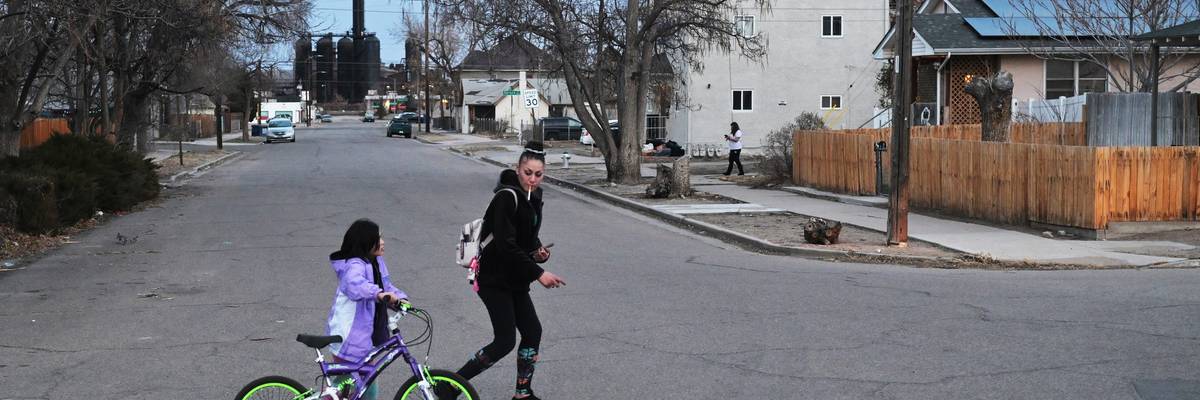
Angelic Herrera and her 11-year-old daughter, Xerih, walk home in Pueblo, Colorado, on February 3, 2025. In the background stands a steel mill built in 1881, a symbol of the city’s environmental justice challenges.
Local and state cumulative impacts laws can provide needed protections for communities where the federal government is failing, and make fertile ground for future federal progress.
One year ago, the Trump administration launched an agenda putting polluting corporations over our health, lives, and future. This week marks the anniversary of the first-ever environmental justice executive order, and yet we are left in the wake of dozens of harmful orders from Trump rescinding that very order and more targeting environmental justice. Along with unprecedented health and environmental rollbacks, this administration is forcing our communities to bear the greatest costs. Now, local leadership is essential. Groundbreaking state and local laws are filling gaps, showing what is possible, and building momentum for what’s next.
While the federal government unlawfully claws back lifesaving investments such as billions of dollars of grants to clean up water, remove lead, and create clean energy jobs in disadvantaged communities, they’ve also attacked over 30 environmental protections, including undoing stronger soot pollution regulations, and gutted bedrock laws. These actions will cause environmental justice neighborhoods (communities of color and low income) to suffer major consequences, with even more toxic pollution and growing impacts of climate change—threatening jobs, families, and lives.
Seventy-eight million people of color live with dangerous air pollution, and, in 97% of US counties, Black people have the highest death rates from soot pollution. In 2025, 75% of the US population—255 million people—were exposed to “dangerous, life-threatening” heat. In NYC, Black people represent 50% of heat-related deaths, despite being only 25% of the population.
These outsize health harms are no accident. A history of redlining was followed by a disproportionate amount of pollution being dumped in communities of color's backyards. Cumulative impacts are the result. Put simply, cumulative impacts are the combination of many sources of pollution and pressures in an area creating a multiplying effect. Visit any community of color or low income overloaded with highways, industrial, or chemical facilities—like the South Bronx, Newark, or “Cancer Alley” in Louisiana—and you will experience the soot, smog, heat, toxic fumes, and smells that show what cumulative impacts really are. Cumulative impacts laws can be a solution by checking the amount of polluting facilities in an area before allowing more to be built, ending old loopholes for existing facilities, limiting new pollution, and more.
The time for reimagining and recommitting to our ambition to achieve environmental justice is now.
State laws can inform and complement the creation of federal laws like the Environmental Justice for All Act, introduced by the late Reps. Donald McEachin (D-Va.) and Raúl Grijalva (D-Ariz.) in 2020. This act embodies input from communities from across the US, and has the promise of being reintroduced by a new generation of congressional champions, inspired by state progress.
We also need these laws to be backed by strong implementation. It is a key moment in New York as the Department of Environmental Conservation is developing rules to carry out the cumulative impacts law. In New Jersey, their Department of Environmental Protection is issuing its first permit decisions based on the cumulative impacts law. These decisions need to set a precedent to break with business as usual, while implementing the strongest conditions in accordance with the environmental justice law. In both cases, the process to put these laws into action must offer real protections and meaningfully include communities.
The time for reimagining and recommitting to our ambition to achieve environmental justice is now. State and local governments must step up in the face of federal attacks and maintain the momentum that environmental justice communities demand and deserve. In this moment, we need more state and local cumulative impact laws that hold the promise of a long-overdue vision of safe and healthy places to live, work, play, and pray.
Dear Common Dreams reader, It’s been nearly 30 years since I co-founded Common Dreams with my late wife, Lina Newhouser. We had the radical notion that journalism should serve the public good, not corporate profits. It was clear to us from the outset what it would take to build such a project. No paid advertisements. No corporate sponsors. No millionaire publisher telling us what to think or do. Many people said we wouldn't last a year, but we proved those doubters wrong. Together with a tremendous team of journalists and dedicated staff, we built an independent media outlet free from the constraints of profits and corporate control. Our mission has always been simple: To inform. To inspire. To ignite change for the common good. Building Common Dreams was not easy. Our survival was never guaranteed. When you take on the most powerful forces—Wall Street greed, fossil fuel industry destruction, Big Tech lobbyists, and uber-rich oligarchs who have spent billions upon billions rigging the economy and democracy in their favor—the only bulwark you have is supporters who believe in your work. But here’s the urgent message from me today. It's never been this bad out there. And it's never been this hard to keep us going. At the very moment Common Dreams is most needed, the threats we face are intensifying. We need your support now more than ever. We don't accept corporate advertising and never will. We don't have a paywall because we don't think people should be blocked from critical news based on their ability to pay. Everything we do is funded by the donations of readers like you. When everyone does the little they can afford, we are strong. But if that support retreats or dries up, so do we. Will you donate now to make sure Common Dreams not only survives but thrives? —Craig Brown, Co-founder |
One year ago, the Trump administration launched an agenda putting polluting corporations over our health, lives, and future. This week marks the anniversary of the first-ever environmental justice executive order, and yet we are left in the wake of dozens of harmful orders from Trump rescinding that very order and more targeting environmental justice. Along with unprecedented health and environmental rollbacks, this administration is forcing our communities to bear the greatest costs. Now, local leadership is essential. Groundbreaking state and local laws are filling gaps, showing what is possible, and building momentum for what’s next.
While the federal government unlawfully claws back lifesaving investments such as billions of dollars of grants to clean up water, remove lead, and create clean energy jobs in disadvantaged communities, they’ve also attacked over 30 environmental protections, including undoing stronger soot pollution regulations, and gutted bedrock laws. These actions will cause environmental justice neighborhoods (communities of color and low income) to suffer major consequences, with even more toxic pollution and growing impacts of climate change—threatening jobs, families, and lives.
Seventy-eight million people of color live with dangerous air pollution, and, in 97% of US counties, Black people have the highest death rates from soot pollution. In 2025, 75% of the US population—255 million people—were exposed to “dangerous, life-threatening” heat. In NYC, Black people represent 50% of heat-related deaths, despite being only 25% of the population.
These outsize health harms are no accident. A history of redlining was followed by a disproportionate amount of pollution being dumped in communities of color's backyards. Cumulative impacts are the result. Put simply, cumulative impacts are the combination of many sources of pollution and pressures in an area creating a multiplying effect. Visit any community of color or low income overloaded with highways, industrial, or chemical facilities—like the South Bronx, Newark, or “Cancer Alley” in Louisiana—and you will experience the soot, smog, heat, toxic fumes, and smells that show what cumulative impacts really are. Cumulative impacts laws can be a solution by checking the amount of polluting facilities in an area before allowing more to be built, ending old loopholes for existing facilities, limiting new pollution, and more.
The time for reimagining and recommitting to our ambition to achieve environmental justice is now.
State laws can inform and complement the creation of federal laws like the Environmental Justice for All Act, introduced by the late Reps. Donald McEachin (D-Va.) and Raúl Grijalva (D-Ariz.) in 2020. This act embodies input from communities from across the US, and has the promise of being reintroduced by a new generation of congressional champions, inspired by state progress.
We also need these laws to be backed by strong implementation. It is a key moment in New York as the Department of Environmental Conservation is developing rules to carry out the cumulative impacts law. In New Jersey, their Department of Environmental Protection is issuing its first permit decisions based on the cumulative impacts law. These decisions need to set a precedent to break with business as usual, while implementing the strongest conditions in accordance with the environmental justice law. In both cases, the process to put these laws into action must offer real protections and meaningfully include communities.
The time for reimagining and recommitting to our ambition to achieve environmental justice is now. State and local governments must step up in the face of federal attacks and maintain the momentum that environmental justice communities demand and deserve. In this moment, we need more state and local cumulative impact laws that hold the promise of a long-overdue vision of safe and healthy places to live, work, play, and pray.
One year ago, the Trump administration launched an agenda putting polluting corporations over our health, lives, and future. This week marks the anniversary of the first-ever environmental justice executive order, and yet we are left in the wake of dozens of harmful orders from Trump rescinding that very order and more targeting environmental justice. Along with unprecedented health and environmental rollbacks, this administration is forcing our communities to bear the greatest costs. Now, local leadership is essential. Groundbreaking state and local laws are filling gaps, showing what is possible, and building momentum for what’s next.
While the federal government unlawfully claws back lifesaving investments such as billions of dollars of grants to clean up water, remove lead, and create clean energy jobs in disadvantaged communities, they’ve also attacked over 30 environmental protections, including undoing stronger soot pollution regulations, and gutted bedrock laws. These actions will cause environmental justice neighborhoods (communities of color and low income) to suffer major consequences, with even more toxic pollution and growing impacts of climate change—threatening jobs, families, and lives.
Seventy-eight million people of color live with dangerous air pollution, and, in 97% of US counties, Black people have the highest death rates from soot pollution. In 2025, 75% of the US population—255 million people—were exposed to “dangerous, life-threatening” heat. In NYC, Black people represent 50% of heat-related deaths, despite being only 25% of the population.
These outsize health harms are no accident. A history of redlining was followed by a disproportionate amount of pollution being dumped in communities of color's backyards. Cumulative impacts are the result. Put simply, cumulative impacts are the combination of many sources of pollution and pressures in an area creating a multiplying effect. Visit any community of color or low income overloaded with highways, industrial, or chemical facilities—like the South Bronx, Newark, or “Cancer Alley” in Louisiana—and you will experience the soot, smog, heat, toxic fumes, and smells that show what cumulative impacts really are. Cumulative impacts laws can be a solution by checking the amount of polluting facilities in an area before allowing more to be built, ending old loopholes for existing facilities, limiting new pollution, and more.
The time for reimagining and recommitting to our ambition to achieve environmental justice is now.
State laws can inform and complement the creation of federal laws like the Environmental Justice for All Act, introduced by the late Reps. Donald McEachin (D-Va.) and Raúl Grijalva (D-Ariz.) in 2020. This act embodies input from communities from across the US, and has the promise of being reintroduced by a new generation of congressional champions, inspired by state progress.
We also need these laws to be backed by strong implementation. It is a key moment in New York as the Department of Environmental Conservation is developing rules to carry out the cumulative impacts law. In New Jersey, their Department of Environmental Protection is issuing its first permit decisions based on the cumulative impacts law. These decisions need to set a precedent to break with business as usual, while implementing the strongest conditions in accordance with the environmental justice law. In both cases, the process to put these laws into action must offer real protections and meaningfully include communities.
The time for reimagining and recommitting to our ambition to achieve environmental justice is now. State and local governments must step up in the face of federal attacks and maintain the momentum that environmental justice communities demand and deserve. In this moment, we need more state and local cumulative impact laws that hold the promise of a long-overdue vision of safe and healthy places to live, work, play, and pray.