SUBSCRIBE TO OUR FREE NEWSLETTER
Daily news & progressive opinion—funded by the people, not the corporations—delivered straight to your inbox.
5
#000000
#FFFFFF
To donate by check, phone, or other method, see our More Ways to Give page.
Daily news & progressive opinion—funded by the people, not the corporations—delivered straight to your inbox.
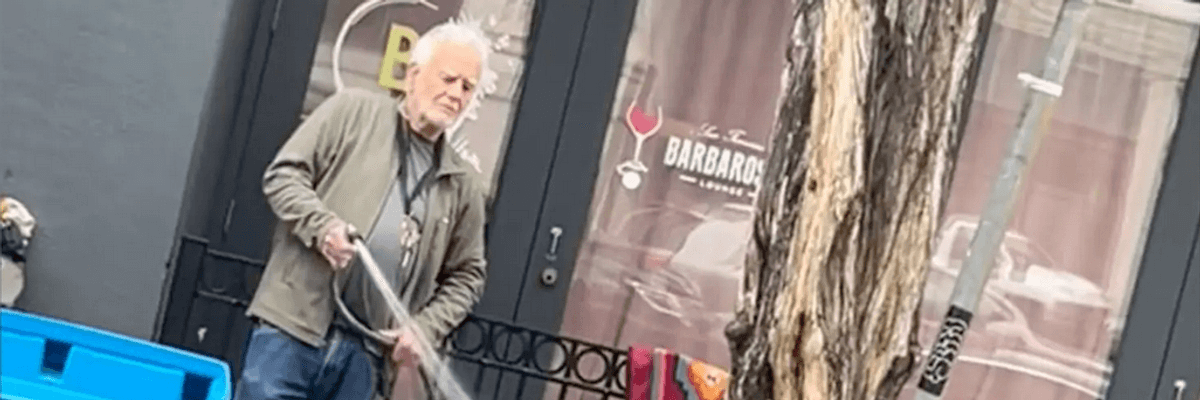
Gallery owner Shannon Collier Gwin, 71, spraying a homeless woman on the sidewalk outside his art gallery in San Francisco’s Financial District, in a video that circulated widely on social media earlier this month.
Gwin's violence against this homeless woman was despicable, and he should be held accountable for his crime.
In the 14-second video now seen by millions, San Francisco gallery owner Collier Gwin stands nonchalant yet intent, his legs crossed casually, his age-folded face glaring as he pummels a Black homeless woman on the sidewalk with cold water spray.
Yes, it's 2023, and a wealthy White man is blasting a hose on a homeless Black woman for sitting on the sidewalk, literally as if she were trash. Power dynamics don't get much starker than that.
We hear of vile, violent abuses against homeless people often, but it's rarely caught on video. Here, thanks to a concerned passerby, Gwin's soulless, sickening assault became documented, indisputable evidence of a violent crime. He's right there in the video, glaring at the woman, blasting cold water on her, shouting "Move! Move!"
Unhoused people are told to "move" constantly, by vigilantes like Gwin and by city police, public works teams, and by society writ large. Just "move" away from this spot right here, where we can see you, to some other spot; out of sight, out of mind.
In a moment, Collier Gwin became a hashtag of horrors, his gallery a window-shattered memory, a one-starred on Yelp. With rising anger came alleged death threats, and soon local television predictably changed the narrative: suddenly, the story was about Gwin's grievances, his lost patience after supposedly trying to help the woman, and about the cascading threats. There was no talk about the homeless woman, her loss and pain, her experience surviving on these cold mean streets.
The woman, the crime victim, was disappeared—nameless, faceless, lost entirely from view. She was described only in Gwin's terms, as a nuisance. We can't even "say her name," because we don't know it.
The woman, the crime victim, was disappeared—nameless, faceless, lost entirely from view.
Meanwhile Gwin, who was at first stunningly unapologetic, embarked on an apology tour of sorts, with a maddeningly compliant media aiding and abetting. He griped to local media, "Nobody can get into their stores or into their offices. And so consequently, you know, if she got wet when that was happening, it was because she was there getting wet."
Instead of a story of violence against a homeless woman, the narrative became about Gwin "snapping," about " patience wearing thin" with homelessness—and even with the term "the homeless," as media still call "them." Instead of a story about the larger violence and criminality of homelessness amid this city and region's epic wealth, Gwin's assault became contorted into a "yeah, but" tale of ultra-privileged exasperation at the unsightly, unprofitable plight in the streets.
Lost in the hubbub about Gwin's attack is the larger constant violence that San Francisco and other big cities wage on unhoused human beings every day. Here in this supposedly "liberal," allegedly "tolerant" city of Saint Francis, homeless people are policed relentlessly, pushed from block to block, and "swept" from view by the city's Department of Public Works, their tents and belongings (clothing, medication, other personal valuables) destroyed.
Even in this cold rainy "Bomb cyclone" winter that's been nasty enough for President Biden to declare a state of emergency, the city continues to "sweep" away homeless people and trash their belongings—in violation of both basic humanity and a court ruling ordering the city to stop its "sweeps" when it has a chronic shortage of shelter space.
This and other daily violence against unhoused human beings is enabled and empowered by an increasingly virulent, reactionary narrative that the poorest of the poor in our society are somehow the problem, that "they" are a nuisance, that "they" are the ones to blame. This is not just a rightwing Republican talking point—it is increasingly adopted by neoliberal Democrats and so-called "moderates" and centrists who insist they are "fed up" with the crises in the streets.
Just a day before Gwin's hose spraying attack, one Tweeter I regrettably engaged with bellowed, "Good, sweep them all away!" Three others "liked" the comment. Another said of homeless people, "Comfortable is a state of being for them. They prefer to not work. No responsibility. No bills. Do drugs. Get free stuff/food." Many peddle the bizarre false notion that the city "pays" homeless people hundreds of dollars a month to live on the streets. Even if someone filled out endless forms, stood on endless lines, and managed to get a host of city, county, state, and federal aid that somehow amounted to "hundreds" of dollars, it would be at best barely enough to stay alive, and nothing more.
This increasingly predominant and insidious neoliberal view falsely (and counter-productively) blames the individual rather than the system (yes, our structural system) of extreme private wealth accumulation and a 40-year demolition of public-sector solutions that are the real root causes of this impoverishment and suffering. We can chart this back to President Reagan's decimation of aid to poor people, and mental health and public housing supports.
We should all be fed up with acts like Gwin's inhumane assault and by the city's daily violence and harassment of homeless people. We should all be fed up with the completely preventable epidemic of homelessness amid epic, obscene wealth and inequality. We should all be fed up knowing that, for all its complexities and varied contexts, homelessness can be prevented by mustering our vast financial resources (city, regional, and national) and some political humanity and courage to invest in meeting people's basic needs.
Gwin's violence against this homeless woman was despicable, and he should be held accountable for his crime. It took more than a week for district attorney Brooke Jenkins to issue an arrest warrant, charging Gwin with misdemeanor battery "for the alleged intentional and unlawful spraying of water on and around a woman experiencing homelessness." With TV crews conveniently on hand, city police picked up Gwin at his gallery.
Meanwhile, the larger crime of homelessness amid extreme wealth goes unchecked; as does the city's ongoing "sweeps" of unhoused people and illegal destruction of their belongings, in violation of court orders. While Gwin's violence against a homeless woman may seem an egregious outlier, it's indicative of a broader violence, hatred, and dehumanizing of homeless human beings. For homelessness to end, this larger violence and crime—the false, stale, and harmful blaming and scapegoating of homeless people, the perception that "they" are the problem—must end.
Dear Common Dreams reader, It’s been nearly 30 years since I co-founded Common Dreams with my late wife, Lina Newhouser. We had the radical notion that journalism should serve the public good, not corporate profits. It was clear to us from the outset what it would take to build such a project. No paid advertisements. No corporate sponsors. No millionaire publisher telling us what to think or do. Many people said we wouldn't last a year, but we proved those doubters wrong. Together with a tremendous team of journalists and dedicated staff, we built an independent media outlet free from the constraints of profits and corporate control. Our mission has always been simple: To inform. To inspire. To ignite change for the common good. Building Common Dreams was not easy. Our survival was never guaranteed. When you take on the most powerful forces—Wall Street greed, fossil fuel industry destruction, Big Tech lobbyists, and uber-rich oligarchs who have spent billions upon billions rigging the economy and democracy in their favor—the only bulwark you have is supporters who believe in your work. But here’s the urgent message from me today. It's never been this bad out there. And it's never been this hard to keep us going. At the very moment Common Dreams is most needed, the threats we face are intensifying. We need your support now more than ever. We don't accept corporate advertising and never will. We don't have a paywall because we don't think people should be blocked from critical news based on their ability to pay. Everything we do is funded by the donations of readers like you. When everyone does the little they can afford, we are strong. But if that support retreats or dries up, so do we. Will you donate now to make sure Common Dreams not only survives but thrives? —Craig Brown, Co-founder |
In the 14-second video now seen by millions, San Francisco gallery owner Collier Gwin stands nonchalant yet intent, his legs crossed casually, his age-folded face glaring as he pummels a Black homeless woman on the sidewalk with cold water spray.
Yes, it's 2023, and a wealthy White man is blasting a hose on a homeless Black woman for sitting on the sidewalk, literally as if she were trash. Power dynamics don't get much starker than that.
We hear of vile, violent abuses against homeless people often, but it's rarely caught on video. Here, thanks to a concerned passerby, Gwin's soulless, sickening assault became documented, indisputable evidence of a violent crime. He's right there in the video, glaring at the woman, blasting cold water on her, shouting "Move! Move!"
Unhoused people are told to "move" constantly, by vigilantes like Gwin and by city police, public works teams, and by society writ large. Just "move" away from this spot right here, where we can see you, to some other spot; out of sight, out of mind.
In a moment, Collier Gwin became a hashtag of horrors, his gallery a window-shattered memory, a one-starred on Yelp. With rising anger came alleged death threats, and soon local television predictably changed the narrative: suddenly, the story was about Gwin's grievances, his lost patience after supposedly trying to help the woman, and about the cascading threats. There was no talk about the homeless woman, her loss and pain, her experience surviving on these cold mean streets.
The woman, the crime victim, was disappeared—nameless, faceless, lost entirely from view. She was described only in Gwin's terms, as a nuisance. We can't even "say her name," because we don't know it.
The woman, the crime victim, was disappeared—nameless, faceless, lost entirely from view.
Meanwhile Gwin, who was at first stunningly unapologetic, embarked on an apology tour of sorts, with a maddeningly compliant media aiding and abetting. He griped to local media, "Nobody can get into their stores or into their offices. And so consequently, you know, if she got wet when that was happening, it was because she was there getting wet."
Instead of a story of violence against a homeless woman, the narrative became about Gwin "snapping," about " patience wearing thin" with homelessness—and even with the term "the homeless," as media still call "them." Instead of a story about the larger violence and criminality of homelessness amid this city and region's epic wealth, Gwin's assault became contorted into a "yeah, but" tale of ultra-privileged exasperation at the unsightly, unprofitable plight in the streets.
Lost in the hubbub about Gwin's attack is the larger constant violence that San Francisco and other big cities wage on unhoused human beings every day. Here in this supposedly "liberal," allegedly "tolerant" city of Saint Francis, homeless people are policed relentlessly, pushed from block to block, and "swept" from view by the city's Department of Public Works, their tents and belongings (clothing, medication, other personal valuables) destroyed.
Even in this cold rainy "Bomb cyclone" winter that's been nasty enough for President Biden to declare a state of emergency, the city continues to "sweep" away homeless people and trash their belongings—in violation of both basic humanity and a court ruling ordering the city to stop its "sweeps" when it has a chronic shortage of shelter space.
This and other daily violence against unhoused human beings is enabled and empowered by an increasingly virulent, reactionary narrative that the poorest of the poor in our society are somehow the problem, that "they" are a nuisance, that "they" are the ones to blame. This is not just a rightwing Republican talking point—it is increasingly adopted by neoliberal Democrats and so-called "moderates" and centrists who insist they are "fed up" with the crises in the streets.
Just a day before Gwin's hose spraying attack, one Tweeter I regrettably engaged with bellowed, "Good, sweep them all away!" Three others "liked" the comment. Another said of homeless people, "Comfortable is a state of being for them. They prefer to not work. No responsibility. No bills. Do drugs. Get free stuff/food." Many peddle the bizarre false notion that the city "pays" homeless people hundreds of dollars a month to live on the streets. Even if someone filled out endless forms, stood on endless lines, and managed to get a host of city, county, state, and federal aid that somehow amounted to "hundreds" of dollars, it would be at best barely enough to stay alive, and nothing more.
This increasingly predominant and insidious neoliberal view falsely (and counter-productively) blames the individual rather than the system (yes, our structural system) of extreme private wealth accumulation and a 40-year demolition of public-sector solutions that are the real root causes of this impoverishment and suffering. We can chart this back to President Reagan's decimation of aid to poor people, and mental health and public housing supports.
We should all be fed up with acts like Gwin's inhumane assault and by the city's daily violence and harassment of homeless people. We should all be fed up with the completely preventable epidemic of homelessness amid epic, obscene wealth and inequality. We should all be fed up knowing that, for all its complexities and varied contexts, homelessness can be prevented by mustering our vast financial resources (city, regional, and national) and some political humanity and courage to invest in meeting people's basic needs.
Gwin's violence against this homeless woman was despicable, and he should be held accountable for his crime. It took more than a week for district attorney Brooke Jenkins to issue an arrest warrant, charging Gwin with misdemeanor battery "for the alleged intentional and unlawful spraying of water on and around a woman experiencing homelessness." With TV crews conveniently on hand, city police picked up Gwin at his gallery.
Meanwhile, the larger crime of homelessness amid extreme wealth goes unchecked; as does the city's ongoing "sweeps" of unhoused people and illegal destruction of their belongings, in violation of court orders. While Gwin's violence against a homeless woman may seem an egregious outlier, it's indicative of a broader violence, hatred, and dehumanizing of homeless human beings. For homelessness to end, this larger violence and crime—the false, stale, and harmful blaming and scapegoating of homeless people, the perception that "they" are the problem—must end.
In the 14-second video now seen by millions, San Francisco gallery owner Collier Gwin stands nonchalant yet intent, his legs crossed casually, his age-folded face glaring as he pummels a Black homeless woman on the sidewalk with cold water spray.
Yes, it's 2023, and a wealthy White man is blasting a hose on a homeless Black woman for sitting on the sidewalk, literally as if she were trash. Power dynamics don't get much starker than that.
We hear of vile, violent abuses against homeless people often, but it's rarely caught on video. Here, thanks to a concerned passerby, Gwin's soulless, sickening assault became documented, indisputable evidence of a violent crime. He's right there in the video, glaring at the woman, blasting cold water on her, shouting "Move! Move!"
Unhoused people are told to "move" constantly, by vigilantes like Gwin and by city police, public works teams, and by society writ large. Just "move" away from this spot right here, where we can see you, to some other spot; out of sight, out of mind.
In a moment, Collier Gwin became a hashtag of horrors, his gallery a window-shattered memory, a one-starred on Yelp. With rising anger came alleged death threats, and soon local television predictably changed the narrative: suddenly, the story was about Gwin's grievances, his lost patience after supposedly trying to help the woman, and about the cascading threats. There was no talk about the homeless woman, her loss and pain, her experience surviving on these cold mean streets.
The woman, the crime victim, was disappeared—nameless, faceless, lost entirely from view. She was described only in Gwin's terms, as a nuisance. We can't even "say her name," because we don't know it.
The woman, the crime victim, was disappeared—nameless, faceless, lost entirely from view.
Meanwhile Gwin, who was at first stunningly unapologetic, embarked on an apology tour of sorts, with a maddeningly compliant media aiding and abetting. He griped to local media, "Nobody can get into their stores or into their offices. And so consequently, you know, if she got wet when that was happening, it was because she was there getting wet."
Instead of a story of violence against a homeless woman, the narrative became about Gwin "snapping," about " patience wearing thin" with homelessness—and even with the term "the homeless," as media still call "them." Instead of a story about the larger violence and criminality of homelessness amid this city and region's epic wealth, Gwin's assault became contorted into a "yeah, but" tale of ultra-privileged exasperation at the unsightly, unprofitable plight in the streets.
Lost in the hubbub about Gwin's attack is the larger constant violence that San Francisco and other big cities wage on unhoused human beings every day. Here in this supposedly "liberal," allegedly "tolerant" city of Saint Francis, homeless people are policed relentlessly, pushed from block to block, and "swept" from view by the city's Department of Public Works, their tents and belongings (clothing, medication, other personal valuables) destroyed.
Even in this cold rainy "Bomb cyclone" winter that's been nasty enough for President Biden to declare a state of emergency, the city continues to "sweep" away homeless people and trash their belongings—in violation of both basic humanity and a court ruling ordering the city to stop its "sweeps" when it has a chronic shortage of shelter space.
This and other daily violence against unhoused human beings is enabled and empowered by an increasingly virulent, reactionary narrative that the poorest of the poor in our society are somehow the problem, that "they" are a nuisance, that "they" are the ones to blame. This is not just a rightwing Republican talking point—it is increasingly adopted by neoliberal Democrats and so-called "moderates" and centrists who insist they are "fed up" with the crises in the streets.
Just a day before Gwin's hose spraying attack, one Tweeter I regrettably engaged with bellowed, "Good, sweep them all away!" Three others "liked" the comment. Another said of homeless people, "Comfortable is a state of being for them. They prefer to not work. No responsibility. No bills. Do drugs. Get free stuff/food." Many peddle the bizarre false notion that the city "pays" homeless people hundreds of dollars a month to live on the streets. Even if someone filled out endless forms, stood on endless lines, and managed to get a host of city, county, state, and federal aid that somehow amounted to "hundreds" of dollars, it would be at best barely enough to stay alive, and nothing more.
This increasingly predominant and insidious neoliberal view falsely (and counter-productively) blames the individual rather than the system (yes, our structural system) of extreme private wealth accumulation and a 40-year demolition of public-sector solutions that are the real root causes of this impoverishment and suffering. We can chart this back to President Reagan's decimation of aid to poor people, and mental health and public housing supports.
We should all be fed up with acts like Gwin's inhumane assault and by the city's daily violence and harassment of homeless people. We should all be fed up with the completely preventable epidemic of homelessness amid epic, obscene wealth and inequality. We should all be fed up knowing that, for all its complexities and varied contexts, homelessness can be prevented by mustering our vast financial resources (city, regional, and national) and some political humanity and courage to invest in meeting people's basic needs.
Gwin's violence against this homeless woman was despicable, and he should be held accountable for his crime. It took more than a week for district attorney Brooke Jenkins to issue an arrest warrant, charging Gwin with misdemeanor battery "for the alleged intentional and unlawful spraying of water on and around a woman experiencing homelessness." With TV crews conveniently on hand, city police picked up Gwin at his gallery.
Meanwhile, the larger crime of homelessness amid extreme wealth goes unchecked; as does the city's ongoing "sweeps" of unhoused people and illegal destruction of their belongings, in violation of court orders. While Gwin's violence against a homeless woman may seem an egregious outlier, it's indicative of a broader violence, hatred, and dehumanizing of homeless human beings. For homelessness to end, this larger violence and crime—the false, stale, and harmful blaming and scapegoating of homeless people, the perception that "they" are the problem—must end.