

SUBSCRIBE TO OUR FREE NEWSLETTER
Daily news & progressive opinion—funded by the people, not the corporations—delivered straight to your inbox.
5
#000000
#FFFFFF
To donate by check, phone, or other method, see our More Ways to Give page.
Daily news & progressive opinion—funded by the people, not the corporations—delivered straight to your inbox.
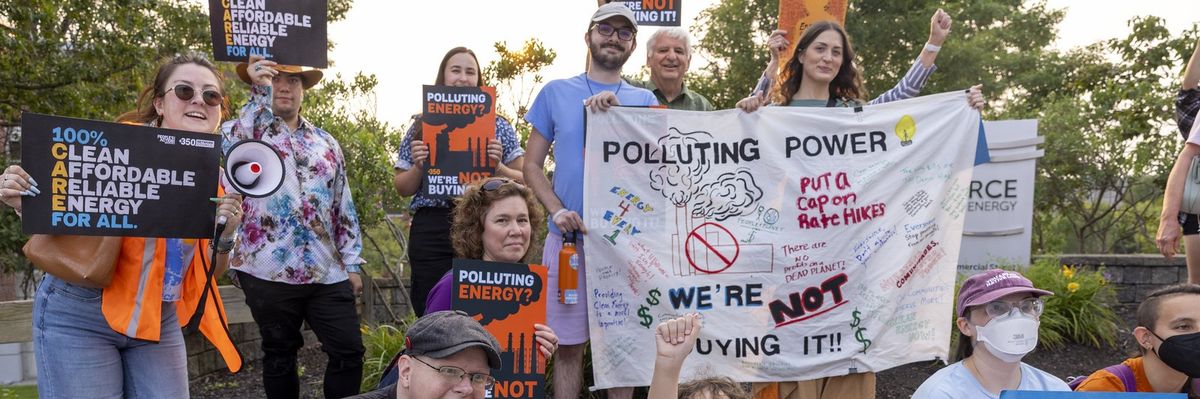
Thirty people gather in Manchester, New Hampshire to call on utility company Eversource to make energy more clean and affordable.
From the Sun Belt to New England, over two dozen coordinated actions were held in 17 states to fight back against monopoly utility companies’ rate hikes and greenwashing.
Across the country, families rely on utility companies to provide the power we need to heat and cool our homes, cook, bathe, and charge the devices we rely on. But instead of focusing on delivering clean, affordable, reliable power to ratepayers, for-profit utility companies are hiking rates on working families while doubling down on fossil fuels. As temperatures rise and utility bills soar, working families have had enough.
This month, ratepayers launched a nationwide escalation for utility justice. From the Sun Belt to New England, over two dozen coordinated actions were held in 17 states to fight back against utility rate hikes and greenwashing. This is a powerful beginning to a locally led, national movement to demand clean, renewable energy from for-profit utility companies, and stop rate hikes for dirty power.
In New Hampshire, climate activists are opposing a 16% rate hike that has been proposed by Eversource, which serves over 70% of the state. The increase is currently under review by the public utilities commission (PUC). The governor-appointed public utilities commission approved the rate hike, as they have with every cost increase that the utility companies have proposed in the last three years. After grassroots organizers stopped Liberty Utilities, another New Hampshire utility company, from building the Granite Bridge fracked gas pipeline in 2020, Liberty attempted to recoup more than $7 million they spent toward the proposal by raising electricity rates. The public utilities commission denied Liberty’s outrageous request, but this is not the first time a utility company has tried to put their expensive failed fossil fuel projects in ratepayers’ utility bills.
There is a long precedent of publicly-owned, democratically-controlled utility companies in the United States and around the world, and no reason why we should assume dirty, corporate-controlled utility companies relying on energy sources of the 1900s have to be our future.
The fights happening in New Hampshire with utility companies are familiar across the country. From Buffalo, New York to the Bay Area of California, ratepayers are protesting and organizing to hold for-profit utility corporations accountable for squeezing ratepayers to pad their pockets while burning the planet.
In Nevada, working families, ratepayers, and climate activists are fighting to stop NV Energy from nearly tripling its monthly fixed service charge on electric bills from $16.50 to $44.40 while lowering the volumetric charge. This regressive policy means ratepayers who use less energy will be charged more, while heavy energy users, like wealthy corporations, will be charged less—it’s wrong. Nevada is one of the fastest-heating states in the nation, and relies on electricity to keep communities comfortable. With NV Energy’s monopoly power and rising temperatures, Nevadans feel like the odds are stacked against them.
Like many for-profit utility companies, NV Energy is raising rates and burning the planet, instead of capitalizing on the plentiful solar capacity of the Sun Belt state it serves. Nevadans are pushing the Public Utilities Commission to stand up for clean, affordable, reliable energy. With an unprecedented $369 billion in federal investments unlocked in the two-year-old Inflation Reduction Act (IRA) to support the transition to clean energy, utility corporations have no excuse, besides greed, to keep charging ratepayers for dirty, expensive, unreliable power.
While companies have raised electricity prices nearly 31% since 2021, and over of a quarter of Americans struggle to pay their utility bills, activists are fighting to stop rate hikes, stop expansions of dirty power, and pressure lawmakers to stop taking political contributions from the utility corporations they are responsible for regulating.
Local communities are right to hold utility corporations accountable for raising costs on families and stalling action on clean energy. But the underlying structure of monopoly utility companies is not sustainable. When given a once-in-a-generation opportunity to transition to a sustainable energy future through the IRA, they opt to expand gas lines and invest in dirty power. Utility Corporations are failing to reimagine how growing electricity needs could be met with wind, solar, geothermal, energy efficiency, and energy conservation efforts.They have no incentive to lower costs for families, and every incentive to use their massive lobbying power to influence policy and raise rates.
Despite the money we pay each month, for-profit utility companies are not accountable to us, and their monopoly power leaves us with no alternatives. The system is rigged, but it does not have to be this way.
Together, we can change the rules. There is a long precedent of publicly-owned, democratically-controlled utility companies in the United States and around the world, and no reason why we should assume dirty, corporate-controlled utility companies relying on energy sources of the 1900s have to be our future. Now is the time to demand utility justice, to ensure clean, affordable, and reliable energy for all in a way that puts people and the planet first.
Dear Common Dreams reader, It’s been nearly 30 years since I co-founded Common Dreams with my late wife, Lina Newhouser. We had the radical notion that journalism should serve the public good, not corporate profits. It was clear to us from the outset what it would take to build such a project. No paid advertisements. No corporate sponsors. No millionaire publisher telling us what to think or do. Many people said we wouldn't last a year, but we proved those doubters wrong. Together with a tremendous team of journalists and dedicated staff, we built an independent media outlet free from the constraints of profits and corporate control. Our mission has always been simple: To inform. To inspire. To ignite change for the common good. Building Common Dreams was not easy. Our survival was never guaranteed. When you take on the most powerful forces—Wall Street greed, fossil fuel industry destruction, Big Tech lobbyists, and uber-rich oligarchs who have spent billions upon billions rigging the economy and democracy in their favor—the only bulwark you have is supporters who believe in your work. But here’s the urgent message from me today. It's never been this bad out there. And it's never been this hard to keep us going. At the very moment Common Dreams is most needed, the threats we face are intensifying. We need your support now more than ever. We don't accept corporate advertising and never will. We don't have a paywall because we don't think people should be blocked from critical news based on their ability to pay. Everything we do is funded by the donations of readers like you. When everyone does the little they can afford, we are strong. But if that support retreats or dries up, so do we. Will you donate now to make sure Common Dreams not only survives but thrives? —Craig Brown, Co-founder |
Across the country, families rely on utility companies to provide the power we need to heat and cool our homes, cook, bathe, and charge the devices we rely on. But instead of focusing on delivering clean, affordable, reliable power to ratepayers, for-profit utility companies are hiking rates on working families while doubling down on fossil fuels. As temperatures rise and utility bills soar, working families have had enough.
This month, ratepayers launched a nationwide escalation for utility justice. From the Sun Belt to New England, over two dozen coordinated actions were held in 17 states to fight back against utility rate hikes and greenwashing. This is a powerful beginning to a locally led, national movement to demand clean, renewable energy from for-profit utility companies, and stop rate hikes for dirty power.
In New Hampshire, climate activists are opposing a 16% rate hike that has been proposed by Eversource, which serves over 70% of the state. The increase is currently under review by the public utilities commission (PUC). The governor-appointed public utilities commission approved the rate hike, as they have with every cost increase that the utility companies have proposed in the last three years. After grassroots organizers stopped Liberty Utilities, another New Hampshire utility company, from building the Granite Bridge fracked gas pipeline in 2020, Liberty attempted to recoup more than $7 million they spent toward the proposal by raising electricity rates. The public utilities commission denied Liberty’s outrageous request, but this is not the first time a utility company has tried to put their expensive failed fossil fuel projects in ratepayers’ utility bills.
There is a long precedent of publicly-owned, democratically-controlled utility companies in the United States and around the world, and no reason why we should assume dirty, corporate-controlled utility companies relying on energy sources of the 1900s have to be our future.
The fights happening in New Hampshire with utility companies are familiar across the country. From Buffalo, New York to the Bay Area of California, ratepayers are protesting and organizing to hold for-profit utility corporations accountable for squeezing ratepayers to pad their pockets while burning the planet.
In Nevada, working families, ratepayers, and climate activists are fighting to stop NV Energy from nearly tripling its monthly fixed service charge on electric bills from $16.50 to $44.40 while lowering the volumetric charge. This regressive policy means ratepayers who use less energy will be charged more, while heavy energy users, like wealthy corporations, will be charged less—it’s wrong. Nevada is one of the fastest-heating states in the nation, and relies on electricity to keep communities comfortable. With NV Energy’s monopoly power and rising temperatures, Nevadans feel like the odds are stacked against them.
Like many for-profit utility companies, NV Energy is raising rates and burning the planet, instead of capitalizing on the plentiful solar capacity of the Sun Belt state it serves. Nevadans are pushing the Public Utilities Commission to stand up for clean, affordable, reliable energy. With an unprecedented $369 billion in federal investments unlocked in the two-year-old Inflation Reduction Act (IRA) to support the transition to clean energy, utility corporations have no excuse, besides greed, to keep charging ratepayers for dirty, expensive, unreliable power.
While companies have raised electricity prices nearly 31% since 2021, and over of a quarter of Americans struggle to pay their utility bills, activists are fighting to stop rate hikes, stop expansions of dirty power, and pressure lawmakers to stop taking political contributions from the utility corporations they are responsible for regulating.
Local communities are right to hold utility corporations accountable for raising costs on families and stalling action on clean energy. But the underlying structure of monopoly utility companies is not sustainable. When given a once-in-a-generation opportunity to transition to a sustainable energy future through the IRA, they opt to expand gas lines and invest in dirty power. Utility Corporations are failing to reimagine how growing electricity needs could be met with wind, solar, geothermal, energy efficiency, and energy conservation efforts.They have no incentive to lower costs for families, and every incentive to use their massive lobbying power to influence policy and raise rates.
Despite the money we pay each month, for-profit utility companies are not accountable to us, and their monopoly power leaves us with no alternatives. The system is rigged, but it does not have to be this way.
Together, we can change the rules. There is a long precedent of publicly-owned, democratically-controlled utility companies in the United States and around the world, and no reason why we should assume dirty, corporate-controlled utility companies relying on energy sources of the 1900s have to be our future. Now is the time to demand utility justice, to ensure clean, affordable, and reliable energy for all in a way that puts people and the planet first.
Across the country, families rely on utility companies to provide the power we need to heat and cool our homes, cook, bathe, and charge the devices we rely on. But instead of focusing on delivering clean, affordable, reliable power to ratepayers, for-profit utility companies are hiking rates on working families while doubling down on fossil fuels. As temperatures rise and utility bills soar, working families have had enough.
This month, ratepayers launched a nationwide escalation for utility justice. From the Sun Belt to New England, over two dozen coordinated actions were held in 17 states to fight back against utility rate hikes and greenwashing. This is a powerful beginning to a locally led, national movement to demand clean, renewable energy from for-profit utility companies, and stop rate hikes for dirty power.
In New Hampshire, climate activists are opposing a 16% rate hike that has been proposed by Eversource, which serves over 70% of the state. The increase is currently under review by the public utilities commission (PUC). The governor-appointed public utilities commission approved the rate hike, as they have with every cost increase that the utility companies have proposed in the last three years. After grassroots organizers stopped Liberty Utilities, another New Hampshire utility company, from building the Granite Bridge fracked gas pipeline in 2020, Liberty attempted to recoup more than $7 million they spent toward the proposal by raising electricity rates. The public utilities commission denied Liberty’s outrageous request, but this is not the first time a utility company has tried to put their expensive failed fossil fuel projects in ratepayers’ utility bills.
There is a long precedent of publicly-owned, democratically-controlled utility companies in the United States and around the world, and no reason why we should assume dirty, corporate-controlled utility companies relying on energy sources of the 1900s have to be our future.
The fights happening in New Hampshire with utility companies are familiar across the country. From Buffalo, New York to the Bay Area of California, ratepayers are protesting and organizing to hold for-profit utility corporations accountable for squeezing ratepayers to pad their pockets while burning the planet.
In Nevada, working families, ratepayers, and climate activists are fighting to stop NV Energy from nearly tripling its monthly fixed service charge on electric bills from $16.50 to $44.40 while lowering the volumetric charge. This regressive policy means ratepayers who use less energy will be charged more, while heavy energy users, like wealthy corporations, will be charged less—it’s wrong. Nevada is one of the fastest-heating states in the nation, and relies on electricity to keep communities comfortable. With NV Energy’s monopoly power and rising temperatures, Nevadans feel like the odds are stacked against them.
Like many for-profit utility companies, NV Energy is raising rates and burning the planet, instead of capitalizing on the plentiful solar capacity of the Sun Belt state it serves. Nevadans are pushing the Public Utilities Commission to stand up for clean, affordable, reliable energy. With an unprecedented $369 billion in federal investments unlocked in the two-year-old Inflation Reduction Act (IRA) to support the transition to clean energy, utility corporations have no excuse, besides greed, to keep charging ratepayers for dirty, expensive, unreliable power.
While companies have raised electricity prices nearly 31% since 2021, and over of a quarter of Americans struggle to pay their utility bills, activists are fighting to stop rate hikes, stop expansions of dirty power, and pressure lawmakers to stop taking political contributions from the utility corporations they are responsible for regulating.
Local communities are right to hold utility corporations accountable for raising costs on families and stalling action on clean energy. But the underlying structure of monopoly utility companies is not sustainable. When given a once-in-a-generation opportunity to transition to a sustainable energy future through the IRA, they opt to expand gas lines and invest in dirty power. Utility Corporations are failing to reimagine how growing electricity needs could be met with wind, solar, geothermal, energy efficiency, and energy conservation efforts.They have no incentive to lower costs for families, and every incentive to use their massive lobbying power to influence policy and raise rates.
Despite the money we pay each month, for-profit utility companies are not accountable to us, and their monopoly power leaves us with no alternatives. The system is rigged, but it does not have to be this way.
Together, we can change the rules. There is a long precedent of publicly-owned, democratically-controlled utility companies in the United States and around the world, and no reason why we should assume dirty, corporate-controlled utility companies relying on energy sources of the 1900s have to be our future. Now is the time to demand utility justice, to ensure clean, affordable, and reliable energy for all in a way that puts people and the planet first.

