SUBSCRIBE TO OUR FREE NEWSLETTER
Daily news & progressive opinion—funded by the people, not the corporations—delivered straight to your inbox.
5
#000000
#FFFFFF
To donate by check, phone, or other method, see our More Ways to Give page.
Daily news & progressive opinion—funded by the people, not the corporations—delivered straight to your inbox.
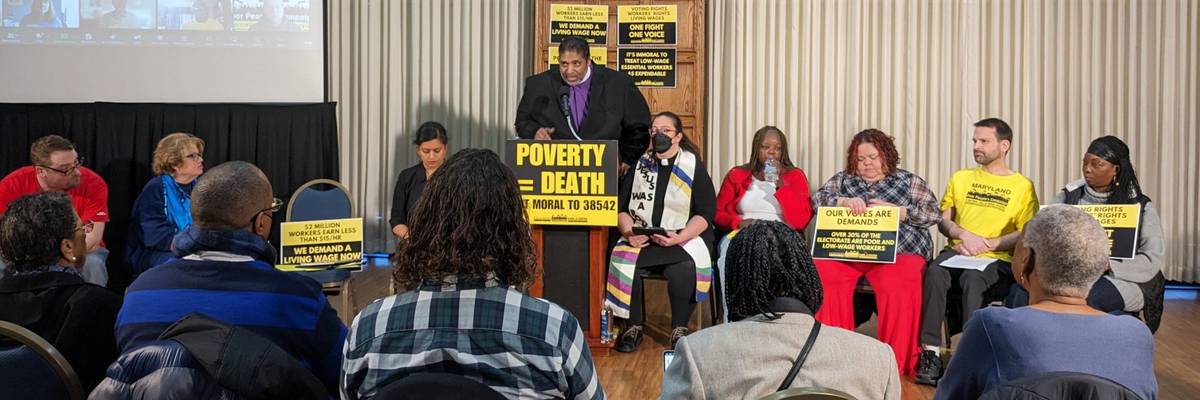
Rev. Dr. William Barber II speaks during the launch of a 2024 election mobilization campaign on February 5, 2024 in Washington, D.C.
The Poor People’s Campaign is organizing to push the concerns of poor and low-income people into the center of the 2024 political debate.
Amidst all the nail-biting uncertainty over the 2024 election, one thing’s for sure: Turnout will be key. This February, the Poor People’s Campaign announced plans to mobilize a powerful yet often overlooked voting bloc: the 85 million eligible voters who are poor or low-income.
The campaign crunched the numbers and determined that if this bloc voted at the same rate as higher-income voters, they could sway elections in every state. But most voting drives—and candidates—still ignore this segment of our society.
“The conventional wisdom—which isn’t very wise—is that the poor don’t care about voting,” said Poor People’s Campaign Policy Director Shailly Gupta Barnes at a February 5 press conference. “But that’s just not true.”
In Arizona, 40% of voters are low-wage—and in 2020 the margin of victory was just 0.03%.
What’s the biggest factor discouraging low-wage people from exercising this basic right?
“Political campaigns do not talk to them or speak to their issues,” explained campaign co-chair Bishop William J. Barber II. “In our election cycles sometimes we have 15, 20 debates for president. In 2020, not one of those—not 15 minutes—was given to raising questions about how the policies of that particular party or politician would impact poor and low-income people.”
The Poor People’s Campaign is organizing to push the concerns of poor and low-income people into the center of the 2024 political debate. Their goal is to mobilize 15 million “infrequent” poor and low-income voters.
Will politicians listen?
At the press conference, pollster Celinda Lake ticked off one battleground state after another where even a small increase in participation could determine the outcome. She pointed out that in Arizona, 40% of voters are low-wage—and in 2020 the margin of victory was just 0.03%. “You’d have to be a moron to not get this,” Lake said.
What are some of the most pressing issues on the Poor People’s Campaign agenda?
The campaign and the Institute for Policy Studies just co-published fact sheets for the nation and all 50 states on the interlocking problems that hit the poor hardest: poverty and inequality, systemic racism, ecological devastation, and militarism. Several speakers spoke about these problems from their own personal experiences.
“I’m tired of companies and billionaires buying politicians who are pushing people deeper into poverty and debt,” said Matthew Rosing of Lancaster, Pennsylvania. “I’ve put up with the thankless toll of minimum wage retail jobs and back-breaking construction jobs in a state that has 19 billionaires. And because of our flat tax, they pay the same state income tax rate as I do.”
Linda Burns, a former Amazon warehouse assembly line worker, has struggled for basic labor rights and decent healthcare benefits. Burns was a supporter of the valiant union drive at the Bessemer, Alabama, facility that Amazon eventually crushed through harsh intimidation tactics.
Burns says she was fired for her union activity, which led to the loss of her health benefits right before a needed surgery related to a workplace injury. Today she works 16 hours a day as a caregiver.
“I’ve worked too hard to have nothing,” said Burns. “We have to stand up for our rights.”
Veronica Burton spoke about the economic gulf in her community of Beloit, Wisconsin. A woman who lives “around the corner” from her is a billionaire while Burton is struggling to pay bills in the face of multiple rent increases and the low wages she earns at an understaffed child-care center.
On top of dealing with her own problems, Burton often finds herself trying to help parents of the children under her care. “We’ve had mothers unenroll their children because they can’t afford their asthma medicine,” she said.
These and other organizers in more than 30 states are ready to put on their door-knocking shoes in the lead-up to this year’s election and beyond. “We are not an insurrection,” Bishop Barber said. “But you better believe we are a resurrection—a resurrection of justice and love and righteousness.”
Dear Common Dreams reader, It’s been nearly 30 years since I co-founded Common Dreams with my late wife, Lina Newhouser. We had the radical notion that journalism should serve the public good, not corporate profits. It was clear to us from the outset what it would take to build such a project. No paid advertisements. No corporate sponsors. No millionaire publisher telling us what to think or do. Many people said we wouldn't last a year, but we proved those doubters wrong. Together with a tremendous team of journalists and dedicated staff, we built an independent media outlet free from the constraints of profits and corporate control. Our mission has always been simple: To inform. To inspire. To ignite change for the common good. Building Common Dreams was not easy. Our survival was never guaranteed. When you take on the most powerful forces—Wall Street greed, fossil fuel industry destruction, Big Tech lobbyists, and uber-rich oligarchs who have spent billions upon billions rigging the economy and democracy in their favor—the only bulwark you have is supporters who believe in your work. But here’s the urgent message from me today. It's never been this bad out there. And it's never been this hard to keep us going. At the very moment Common Dreams is most needed, the threats we face are intensifying. We need your support now more than ever. We don't accept corporate advertising and never will. We don't have a paywall because we don't think people should be blocked from critical news based on their ability to pay. Everything we do is funded by the donations of readers like you. When everyone does the little they can afford, we are strong. But if that support retreats or dries up, so do we. Will you donate now to make sure Common Dreams not only survives but thrives? —Craig Brown, Co-founder |
Amidst all the nail-biting uncertainty over the 2024 election, one thing’s for sure: Turnout will be key. This February, the Poor People’s Campaign announced plans to mobilize a powerful yet often overlooked voting bloc: the 85 million eligible voters who are poor or low-income.
The campaign crunched the numbers and determined that if this bloc voted at the same rate as higher-income voters, they could sway elections in every state. But most voting drives—and candidates—still ignore this segment of our society.
“The conventional wisdom—which isn’t very wise—is that the poor don’t care about voting,” said Poor People’s Campaign Policy Director Shailly Gupta Barnes at a February 5 press conference. “But that’s just not true.”
In Arizona, 40% of voters are low-wage—and in 2020 the margin of victory was just 0.03%.
What’s the biggest factor discouraging low-wage people from exercising this basic right?
“Political campaigns do not talk to them or speak to their issues,” explained campaign co-chair Bishop William J. Barber II. “In our election cycles sometimes we have 15, 20 debates for president. In 2020, not one of those—not 15 minutes—was given to raising questions about how the policies of that particular party or politician would impact poor and low-income people.”
The Poor People’s Campaign is organizing to push the concerns of poor and low-income people into the center of the 2024 political debate. Their goal is to mobilize 15 million “infrequent” poor and low-income voters.
Will politicians listen?
At the press conference, pollster Celinda Lake ticked off one battleground state after another where even a small increase in participation could determine the outcome. She pointed out that in Arizona, 40% of voters are low-wage—and in 2020 the margin of victory was just 0.03%. “You’d have to be a moron to not get this,” Lake said.
What are some of the most pressing issues on the Poor People’s Campaign agenda?
The campaign and the Institute for Policy Studies just co-published fact sheets for the nation and all 50 states on the interlocking problems that hit the poor hardest: poverty and inequality, systemic racism, ecological devastation, and militarism. Several speakers spoke about these problems from their own personal experiences.
“I’m tired of companies and billionaires buying politicians who are pushing people deeper into poverty and debt,” said Matthew Rosing of Lancaster, Pennsylvania. “I’ve put up with the thankless toll of minimum wage retail jobs and back-breaking construction jobs in a state that has 19 billionaires. And because of our flat tax, they pay the same state income tax rate as I do.”
Linda Burns, a former Amazon warehouse assembly line worker, has struggled for basic labor rights and decent healthcare benefits. Burns was a supporter of the valiant union drive at the Bessemer, Alabama, facility that Amazon eventually crushed through harsh intimidation tactics.
Burns says she was fired for her union activity, which led to the loss of her health benefits right before a needed surgery related to a workplace injury. Today she works 16 hours a day as a caregiver.
“I’ve worked too hard to have nothing,” said Burns. “We have to stand up for our rights.”
Veronica Burton spoke about the economic gulf in her community of Beloit, Wisconsin. A woman who lives “around the corner” from her is a billionaire while Burton is struggling to pay bills in the face of multiple rent increases and the low wages she earns at an understaffed child-care center.
On top of dealing with her own problems, Burton often finds herself trying to help parents of the children under her care. “We’ve had mothers unenroll their children because they can’t afford their asthma medicine,” she said.
These and other organizers in more than 30 states are ready to put on their door-knocking shoes in the lead-up to this year’s election and beyond. “We are not an insurrection,” Bishop Barber said. “But you better believe we are a resurrection—a resurrection of justice and love and righteousness.”
Amidst all the nail-biting uncertainty over the 2024 election, one thing’s for sure: Turnout will be key. This February, the Poor People’s Campaign announced plans to mobilize a powerful yet often overlooked voting bloc: the 85 million eligible voters who are poor or low-income.
The campaign crunched the numbers and determined that if this bloc voted at the same rate as higher-income voters, they could sway elections in every state. But most voting drives—and candidates—still ignore this segment of our society.
“The conventional wisdom—which isn’t very wise—is that the poor don’t care about voting,” said Poor People’s Campaign Policy Director Shailly Gupta Barnes at a February 5 press conference. “But that’s just not true.”
In Arizona, 40% of voters are low-wage—and in 2020 the margin of victory was just 0.03%.
What’s the biggest factor discouraging low-wage people from exercising this basic right?
“Political campaigns do not talk to them or speak to their issues,” explained campaign co-chair Bishop William J. Barber II. “In our election cycles sometimes we have 15, 20 debates for president. In 2020, not one of those—not 15 minutes—was given to raising questions about how the policies of that particular party or politician would impact poor and low-income people.”
The Poor People’s Campaign is organizing to push the concerns of poor and low-income people into the center of the 2024 political debate. Their goal is to mobilize 15 million “infrequent” poor and low-income voters.
Will politicians listen?
At the press conference, pollster Celinda Lake ticked off one battleground state after another where even a small increase in participation could determine the outcome. She pointed out that in Arizona, 40% of voters are low-wage—and in 2020 the margin of victory was just 0.03%. “You’d have to be a moron to not get this,” Lake said.
What are some of the most pressing issues on the Poor People’s Campaign agenda?
The campaign and the Institute for Policy Studies just co-published fact sheets for the nation and all 50 states on the interlocking problems that hit the poor hardest: poverty and inequality, systemic racism, ecological devastation, and militarism. Several speakers spoke about these problems from their own personal experiences.
“I’m tired of companies and billionaires buying politicians who are pushing people deeper into poverty and debt,” said Matthew Rosing of Lancaster, Pennsylvania. “I’ve put up with the thankless toll of minimum wage retail jobs and back-breaking construction jobs in a state that has 19 billionaires. And because of our flat tax, they pay the same state income tax rate as I do.”
Linda Burns, a former Amazon warehouse assembly line worker, has struggled for basic labor rights and decent healthcare benefits. Burns was a supporter of the valiant union drive at the Bessemer, Alabama, facility that Amazon eventually crushed through harsh intimidation tactics.
Burns says she was fired for her union activity, which led to the loss of her health benefits right before a needed surgery related to a workplace injury. Today she works 16 hours a day as a caregiver.
“I’ve worked too hard to have nothing,” said Burns. “We have to stand up for our rights.”
Veronica Burton spoke about the economic gulf in her community of Beloit, Wisconsin. A woman who lives “around the corner” from her is a billionaire while Burton is struggling to pay bills in the face of multiple rent increases and the low wages she earns at an understaffed child-care center.
On top of dealing with her own problems, Burton often finds herself trying to help parents of the children under her care. “We’ve had mothers unenroll their children because they can’t afford their asthma medicine,” she said.
These and other organizers in more than 30 states are ready to put on their door-knocking shoes in the lead-up to this year’s election and beyond. “We are not an insurrection,” Bishop Barber said. “But you better believe we are a resurrection—a resurrection of justice and love and righteousness.”