SUBSCRIBE TO OUR FREE NEWSLETTER
Daily news & progressive opinion—funded by the people, not the corporations—delivered straight to your inbox.
5
#000000
#FFFFFF
To donate by check, phone, or other method, see our More Ways to Give page.
Daily news & progressive opinion—funded by the people, not the corporations—delivered straight to your inbox.
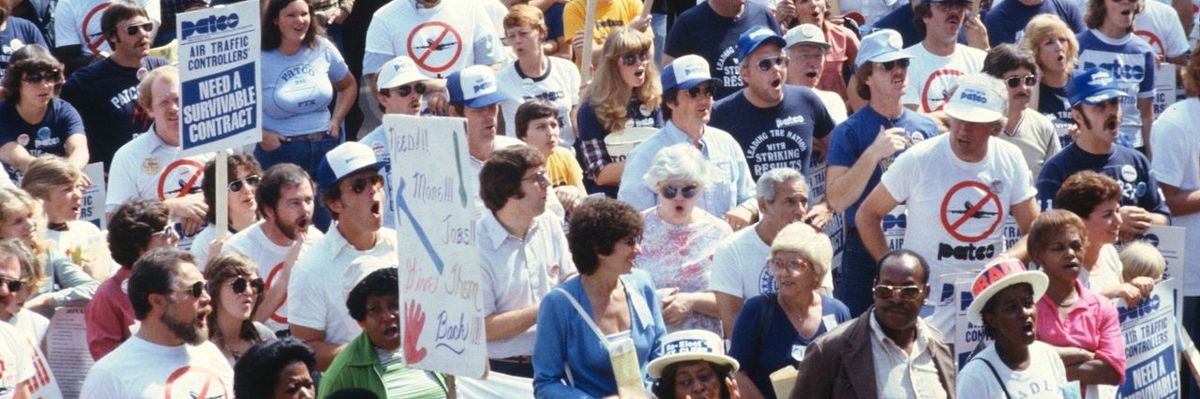
The Labor Day celebration in early September of 1981 was dominated by the contingent of determined PATCO strikers, who were battling with Republican President Ronald Reagan.
It’s time to link up with politically alienated workers and build something new.
I learned early on in my career that it’s not easy to discuss alternatives to the Democratic Party, especially with labor union officials. In 1979, I was piloting the Labor Institute’s new political economy workshop with UAW Local 259, which represented Cadillac mechanics in the New York City area.
Sam Meyers, the president, was a labor radical who had survived the McCarthy era. He was militant and deeply committed to social democracy. He and Bernie would have gotten along nicely.
At the end of the course, in all naivete, I asked the workers what kind of political party they wanted to support – The Democrats? The Republicans? Or a new workers’ party? There was nearly unanimous consent for a new workers’ party.
Except for Sam, who jumped up and said, “You can’t do that. We have to stick with the Democrats.” And that shut down the discussion.
It’s been that way ever since. The leadership of nearly every progressive labor union is deeply entwined with the Democrats, even as half or more of their members have defected to MAGA.
Trump is in power for the second time because there is no magic formula that will stop the exodus of workers of all shades and proclivities from the Democratic Party.
As one national official told me, “The Democrats are the only political friends we have.” As a result, union members are not asked what they want politically, because the leadership fears the answer will divert the union from what it must do – stick with the Democrats at all costs.
But it’s a losing battle. Working-class support for Democratic presidential candidates has collapsed. Jimmy Carter received 52 percent in 1976. Kamal Harris got only 33 percent in 2024.
In rural America, the defections are even greater. Take Mingo County, West Virginia, the county that has lost 3,000 of its 3,300 coal jobs. In 1996, Bill Clinton got 70 percent of the vote. In each following national election, the Democratic vote has declined, with Joe ‘Six-Pack’ Biden getting 14 percent in 2020, and Kamala Harris getting only 12 percent in 2024. The research for my book showed that since the 1990s, as the mass layoff rate went up in rust-belt counties, the Democratic vote went down. (See Wall Street’s War on Workers.)
It’s hard not to sympathize with labor leaders as they cope with the day-to-day tasks of keeping their union alive and protecting their members from a system that is rigged against them. In that context, building something new is a fantasy, the idle dreams of pontificators (like me!). These leaders believe what others have been saying for decades – that third parties are impossible in the system we have.
There is some very good rationale behind their fears. Third-party efforts can be dangerous, acting as “spoilers,” which then help anti-labor candidates win. Ralph Nader’s presidential run in 2020 may have tilted Florida and the presidency to Bush. After all those hanging chads, third parties became anathema to political dreamers, as well as labor leaders.
Most third-party efforts fail because they attract so few voters. They are then viewed as time-consuming distractions – more like vanity projects with the potential to have serious negative consequences.
But that’s not inevitable. The spoiler effect can be mitigated if the third-party efforts refrain from electoral activities until they are large enough to seriously contend.
So here's a fresh question: What would you think if a million workers said they would be willing to back a new political effort?
One million names on a petition would show that the effort has a far wider reach than a fringe group or a self-promoter. One million names would signal to the political actors that there is mass support for building a new working-class political home. One million names might even push some Democrats to support pro-worker legislation.
Mobilizing a petition drive would cost relatively little and could start with a few progressive unions circulating one that read:
We the undersigned support building a new independent party of working people that would back working-class issues independent of both the Democratic and Republican parties. The new party would fight to:
The Billionaires have two parties. We need one of our own!
Once a million names, emails, and telephone numbers are recorded, ways could be found to support independent candidates who were willing to fight for this platform and organize around ballot initiatives or legislation that would push such demands forward. A website and newsletter could connect with those who have signed up.
But are there really a million working people out there who would sign this petition? We won’t know until it’s tried. Right now, approximately 1.7 million workers are suffering through involuntary layoffs each month. Federal workers are joining these ranks as Musk wields his axe. These are potential recruits for this petition, effort, let's call it the Committee of a Million.
Are there really a million working people out there who would sign this petition?
Dan Osborn, the former local union president, ran in 2024 as an independent for Senate in Nebraska on a powerful worker-focused populist campaign. He lost by seven points, while Kamala Harris lost the state by 20 points. Osborn is now setting up a political action committee to recruit and support more working-class candidates. Imagine what could happen if the Committee of a Million linked with his effort.
No! No! No! Say my friends in the labor movement. “We have to support the Dems to take back control of the House and stop Trump.”
But can’t we walk and chew politics at the same time? Can’t we work on those swing districts and support independents like Osborn? Don’t we have an obligation at least to ask our members what they really want? Wouldn’t it be worthwhile to find out if they are willing to sign up for the Committee of a Million?
I can’t stop obsessing over brutal realities. Trump is in power for the second time because there is no magic formula that will stop the exodus of workers of all shades and proclivities from the Democratic Party.
Sure, it could fail. But continued failure is certain if we don’t try something new.
That ship has sailed. It’s time to link up with politically alienated workers and build something new outside of the two-party political oligopoly.
Sure, it could fail. But continued failure is certain if we don’t try something new.
If you have an alternative idea, please send it along. We’ve got to have this discussion.
Dear Common Dreams reader, It’s been nearly 30 years since I co-founded Common Dreams with my late wife, Lina Newhouser. We had the radical notion that journalism should serve the public good, not corporate profits. It was clear to us from the outset what it would take to build such a project. No paid advertisements. No corporate sponsors. No millionaire publisher telling us what to think or do. Many people said we wouldn't last a year, but we proved those doubters wrong. Together with a tremendous team of journalists and dedicated staff, we built an independent media outlet free from the constraints of profits and corporate control. Our mission has always been simple: To inform. To inspire. To ignite change for the common good. Building Common Dreams was not easy. Our survival was never guaranteed. When you take on the most powerful forces—Wall Street greed, fossil fuel industry destruction, Big Tech lobbyists, and uber-rich oligarchs who have spent billions upon billions rigging the economy and democracy in their favor—the only bulwark you have is supporters who believe in your work. But here’s the urgent message from me today. It's never been this bad out there. And it's never been this hard to keep us going. At the very moment Common Dreams is most needed, the threats we face are intensifying. We need your support now more than ever. We don't accept corporate advertising and never will. We don't have a paywall because we don't think people should be blocked from critical news based on their ability to pay. Everything we do is funded by the donations of readers like you. When everyone does the little they can afford, we are strong. But if that support retreats or dries up, so do we. Will you donate now to make sure Common Dreams not only survives but thrives? —Craig Brown, Co-founder |
Les Leopold is the executive director of the Labor Institute and author of the new book, “The Billionaires Have Two Parties, We Need a Party of Our Own” (2026). His previous books include: “Wall Street’s War on Workers: How Mass Layoffs and Greed Are Destroying the Working Class and What to Do About It" (2024); "Runaway Inequality: An Activist's Guide to Economic Justice" (2015); and “The Man Who Hated Work and Loved Labor: The Life and Times of Tony Mazzocchi” (2007). Read more of his work on his substack here.
I learned early on in my career that it’s not easy to discuss alternatives to the Democratic Party, especially with labor union officials. In 1979, I was piloting the Labor Institute’s new political economy workshop with UAW Local 259, which represented Cadillac mechanics in the New York City area.
Sam Meyers, the president, was a labor radical who had survived the McCarthy era. He was militant and deeply committed to social democracy. He and Bernie would have gotten along nicely.
At the end of the course, in all naivete, I asked the workers what kind of political party they wanted to support – The Democrats? The Republicans? Or a new workers’ party? There was nearly unanimous consent for a new workers’ party.
Except for Sam, who jumped up and said, “You can’t do that. We have to stick with the Democrats.” And that shut down the discussion.
It’s been that way ever since. The leadership of nearly every progressive labor union is deeply entwined with the Democrats, even as half or more of their members have defected to MAGA.
Trump is in power for the second time because there is no magic formula that will stop the exodus of workers of all shades and proclivities from the Democratic Party.
As one national official told me, “The Democrats are the only political friends we have.” As a result, union members are not asked what they want politically, because the leadership fears the answer will divert the union from what it must do – stick with the Democrats at all costs.
But it’s a losing battle. Working-class support for Democratic presidential candidates has collapsed. Jimmy Carter received 52 percent in 1976. Kamal Harris got only 33 percent in 2024.
In rural America, the defections are even greater. Take Mingo County, West Virginia, the county that has lost 3,000 of its 3,300 coal jobs. In 1996, Bill Clinton got 70 percent of the vote. In each following national election, the Democratic vote has declined, with Joe ‘Six-Pack’ Biden getting 14 percent in 2020, and Kamala Harris getting only 12 percent in 2024. The research for my book showed that since the 1990s, as the mass layoff rate went up in rust-belt counties, the Democratic vote went down. (See Wall Street’s War on Workers.)
It’s hard not to sympathize with labor leaders as they cope with the day-to-day tasks of keeping their union alive and protecting their members from a system that is rigged against them. In that context, building something new is a fantasy, the idle dreams of pontificators (like me!). These leaders believe what others have been saying for decades – that third parties are impossible in the system we have.
There is some very good rationale behind their fears. Third-party efforts can be dangerous, acting as “spoilers,” which then help anti-labor candidates win. Ralph Nader’s presidential run in 2020 may have tilted Florida and the presidency to Bush. After all those hanging chads, third parties became anathema to political dreamers, as well as labor leaders.
Most third-party efforts fail because they attract so few voters. They are then viewed as time-consuming distractions – more like vanity projects with the potential to have serious negative consequences.
But that’s not inevitable. The spoiler effect can be mitigated if the third-party efforts refrain from electoral activities until they are large enough to seriously contend.
So here's a fresh question: What would you think if a million workers said they would be willing to back a new political effort?
One million names on a petition would show that the effort has a far wider reach than a fringe group or a self-promoter. One million names would signal to the political actors that there is mass support for building a new working-class political home. One million names might even push some Democrats to support pro-worker legislation.
Mobilizing a petition drive would cost relatively little and could start with a few progressive unions circulating one that read:
We the undersigned support building a new independent party of working people that would back working-class issues independent of both the Democratic and Republican parties. The new party would fight to:
The Billionaires have two parties. We need one of our own!
Once a million names, emails, and telephone numbers are recorded, ways could be found to support independent candidates who were willing to fight for this platform and organize around ballot initiatives or legislation that would push such demands forward. A website and newsletter could connect with those who have signed up.
But are there really a million working people out there who would sign this petition? We won’t know until it’s tried. Right now, approximately 1.7 million workers are suffering through involuntary layoffs each month. Federal workers are joining these ranks as Musk wields his axe. These are potential recruits for this petition, effort, let's call it the Committee of a Million.
Are there really a million working people out there who would sign this petition?
Dan Osborn, the former local union president, ran in 2024 as an independent for Senate in Nebraska on a powerful worker-focused populist campaign. He lost by seven points, while Kamala Harris lost the state by 20 points. Osborn is now setting up a political action committee to recruit and support more working-class candidates. Imagine what could happen if the Committee of a Million linked with his effort.
No! No! No! Say my friends in the labor movement. “We have to support the Dems to take back control of the House and stop Trump.”
But can’t we walk and chew politics at the same time? Can’t we work on those swing districts and support independents like Osborn? Don’t we have an obligation at least to ask our members what they really want? Wouldn’t it be worthwhile to find out if they are willing to sign up for the Committee of a Million?
I can’t stop obsessing over brutal realities. Trump is in power for the second time because there is no magic formula that will stop the exodus of workers of all shades and proclivities from the Democratic Party.
Sure, it could fail. But continued failure is certain if we don’t try something new.
That ship has sailed. It’s time to link up with politically alienated workers and build something new outside of the two-party political oligopoly.
Sure, it could fail. But continued failure is certain if we don’t try something new.
If you have an alternative idea, please send it along. We’ve got to have this discussion.
Les Leopold is the executive director of the Labor Institute and author of the new book, “The Billionaires Have Two Parties, We Need a Party of Our Own” (2026). His previous books include: “Wall Street’s War on Workers: How Mass Layoffs and Greed Are Destroying the Working Class and What to Do About It" (2024); "Runaway Inequality: An Activist's Guide to Economic Justice" (2015); and “The Man Who Hated Work and Loved Labor: The Life and Times of Tony Mazzocchi” (2007). Read more of his work on his substack here.
I learned early on in my career that it’s not easy to discuss alternatives to the Democratic Party, especially with labor union officials. In 1979, I was piloting the Labor Institute’s new political economy workshop with UAW Local 259, which represented Cadillac mechanics in the New York City area.
Sam Meyers, the president, was a labor radical who had survived the McCarthy era. He was militant and deeply committed to social democracy. He and Bernie would have gotten along nicely.
At the end of the course, in all naivete, I asked the workers what kind of political party they wanted to support – The Democrats? The Republicans? Or a new workers’ party? There was nearly unanimous consent for a new workers’ party.
Except for Sam, who jumped up and said, “You can’t do that. We have to stick with the Democrats.” And that shut down the discussion.
It’s been that way ever since. The leadership of nearly every progressive labor union is deeply entwined with the Democrats, even as half or more of their members have defected to MAGA.
Trump is in power for the second time because there is no magic formula that will stop the exodus of workers of all shades and proclivities from the Democratic Party.
As one national official told me, “The Democrats are the only political friends we have.” As a result, union members are not asked what they want politically, because the leadership fears the answer will divert the union from what it must do – stick with the Democrats at all costs.
But it’s a losing battle. Working-class support for Democratic presidential candidates has collapsed. Jimmy Carter received 52 percent in 1976. Kamal Harris got only 33 percent in 2024.
In rural America, the defections are even greater. Take Mingo County, West Virginia, the county that has lost 3,000 of its 3,300 coal jobs. In 1996, Bill Clinton got 70 percent of the vote. In each following national election, the Democratic vote has declined, with Joe ‘Six-Pack’ Biden getting 14 percent in 2020, and Kamala Harris getting only 12 percent in 2024. The research for my book showed that since the 1990s, as the mass layoff rate went up in rust-belt counties, the Democratic vote went down. (See Wall Street’s War on Workers.)
It’s hard not to sympathize with labor leaders as they cope with the day-to-day tasks of keeping their union alive and protecting their members from a system that is rigged against them. In that context, building something new is a fantasy, the idle dreams of pontificators (like me!). These leaders believe what others have been saying for decades – that third parties are impossible in the system we have.
There is some very good rationale behind their fears. Third-party efforts can be dangerous, acting as “spoilers,” which then help anti-labor candidates win. Ralph Nader’s presidential run in 2020 may have tilted Florida and the presidency to Bush. After all those hanging chads, third parties became anathema to political dreamers, as well as labor leaders.
Most third-party efforts fail because they attract so few voters. They are then viewed as time-consuming distractions – more like vanity projects with the potential to have serious negative consequences.
But that’s not inevitable. The spoiler effect can be mitigated if the third-party efforts refrain from electoral activities until they are large enough to seriously contend.
So here's a fresh question: What would you think if a million workers said they would be willing to back a new political effort?
One million names on a petition would show that the effort has a far wider reach than a fringe group or a self-promoter. One million names would signal to the political actors that there is mass support for building a new working-class political home. One million names might even push some Democrats to support pro-worker legislation.
Mobilizing a petition drive would cost relatively little and could start with a few progressive unions circulating one that read:
We the undersigned support building a new independent party of working people that would back working-class issues independent of both the Democratic and Republican parties. The new party would fight to:
The Billionaires have two parties. We need one of our own!
Once a million names, emails, and telephone numbers are recorded, ways could be found to support independent candidates who were willing to fight for this platform and organize around ballot initiatives or legislation that would push such demands forward. A website and newsletter could connect with those who have signed up.
But are there really a million working people out there who would sign this petition? We won’t know until it’s tried. Right now, approximately 1.7 million workers are suffering through involuntary layoffs each month. Federal workers are joining these ranks as Musk wields his axe. These are potential recruits for this petition, effort, let's call it the Committee of a Million.
Are there really a million working people out there who would sign this petition?
Dan Osborn, the former local union president, ran in 2024 as an independent for Senate in Nebraska on a powerful worker-focused populist campaign. He lost by seven points, while Kamala Harris lost the state by 20 points. Osborn is now setting up a political action committee to recruit and support more working-class candidates. Imagine what could happen if the Committee of a Million linked with his effort.
No! No! No! Say my friends in the labor movement. “We have to support the Dems to take back control of the House and stop Trump.”
But can’t we walk and chew politics at the same time? Can’t we work on those swing districts and support independents like Osborn? Don’t we have an obligation at least to ask our members what they really want? Wouldn’t it be worthwhile to find out if they are willing to sign up for the Committee of a Million?
I can’t stop obsessing over brutal realities. Trump is in power for the second time because there is no magic formula that will stop the exodus of workers of all shades and proclivities from the Democratic Party.
Sure, it could fail. But continued failure is certain if we don’t try something new.
That ship has sailed. It’s time to link up with politically alienated workers and build something new outside of the two-party political oligopoly.
Sure, it could fail. But continued failure is certain if we don’t try something new.
If you have an alternative idea, please send it along. We’ve got to have this discussion.