
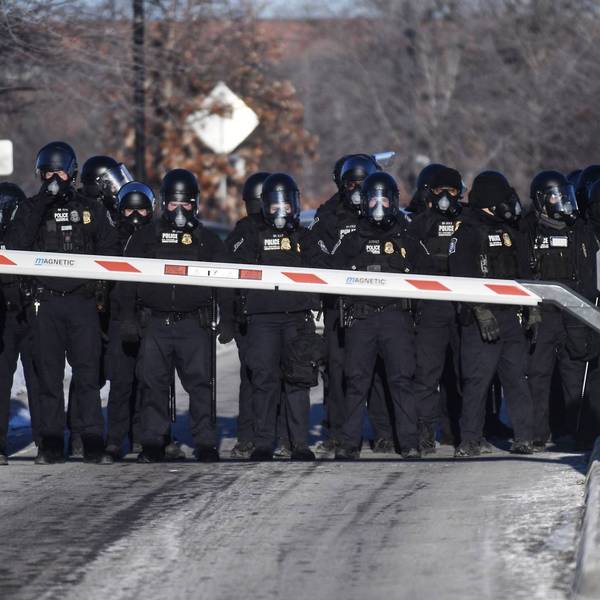
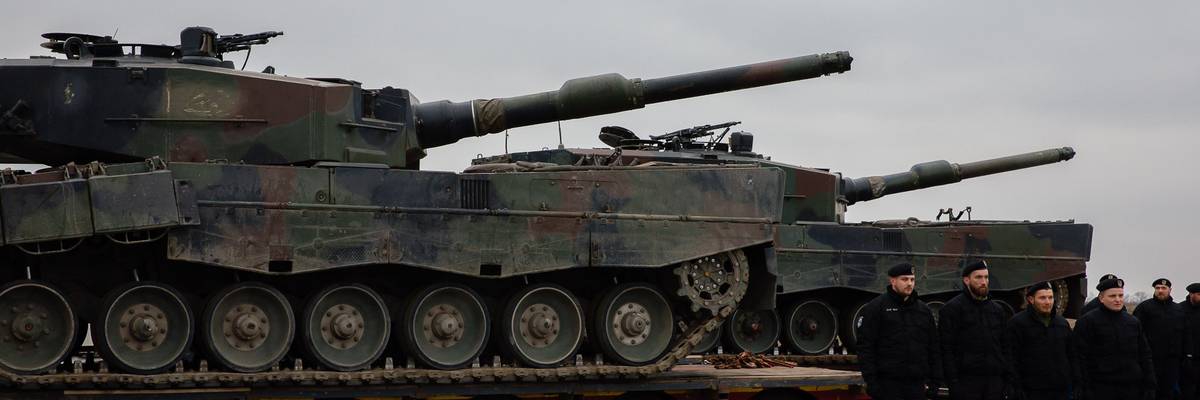
Polish Prime Minister Mateusz Morawiecki inspects a site with Ukrainian Prime Minister Denys Shmyhal on February 24, 2023.
Ninety Seconds to Midnight and War's Escalation in Ukraine
There is too strong a possibility of nuclear war breaking out as a product of miscalculation to dismiss or understate the risk of escalation.
We live in “a time of unprecedented danger.” The Doomsday Clock was moved to ninety seconds before midnight by the Bulletin of Atomic Scientists on January 24, 2023. This is the closest to apocalypse the clock has been set since its founding in 1947, largely because of “the mounting dangers of the war in Ukraine.” Specifically, “Russia’s thinly veiled threats to use nuclear weapons remind the world that escalation of the conflict—by accident, intention, or miscalculation—is a terrible risk.” The seriousness of the threat of war’s escalation, says the Bulletin’s Science and Security Board, requires the US, NATO, and Ukraine to find “a path to serious peace negotiations” with Russia.
Still, pressure mounts to escalate the war at the pivotal moment of its one-year anniversary and a corresponding surge in the fighting. To underscore unwavering support of Ukraine, President Biden undertook a surprise visit to Kyiv on February 20 and delivered a speech in Warsaw the following day, declaring that Ukraine is “on the front lines” in “the perennial struggle for freedom and democracy.” Putin has rejected diplomacy and has been “bent on violence from the start,” he said. The US and NATO “must commit now to be in this fight for the long haul.” Biden appears determined to outlast Putin in Ukraine. Putin’s response is another thinly veiled threat, announcing just ahead of Biden’s speech the suspension of New START, Russia’s only remaining nuclear arms control agreement with the U.S.
This is the immediate context in which the voice of escalation, including the Editorial Board of the Washington Post, insists the risk of nuclear war is “overblown” and that Biden should now abandon his “cautious and calibrated approach” to arming Ukraine. Putin’s war is a “moral travesty,” the editorial attests, an aggression against democracy, and a “potentially lethal blow” to “civilized international conduct” as well as US “interests, leadership and prestige.” Likewise, Okeksandra Matviichuk writes in the Washington Post, with the moral authority of a 2022 Nobel Peace Prize recipient, that it is “immoral” to deprive Ukraine of the weapons it needs for its defense by alleging such support “contributes to escalation of the conflict.” It is wrong to abandon the values of democracy, rule of law, and human rights, Matviichuk contends, when confronted by an authoritarian enemy armed with nuclear weapons.
Why might we think the threat of Putin unleashing his nuclear arsenal is overblown? The two main reasons cited by the Washington Post’s Editorial Board are that Putin cannot risk alienating China, his most important ally, or turning Russia into an international pariah by using nuclear weapons. Additional reasons offered by others to reduce fears of Russian nuclear warfare include that Putin is a rational actor and that he may have concluded his nuclear threats have backfired. Thus, a common view in the West is that Putin’s bluster reduces to a scare tactic.
"Creeping toward nuclear apocalypse is a nightmare scenario perhaps too ominous to contemplate."
Yet it could be more than mere bluster. As Masha Gessen, writing in The New Yorker, has poignantly observed, “the problem is that there is a world in which it is rational for [Putin] to move ever closer to a nuclear strike.” In such a world, Putin sees his mission in grand terms, believing that Russia faces an existential threat from the West and that the West does not have the will to retaliate in kind after a Russian nuclear strike. Moreover, he believes he will survive any nuclear exchange living in his luxurious underground bunkers. He also believes Russia is politically, economically, and militarily strong enough to survive any loss of support from its allies.
At the very least, there is too strong a possibility of nuclear war breaking out as a product of miscalculation to dismiss or understate the risk of escalation. Is it wise or even necessary to downplay the chance of nuclear conflagration in the name of protecting democracy, saving civilization, or advancing national interest and prestige? Fortunately, so far, the Biden administration has refused to take lightly the risk that war in Ukraine will escalate into a nuclear conflict. Thus, it has avoided NATO forces entering directly into the fighting and has calibrated the type and number of weapons supplied to Ukraine. Each recalculation has inched closer to the line of intervention, however, as pressure builds to send not only heavier tanks but also more advanced arms, including fighter jets and other longer-range lethal systems. Talk increasingly is about defeating Russia more than pursuing a path of diplomacy and negotiation. Biden’s Warsaw speech made it clear that he thinks “swift and punishing costs” are the only means of getting Putin to change course.
Creeping toward nuclear apocalypse is a nightmare scenario perhaps too ominous to contemplate. That may be why one is tempted to think the risk is overblown and nuclear war unlikely. Besides, there is no good bargain to be had with the devil that is Putin. Tyrants require submission and take the soul of democracy in payment for our sheer survival. These are psychological dynamics woven into the language and logic of war we know so well and that can negatively influence already inexact calculations of what military assistance to Ukraine falls short of provoking Putin to make good on his threat.
Thus, the most alarming aspect of the Post’s editorial position—that the nuclear threat is overblown—is that it expresses an increasingly commonplace outlook that not only biases a necessarily imperfect assessment of the nuclear trip line but also undercuts a commitment to diplomacy aimed at giving Putin a way out of the war. Once again, we are caught in a web of belligerence from which there is no simple escape, this time with a substantial risk of nuclear conflagration. Even as President Biden attempts to force Putin to negotiate by strengthening Ukraine’s hand on the battlefield, he must not diminish the nuclear menace at hand. Nor is it conducive to a plausible peace to overstate the conditions of victory or understate the possibilities of compromise. Fighting for the right side in this conflict, as Timothy Garton Ash argues, does not automatically exclude the necessity or even potential benefit of eventually supporting some territorial compromises, such as settling for a Russian troop withdrawal to the pre-February 2022 lines, or deferring the ultimate fate of Crimea. It does exclude, however, playing a terminal game of chicken with a nuclear-armed adversary.
An Urgent Message From Our Co-Founder
Dear Common Dreams reader, It’s been nearly 30 years since I co-founded Common Dreams with my late wife, Lina Newhouser. We had the radical notion that journalism should serve the public good, not corporate profits. It was clear to us from the outset what it would take to build such a project. No paid advertisements. No corporate sponsors. No millionaire publisher telling us what to think or do. Many people said we wouldn't last a year, but we proved those doubters wrong. Together with a tremendous team of journalists and dedicated staff, we built an independent media outlet free from the constraints of profits and corporate control. Our mission has always been simple: To inform. To inspire. To ignite change for the common good. Building Common Dreams was not easy. Our survival was never guaranteed. When you take on the most powerful forces—Wall Street greed, fossil fuel industry destruction, Big Tech lobbyists, and uber-rich oligarchs who have spent billions upon billions rigging the economy and democracy in their favor—the only bulwark you have is supporters who believe in your work. But here’s the urgent message from me today. It's never been this bad out there. And it's never been this hard to keep us going. At the very moment Common Dreams is most needed, the threats we face are intensifying. We need your support now more than ever. We don't accept corporate advertising and never will. We don't have a paywall because we don't think people should be blocked from critical news based on their ability to pay. Everything we do is funded by the donations of readers like you. When everyone does the little they can afford, we are strong. But if that support retreats or dries up, so do we. Will you donate now to make sure Common Dreams not only survives but thrives? —Craig Brown, Co-founder |
Robert Ivie is Professor Emeritus in English (Rhetoric) and American Studies at Indiana University, Bloomington. His latest book, with Oscar Giner, is After Empire: Myth, Rhetoric, and Democratic Revival (2024). Others books include: Hunt the Devil: A Demonology of U.S. War Culture (2015), with Oscar Giner; Dissent from War (2007); and Democracy and America’s War on Terror (2005). For additional information and blogposts see his website and blog.
We live in “a time of unprecedented danger.” The Doomsday Clock was moved to ninety seconds before midnight by the Bulletin of Atomic Scientists on January 24, 2023. This is the closest to apocalypse the clock has been set since its founding in 1947, largely because of “the mounting dangers of the war in Ukraine.” Specifically, “Russia’s thinly veiled threats to use nuclear weapons remind the world that escalation of the conflict—by accident, intention, or miscalculation—is a terrible risk.” The seriousness of the threat of war’s escalation, says the Bulletin’s Science and Security Board, requires the US, NATO, and Ukraine to find “a path to serious peace negotiations” with Russia.
Still, pressure mounts to escalate the war at the pivotal moment of its one-year anniversary and a corresponding surge in the fighting. To underscore unwavering support of Ukraine, President Biden undertook a surprise visit to Kyiv on February 20 and delivered a speech in Warsaw the following day, declaring that Ukraine is “on the front lines” in “the perennial struggle for freedom and democracy.” Putin has rejected diplomacy and has been “bent on violence from the start,” he said. The US and NATO “must commit now to be in this fight for the long haul.” Biden appears determined to outlast Putin in Ukraine. Putin’s response is another thinly veiled threat, announcing just ahead of Biden’s speech the suspension of New START, Russia’s only remaining nuclear arms control agreement with the U.S.
This is the immediate context in which the voice of escalation, including the Editorial Board of the Washington Post, insists the risk of nuclear war is “overblown” and that Biden should now abandon his “cautious and calibrated approach” to arming Ukraine. Putin’s war is a “moral travesty,” the editorial attests, an aggression against democracy, and a “potentially lethal blow” to “civilized international conduct” as well as US “interests, leadership and prestige.” Likewise, Okeksandra Matviichuk writes in the Washington Post, with the moral authority of a 2022 Nobel Peace Prize recipient, that it is “immoral” to deprive Ukraine of the weapons it needs for its defense by alleging such support “contributes to escalation of the conflict.” It is wrong to abandon the values of democracy, rule of law, and human rights, Matviichuk contends, when confronted by an authoritarian enemy armed with nuclear weapons.
Why might we think the threat of Putin unleashing his nuclear arsenal is overblown? The two main reasons cited by the Washington Post’s Editorial Board are that Putin cannot risk alienating China, his most important ally, or turning Russia into an international pariah by using nuclear weapons. Additional reasons offered by others to reduce fears of Russian nuclear warfare include that Putin is a rational actor and that he may have concluded his nuclear threats have backfired. Thus, a common view in the West is that Putin’s bluster reduces to a scare tactic.
"Creeping toward nuclear apocalypse is a nightmare scenario perhaps too ominous to contemplate."
Yet it could be more than mere bluster. As Masha Gessen, writing in The New Yorker, has poignantly observed, “the problem is that there is a world in which it is rational for [Putin] to move ever closer to a nuclear strike.” In such a world, Putin sees his mission in grand terms, believing that Russia faces an existential threat from the West and that the West does not have the will to retaliate in kind after a Russian nuclear strike. Moreover, he believes he will survive any nuclear exchange living in his luxurious underground bunkers. He also believes Russia is politically, economically, and militarily strong enough to survive any loss of support from its allies.
At the very least, there is too strong a possibility of nuclear war breaking out as a product of miscalculation to dismiss or understate the risk of escalation. Is it wise or even necessary to downplay the chance of nuclear conflagration in the name of protecting democracy, saving civilization, or advancing national interest and prestige? Fortunately, so far, the Biden administration has refused to take lightly the risk that war in Ukraine will escalate into a nuclear conflict. Thus, it has avoided NATO forces entering directly into the fighting and has calibrated the type and number of weapons supplied to Ukraine. Each recalculation has inched closer to the line of intervention, however, as pressure builds to send not only heavier tanks but also more advanced arms, including fighter jets and other longer-range lethal systems. Talk increasingly is about defeating Russia more than pursuing a path of diplomacy and negotiation. Biden’s Warsaw speech made it clear that he thinks “swift and punishing costs” are the only means of getting Putin to change course.
Creeping toward nuclear apocalypse is a nightmare scenario perhaps too ominous to contemplate. That may be why one is tempted to think the risk is overblown and nuclear war unlikely. Besides, there is no good bargain to be had with the devil that is Putin. Tyrants require submission and take the soul of democracy in payment for our sheer survival. These are psychological dynamics woven into the language and logic of war we know so well and that can negatively influence already inexact calculations of what military assistance to Ukraine falls short of provoking Putin to make good on his threat.
Thus, the most alarming aspect of the Post’s editorial position—that the nuclear threat is overblown—is that it expresses an increasingly commonplace outlook that not only biases a necessarily imperfect assessment of the nuclear trip line but also undercuts a commitment to diplomacy aimed at giving Putin a way out of the war. Once again, we are caught in a web of belligerence from which there is no simple escape, this time with a substantial risk of nuclear conflagration. Even as President Biden attempts to force Putin to negotiate by strengthening Ukraine’s hand on the battlefield, he must not diminish the nuclear menace at hand. Nor is it conducive to a plausible peace to overstate the conditions of victory or understate the possibilities of compromise. Fighting for the right side in this conflict, as Timothy Garton Ash argues, does not automatically exclude the necessity or even potential benefit of eventually supporting some territorial compromises, such as settling for a Russian troop withdrawal to the pre-February 2022 lines, or deferring the ultimate fate of Crimea. It does exclude, however, playing a terminal game of chicken with a nuclear-armed adversary.
Robert Ivie is Professor Emeritus in English (Rhetoric) and American Studies at Indiana University, Bloomington. His latest book, with Oscar Giner, is After Empire: Myth, Rhetoric, and Democratic Revival (2024). Others books include: Hunt the Devil: A Demonology of U.S. War Culture (2015), with Oscar Giner; Dissent from War (2007); and Democracy and America’s War on Terror (2005). For additional information and blogposts see his website and blog.
We live in “a time of unprecedented danger.” The Doomsday Clock was moved to ninety seconds before midnight by the Bulletin of Atomic Scientists on January 24, 2023. This is the closest to apocalypse the clock has been set since its founding in 1947, largely because of “the mounting dangers of the war in Ukraine.” Specifically, “Russia’s thinly veiled threats to use nuclear weapons remind the world that escalation of the conflict—by accident, intention, or miscalculation—is a terrible risk.” The seriousness of the threat of war’s escalation, says the Bulletin’s Science and Security Board, requires the US, NATO, and Ukraine to find “a path to serious peace negotiations” with Russia.
Still, pressure mounts to escalate the war at the pivotal moment of its one-year anniversary and a corresponding surge in the fighting. To underscore unwavering support of Ukraine, President Biden undertook a surprise visit to Kyiv on February 20 and delivered a speech in Warsaw the following day, declaring that Ukraine is “on the front lines” in “the perennial struggle for freedom and democracy.” Putin has rejected diplomacy and has been “bent on violence from the start,” he said. The US and NATO “must commit now to be in this fight for the long haul.” Biden appears determined to outlast Putin in Ukraine. Putin’s response is another thinly veiled threat, announcing just ahead of Biden’s speech the suspension of New START, Russia’s only remaining nuclear arms control agreement with the U.S.
This is the immediate context in which the voice of escalation, including the Editorial Board of the Washington Post, insists the risk of nuclear war is “overblown” and that Biden should now abandon his “cautious and calibrated approach” to arming Ukraine. Putin’s war is a “moral travesty,” the editorial attests, an aggression against democracy, and a “potentially lethal blow” to “civilized international conduct” as well as US “interests, leadership and prestige.” Likewise, Okeksandra Matviichuk writes in the Washington Post, with the moral authority of a 2022 Nobel Peace Prize recipient, that it is “immoral” to deprive Ukraine of the weapons it needs for its defense by alleging such support “contributes to escalation of the conflict.” It is wrong to abandon the values of democracy, rule of law, and human rights, Matviichuk contends, when confronted by an authoritarian enemy armed with nuclear weapons.
Why might we think the threat of Putin unleashing his nuclear arsenal is overblown? The two main reasons cited by the Washington Post’s Editorial Board are that Putin cannot risk alienating China, his most important ally, or turning Russia into an international pariah by using nuclear weapons. Additional reasons offered by others to reduce fears of Russian nuclear warfare include that Putin is a rational actor and that he may have concluded his nuclear threats have backfired. Thus, a common view in the West is that Putin’s bluster reduces to a scare tactic.
"Creeping toward nuclear apocalypse is a nightmare scenario perhaps too ominous to contemplate."
Yet it could be more than mere bluster. As Masha Gessen, writing in The New Yorker, has poignantly observed, “the problem is that there is a world in which it is rational for [Putin] to move ever closer to a nuclear strike.” In such a world, Putin sees his mission in grand terms, believing that Russia faces an existential threat from the West and that the West does not have the will to retaliate in kind after a Russian nuclear strike. Moreover, he believes he will survive any nuclear exchange living in his luxurious underground bunkers. He also believes Russia is politically, economically, and militarily strong enough to survive any loss of support from its allies.
At the very least, there is too strong a possibility of nuclear war breaking out as a product of miscalculation to dismiss or understate the risk of escalation. Is it wise or even necessary to downplay the chance of nuclear conflagration in the name of protecting democracy, saving civilization, or advancing national interest and prestige? Fortunately, so far, the Biden administration has refused to take lightly the risk that war in Ukraine will escalate into a nuclear conflict. Thus, it has avoided NATO forces entering directly into the fighting and has calibrated the type and number of weapons supplied to Ukraine. Each recalculation has inched closer to the line of intervention, however, as pressure builds to send not only heavier tanks but also more advanced arms, including fighter jets and other longer-range lethal systems. Talk increasingly is about defeating Russia more than pursuing a path of diplomacy and negotiation. Biden’s Warsaw speech made it clear that he thinks “swift and punishing costs” are the only means of getting Putin to change course.
Creeping toward nuclear apocalypse is a nightmare scenario perhaps too ominous to contemplate. That may be why one is tempted to think the risk is overblown and nuclear war unlikely. Besides, there is no good bargain to be had with the devil that is Putin. Tyrants require submission and take the soul of democracy in payment for our sheer survival. These are psychological dynamics woven into the language and logic of war we know so well and that can negatively influence already inexact calculations of what military assistance to Ukraine falls short of provoking Putin to make good on his threat.
Thus, the most alarming aspect of the Post’s editorial position—that the nuclear threat is overblown—is that it expresses an increasingly commonplace outlook that not only biases a necessarily imperfect assessment of the nuclear trip line but also undercuts a commitment to diplomacy aimed at giving Putin a way out of the war. Once again, we are caught in a web of belligerence from which there is no simple escape, this time with a substantial risk of nuclear conflagration. Even as President Biden attempts to force Putin to negotiate by strengthening Ukraine’s hand on the battlefield, he must not diminish the nuclear menace at hand. Nor is it conducive to a plausible peace to overstate the conditions of victory or understate the possibilities of compromise. Fighting for the right side in this conflict, as Timothy Garton Ash argues, does not automatically exclude the necessity or even potential benefit of eventually supporting some territorial compromises, such as settling for a Russian troop withdrawal to the pre-February 2022 lines, or deferring the ultimate fate of Crimea. It does exclude, however, playing a terminal game of chicken with a nuclear-armed adversary.