

SUBSCRIBE TO OUR FREE NEWSLETTER
Daily news & progressive opinion—funded by the people, not the corporations—delivered straight to your inbox.
5
#000000
#FFFFFF
To donate by check, phone, or other method, see our More Ways to Give page.
Daily news & progressive opinion—funded by the people, not the corporations—delivered straight to your inbox.
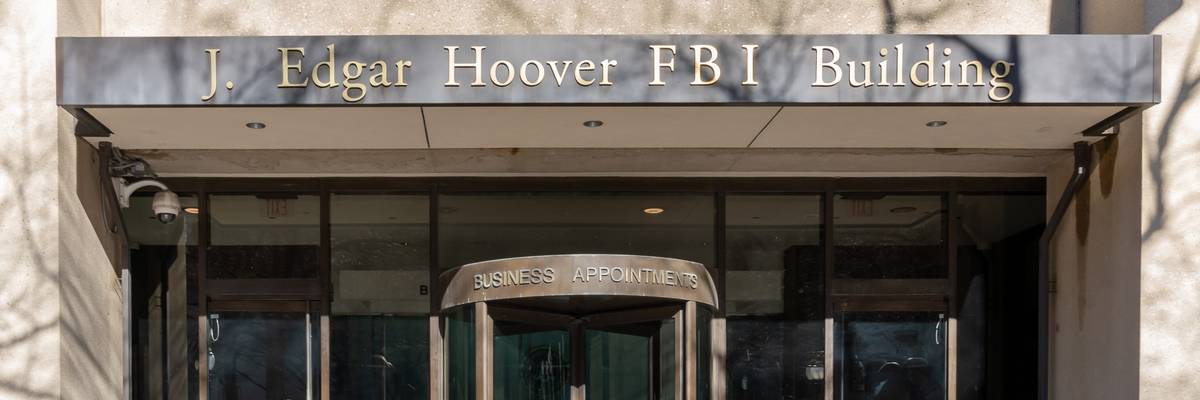
The entrance of the Federal Bureau of Investigation (FBI) headquarters building in Washington, D.C, USA.
The agency may have earned praise in the Trump investigation, but it has a long, dark history of targeting political dissidents and other marginalized communities.
Former president Donald Trump has been criminally indicted for the third time in four months. Justice Department Special Counsel Jack Smith’s indictment describes Trump’s attempt to overturn his loss in the 2020 election and cling to power. The four charges include the criminal violation of the rights of Americans to have their votes counted.
Republican loyalists are parroting Trump’s mantra that the investigations are all part of a witch hunt intended to keep him from regaining the White House in 2024. But many legal analysts have praised the strategy behind the historic indictment for targeting Trump without additional defendants or other complications that might prevent a speedy trial.
“I would like to thank the members of the Federal Bureau of Investigation who are working on this investigation with my office,” Smith said in his short public statement on August 1, after the indictment was unsealed. “These women and men are public servants at the very highest order, and it is a privilege to work alongside them.”
“The FBI invented the conspiracy, identified the targets; manufactured the ordnance; federalized what would otherwise have been a state crime.”
Smith’s praise may well be warranted in this case. But the FBI has a long, dark history of targeting political dissidents and other marginalized communities. Muslim Americans were especially hard hit in the wake of the attacks of September 11th, 2001.
Take the case of the Newburgh Four. Just days before this latest Trump indictment was unsealed, a federal judge in New York granted compassionate release to three inmates who had been convicted in 2010 of terrorism and given the mandatory minimum sentence of 25 years in prison. These prisoners, David Williams, Onta Williams, and Laguerre Payen are three members of a group known as the Newburgh Four. The fourth, James Cromitie, is expected to apply separately for compassionate release.
“A person… would be left with the impression that the offending defendants were sophisticated international terrorists committed to jihad against the United States,” U.S. District Court Judge Colleen McMahon wrote in her order. “However, they were, in actual reality, hapless, easily manipulated and penurious petty criminals… impoverished small-time grifters and drug users/street level dealers who could use some money.”
Judge McMahon ordered the three prisoners released within 90 days, having already served 14 years. The Newburgh Four were big news following their 2008 arrest, accused of plotting to blow up a synagogue in the Bronx and to shoot down U.S. military aircraft with surface-to-air missiles. The FBI used a shady paid informant, Shahed Hussain, a career criminal desperate to avoid deportation, to lure the four into the plot.
Judge McMahon wrote, “The FBI invented the conspiracy, identified the targets; manufactured the ordnance; federalized what would otherwise have been a state crime… by driving three of the four men into Connecticut to view the ‘bombs’ and ‘stinger missile launchers’… Hussain drove the four men to Riverdale (they had no way to drive themselves); ‘armed’ the ‘bomb’ (because the hapless Cromitie, despite his ‘training,’ could not figure out how to do it); and told Cromitie how to place the device.”
McMahon has long criticized the government’s conduct in this elaborate entrapment operation, and the fact that she was forced to sentence the defendants to the mandatory minimum. “The fact that what the government did was legal does not make it just,” McMahon wrote, when ordering the compassionate release of the three.
The Newburgh Four were one in a string of informant-driven prosecutions that entrapped members of the Muslim community. “We have a lot of cases out there. The Fort Dix Five is one. The Holy Land Five is another case. Aafia Siddiqui is another case. You can go down a whole long list,” Stephen Downs said on the Democracy Now! news hour. He is the board chair of the Coalition for Civil Freedoms and represents David Williams of the Newburgh Four. Downs is also the former chief attorney of New York State’s Commission on Judicial Conduct.
“They were out there going to create as many terrorists as they could, to show the public… that they were keeping America safe.”
“This was the government’s standard operating procedure right after 9/11,” Downs explained. “They were out there going to create as many terrorists as they could, to show the public… that they were keeping America safe. If they couldn’t find any real terrorists—and they couldn’t; there really weren’t any real terrorists around—they had to create them. And that’s what they did: They created these terrorists.”
The prosecution of the Newburgh Four was a political prosecution. They cannot recover the 14 years they’ve lost, they will still be on probation, subject to reimprisonment, and they will still be considered “felons” with all the burdens that designation carries.
Meanwhile, last October, a lead federal prosecutor of the Newburgh Four, David Raskin, joined the prosecutorial team investigating the Trump/Mar-a-Lago classified documents case. Jack Smith has an enormous challenge before him, prosecuting Trump’s attempted coup d’état, while rising above the FBI’s well-documented legacy of political persecution.
Dear Common Dreams reader, It’s been nearly 30 years since I co-founded Common Dreams with my late wife, Lina Newhouser. We had the radical notion that journalism should serve the public good, not corporate profits. It was clear to us from the outset what it would take to build such a project. No paid advertisements. No corporate sponsors. No millionaire publisher telling us what to think or do. Many people said we wouldn't last a year, but we proved those doubters wrong. Together with a tremendous team of journalists and dedicated staff, we built an independent media outlet free from the constraints of profits and corporate control. Our mission has always been simple: To inform. To inspire. To ignite change for the common good. Building Common Dreams was not easy. Our survival was never guaranteed. When you take on the most powerful forces—Wall Street greed, fossil fuel industry destruction, Big Tech lobbyists, and uber-rich oligarchs who have spent billions upon billions rigging the economy and democracy in their favor—the only bulwark you have is supporters who believe in your work. But here’s the urgent message from me today. It's never been this bad out there. And it's never been this hard to keep us going. At the very moment Common Dreams is most needed, the threats we face are intensifying. We need your support now more than ever. We don't accept corporate advertising and never will. We don't have a paywall because we don't think people should be blocked from critical news based on their ability to pay. Everything we do is funded by the donations of readers like you. When everyone does the little they can afford, we are strong. But if that support retreats or dries up, so do we. Will you donate now to make sure Common Dreams not only survives but thrives? —Craig Brown, Co-founder |
Former president Donald Trump has been criminally indicted for the third time in four months. Justice Department Special Counsel Jack Smith’s indictment describes Trump’s attempt to overturn his loss in the 2020 election and cling to power. The four charges include the criminal violation of the rights of Americans to have their votes counted.
Republican loyalists are parroting Trump’s mantra that the investigations are all part of a witch hunt intended to keep him from regaining the White House in 2024. But many legal analysts have praised the strategy behind the historic indictment for targeting Trump without additional defendants or other complications that might prevent a speedy trial.
“I would like to thank the members of the Federal Bureau of Investigation who are working on this investigation with my office,” Smith said in his short public statement on August 1, after the indictment was unsealed. “These women and men are public servants at the very highest order, and it is a privilege to work alongside them.”
“The FBI invented the conspiracy, identified the targets; manufactured the ordnance; federalized what would otherwise have been a state crime.”
Smith’s praise may well be warranted in this case. But the FBI has a long, dark history of targeting political dissidents and other marginalized communities. Muslim Americans were especially hard hit in the wake of the attacks of September 11th, 2001.
Take the case of the Newburgh Four. Just days before this latest Trump indictment was unsealed, a federal judge in New York granted compassionate release to three inmates who had been convicted in 2010 of terrorism and given the mandatory minimum sentence of 25 years in prison. These prisoners, David Williams, Onta Williams, and Laguerre Payen are three members of a group known as the Newburgh Four. The fourth, James Cromitie, is expected to apply separately for compassionate release.
“A person… would be left with the impression that the offending defendants were sophisticated international terrorists committed to jihad against the United States,” U.S. District Court Judge Colleen McMahon wrote in her order. “However, they were, in actual reality, hapless, easily manipulated and penurious petty criminals… impoverished small-time grifters and drug users/street level dealers who could use some money.”
Judge McMahon ordered the three prisoners released within 90 days, having already served 14 years. The Newburgh Four were big news following their 2008 arrest, accused of plotting to blow up a synagogue in the Bronx and to shoot down U.S. military aircraft with surface-to-air missiles. The FBI used a shady paid informant, Shahed Hussain, a career criminal desperate to avoid deportation, to lure the four into the plot.
Judge McMahon wrote, “The FBI invented the conspiracy, identified the targets; manufactured the ordnance; federalized what would otherwise have been a state crime… by driving three of the four men into Connecticut to view the ‘bombs’ and ‘stinger missile launchers’… Hussain drove the four men to Riverdale (they had no way to drive themselves); ‘armed’ the ‘bomb’ (because the hapless Cromitie, despite his ‘training,’ could not figure out how to do it); and told Cromitie how to place the device.”
McMahon has long criticized the government’s conduct in this elaborate entrapment operation, and the fact that she was forced to sentence the defendants to the mandatory minimum. “The fact that what the government did was legal does not make it just,” McMahon wrote, when ordering the compassionate release of the three.
The Newburgh Four were one in a string of informant-driven prosecutions that entrapped members of the Muslim community. “We have a lot of cases out there. The Fort Dix Five is one. The Holy Land Five is another case. Aafia Siddiqui is another case. You can go down a whole long list,” Stephen Downs said on the Democracy Now! news hour. He is the board chair of the Coalition for Civil Freedoms and represents David Williams of the Newburgh Four. Downs is also the former chief attorney of New York State’s Commission on Judicial Conduct.
“They were out there going to create as many terrorists as they could, to show the public… that they were keeping America safe.”
“This was the government’s standard operating procedure right after 9/11,” Downs explained. “They were out there going to create as many terrorists as they could, to show the public… that they were keeping America safe. If they couldn’t find any real terrorists—and they couldn’t; there really weren’t any real terrorists around—they had to create them. And that’s what they did: They created these terrorists.”
The prosecution of the Newburgh Four was a political prosecution. They cannot recover the 14 years they’ve lost, they will still be on probation, subject to reimprisonment, and they will still be considered “felons” with all the burdens that designation carries.
Meanwhile, last October, a lead federal prosecutor of the Newburgh Four, David Raskin, joined the prosecutorial team investigating the Trump/Mar-a-Lago classified documents case. Jack Smith has an enormous challenge before him, prosecuting Trump’s attempted coup d’état, while rising above the FBI’s well-documented legacy of political persecution.
Former president Donald Trump has been criminally indicted for the third time in four months. Justice Department Special Counsel Jack Smith’s indictment describes Trump’s attempt to overturn his loss in the 2020 election and cling to power. The four charges include the criminal violation of the rights of Americans to have their votes counted.
Republican loyalists are parroting Trump’s mantra that the investigations are all part of a witch hunt intended to keep him from regaining the White House in 2024. But many legal analysts have praised the strategy behind the historic indictment for targeting Trump without additional defendants or other complications that might prevent a speedy trial.
“I would like to thank the members of the Federal Bureau of Investigation who are working on this investigation with my office,” Smith said in his short public statement on August 1, after the indictment was unsealed. “These women and men are public servants at the very highest order, and it is a privilege to work alongside them.”
“The FBI invented the conspiracy, identified the targets; manufactured the ordnance; federalized what would otherwise have been a state crime.”
Smith’s praise may well be warranted in this case. But the FBI has a long, dark history of targeting political dissidents and other marginalized communities. Muslim Americans were especially hard hit in the wake of the attacks of September 11th, 2001.
Take the case of the Newburgh Four. Just days before this latest Trump indictment was unsealed, a federal judge in New York granted compassionate release to three inmates who had been convicted in 2010 of terrorism and given the mandatory minimum sentence of 25 years in prison. These prisoners, David Williams, Onta Williams, and Laguerre Payen are three members of a group known as the Newburgh Four. The fourth, James Cromitie, is expected to apply separately for compassionate release.
“A person… would be left with the impression that the offending defendants were sophisticated international terrorists committed to jihad against the United States,” U.S. District Court Judge Colleen McMahon wrote in her order. “However, they were, in actual reality, hapless, easily manipulated and penurious petty criminals… impoverished small-time grifters and drug users/street level dealers who could use some money.”
Judge McMahon ordered the three prisoners released within 90 days, having already served 14 years. The Newburgh Four were big news following their 2008 arrest, accused of plotting to blow up a synagogue in the Bronx and to shoot down U.S. military aircraft with surface-to-air missiles. The FBI used a shady paid informant, Shahed Hussain, a career criminal desperate to avoid deportation, to lure the four into the plot.
Judge McMahon wrote, “The FBI invented the conspiracy, identified the targets; manufactured the ordnance; federalized what would otherwise have been a state crime… by driving three of the four men into Connecticut to view the ‘bombs’ and ‘stinger missile launchers’… Hussain drove the four men to Riverdale (they had no way to drive themselves); ‘armed’ the ‘bomb’ (because the hapless Cromitie, despite his ‘training,’ could not figure out how to do it); and told Cromitie how to place the device.”
McMahon has long criticized the government’s conduct in this elaborate entrapment operation, and the fact that she was forced to sentence the defendants to the mandatory minimum. “The fact that what the government did was legal does not make it just,” McMahon wrote, when ordering the compassionate release of the three.
The Newburgh Four were one in a string of informant-driven prosecutions that entrapped members of the Muslim community. “We have a lot of cases out there. The Fort Dix Five is one. The Holy Land Five is another case. Aafia Siddiqui is another case. You can go down a whole long list,” Stephen Downs said on the Democracy Now! news hour. He is the board chair of the Coalition for Civil Freedoms and represents David Williams of the Newburgh Four. Downs is also the former chief attorney of New York State’s Commission on Judicial Conduct.
“They were out there going to create as many terrorists as they could, to show the public… that they were keeping America safe.”
“This was the government’s standard operating procedure right after 9/11,” Downs explained. “They were out there going to create as many terrorists as they could, to show the public… that they were keeping America safe. If they couldn’t find any real terrorists—and they couldn’t; there really weren’t any real terrorists around—they had to create them. And that’s what they did: They created these terrorists.”
The prosecution of the Newburgh Four was a political prosecution. They cannot recover the 14 years they’ve lost, they will still be on probation, subject to reimprisonment, and they will still be considered “felons” with all the burdens that designation carries.
Meanwhile, last October, a lead federal prosecutor of the Newburgh Four, David Raskin, joined the prosecutorial team investigating the Trump/Mar-a-Lago classified documents case. Jack Smith has an enormous challenge before him, prosecuting Trump’s attempted coup d’état, while rising above the FBI’s well-documented legacy of political persecution.

