SUBSCRIBE TO OUR FREE NEWSLETTER
Daily news & progressive opinion—funded by the people, not the corporations—delivered straight to your inbox.
5
#000000
#FFFFFF
To donate by check, phone, or other method, see our More Ways to Give page.
Daily news & progressive opinion—funded by the people, not the corporations—delivered straight to your inbox.
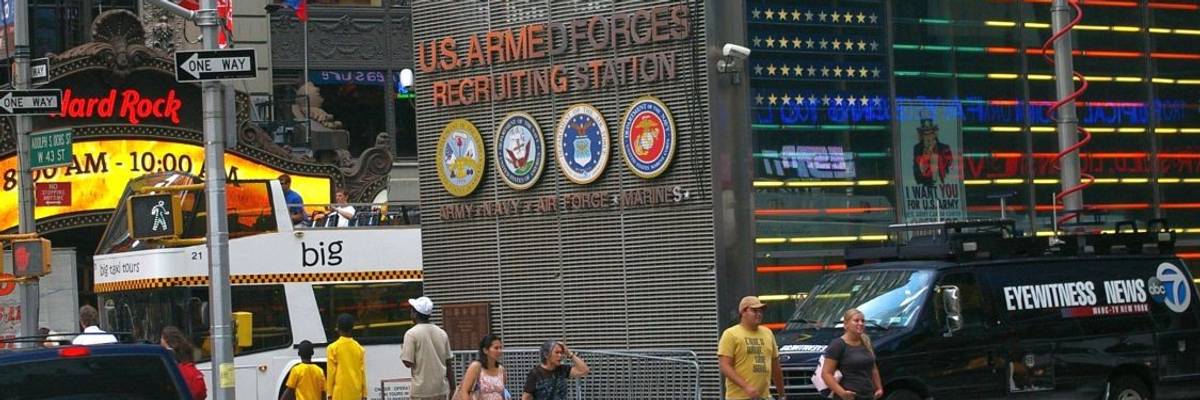
Pedestrians walk by a United States Military recruiting station at Times Square, New York City.
Is it possible that collective humanity is actually turning against war—seeing it more as the primary problem than the solution to our global ills?
Some experts worry that, if the country went to war, many reserve units might be unable to deploy. A U.S. official who works on these issues put it simply: ‘We can’t get enough people.’”
“Vietnam Syndrome” hasn’t gone away! It resulted in the elimination of the draft and ultimately morphed into “Iraq Syndrome”—so it seems—and even though those lost, horrific wars are now nothing but history, the next American war is ever-looming (against Canada?... against Greenland?). And yet, good God, the military is having a hard time recruiting a sufficient amount of patriotic cannon fodder.
“We can’t get enough people”—you know, to kill the enemy and to risk coming home in a box. And maybe that’s a good thing! The public is kind of getting it: War is obsolete (to put it politely). War is insane; it threatens the future of life on the planet—even though a huge swatch of the American media seems unwilling to get it and continues to report on war and militarism as though they literally equaled “national defense.” After all, we spend a trillion dollars annually on it.
Indeed, war unites us... in hell.
The above quote is from a fascinating—and troubling—piece by Dexter Filkins in The New Yorker, which has long been my favorite magazine. What troubled me was the unquestioned acceptance in the piece of the inevitability, indeed, the normalcy, of going off to war. In that context, war is simply an abstraction—a real-life game of Risk, you might say—and the proclaimed enemy is, ipso facto, less human than we are, and thus more easily reduced to collateral damage.
The article addresses a highly problematic (from a military point of view) diminishing of the military’s recruitment base. For instance: “Recruiters,” Filkins writes, “are contending with a population that’s not just unenthusiastic but incapable. According to a Pentagon study, more than three-quarters of Americans between the ages of 17 and 24 are ineligible, because they are overweight, unable to pass the aptitude test, afflicted by physical or mental-health issues, or disqualified by such factors as a criminal record. While the political argument festers, military leaders are left to contemplate a broader problem: Can a country defend itself if not enough people are willing or able to fight?”
While this is no doubt a legitimate question—militarism, after all, exists in a social context—what’s missing from this question, from my point of view, is the larger one that hovers above it, emerging from the future. Perhaps the larger question could be put this way: In a world that is hostage to multi-thousands of nuclear weapons across the planet, and on the edge of ecological collapse—with its Doomsday Clock currently set at 89 seconds to midnight—can a country defend itself from its greatest risks by going to war? Or will doing so simply intensify those risks?
Here’s a slightly simpler way to put it: For God’s sake, isn’t war obsolete by now? Isn’t militarism obsolete? I’m surprised The New Yorker piece didn’t reach a little further into the stratosphere to establish the story’s context. Come on! This is the media’s job.
Actually, there’s also a second question emerging as well. Let me put it this way: Is it possible that collective humanity is actually turning against war—seeing it more as the primary problem than the solution to our global ills? Could this be so despite the quasi-meaningless borders the world has divided itself into, which must be “protected” with ever more omnicidal violence?
The story notes: “After the terrorist attacks of September 11, 2001, a groundswell of patriotic feeling encouraged young people to volunteer for the military. The sentiment held as the U.S. attacked the Taliban and al Qaeda in Afghanistan, and then as it launched an invasion of Iraq, which quickly toppled Saddam Hussein’s regime. But, as those wars dragged on, the public mood soured. The troops deployed there were unprepared and ill-equipped, sent to pursue objectives that could be bafflingly opaque.”
The public mood soured? Could this possibly be described in a more simplistic way—with less respect for the national collective awareness? What if something a bit more significant were actually happening, e.g., a public majority began seeing the invasion, the devastation of hundreds of thousands of lives, as... wrong?
And might, let us say, enormous human change be brewing? The same thing happened in Vietnam. It turned into hell, not just for the people of Vietnam—the war’s primary victims—but for the U.S. troops waging it. It became unendurable. “Fragging”—the killing of officers—started happening. So did moral injury: psychological woundedness that wouldn’t go away. Vet suicides started becoming common.
Back to Iraq. At one point the story mentions Bravo Company, a Marine battalion that had led the bloody assault on Fallujah in 2004. Two decades later, some of the surviving members held a reunion, which was permeated with anguish and guilt. For many, the trauma of Fallujah hadn’t gone away, and they remained emotionally troubled, often turning for relief to painkillers, alcohol, and methedrine.
All of which is deeply soul-cutting, but there’s a bit missing from the context: “Twenty years after the U.S. military offensive in the Iraqi city of Fallujah, locals are still suffering from the lasting impacts of the use of internationally banned weapons by U.S. forces,” according to Global Times. This includes such hellish instruments of war as white phosphorous and depleted uranium, the effects of which—on local air, soil, water, and vegetation—do not go away.
And of course the consequences for the locals have been ghastly, including enormous increases in cancer, birth defects, leukemia, still births, infant mortality and so, so much more, including “the emergence of diseases that were not known in the city before 2004.” And these effects will remain present in Fallujah, according to the article, for hundreds of years.
But the U.S. had to defend itself!
This is insane. War, as I have noted previously, is humanity’s cancer. It affects all of us, whether we belong to “us” or “them.” It affects us collectively. Indeed, war unites us... in hell. The mainstream media needs to stop pretending it doesn’t realize this.
Dear Common Dreams reader, It’s been nearly 30 years since I co-founded Common Dreams with my late wife, Lina Newhouser. We had the radical notion that journalism should serve the public good, not corporate profits. It was clear to us from the outset what it would take to build such a project. No paid advertisements. No corporate sponsors. No millionaire publisher telling us what to think or do. Many people said we wouldn't last a year, but we proved those doubters wrong. Together with a tremendous team of journalists and dedicated staff, we built an independent media outlet free from the constraints of profits and corporate control. Our mission has always been simple: To inform. To inspire. To ignite change for the common good. Building Common Dreams was not easy. Our survival was never guaranteed. When you take on the most powerful forces—Wall Street greed, fossil fuel industry destruction, Big Tech lobbyists, and uber-rich oligarchs who have spent billions upon billions rigging the economy and democracy in their favor—the only bulwark you have is supporters who believe in your work. But here’s the urgent message from me today. It's never been this bad out there. And it's never been this hard to keep us going. At the very moment Common Dreams is most needed, the threats we face are intensifying. We need your support now more than ever. We don't accept corporate advertising and never will. We don't have a paywall because we don't think people should be blocked from critical news based on their ability to pay. Everything we do is funded by the donations of readers like you. When everyone does the little they can afford, we are strong. But if that support retreats or dries up, so do we. Will you donate now to make sure Common Dreams not only survives but thrives? —Craig Brown, Co-founder |
Some experts worry that, if the country went to war, many reserve units might be unable to deploy. A U.S. official who works on these issues put it simply: ‘We can’t get enough people.’”
“Vietnam Syndrome” hasn’t gone away! It resulted in the elimination of the draft and ultimately morphed into “Iraq Syndrome”—so it seems—and even though those lost, horrific wars are now nothing but history, the next American war is ever-looming (against Canada?... against Greenland?). And yet, good God, the military is having a hard time recruiting a sufficient amount of patriotic cannon fodder.
“We can’t get enough people”—you know, to kill the enemy and to risk coming home in a box. And maybe that’s a good thing! The public is kind of getting it: War is obsolete (to put it politely). War is insane; it threatens the future of life on the planet—even though a huge swatch of the American media seems unwilling to get it and continues to report on war and militarism as though they literally equaled “national defense.” After all, we spend a trillion dollars annually on it.
Indeed, war unites us... in hell.
The above quote is from a fascinating—and troubling—piece by Dexter Filkins in The New Yorker, which has long been my favorite magazine. What troubled me was the unquestioned acceptance in the piece of the inevitability, indeed, the normalcy, of going off to war. In that context, war is simply an abstraction—a real-life game of Risk, you might say—and the proclaimed enemy is, ipso facto, less human than we are, and thus more easily reduced to collateral damage.
The article addresses a highly problematic (from a military point of view) diminishing of the military’s recruitment base. For instance: “Recruiters,” Filkins writes, “are contending with a population that’s not just unenthusiastic but incapable. According to a Pentagon study, more than three-quarters of Americans between the ages of 17 and 24 are ineligible, because they are overweight, unable to pass the aptitude test, afflicted by physical or mental-health issues, or disqualified by such factors as a criminal record. While the political argument festers, military leaders are left to contemplate a broader problem: Can a country defend itself if not enough people are willing or able to fight?”
While this is no doubt a legitimate question—militarism, after all, exists in a social context—what’s missing from this question, from my point of view, is the larger one that hovers above it, emerging from the future. Perhaps the larger question could be put this way: In a world that is hostage to multi-thousands of nuclear weapons across the planet, and on the edge of ecological collapse—with its Doomsday Clock currently set at 89 seconds to midnight—can a country defend itself from its greatest risks by going to war? Or will doing so simply intensify those risks?
Here’s a slightly simpler way to put it: For God’s sake, isn’t war obsolete by now? Isn’t militarism obsolete? I’m surprised The New Yorker piece didn’t reach a little further into the stratosphere to establish the story’s context. Come on! This is the media’s job.
Actually, there’s also a second question emerging as well. Let me put it this way: Is it possible that collective humanity is actually turning against war—seeing it more as the primary problem than the solution to our global ills? Could this be so despite the quasi-meaningless borders the world has divided itself into, which must be “protected” with ever more omnicidal violence?
The story notes: “After the terrorist attacks of September 11, 2001, a groundswell of patriotic feeling encouraged young people to volunteer for the military. The sentiment held as the U.S. attacked the Taliban and al Qaeda in Afghanistan, and then as it launched an invasion of Iraq, which quickly toppled Saddam Hussein’s regime. But, as those wars dragged on, the public mood soured. The troops deployed there were unprepared and ill-equipped, sent to pursue objectives that could be bafflingly opaque.”
The public mood soured? Could this possibly be described in a more simplistic way—with less respect for the national collective awareness? What if something a bit more significant were actually happening, e.g., a public majority began seeing the invasion, the devastation of hundreds of thousands of lives, as... wrong?
And might, let us say, enormous human change be brewing? The same thing happened in Vietnam. It turned into hell, not just for the people of Vietnam—the war’s primary victims—but for the U.S. troops waging it. It became unendurable. “Fragging”—the killing of officers—started happening. So did moral injury: psychological woundedness that wouldn’t go away. Vet suicides started becoming common.
Back to Iraq. At one point the story mentions Bravo Company, a Marine battalion that had led the bloody assault on Fallujah in 2004. Two decades later, some of the surviving members held a reunion, which was permeated with anguish and guilt. For many, the trauma of Fallujah hadn’t gone away, and they remained emotionally troubled, often turning for relief to painkillers, alcohol, and methedrine.
All of which is deeply soul-cutting, but there’s a bit missing from the context: “Twenty years after the U.S. military offensive in the Iraqi city of Fallujah, locals are still suffering from the lasting impacts of the use of internationally banned weapons by U.S. forces,” according to Global Times. This includes such hellish instruments of war as white phosphorous and depleted uranium, the effects of which—on local air, soil, water, and vegetation—do not go away.
And of course the consequences for the locals have been ghastly, including enormous increases in cancer, birth defects, leukemia, still births, infant mortality and so, so much more, including “the emergence of diseases that were not known in the city before 2004.” And these effects will remain present in Fallujah, according to the article, for hundreds of years.
But the U.S. had to defend itself!
This is insane. War, as I have noted previously, is humanity’s cancer. It affects all of us, whether we belong to “us” or “them.” It affects us collectively. Indeed, war unites us... in hell. The mainstream media needs to stop pretending it doesn’t realize this.
Some experts worry that, if the country went to war, many reserve units might be unable to deploy. A U.S. official who works on these issues put it simply: ‘We can’t get enough people.’”
“Vietnam Syndrome” hasn’t gone away! It resulted in the elimination of the draft and ultimately morphed into “Iraq Syndrome”—so it seems—and even though those lost, horrific wars are now nothing but history, the next American war is ever-looming (against Canada?... against Greenland?). And yet, good God, the military is having a hard time recruiting a sufficient amount of patriotic cannon fodder.
“We can’t get enough people”—you know, to kill the enemy and to risk coming home in a box. And maybe that’s a good thing! The public is kind of getting it: War is obsolete (to put it politely). War is insane; it threatens the future of life on the planet—even though a huge swatch of the American media seems unwilling to get it and continues to report on war and militarism as though they literally equaled “national defense.” After all, we spend a trillion dollars annually on it.
Indeed, war unites us... in hell.
The above quote is from a fascinating—and troubling—piece by Dexter Filkins in The New Yorker, which has long been my favorite magazine. What troubled me was the unquestioned acceptance in the piece of the inevitability, indeed, the normalcy, of going off to war. In that context, war is simply an abstraction—a real-life game of Risk, you might say—and the proclaimed enemy is, ipso facto, less human than we are, and thus more easily reduced to collateral damage.
The article addresses a highly problematic (from a military point of view) diminishing of the military’s recruitment base. For instance: “Recruiters,” Filkins writes, “are contending with a population that’s not just unenthusiastic but incapable. According to a Pentagon study, more than three-quarters of Americans between the ages of 17 and 24 are ineligible, because they are overweight, unable to pass the aptitude test, afflicted by physical or mental-health issues, or disqualified by such factors as a criminal record. While the political argument festers, military leaders are left to contemplate a broader problem: Can a country defend itself if not enough people are willing or able to fight?”
While this is no doubt a legitimate question—militarism, after all, exists in a social context—what’s missing from this question, from my point of view, is the larger one that hovers above it, emerging from the future. Perhaps the larger question could be put this way: In a world that is hostage to multi-thousands of nuclear weapons across the planet, and on the edge of ecological collapse—with its Doomsday Clock currently set at 89 seconds to midnight—can a country defend itself from its greatest risks by going to war? Or will doing so simply intensify those risks?
Here’s a slightly simpler way to put it: For God’s sake, isn’t war obsolete by now? Isn’t militarism obsolete? I’m surprised The New Yorker piece didn’t reach a little further into the stratosphere to establish the story’s context. Come on! This is the media’s job.
Actually, there’s also a second question emerging as well. Let me put it this way: Is it possible that collective humanity is actually turning against war—seeing it more as the primary problem than the solution to our global ills? Could this be so despite the quasi-meaningless borders the world has divided itself into, which must be “protected” with ever more omnicidal violence?
The story notes: “After the terrorist attacks of September 11, 2001, a groundswell of patriotic feeling encouraged young people to volunteer for the military. The sentiment held as the U.S. attacked the Taliban and al Qaeda in Afghanistan, and then as it launched an invasion of Iraq, which quickly toppled Saddam Hussein’s regime. But, as those wars dragged on, the public mood soured. The troops deployed there were unprepared and ill-equipped, sent to pursue objectives that could be bafflingly opaque.”
The public mood soured? Could this possibly be described in a more simplistic way—with less respect for the national collective awareness? What if something a bit more significant were actually happening, e.g., a public majority began seeing the invasion, the devastation of hundreds of thousands of lives, as... wrong?
And might, let us say, enormous human change be brewing? The same thing happened in Vietnam. It turned into hell, not just for the people of Vietnam—the war’s primary victims—but for the U.S. troops waging it. It became unendurable. “Fragging”—the killing of officers—started happening. So did moral injury: psychological woundedness that wouldn’t go away. Vet suicides started becoming common.
Back to Iraq. At one point the story mentions Bravo Company, a Marine battalion that had led the bloody assault on Fallujah in 2004. Two decades later, some of the surviving members held a reunion, which was permeated with anguish and guilt. For many, the trauma of Fallujah hadn’t gone away, and they remained emotionally troubled, often turning for relief to painkillers, alcohol, and methedrine.
All of which is deeply soul-cutting, but there’s a bit missing from the context: “Twenty years after the U.S. military offensive in the Iraqi city of Fallujah, locals are still suffering from the lasting impacts of the use of internationally banned weapons by U.S. forces,” according to Global Times. This includes such hellish instruments of war as white phosphorous and depleted uranium, the effects of which—on local air, soil, water, and vegetation—do not go away.
And of course the consequences for the locals have been ghastly, including enormous increases in cancer, birth defects, leukemia, still births, infant mortality and so, so much more, including “the emergence of diseases that were not known in the city before 2004.” And these effects will remain present in Fallujah, according to the article, for hundreds of years.
But the U.S. had to defend itself!
This is insane. War, as I have noted previously, is humanity’s cancer. It affects all of us, whether we belong to “us” or “them.” It affects us collectively. Indeed, war unites us... in hell. The mainstream media needs to stop pretending it doesn’t realize this.