

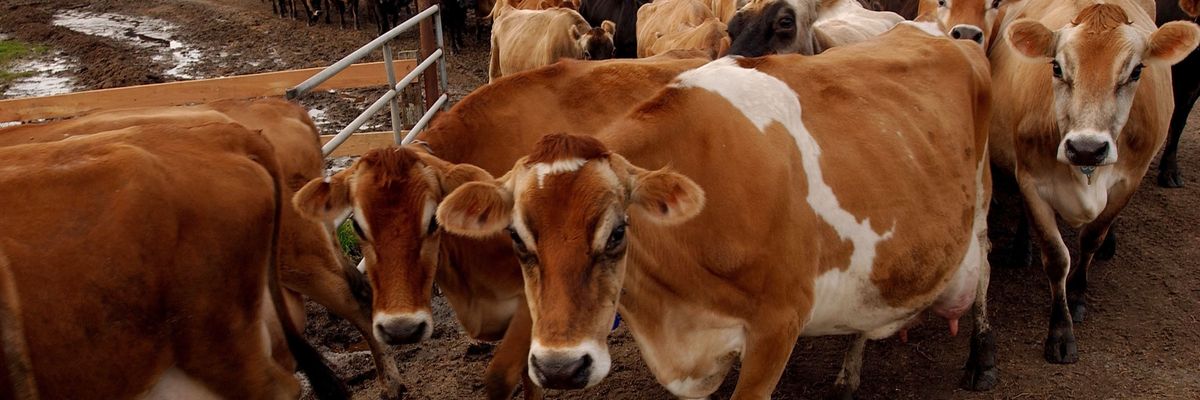
Cows graze in the fields and farms December 26, 2003 outside of Petaluma, California.
Measure J in California's Sonoma County Paves the Way for Environmental Health
Examining the hidden impacts of factory farming and how a ballot measure in the heart of wine country could put us on a path to a more sustainable and healthier future.
In a June article in Politico, the author of “Animal rights comes to ‘America’s Provence’ and farmers are worried” dives into the ongoing debate over Measure J on Sonoma County’s November ballot, which seeks to bar the operation and maintenance of concentrated (or confined) animal feeding operations. The piece overlooks the significant damages that CAFOs have historically inflicted upon surrounding communities and animals.
The piece cites CAFO operators’ commitment to sustainable practices and “compliance monitoring,” such as recycling manure by applying it to agricultural land as a natural fertilizer. Such land applications, however, frequently lead to groundwater contamination through runoff. Sonoma County has the most wells per capita of any California county, with around 23,000 properties relying on groundwater from a private well for their water supply. Sonoma County residents deserve access to clean water, uncontaminated by manure.
These facilities also impact air quality and human health. A 2019 University of Wisconsin-Madison study corroborated previous findings stating that the closer children lived to a CAFO, the more likely they were to develop asthma. According to the California Air Resources Board, one in six children living in California’s Central Valley suffer from asthma.
Measure J offers a path to a more sustainable future for Sonoma County. Voting for Measure J this November would allow the county to lead by example—pushing for environmental and public health protections and making a collective effort to protect our environment and public health.
Asthmatic symptoms caused by hazardous contaminants are not the only consequence of CAFO air pollution. CAFOs emit egregious amounts of greenhouse gases that heavily contribute to climate change. Methane and nitrous oxide emissions are 23 and 300 times more potent than carbon dioxide as greenhouse gases, respectively. Animal agriculture is the leading source of U.S. methane emissions, while agricultural soil management is responsible for 75% of U.S. nitrous oxide emissions, primarily because of the use of manure from animal agribusiness.
CAFOs are also associated with the increased spread of diseases—including avian flu—among animals and humans. In the original article, farmer Mike Weber admitted that he had to kill all 550,000 chickens in December due to an outbreak. Several states have recently suffered from avian flu outbreaks, 48 with affected poultry and 12 with affected cattle. The extremely high-density environment of a CAFO facilitates a quicker transfer of the virus, exacerbated by wastewater that is often improperly treated and discharged. These cruel conditions are a perfect storm for a public health disaster, while also causing high levels of stress, discomfort, and illness among the animals housed there.
Although the piece argues that Measure J would impede family farm livelihood, it is actually the opposite. As a matter of fact, small family farmers are often the strongest adversaries of large, industrial-scale CAFOs. For example, family farmers in Iowa are calling for reduced federal subsidies for large CAFOs in favor of increased funding for conservation programs targeted at smaller farms. These are not activists wanting to “eradicate animal farming entirely.” The opposition to CAFOs is a community-led effort to ensure all Californians get a cleaner and healthier food system and environment.
Measure J seeks to prohibit the establishment, operation, expansion, or maintenance of CAFOs in the unincorporated areas of Sonoma County. This prohibition aims to protect the environment, safeguard public health, and address environmental justice concerns. It even provides existing CAFOs with a phase-out period of three years to modify or cease operations.
The measure does not simply cast CAFO owners aside. It includes provisions to ensure that farm workers receive the assistance and training they may need to transition to government-sanctioned agricultural operations. The measure does not require these animal feeding operations to close outright but rather gives them a three-year period to modify their operations so that they no longer qualify as CAFOs. That time period presents the perfect opportunity for owners to lean into sustainable agricultural practices, for which Sonoma County has long been known. Sustainable approaches, such as implementing pasture-based feeding and taking a circular, whole-systems farming approach, are increasingly feasible, economically viable, and almost always more humane.
Measure J offers a path to a more sustainable future for Sonoma County. Voting for Measure J this November would allow the county to lead by example—pushing for environmental and public health protections and making a collective effort to protect our environment and public health. It's time to prioritize human and environmental health over industrial farming practices that harm our communities, animals, and planet.
An Urgent Message From Our Co-Founder
Dear Common Dreams reader, It’s been nearly 30 years since I co-founded Common Dreams with my late wife, Lina Newhouser. We had the radical notion that journalism should serve the public good, not corporate profits. It was clear to us from the outset what it would take to build such a project. No paid advertisements. No corporate sponsors. No millionaire publisher telling us what to think or do. Many people said we wouldn't last a year, but we proved those doubters wrong. Together with a tremendous team of journalists and dedicated staff, we built an independent media outlet free from the constraints of profits and corporate control. Our mission has always been simple: To inform. To inspire. To ignite change for the common good. Building Common Dreams was not easy. Our survival was never guaranteed. When you take on the most powerful forces—Wall Street greed, fossil fuel industry destruction, Big Tech lobbyists, and uber-rich oligarchs who have spent billions upon billions rigging the economy and democracy in their favor—the only bulwark you have is supporters who believe in your work. But here’s the urgent message from me today. It's never been this bad out there. And it's never been this hard to keep us going. At the very moment Common Dreams is most needed, the threats we face are intensifying. We need your support now more than ever. We don't accept corporate advertising and never will. We don't have a paywall because we don't think people should be blocked from critical news based on their ability to pay. Everything we do is funded by the donations of readers like you. When everyone does the little they can afford, we are strong. But if that support retreats or dries up, so do we. Will you donate now to make sure Common Dreams not only survives but thrives? —Craig Brown, Co-founder |
In a June article in Politico, the author of “Animal rights comes to ‘America’s Provence’ and farmers are worried” dives into the ongoing debate over Measure J on Sonoma County’s November ballot, which seeks to bar the operation and maintenance of concentrated (or confined) animal feeding operations. The piece overlooks the significant damages that CAFOs have historically inflicted upon surrounding communities and animals.
The piece cites CAFO operators’ commitment to sustainable practices and “compliance monitoring,” such as recycling manure by applying it to agricultural land as a natural fertilizer. Such land applications, however, frequently lead to groundwater contamination through runoff. Sonoma County has the most wells per capita of any California county, with around 23,000 properties relying on groundwater from a private well for their water supply. Sonoma County residents deserve access to clean water, uncontaminated by manure.
These facilities also impact air quality and human health. A 2019 University of Wisconsin-Madison study corroborated previous findings stating that the closer children lived to a CAFO, the more likely they were to develop asthma. According to the California Air Resources Board, one in six children living in California’s Central Valley suffer from asthma.
Measure J offers a path to a more sustainable future for Sonoma County. Voting for Measure J this November would allow the county to lead by example—pushing for environmental and public health protections and making a collective effort to protect our environment and public health.
Asthmatic symptoms caused by hazardous contaminants are not the only consequence of CAFO air pollution. CAFOs emit egregious amounts of greenhouse gases that heavily contribute to climate change. Methane and nitrous oxide emissions are 23 and 300 times more potent than carbon dioxide as greenhouse gases, respectively. Animal agriculture is the leading source of U.S. methane emissions, while agricultural soil management is responsible for 75% of U.S. nitrous oxide emissions, primarily because of the use of manure from animal agribusiness.
CAFOs are also associated with the increased spread of diseases—including avian flu—among animals and humans. In the original article, farmer Mike Weber admitted that he had to kill all 550,000 chickens in December due to an outbreak. Several states have recently suffered from avian flu outbreaks, 48 with affected poultry and 12 with affected cattle. The extremely high-density environment of a CAFO facilitates a quicker transfer of the virus, exacerbated by wastewater that is often improperly treated and discharged. These cruel conditions are a perfect storm for a public health disaster, while also causing high levels of stress, discomfort, and illness among the animals housed there.
Although the piece argues that Measure J would impede family farm livelihood, it is actually the opposite. As a matter of fact, small family farmers are often the strongest adversaries of large, industrial-scale CAFOs. For example, family farmers in Iowa are calling for reduced federal subsidies for large CAFOs in favor of increased funding for conservation programs targeted at smaller farms. These are not activists wanting to “eradicate animal farming entirely.” The opposition to CAFOs is a community-led effort to ensure all Californians get a cleaner and healthier food system and environment.
Measure J seeks to prohibit the establishment, operation, expansion, or maintenance of CAFOs in the unincorporated areas of Sonoma County. This prohibition aims to protect the environment, safeguard public health, and address environmental justice concerns. It even provides existing CAFOs with a phase-out period of three years to modify or cease operations.
The measure does not simply cast CAFO owners aside. It includes provisions to ensure that farm workers receive the assistance and training they may need to transition to government-sanctioned agricultural operations. The measure does not require these animal feeding operations to close outright but rather gives them a three-year period to modify their operations so that they no longer qualify as CAFOs. That time period presents the perfect opportunity for owners to lean into sustainable agricultural practices, for which Sonoma County has long been known. Sustainable approaches, such as implementing pasture-based feeding and taking a circular, whole-systems farming approach, are increasingly feasible, economically viable, and almost always more humane.
Measure J offers a path to a more sustainable future for Sonoma County. Voting for Measure J this November would allow the county to lead by example—pushing for environmental and public health protections and making a collective effort to protect our environment and public health. It's time to prioritize human and environmental health over industrial farming practices that harm our communities, animals, and planet.
In a June article in Politico, the author of “Animal rights comes to ‘America’s Provence’ and farmers are worried” dives into the ongoing debate over Measure J on Sonoma County’s November ballot, which seeks to bar the operation and maintenance of concentrated (or confined) animal feeding operations. The piece overlooks the significant damages that CAFOs have historically inflicted upon surrounding communities and animals.
The piece cites CAFO operators’ commitment to sustainable practices and “compliance monitoring,” such as recycling manure by applying it to agricultural land as a natural fertilizer. Such land applications, however, frequently lead to groundwater contamination through runoff. Sonoma County has the most wells per capita of any California county, with around 23,000 properties relying on groundwater from a private well for their water supply. Sonoma County residents deserve access to clean water, uncontaminated by manure.
These facilities also impact air quality and human health. A 2019 University of Wisconsin-Madison study corroborated previous findings stating that the closer children lived to a CAFO, the more likely they were to develop asthma. According to the California Air Resources Board, one in six children living in California’s Central Valley suffer from asthma.
Measure J offers a path to a more sustainable future for Sonoma County. Voting for Measure J this November would allow the county to lead by example—pushing for environmental and public health protections and making a collective effort to protect our environment and public health.
Asthmatic symptoms caused by hazardous contaminants are not the only consequence of CAFO air pollution. CAFOs emit egregious amounts of greenhouse gases that heavily contribute to climate change. Methane and nitrous oxide emissions are 23 and 300 times more potent than carbon dioxide as greenhouse gases, respectively. Animal agriculture is the leading source of U.S. methane emissions, while agricultural soil management is responsible for 75% of U.S. nitrous oxide emissions, primarily because of the use of manure from animal agribusiness.
CAFOs are also associated with the increased spread of diseases—including avian flu—among animals and humans. In the original article, farmer Mike Weber admitted that he had to kill all 550,000 chickens in December due to an outbreak. Several states have recently suffered from avian flu outbreaks, 48 with affected poultry and 12 with affected cattle. The extremely high-density environment of a CAFO facilitates a quicker transfer of the virus, exacerbated by wastewater that is often improperly treated and discharged. These cruel conditions are a perfect storm for a public health disaster, while also causing high levels of stress, discomfort, and illness among the animals housed there.
Although the piece argues that Measure J would impede family farm livelihood, it is actually the opposite. As a matter of fact, small family farmers are often the strongest adversaries of large, industrial-scale CAFOs. For example, family farmers in Iowa are calling for reduced federal subsidies for large CAFOs in favor of increased funding for conservation programs targeted at smaller farms. These are not activists wanting to “eradicate animal farming entirely.” The opposition to CAFOs is a community-led effort to ensure all Californians get a cleaner and healthier food system and environment.
Measure J seeks to prohibit the establishment, operation, expansion, or maintenance of CAFOs in the unincorporated areas of Sonoma County. This prohibition aims to protect the environment, safeguard public health, and address environmental justice concerns. It even provides existing CAFOs with a phase-out period of three years to modify or cease operations.
The measure does not simply cast CAFO owners aside. It includes provisions to ensure that farm workers receive the assistance and training they may need to transition to government-sanctioned agricultural operations. The measure does not require these animal feeding operations to close outright but rather gives them a three-year period to modify their operations so that they no longer qualify as CAFOs. That time period presents the perfect opportunity for owners to lean into sustainable agricultural practices, for which Sonoma County has long been known. Sustainable approaches, such as implementing pasture-based feeding and taking a circular, whole-systems farming approach, are increasingly feasible, economically viable, and almost always more humane.
Measure J offers a path to a more sustainable future for Sonoma County. Voting for Measure J this November would allow the county to lead by example—pushing for environmental and public health protections and making a collective effort to protect our environment and public health. It's time to prioritize human and environmental health over industrial farming practices that harm our communities, animals, and planet.