

SUBSCRIBE TO OUR FREE NEWSLETTER
Daily news & progressive opinion—funded by the people, not the corporations—delivered straight to your inbox.
5
#000000
#FFFFFF
To donate by check, phone, or other method, see our More Ways to Give page.
Daily news & progressive opinion—funded by the people, not the corporations—delivered straight to your inbox.
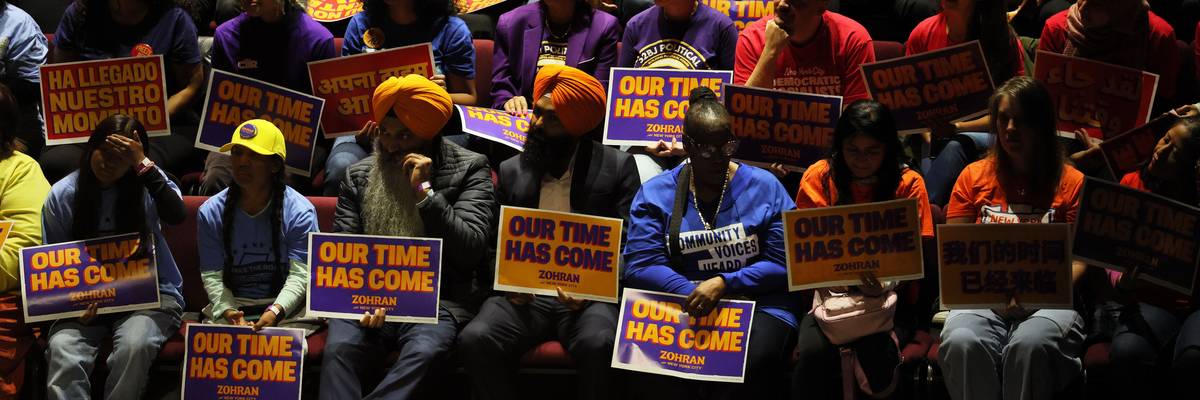
Supporters of New York City Mayoral candidate Zohran Mamdani hold campaign signs during a campaign rally at United Palace on October 13, 2025 in New York City.
Mamdani is the antidote to the corporate landlord dominance we see in cities across the US. He doesn’t just speak on behalf of rent-stabilized tenants; he is one.
Zohran Mamdani, a tenant who lives in a rent-stabilized apartment and made affordable rent the primary issue in his campaign, has been elected mayor of New York City.
To be clear, a win for Mamdani is a huge win for renters—not just in New York, but across the country. Mayor-elect Mamdani has shown that a populist mayoral candidate with a bullhorn can ground a winning campaign in issues that impact constituents just trying to get by and have a decent place to live.
During the campaign, former New York Gov. Andrew Cuomo repeatedly attacked Mamdani for living in a rent-stabilized apartment and supporting a rent freeze. It was a display of character and courage that Mamdani never backed down. Instead, he doubled down. And the attacks against him continued through the last mayoral debate, where Mamdani stated emphatically, “You’ve heard it from Andrew Cuomo that the number one crisis in this city, the housing crisis, the answer is to evict my wife and I. He thinks you address this crisis by unleashing my landlord’s ability to raise my rent. If you think that the problem in this city is that my rent is too low, vote for him. If you know the problem in this city is that your rent is too high, vote for me.”
Mamdani understands the debate comes down to a very basic question: With rents so high, where are people supposed to live? The Starbucks barista, McDonald's worker, and Lyft driver are experiencing what most candidates are afraid to talk about—that they are one rent increase away from losing their apartment.
With over 2.3 million renters in New York City, it’s about time they elected a mayor who would put affordable rents front and center.
Too often, the dialogue around rent has been dominated by investors and corporate landlords. They seemingly have a bottomless pit of money to get their message out and line the campaign coffers of candidates who offer them carte blanche to raise rents and undermine tenants. As Mamdani stated during the race, “The same landlords who said they didn’t have enough money to freeze the rent, gave Cuomo $2.5 million dollars, the single largest check in this entire race.”
Mamdani is the antidote to the corporate landlord dominance we see in cities across the US. He doesn’t just speak on behalf of rent-stabilized tenants; he is one. And that makes all the difference.
Rent control is not new. It has been around since 1919. As real estate became more corporatized, multi-family buildings became a commodity—a line on a balance sheet. It’s less about the people and more about the building as an asset whose value is based on rents. In the 1990s, Apartment Associations led a nationwide campaign to curtail or ban altogether rent control. Currently, 37 states have banned it and states like California only allow rent control in buildings built in 1996.
Cash-strapped tenant organizations have done their best to move the needle on rent stabilization efforts, but they often face a deluge of money from the real estate industry, expensive lawsuits, and elected officials willing to reverse their progress.
Mamdani’s win as mayor signals new hope for campaigns that address the need to control skyrocketing rents. It sets in motion a new model nationwide centered on the needs of constituents, rather than corporate-dominated policies that have no tangible benefit to constituents and fail to improve the quality of life for low-income people.
With over 2.3 million renters in New York City, it’s about time they elected a mayor who would put affordable rents front and center.
Leaders across the country are watching what is happening in New York. The rents are so high that even someone working two full-time jobs can still be rent-burdened, paying over 30% of their income in rent. That is not sustainable.
New Yorkers reached a tipping point and found in Mamdani a leader who provided a platform of solutions, not more excuses for why they cannot get the relief they need. And hopefully, other cities will follow suit, attracting candidates that want to solve problems rather than kowtow to rich donors.
Let’s face it: Stabilizing housing costs is a reasonable practice, which is why most homeowners pay the same amount every month in mortgage payments. Mortgages don’t go up 17% every year to line the pockets of lenders. That would be ridiculous, and it is for renters too. Giving renters stability is not just a reasonable ask; it is a necessity.
As a lifelong renter, I believe we are on the precipice of policy change in the US. Renters and low-income communities are rising up to demand that the government acts in their interest.
Mamdani serving as mayor of America’s largest city, while living in a rent-stabilized apartment, is a game changer. More of this in other cities is desperately needed.
Dear Common Dreams reader, It’s been nearly 30 years since I co-founded Common Dreams with my late wife, Lina Newhouser. We had the radical notion that journalism should serve the public good, not corporate profits. It was clear to us from the outset what it would take to build such a project. No paid advertisements. No corporate sponsors. No millionaire publisher telling us what to think or do. Many people said we wouldn't last a year, but we proved those doubters wrong. Together with a tremendous team of journalists and dedicated staff, we built an independent media outlet free from the constraints of profits and corporate control. Our mission has always been simple: To inform. To inspire. To ignite change for the common good. Building Common Dreams was not easy. Our survival was never guaranteed. When you take on the most powerful forces—Wall Street greed, fossil fuel industry destruction, Big Tech lobbyists, and uber-rich oligarchs who have spent billions upon billions rigging the economy and democracy in their favor—the only bulwark you have is supporters who believe in your work. But here’s the urgent message from me today. It's never been this bad out there. And it's never been this hard to keep us going. At the very moment Common Dreams is most needed, the threats we face are intensifying. We need your support now more than ever. We don't accept corporate advertising and never will. We don't have a paywall because we don't think people should be blocked from critical news based on their ability to pay. Everything we do is funded by the donations of readers like you. When everyone does the little they can afford, we are strong. But if that support retreats or dries up, so do we. Will you donate now to make sure Common Dreams not only survives but thrives? —Craig Brown, Co-founder |
Zohran Mamdani, a tenant who lives in a rent-stabilized apartment and made affordable rent the primary issue in his campaign, has been elected mayor of New York City.
To be clear, a win for Mamdani is a huge win for renters—not just in New York, but across the country. Mayor-elect Mamdani has shown that a populist mayoral candidate with a bullhorn can ground a winning campaign in issues that impact constituents just trying to get by and have a decent place to live.
During the campaign, former New York Gov. Andrew Cuomo repeatedly attacked Mamdani for living in a rent-stabilized apartment and supporting a rent freeze. It was a display of character and courage that Mamdani never backed down. Instead, he doubled down. And the attacks against him continued through the last mayoral debate, where Mamdani stated emphatically, “You’ve heard it from Andrew Cuomo that the number one crisis in this city, the housing crisis, the answer is to evict my wife and I. He thinks you address this crisis by unleashing my landlord’s ability to raise my rent. If you think that the problem in this city is that my rent is too low, vote for him. If you know the problem in this city is that your rent is too high, vote for me.”
Mamdani understands the debate comes down to a very basic question: With rents so high, where are people supposed to live? The Starbucks barista, McDonald's worker, and Lyft driver are experiencing what most candidates are afraid to talk about—that they are one rent increase away from losing their apartment.
With over 2.3 million renters in New York City, it’s about time they elected a mayor who would put affordable rents front and center.
Too often, the dialogue around rent has been dominated by investors and corporate landlords. They seemingly have a bottomless pit of money to get their message out and line the campaign coffers of candidates who offer them carte blanche to raise rents and undermine tenants. As Mamdani stated during the race, “The same landlords who said they didn’t have enough money to freeze the rent, gave Cuomo $2.5 million dollars, the single largest check in this entire race.”
Mamdani is the antidote to the corporate landlord dominance we see in cities across the US. He doesn’t just speak on behalf of rent-stabilized tenants; he is one. And that makes all the difference.
Rent control is not new. It has been around since 1919. As real estate became more corporatized, multi-family buildings became a commodity—a line on a balance sheet. It’s less about the people and more about the building as an asset whose value is based on rents. In the 1990s, Apartment Associations led a nationwide campaign to curtail or ban altogether rent control. Currently, 37 states have banned it and states like California only allow rent control in buildings built in 1996.
Cash-strapped tenant organizations have done their best to move the needle on rent stabilization efforts, but they often face a deluge of money from the real estate industry, expensive lawsuits, and elected officials willing to reverse their progress.
Mamdani’s win as mayor signals new hope for campaigns that address the need to control skyrocketing rents. It sets in motion a new model nationwide centered on the needs of constituents, rather than corporate-dominated policies that have no tangible benefit to constituents and fail to improve the quality of life for low-income people.
With over 2.3 million renters in New York City, it’s about time they elected a mayor who would put affordable rents front and center.
Leaders across the country are watching what is happening in New York. The rents are so high that even someone working two full-time jobs can still be rent-burdened, paying over 30% of their income in rent. That is not sustainable.
New Yorkers reached a tipping point and found in Mamdani a leader who provided a platform of solutions, not more excuses for why they cannot get the relief they need. And hopefully, other cities will follow suit, attracting candidates that want to solve problems rather than kowtow to rich donors.
Let’s face it: Stabilizing housing costs is a reasonable practice, which is why most homeowners pay the same amount every month in mortgage payments. Mortgages don’t go up 17% every year to line the pockets of lenders. That would be ridiculous, and it is for renters too. Giving renters stability is not just a reasonable ask; it is a necessity.
As a lifelong renter, I believe we are on the precipice of policy change in the US. Renters and low-income communities are rising up to demand that the government acts in their interest.
Mamdani serving as mayor of America’s largest city, while living in a rent-stabilized apartment, is a game changer. More of this in other cities is desperately needed.
Zohran Mamdani, a tenant who lives in a rent-stabilized apartment and made affordable rent the primary issue in his campaign, has been elected mayor of New York City.
To be clear, a win for Mamdani is a huge win for renters—not just in New York, but across the country. Mayor-elect Mamdani has shown that a populist mayoral candidate with a bullhorn can ground a winning campaign in issues that impact constituents just trying to get by and have a decent place to live.
During the campaign, former New York Gov. Andrew Cuomo repeatedly attacked Mamdani for living in a rent-stabilized apartment and supporting a rent freeze. It was a display of character and courage that Mamdani never backed down. Instead, he doubled down. And the attacks against him continued through the last mayoral debate, where Mamdani stated emphatically, “You’ve heard it from Andrew Cuomo that the number one crisis in this city, the housing crisis, the answer is to evict my wife and I. He thinks you address this crisis by unleashing my landlord’s ability to raise my rent. If you think that the problem in this city is that my rent is too low, vote for him. If you know the problem in this city is that your rent is too high, vote for me.”
Mamdani understands the debate comes down to a very basic question: With rents so high, where are people supposed to live? The Starbucks barista, McDonald's worker, and Lyft driver are experiencing what most candidates are afraid to talk about—that they are one rent increase away from losing their apartment.
With over 2.3 million renters in New York City, it’s about time they elected a mayor who would put affordable rents front and center.
Too often, the dialogue around rent has been dominated by investors and corporate landlords. They seemingly have a bottomless pit of money to get their message out and line the campaign coffers of candidates who offer them carte blanche to raise rents and undermine tenants. As Mamdani stated during the race, “The same landlords who said they didn’t have enough money to freeze the rent, gave Cuomo $2.5 million dollars, the single largest check in this entire race.”
Mamdani is the antidote to the corporate landlord dominance we see in cities across the US. He doesn’t just speak on behalf of rent-stabilized tenants; he is one. And that makes all the difference.
Rent control is not new. It has been around since 1919. As real estate became more corporatized, multi-family buildings became a commodity—a line on a balance sheet. It’s less about the people and more about the building as an asset whose value is based on rents. In the 1990s, Apartment Associations led a nationwide campaign to curtail or ban altogether rent control. Currently, 37 states have banned it and states like California only allow rent control in buildings built in 1996.
Cash-strapped tenant organizations have done their best to move the needle on rent stabilization efforts, but they often face a deluge of money from the real estate industry, expensive lawsuits, and elected officials willing to reverse their progress.
Mamdani’s win as mayor signals new hope for campaigns that address the need to control skyrocketing rents. It sets in motion a new model nationwide centered on the needs of constituents, rather than corporate-dominated policies that have no tangible benefit to constituents and fail to improve the quality of life for low-income people.
With over 2.3 million renters in New York City, it’s about time they elected a mayor who would put affordable rents front and center.
Leaders across the country are watching what is happening in New York. The rents are so high that even someone working two full-time jobs can still be rent-burdened, paying over 30% of their income in rent. That is not sustainable.
New Yorkers reached a tipping point and found in Mamdani a leader who provided a platform of solutions, not more excuses for why they cannot get the relief they need. And hopefully, other cities will follow suit, attracting candidates that want to solve problems rather than kowtow to rich donors.
Let’s face it: Stabilizing housing costs is a reasonable practice, which is why most homeowners pay the same amount every month in mortgage payments. Mortgages don’t go up 17% every year to line the pockets of lenders. That would be ridiculous, and it is for renters too. Giving renters stability is not just a reasonable ask; it is a necessity.
As a lifelong renter, I believe we are on the precipice of policy change in the US. Renters and low-income communities are rising up to demand that the government acts in their interest.
Mamdani serving as mayor of America’s largest city, while living in a rent-stabilized apartment, is a game changer. More of this in other cities is desperately needed.

