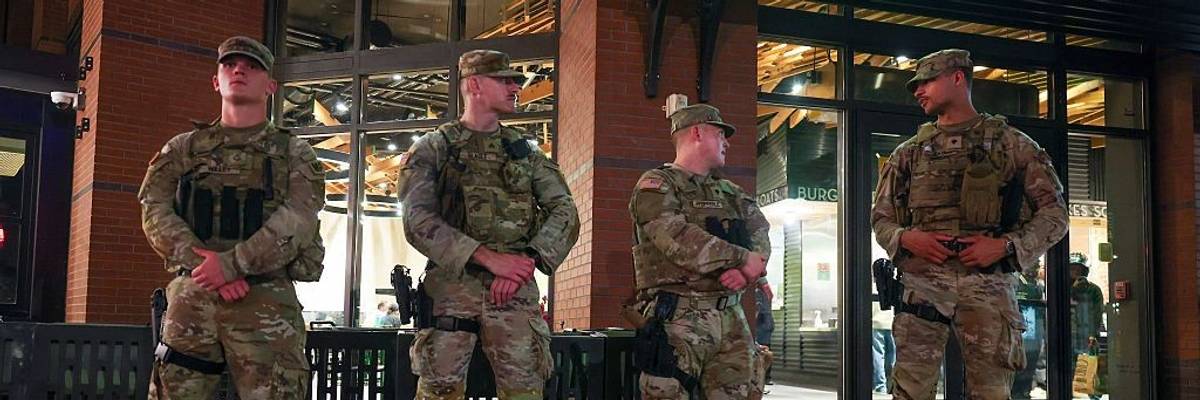
National Guard Members patrol 14th street, working with Washington DC Metro police on August 24, 2025 in Washington, DC. An increased presence of law enforcement has been seen throughout the nation's capital since U.S. President Donald Trump ordered in federal officers and the U.S. National Guard.
Do Americans Really Want to Live in a Militarized City?
While Trump bulldozes his way to enforce his anti-crime agenda, American cities are slowly becoming under military rule as we continue to lose our human rights and democracy.
Despite protests nationwide, a California district court order, and politician complaints, President Trump with the blessing of Governor Bill Lee is expected tosend troops any day now to Memphis. Growing up in my hometown, I can’t imagine seeing National Guard troops patrolling the streets of Elvis Presley Blvd or walking down my old neighborhood in Whitehaven.
I am a product of the Memphis City Public School System and remember the countless of free youth employment programs to help keep kids off the streets. Those summer enrichment programs led me to an international development career with the U.S. Agency for International Development, which was sadly dismantled. During my family’s assignments in Honduras, Nigeria and Rwanda, I saw first hand the human and political toll that countries face using their militaries as local law enforcement. I am heartbroken that my hometown has fallen victim to a disorganized Trump policy similar to the abrupt closure of USAID. I am also shocked by how casual Americans debate over using the National Guard to solve America’s crime problems in mainstream and social media. But do Americans really want to live in a militarized city?
Avoiding Narcos in Honduras
The thought of the National Guard running checkpoints near Beale Street, brought back triggering images of living overseas with USAID. During my family’s first USAID assignment in Honduras in 2010, the country was battling with narco violence and corruption. The violence and stress of living in the capital of Tegucigalpa hit home for me when my daughter’s kindergarten classmate was almost killed in the middle of a crossfire between narco cartels and the Honduran police. Fast forward twelve years later, Honduras is still unstable and unsafe even with their new 2022 national emergency declaration mandate to send military and police to address crime.
Policing in Mexico
Earlier in my diplomatic career, my family and I moved to Ciudad Juárez, Mexico in 2008 where women were brutally murdered on a daily basis. Mexican police and military were outgunned and outnumbered by narco cartels. Tragically, news broke out one day at my job that one of my American colleagues was brutally murdered inside her car with her American husband. The couple were leaving a consulate party and were chased down by a suspected drug hitman before they were brutally killed near the US-Mexico border. However, their baby girl survived. BBC reported that due to the former President Felipe Calderon’s aggressive crackdown on cartel violence, over 30,000 people were murdered across the country from 2006 to 2010.
Dealing with checkpoints in Nigeria
When I moved thousands of miles to work at the USAID mission in Nigeria, my family in Memphis were worried for my safety. Nigeria faced issues of high crime, terrorist attacks in the north, and kidnappings. In Nigeria, the security challenges were so great that President Tinubu deployed the military and police to patrol the streets. Going to a restaurant at night and passing through a military checkpoint was common. Unfortunately, the increased presence of the military on streets across Nigeria has not been effective in reducing crime and armed robberies.
As President Trump bulldozes his way to enforce his anti-crime agenda, American cities are slowly becoming under military rule. We are losing our human rights and democracy. I have seen this story before. Militarizing US cities is not a permanent solution to reduce crime. Policy makers should push for poverty reduction programs, ending homelessness and creating more jobs for youth to address the root causes of crime.
We are at a crossroads
This country and this world are at a monumental crossroads. In a few short weeks, US voters will have an opportunity to beat back the forces of fascism and confront the billionaires who are rigging the economy, our media system, and our democracy, making it increasingly impossible for ordinary people to get by. We’re not just talking about the election. We’re talking about what must be done once these fascist elements are vanquished from power. We need a bolder set of solutions than what either major party has so far been willing to offer and a working-class movement ready to fight like hell for it. Trump didn't emerge from nowhere. The conditions that fueled MAGA authoritarianism were created by decades of radical neoliberal economic policies and a corrupt political system dominated by corporate interests. They slashed taxes on the super-rich, promising that the benefits would trickle down. They said giveaways to the corporate titans would make life more affordable for the rest of us. It was all bullshit. And when a bitter, betrayed populace searches for someone to blame, right-wing demagogues have little trouble finding scapegoats. People know when they're being lied to, but you won't hear any of this from the corporate media. Only independent journalism—powered and funded by people who believe in building a better world—can deliver truly trustworthy daily news. Our Fall Campaign is underway, and we need your help. To power our newsroom through the rest of the year, we need to raise $125,000 by midnight on October 31. So if you share our vision, please contribute whatever you can to sustain our work. |
Despite protests nationwide, a California district court order, and politician complaints, President Trump with the blessing of Governor Bill Lee is expected tosend troops any day now to Memphis. Growing up in my hometown, I can’t imagine seeing National Guard troops patrolling the streets of Elvis Presley Blvd or walking down my old neighborhood in Whitehaven.
I am a product of the Memphis City Public School System and remember the countless of free youth employment programs to help keep kids off the streets. Those summer enrichment programs led me to an international development career with the U.S. Agency for International Development, which was sadly dismantled. During my family’s assignments in Honduras, Nigeria and Rwanda, I saw first hand the human and political toll that countries face using their militaries as local law enforcement. I am heartbroken that my hometown has fallen victim to a disorganized Trump policy similar to the abrupt closure of USAID. I am also shocked by how casual Americans debate over using the National Guard to solve America’s crime problems in mainstream and social media. But do Americans really want to live in a militarized city?
Avoiding Narcos in Honduras
The thought of the National Guard running checkpoints near Beale Street, brought back triggering images of living overseas with USAID. During my family’s first USAID assignment in Honduras in 2010, the country was battling with narco violence and corruption. The violence and stress of living in the capital of Tegucigalpa hit home for me when my daughter’s kindergarten classmate was almost killed in the middle of a crossfire between narco cartels and the Honduran police. Fast forward twelve years later, Honduras is still unstable and unsafe even with their new 2022 national emergency declaration mandate to send military and police to address crime.
Policing in Mexico
Earlier in my diplomatic career, my family and I moved to Ciudad Juárez, Mexico in 2008 where women were brutally murdered on a daily basis. Mexican police and military were outgunned and outnumbered by narco cartels. Tragically, news broke out one day at my job that one of my American colleagues was brutally murdered inside her car with her American husband. The couple were leaving a consulate party and were chased down by a suspected drug hitman before they were brutally killed near the US-Mexico border. However, their baby girl survived. BBC reported that due to the former President Felipe Calderon’s aggressive crackdown on cartel violence, over 30,000 people were murdered across the country from 2006 to 2010.
Dealing with checkpoints in Nigeria
When I moved thousands of miles to work at the USAID mission in Nigeria, my family in Memphis were worried for my safety. Nigeria faced issues of high crime, terrorist attacks in the north, and kidnappings. In Nigeria, the security challenges were so great that President Tinubu deployed the military and police to patrol the streets. Going to a restaurant at night and passing through a military checkpoint was common. Unfortunately, the increased presence of the military on streets across Nigeria has not been effective in reducing crime and armed robberies.
As President Trump bulldozes his way to enforce his anti-crime agenda, American cities are slowly becoming under military rule. We are losing our human rights and democracy. I have seen this story before. Militarizing US cities is not a permanent solution to reduce crime. Policy makers should push for poverty reduction programs, ending homelessness and creating more jobs for youth to address the root causes of crime.
Despite protests nationwide, a California district court order, and politician complaints, President Trump with the blessing of Governor Bill Lee is expected tosend troops any day now to Memphis. Growing up in my hometown, I can’t imagine seeing National Guard troops patrolling the streets of Elvis Presley Blvd or walking down my old neighborhood in Whitehaven.
I am a product of the Memphis City Public School System and remember the countless of free youth employment programs to help keep kids off the streets. Those summer enrichment programs led me to an international development career with the U.S. Agency for International Development, which was sadly dismantled. During my family’s assignments in Honduras, Nigeria and Rwanda, I saw first hand the human and political toll that countries face using their militaries as local law enforcement. I am heartbroken that my hometown has fallen victim to a disorganized Trump policy similar to the abrupt closure of USAID. I am also shocked by how casual Americans debate over using the National Guard to solve America’s crime problems in mainstream and social media. But do Americans really want to live in a militarized city?
Avoiding Narcos in Honduras
The thought of the National Guard running checkpoints near Beale Street, brought back triggering images of living overseas with USAID. During my family’s first USAID assignment in Honduras in 2010, the country was battling with narco violence and corruption. The violence and stress of living in the capital of Tegucigalpa hit home for me when my daughter’s kindergarten classmate was almost killed in the middle of a crossfire between narco cartels and the Honduran police. Fast forward twelve years later, Honduras is still unstable and unsafe even with their new 2022 national emergency declaration mandate to send military and police to address crime.
Policing in Mexico
Earlier in my diplomatic career, my family and I moved to Ciudad Juárez, Mexico in 2008 where women were brutally murdered on a daily basis. Mexican police and military were outgunned and outnumbered by narco cartels. Tragically, news broke out one day at my job that one of my American colleagues was brutally murdered inside her car with her American husband. The couple were leaving a consulate party and were chased down by a suspected drug hitman before they were brutally killed near the US-Mexico border. However, their baby girl survived. BBC reported that due to the former President Felipe Calderon’s aggressive crackdown on cartel violence, over 30,000 people were murdered across the country from 2006 to 2010.
Dealing with checkpoints in Nigeria
When I moved thousands of miles to work at the USAID mission in Nigeria, my family in Memphis were worried for my safety. Nigeria faced issues of high crime, terrorist attacks in the north, and kidnappings. In Nigeria, the security challenges were so great that President Tinubu deployed the military and police to patrol the streets. Going to a restaurant at night and passing through a military checkpoint was common. Unfortunately, the increased presence of the military on streets across Nigeria has not been effective in reducing crime and armed robberies.
As President Trump bulldozes his way to enforce his anti-crime agenda, American cities are slowly becoming under military rule. We are losing our human rights and democracy. I have seen this story before. Militarizing US cities is not a permanent solution to reduce crime. Policy makers should push for poverty reduction programs, ending homelessness and creating more jobs for youth to address the root causes of crime.