SUBSCRIBE TO OUR FREE NEWSLETTER
Daily news & progressive opinion—funded by the people, not the corporations—delivered straight to your inbox.
5
#000000
#FFFFFF
To donate by check, phone, or other method, see our More Ways to Give page.
Daily news & progressive opinion—funded by the people, not the corporations—delivered straight to your inbox.
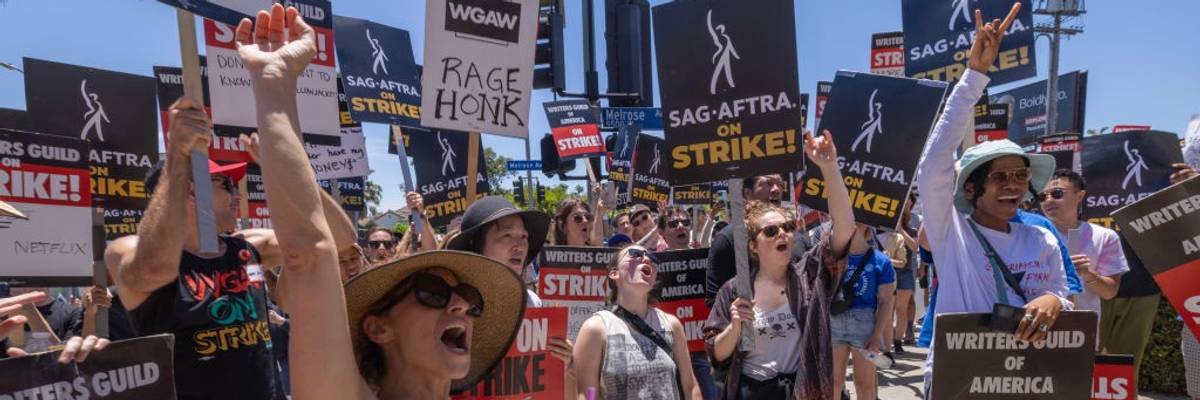
Members of the Hollywood actors SAG-AFTRA union walk a picket line with screenwriters outside of Paramount Studios on Day 2 of the actors’ strike on July 14, 2023, in Los Angeles, California.
This is the moment for policymakers to demonstrate leadership and act in the best interest of the workers who keep our economy and our society functioning.
We are in an unprecedented moment in history for the modern American labor movement, with widespread labor strikes that stretch from coast to coast. From machinists to movie stars, worker-led actions are reverberating across sectors and sending a powerful message: Workers demand more.
Right now, more than 170,000 media professionals and writers are on strike demanding fair compensation from the Alliance of Motion Picture and Television Producers, and there are 146,000 workers represented by the United Auto Workers (UAW) ready to strike on September 15 if the Big Three American automakers (Ford, General Motors, and Stellantis) fail to improve working conditions and compensation. A strike by the UAW would increase the number of American workers on strike to the highest level since 1983. The scale of these strikes represents a significant shift in labor relations and a unique opportunity to shape an economic future that values and respects the dignity of work and the rights of workers.
For the first time in decades, the public is overwhelmingly on the side of workers. According to Gallup surveys, public support for labor unions is at its highest level in nearly 60 years. This surge in approval signals a significant societal shift and an awakening to the reality of working conditions in a 21st-century economy that often prioritizes profit over people.
Today’s labor movement, emboldened by a call for solidarity, represents a watershed moment for the advocacy and protection of workers’ rights.
Historically, labor unions have been instrumental in securing essential rights and protections for workers, from a five-day workweek to safer working conditions.
Today’s labor movement, emboldened by a call for solidarity, represents a watershed moment for the advocacy and protection of workers’ rights.
Yet, while public sentiment may be evolving, policy and legislation have been slower to catch up. A fair and thriving society needs laws protecting labor that keep pace with the changing workplace landscape. The recent wave of technological innovations, the Covid-19 pandemic, and rising global temperatures are all reshaping how we work, and policymakers must rise to the occasion. In an era marked by increasing employer power over workers and the growing prevalence of precarious work, policies that strengthen the right to strike and to collective bargaining are more critical than ever.
After years of corporate attacks, current labor policies do not respect and promote the collective power of workers. Rather, they enable harmful practices like union-busting, wage theft, and even corporate exploitation of children. Enacting laws that promote labor protections is not just a matter of economic justice—it is a question of human dignity. The right to fair compensation for work, to safe conditions, and to collective bargaining are cornerstones of a just society.
This is the moment for policymakers to demonstrate leadership and act in the best interest of the workers who keep our economy and our society functioning. It is a pivotal opportunity to strengthen labor laws, protect the right to strike and bargain collectively, and, ultimately, pave the way for a more equitable and fair society. The labor reforms available are wide-ranging: Policymakers can end at-will employment, support sectoral bargaining, center workers in workforce development, and raise the decision-making power of workers and unions.
The resurgence of the labor movement is not a temporary disruption to be weathered; it’s a clarion call for change to be embraced. Let’s ensure that this watershed moment in labor history leads to lasting change for the millions of workers who deserve nothing less.
Dear Common Dreams reader, It’s been nearly 30 years since I co-founded Common Dreams with my late wife, Lina Newhouser. We had the radical notion that journalism should serve the public good, not corporate profits. It was clear to us from the outset what it would take to build such a project. No paid advertisements. No corporate sponsors. No millionaire publisher telling us what to think or do. Many people said we wouldn't last a year, but we proved those doubters wrong. Together with a tremendous team of journalists and dedicated staff, we built an independent media outlet free from the constraints of profits and corporate control. Our mission has always been simple: To inform. To inspire. To ignite change for the common good. Building Common Dreams was not easy. Our survival was never guaranteed. When you take on the most powerful forces—Wall Street greed, fossil fuel industry destruction, Big Tech lobbyists, and uber-rich oligarchs who have spent billions upon billions rigging the economy and democracy in their favor—the only bulwark you have is supporters who believe in your work. But here’s the urgent message from me today. It's never been this bad out there. And it's never been this hard to keep us going. At the very moment Common Dreams is most needed, the threats we face are intensifying. We need your support now more than ever. We don't accept corporate advertising and never will. We don't have a paywall because we don't think people should be blocked from critical news based on their ability to pay. Everything we do is funded by the donations of readers like you. When everyone does the little they can afford, we are strong. But if that support retreats or dries up, so do we. Will you donate now to make sure Common Dreams not only survives but thrives? —Craig Brown, Co-founder |
We are in an unprecedented moment in history for the modern American labor movement, with widespread labor strikes that stretch from coast to coast. From machinists to movie stars, worker-led actions are reverberating across sectors and sending a powerful message: Workers demand more.
Right now, more than 170,000 media professionals and writers are on strike demanding fair compensation from the Alliance of Motion Picture and Television Producers, and there are 146,000 workers represented by the United Auto Workers (UAW) ready to strike on September 15 if the Big Three American automakers (Ford, General Motors, and Stellantis) fail to improve working conditions and compensation. A strike by the UAW would increase the number of American workers on strike to the highest level since 1983. The scale of these strikes represents a significant shift in labor relations and a unique opportunity to shape an economic future that values and respects the dignity of work and the rights of workers.
For the first time in decades, the public is overwhelmingly on the side of workers. According to Gallup surveys, public support for labor unions is at its highest level in nearly 60 years. This surge in approval signals a significant societal shift and an awakening to the reality of working conditions in a 21st-century economy that often prioritizes profit over people.
Today’s labor movement, emboldened by a call for solidarity, represents a watershed moment for the advocacy and protection of workers’ rights.
Historically, labor unions have been instrumental in securing essential rights and protections for workers, from a five-day workweek to safer working conditions.
Today’s labor movement, emboldened by a call for solidarity, represents a watershed moment for the advocacy and protection of workers’ rights.
Yet, while public sentiment may be evolving, policy and legislation have been slower to catch up. A fair and thriving society needs laws protecting labor that keep pace with the changing workplace landscape. The recent wave of technological innovations, the Covid-19 pandemic, and rising global temperatures are all reshaping how we work, and policymakers must rise to the occasion. In an era marked by increasing employer power over workers and the growing prevalence of precarious work, policies that strengthen the right to strike and to collective bargaining are more critical than ever.
After years of corporate attacks, current labor policies do not respect and promote the collective power of workers. Rather, they enable harmful practices like union-busting, wage theft, and even corporate exploitation of children. Enacting laws that promote labor protections is not just a matter of economic justice—it is a question of human dignity. The right to fair compensation for work, to safe conditions, and to collective bargaining are cornerstones of a just society.
This is the moment for policymakers to demonstrate leadership and act in the best interest of the workers who keep our economy and our society functioning. It is a pivotal opportunity to strengthen labor laws, protect the right to strike and bargain collectively, and, ultimately, pave the way for a more equitable and fair society. The labor reforms available are wide-ranging: Policymakers can end at-will employment, support sectoral bargaining, center workers in workforce development, and raise the decision-making power of workers and unions.
The resurgence of the labor movement is not a temporary disruption to be weathered; it’s a clarion call for change to be embraced. Let’s ensure that this watershed moment in labor history leads to lasting change for the millions of workers who deserve nothing less.
We are in an unprecedented moment in history for the modern American labor movement, with widespread labor strikes that stretch from coast to coast. From machinists to movie stars, worker-led actions are reverberating across sectors and sending a powerful message: Workers demand more.
Right now, more than 170,000 media professionals and writers are on strike demanding fair compensation from the Alliance of Motion Picture and Television Producers, and there are 146,000 workers represented by the United Auto Workers (UAW) ready to strike on September 15 if the Big Three American automakers (Ford, General Motors, and Stellantis) fail to improve working conditions and compensation. A strike by the UAW would increase the number of American workers on strike to the highest level since 1983. The scale of these strikes represents a significant shift in labor relations and a unique opportunity to shape an economic future that values and respects the dignity of work and the rights of workers.
For the first time in decades, the public is overwhelmingly on the side of workers. According to Gallup surveys, public support for labor unions is at its highest level in nearly 60 years. This surge in approval signals a significant societal shift and an awakening to the reality of working conditions in a 21st-century economy that often prioritizes profit over people.
Today’s labor movement, emboldened by a call for solidarity, represents a watershed moment for the advocacy and protection of workers’ rights.
Historically, labor unions have been instrumental in securing essential rights and protections for workers, from a five-day workweek to safer working conditions.
Today’s labor movement, emboldened by a call for solidarity, represents a watershed moment for the advocacy and protection of workers’ rights.
Yet, while public sentiment may be evolving, policy and legislation have been slower to catch up. A fair and thriving society needs laws protecting labor that keep pace with the changing workplace landscape. The recent wave of technological innovations, the Covid-19 pandemic, and rising global temperatures are all reshaping how we work, and policymakers must rise to the occasion. In an era marked by increasing employer power over workers and the growing prevalence of precarious work, policies that strengthen the right to strike and to collective bargaining are more critical than ever.
After years of corporate attacks, current labor policies do not respect and promote the collective power of workers. Rather, they enable harmful practices like union-busting, wage theft, and even corporate exploitation of children. Enacting laws that promote labor protections is not just a matter of economic justice—it is a question of human dignity. The right to fair compensation for work, to safe conditions, and to collective bargaining are cornerstones of a just society.
This is the moment for policymakers to demonstrate leadership and act in the best interest of the workers who keep our economy and our society functioning. It is a pivotal opportunity to strengthen labor laws, protect the right to strike and bargain collectively, and, ultimately, pave the way for a more equitable and fair society. The labor reforms available are wide-ranging: Policymakers can end at-will employment, support sectoral bargaining, center workers in workforce development, and raise the decision-making power of workers and unions.
The resurgence of the labor movement is not a temporary disruption to be weathered; it’s a clarion call for change to be embraced. Let’s ensure that this watershed moment in labor history leads to lasting change for the millions of workers who deserve nothing less.