SUBSCRIBE TO OUR FREE NEWSLETTER
Daily news & progressive opinion—funded by the people, not the corporations—delivered straight to your inbox.
5
#000000
#FFFFFF
To donate by check, phone, or other method, see our More Ways to Give page.
Daily news & progressive opinion—funded by the people, not the corporations—delivered straight to your inbox.
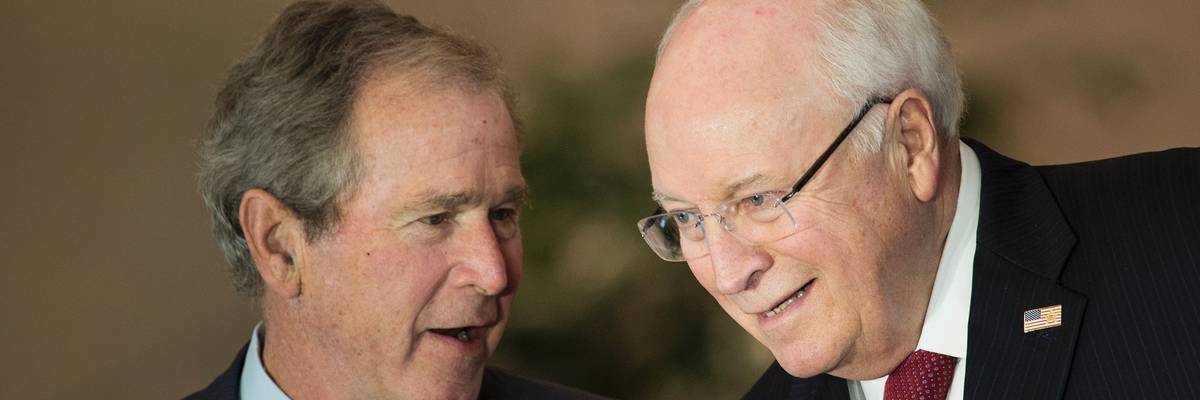
Former US President George W. Bush and Vice President Dick Cheney talk on December 3, 2015, during a dedication ceremony hosted by the US Senate at Emancipation Hall of the US Capitol Visitor Center in Washington, DC.
In seeking to defend democracy at all costs, Dick Cheney helped build the machinery that would one day dismantle it. His war on terror became our war on truth, and the nation has yet to recover.
When Richard Cheney died, it marked more than the end of a political life. It marked the closing of an American chapter, one that began in the smoke of the Twin Towers and stretches to the chaos of today. Between those two moments lies the tragedy of Cheney’s legacy: a man who claimed to defend democracy while systematically undermining its moral foundations.
Cheney was not a showman or a populist firebrand. He was austere, secretive, and precise—a master of bureaucratic power. Yet few figures in modern history have reshaped the nation’s moral and legal architecture as thoroughly. In his determination to protect Americans, he normalized fear. In his effort to preserve liberty, he institutionalized its violation.
After September 11, Cheney became the chief engineer of America’s “War on Terror.” Torture was rebranded as “enhanced interrogation,” mass surveillance legalized under the Patriot Act, and the rule of law quietly rewritten in the name of necessity. Drone strikes, secret prisons, preemptive war — all were justified as temporary measures to secure the homeland. But what began as emergency measures became permanent instruments of power.
Donald Trump did not create this destructive architecture of control; he inherited it.
What began in black sites abroad found its echo in cages at the southern border and in the assault on democratic norms at home.
Cheney and Trump despised one another, one a cold technocrat, the other a performative populist, but their philosophies were aligned in principle. Both believed the ends justify the means. Both treated human dignity as negotiable. Cheney authorized torture to protect Americans from terror. Trump uses that logic to justify cruelty against immigrants, journalists, and political opponents. The moral exception Cheney carved for national security became Trump’s template for political dominance.
The irony is brutal. The man who professed to honor institutions helped birth a movement that scorns them. The leader who claimed to defend freedom helped create conditions for its dismantling. Cheney’s “war on terror” became Trump’s “war on truth.” What began in black sites abroad found its echo in cages at the southern border and in the assault on democratic norms at home.
Cheney was not a cynic; he was a believer. That is what makes his legacy tragic. He genuinely thought America could preserve its dignity while denying it to others. He mistook pragmatism for wisdom and necessity for virtue. In doing so, he opened a door that democracy has not yet closed.
Two decades on, the consequences are visible everywhere: in the surveillance economy, in militarized policing, in the normalization of fear, and in political leaders who wield cruelty as strategy. Cheney gave America the vocabulary of exception. Trump turned it into the language of rule.
The tragedy is not Cheney’s alone, it is ours. By allowing the moral compromises of the past to stand unchallenged, we learned to live with a democracy that operates on exceptions, a freedom bounded by checkpoints, and a conscience dulled by fear.
If America is to escape the shadow of Cheney’s legacy, and prevent its lessons from being exploited againit, must reclaim what both men forgot: the true strength of democracy lies not in its power to destroy its enemies, but in its refusal to become them.
This country and this world are at a monumental crossroads. US voters have an opportunity to beat back the forces of fascism and confront the billionaires who are rigging the economy, our media system, and our democracy, making it increasingly impossible for ordinary people to get by. We’re not just talking about the election. We’re talking about what must be done once these fascist elements are vanquished from power. We need a bolder set of solutions than what either major party has so far been willing to offer and a working-class movement ready to fight like hell for it. Trump didn't emerge from nowhere. The conditions that fueled MAGA authoritarianism were created by decades of radical neoliberal economic policies and a corrupt political system dominated by corporate interests. They slashed taxes on the super-rich, promising that the benefits would trickle down. They said giveaways to the corporate titans would make life more affordable for the rest of us. It was all bullshit. And when a bitter, betrayed populace searches for someone to blame, right-wing demagogues have little trouble finding scapegoats. People know when they're being lied to, but you won't hear any of this from the corporate media. Only independent journalism—powered and funded by people who believe in building a better world—can deliver truly trustworthy daily news. If you share our vision, please contribute whatever you can to sustain our work. |
When Richard Cheney died, it marked more than the end of a political life. It marked the closing of an American chapter, one that began in the smoke of the Twin Towers and stretches to the chaos of today. Between those two moments lies the tragedy of Cheney’s legacy: a man who claimed to defend democracy while systematically undermining its moral foundations.
Cheney was not a showman or a populist firebrand. He was austere, secretive, and precise—a master of bureaucratic power. Yet few figures in modern history have reshaped the nation’s moral and legal architecture as thoroughly. In his determination to protect Americans, he normalized fear. In his effort to preserve liberty, he institutionalized its violation.
After September 11, Cheney became the chief engineer of America’s “War on Terror.” Torture was rebranded as “enhanced interrogation,” mass surveillance legalized under the Patriot Act, and the rule of law quietly rewritten in the name of necessity. Drone strikes, secret prisons, preemptive war — all were justified as temporary measures to secure the homeland. But what began as emergency measures became permanent instruments of power.
Donald Trump did not create this destructive architecture of control; he inherited it.
What began in black sites abroad found its echo in cages at the southern border and in the assault on democratic norms at home.
Cheney and Trump despised one another, one a cold technocrat, the other a performative populist, but their philosophies were aligned in principle. Both believed the ends justify the means. Both treated human dignity as negotiable. Cheney authorized torture to protect Americans from terror. Trump uses that logic to justify cruelty against immigrants, journalists, and political opponents. The moral exception Cheney carved for national security became Trump’s template for political dominance.
The irony is brutal. The man who professed to honor institutions helped birth a movement that scorns them. The leader who claimed to defend freedom helped create conditions for its dismantling. Cheney’s “war on terror” became Trump’s “war on truth.” What began in black sites abroad found its echo in cages at the southern border and in the assault on democratic norms at home.
Cheney was not a cynic; he was a believer. That is what makes his legacy tragic. He genuinely thought America could preserve its dignity while denying it to others. He mistook pragmatism for wisdom and necessity for virtue. In doing so, he opened a door that democracy has not yet closed.
Two decades on, the consequences are visible everywhere: in the surveillance economy, in militarized policing, in the normalization of fear, and in political leaders who wield cruelty as strategy. Cheney gave America the vocabulary of exception. Trump turned it into the language of rule.
The tragedy is not Cheney’s alone, it is ours. By allowing the moral compromises of the past to stand unchallenged, we learned to live with a democracy that operates on exceptions, a freedom bounded by checkpoints, and a conscience dulled by fear.
If America is to escape the shadow of Cheney’s legacy, and prevent its lessons from being exploited againit, must reclaim what both men forgot: the true strength of democracy lies not in its power to destroy its enemies, but in its refusal to become them.