SUBSCRIBE TO OUR FREE NEWSLETTER
Daily news & progressive opinion—funded by the people, not the corporations—delivered straight to your inbox.
5
#000000
#FFFFFF
To donate by check, phone, or other method, see our More Ways to Give page.
Daily news & progressive opinion—funded by the people, not the corporations—delivered straight to your inbox.
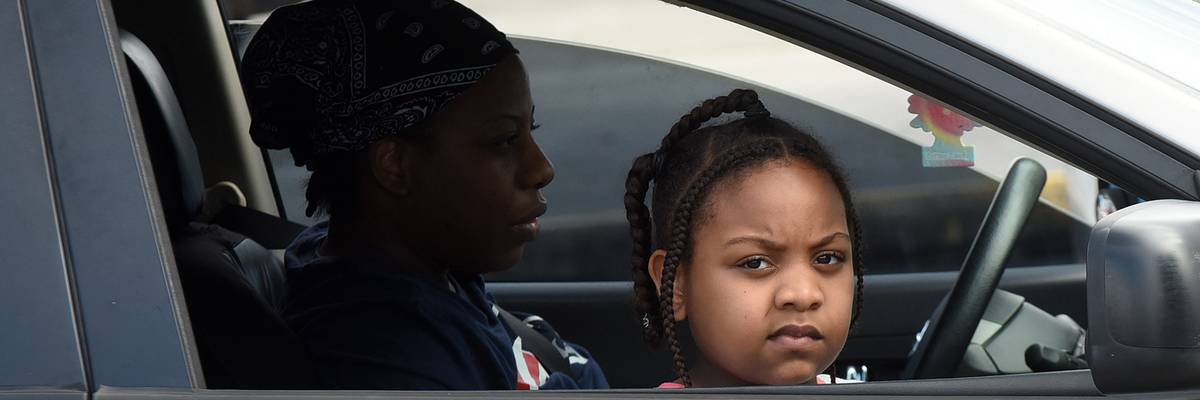
A child and her mother wait in their car at a food distribution site at Lake-Sumter State College sponsored by the Second Harvest Food Bank of Central Florida and local churches.
If we are serious about supporting families, then we need to stop romanticizing hardship and start investing in mothers in real, tangible ways.
Happy Mother’s Day—because that’s what you’re supposed to say, right?
Motherhood is always dressed up in soft language like community, support, and…“it takes a village.” But I have learned in real time that not all of us actually have one.
I am raising my sons without consistent help, without a built-in break, without the kind of support people assume is just there. Everything falls on me emotionally, financially, and physically, and I still have to show up every single day like I am not carrying all of it alone. And when I do pull back, when I protect my energy or go quiet, it is not because I am distant. It is because I am overwhelmed.
There is this unspoken expectation that mothers, especially single mothers, are just supposed to figure it out, hold it together, and do it gracefully. But the truth is, a lot of us are doing the work of an entire village by ourselves, and nobody wants to say that part out loud.
In Baltimore's guaranteed income pilot, of which I was a part, data shows that I'm not alone: Young parents reported less stress and more stability, and those improvements lasted even after the payments stopped.
And this is where the conversation needs to shift, because how I feel about motherhood and how motherhood is structured in this country are two very different things.
I love being a mother. My children are everything to me. They are the reason I keep going when I am tired, when I am stretched thin, when I feel like there is nothing left to give. But love does not remove the weight. It does not pay bills. It does not create time, energy, or support where there is none. Loving my children deeply does not make the system around me any less difficult to navigate.
When people talk about motherhood like it is just a personal experience, like it begins and ends with love and sacrifice, they miss something critical.
Because motherhood is also structural. It is economic. It is shaped by whether or not you have resources, support, and stability. And when those things are missing, love alone is not enough to carry the load.
That is exactly why I stand behind guaranteed income strongly.
Because when there is no village, money becomes the closest thing to stability, something that's within our control.
It is about investing in the people who hold families together.
It is about acknowledging reality.
Caregiving is labor. Raising children is labor. Holding a household together on your own is labor.
Guaranteed income gives mothers breathing room. It gives us the ability to make decisions from a place of stability instead of survival.
It means not having to choose between rest and responsibility, between being present with our children or being consumed by stress.
In Baltimore's guaranteed income pilot, of which I was a part, data shows that I'm not alone: Young parents reported less stress and more stability, and those improvements lasted even after the payments stopped.
Right now, too many mothers are forced into impossible trade-offs. Work more and lose time with your kids. Stay present and fall behind financially. Ask for help and risk being judged. Stay silent and carry it alone. These are not personal failures. These are policy failures.
People love to celebrate strong mothers, but strength should not have to come from constant struggle. Strength should not be built on exhaustion. And survival should not be the standard we measure good parenting by.
If we are serious about supporting families, then we need to stop romanticizing hardship and start investing in mothers in real, tangible ways. Guaranteed income is one of those ways. It is not a cure-all, but it is a foundation. It is a recognition that mothers should not have to break themselves just to keep their households afloat.
Because the truth is, many of us are not asking for a village anymore…
We are building without one.
We are showing up every day, making a way out of no way, holding everything together with very little support and even less margin for error.
And still, we keep going.
So yes—Happy Mother’s Day.
Not the polished version. Not the performative one. But the real one.
Happy Mother’s Day to the mothers who carry what no one sees, who love without limit, who build without a village, and who keep showing up anyway. You are not invisible. You are powerful. And you are worthy of more than survival.
Dear Common Dreams reader, It’s been nearly 30 years since I co-founded Common Dreams with my late wife, Lina Newhouser. We had the radical notion that journalism should serve the public good, not corporate profits. It was clear to us from the outset what it would take to build such a project. No paid advertisements. No corporate sponsors. No millionaire publisher telling us what to think or do. Many people said we wouldn't last a year, but we proved those doubters wrong. Together with a tremendous team of journalists and dedicated staff, we built an independent media outlet free from the constraints of profits and corporate control. Our mission has always been simple: To inform. To inspire. To ignite change for the common good. Building Common Dreams was not easy. Our survival was never guaranteed. When you take on the most powerful forces—Wall Street greed, fossil fuel industry destruction, Big Tech lobbyists, and uber-rich oligarchs who have spent billions upon billions rigging the economy and democracy in their favor—the only bulwark you have is supporters who believe in your work. But here’s the urgent message from me today. It's never been this bad out there. And it's never been this hard to keep us going. At the very moment Common Dreams is most needed, the threats we face are intensifying. We need your support now more than ever. We don't accept corporate advertising and never will. We don't have a paywall because we don't think people should be blocked from critical news based on their ability to pay. Everything we do is funded by the donations of readers like you. When everyone does the little they can afford, we are strong. But if that support retreats or dries up, so do we. Will you donate now to make sure Common Dreams not only survives but thrives? —Craig Brown, Co-founder |
Happy Mother’s Day—because that’s what you’re supposed to say, right?
Motherhood is always dressed up in soft language like community, support, and…“it takes a village.” But I have learned in real time that not all of us actually have one.
I am raising my sons without consistent help, without a built-in break, without the kind of support people assume is just there. Everything falls on me emotionally, financially, and physically, and I still have to show up every single day like I am not carrying all of it alone. And when I do pull back, when I protect my energy or go quiet, it is not because I am distant. It is because I am overwhelmed.
There is this unspoken expectation that mothers, especially single mothers, are just supposed to figure it out, hold it together, and do it gracefully. But the truth is, a lot of us are doing the work of an entire village by ourselves, and nobody wants to say that part out loud.
In Baltimore's guaranteed income pilot, of which I was a part, data shows that I'm not alone: Young parents reported less stress and more stability, and those improvements lasted even after the payments stopped.
And this is where the conversation needs to shift, because how I feel about motherhood and how motherhood is structured in this country are two very different things.
I love being a mother. My children are everything to me. They are the reason I keep going when I am tired, when I am stretched thin, when I feel like there is nothing left to give. But love does not remove the weight. It does not pay bills. It does not create time, energy, or support where there is none. Loving my children deeply does not make the system around me any less difficult to navigate.
When people talk about motherhood like it is just a personal experience, like it begins and ends with love and sacrifice, they miss something critical.
Because motherhood is also structural. It is economic. It is shaped by whether or not you have resources, support, and stability. And when those things are missing, love alone is not enough to carry the load.
That is exactly why I stand behind guaranteed income strongly.
Because when there is no village, money becomes the closest thing to stability, something that's within our control.
It is about investing in the people who hold families together.
It is about acknowledging reality.
Caregiving is labor. Raising children is labor. Holding a household together on your own is labor.
Guaranteed income gives mothers breathing room. It gives us the ability to make decisions from a place of stability instead of survival.
It means not having to choose between rest and responsibility, between being present with our children or being consumed by stress.
In Baltimore's guaranteed income pilot, of which I was a part, data shows that I'm not alone: Young parents reported less stress and more stability, and those improvements lasted even after the payments stopped.
Right now, too many mothers are forced into impossible trade-offs. Work more and lose time with your kids. Stay present and fall behind financially. Ask for help and risk being judged. Stay silent and carry it alone. These are not personal failures. These are policy failures.
People love to celebrate strong mothers, but strength should not have to come from constant struggle. Strength should not be built on exhaustion. And survival should not be the standard we measure good parenting by.
If we are serious about supporting families, then we need to stop romanticizing hardship and start investing in mothers in real, tangible ways. Guaranteed income is one of those ways. It is not a cure-all, but it is a foundation. It is a recognition that mothers should not have to break themselves just to keep their households afloat.
Because the truth is, many of us are not asking for a village anymore…
We are building without one.
We are showing up every day, making a way out of no way, holding everything together with very little support and even less margin for error.
And still, we keep going.
So yes—Happy Mother’s Day.
Not the polished version. Not the performative one. But the real one.
Happy Mother’s Day to the mothers who carry what no one sees, who love without limit, who build without a village, and who keep showing up anyway. You are not invisible. You are powerful. And you are worthy of more than survival.
Happy Mother’s Day—because that’s what you’re supposed to say, right?
Motherhood is always dressed up in soft language like community, support, and…“it takes a village.” But I have learned in real time that not all of us actually have one.
I am raising my sons without consistent help, without a built-in break, without the kind of support people assume is just there. Everything falls on me emotionally, financially, and physically, and I still have to show up every single day like I am not carrying all of it alone. And when I do pull back, when I protect my energy or go quiet, it is not because I am distant. It is because I am overwhelmed.
There is this unspoken expectation that mothers, especially single mothers, are just supposed to figure it out, hold it together, and do it gracefully. But the truth is, a lot of us are doing the work of an entire village by ourselves, and nobody wants to say that part out loud.
In Baltimore's guaranteed income pilot, of which I was a part, data shows that I'm not alone: Young parents reported less stress and more stability, and those improvements lasted even after the payments stopped.
And this is where the conversation needs to shift, because how I feel about motherhood and how motherhood is structured in this country are two very different things.
I love being a mother. My children are everything to me. They are the reason I keep going when I am tired, when I am stretched thin, when I feel like there is nothing left to give. But love does not remove the weight. It does not pay bills. It does not create time, energy, or support where there is none. Loving my children deeply does not make the system around me any less difficult to navigate.
When people talk about motherhood like it is just a personal experience, like it begins and ends with love and sacrifice, they miss something critical.
Because motherhood is also structural. It is economic. It is shaped by whether or not you have resources, support, and stability. And when those things are missing, love alone is not enough to carry the load.
That is exactly why I stand behind guaranteed income strongly.
Because when there is no village, money becomes the closest thing to stability, something that's within our control.
It is about investing in the people who hold families together.
It is about acknowledging reality.
Caregiving is labor. Raising children is labor. Holding a household together on your own is labor.
Guaranteed income gives mothers breathing room. It gives us the ability to make decisions from a place of stability instead of survival.
It means not having to choose between rest and responsibility, between being present with our children or being consumed by stress.
In Baltimore's guaranteed income pilot, of which I was a part, data shows that I'm not alone: Young parents reported less stress and more stability, and those improvements lasted even after the payments stopped.
Right now, too many mothers are forced into impossible trade-offs. Work more and lose time with your kids. Stay present and fall behind financially. Ask for help and risk being judged. Stay silent and carry it alone. These are not personal failures. These are policy failures.
People love to celebrate strong mothers, but strength should not have to come from constant struggle. Strength should not be built on exhaustion. And survival should not be the standard we measure good parenting by.
If we are serious about supporting families, then we need to stop romanticizing hardship and start investing in mothers in real, tangible ways. Guaranteed income is one of those ways. It is not a cure-all, but it is a foundation. It is a recognition that mothers should not have to break themselves just to keep their households afloat.
Because the truth is, many of us are not asking for a village anymore…
We are building without one.
We are showing up every day, making a way out of no way, holding everything together with very little support and even less margin for error.
And still, we keep going.
So yes—Happy Mother’s Day.
Not the polished version. Not the performative one. But the real one.
Happy Mother’s Day to the mothers who carry what no one sees, who love without limit, who build without a village, and who keep showing up anyway. You are not invisible. You are powerful. And you are worthy of more than survival.