SUBSCRIBE TO OUR FREE NEWSLETTER
Daily news & progressive opinion—funded by the people, not the corporations—delivered straight to your inbox.
5
#000000
#FFFFFF
To donate by check, phone, or other method, see our More Ways to Give page.
Daily news & progressive opinion—funded by the people, not the corporations—delivered straight to your inbox.
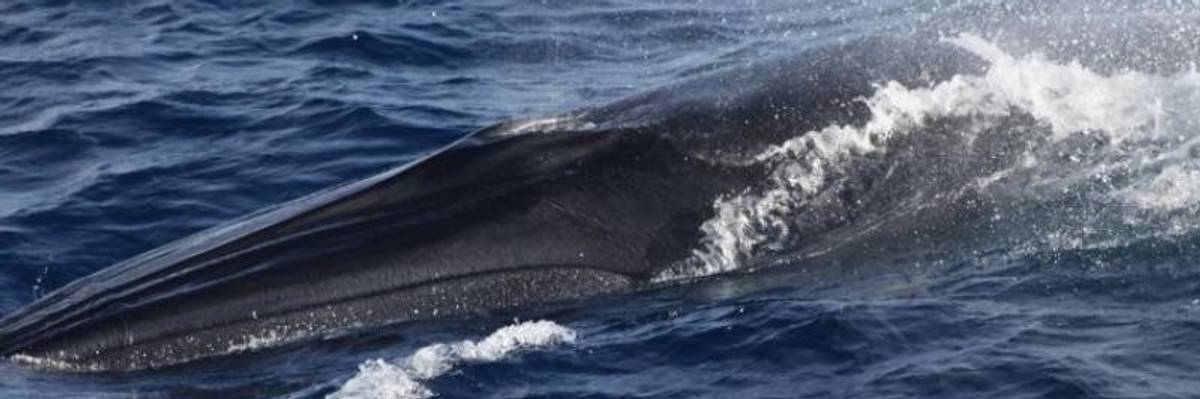
Oil and gas operations in the Gulf of Mexico pose several threats to the Rice’s whale (pictured), one of the most endangered species in the world.
Think tanks funded by ultra-conservative donors and fossil fuel companies coopted a coalition of “grassroots” opposition organizations to stop the development of clean energy, despite the fact that oil and gas are the true threats to ocean life.
As a communications director for an environmental nonprofit, much of my job boils down to separating fact from fiction and disseminating the former to the public. That’s why in June, National Ocean Month, at the top of my to-do list has been disentangling a convoluted narrative touted by Republican party officials. They claim offshore wind energy is threatening marine wildlife, begging the question, “Have Trump and his allies turned into unlikely environmental champions sporting ‘Save the Whales’ placards? Or is something more suspect lurking beneath the surface?”
Republicans have run with the myth that offshore wind energy development endangers whales drawing from vague theories about noise and electrical generation and the construction of turbines. This myth has stopped multiple wind projects in their tracks in New York and New Jersey. It has been the fodder of countless viral media moments. And most recently, it has propelled a lawsuit against a Biden administration wind project off the coast of Virginia. Despite the fact that scientists and experts say there is absolutely no evidence linking wind development to whale endangerment, this messaging spin has proliferated.
So how—and why—did the GOP successfully promulgate this false narrative without any scientific backing? Like all successful propagandists, they didn’t act alone. Think tanks funded by ultra-conservative donors and fossil fuel companies coopted a coalition of “grassroots” opposition organizations to stop the development of clean energy. The fossil fuel industry has weaponized its cronies in Congress and “the third sector” to maintain the status quo of oil and gas energy dominance. Where there was blatant climate denial years ago, there were industry-funded politicians parroting Big Oil talking points. And where there is clean energy policy obstruction and interference now, there are the same industry-bought politicians and community “environmentalist” allies with newly outfitted sloganeering.
The fossil fuel industry and its allies will continue to fight to the bloody end for the last drops of oil and the last scraps of profit, and we do not have time to entertain their deceit.
The fact is that investment in renewable energy would actually help whales and other marine species whose habitats are threatened by the effects of the climate crisis. But the richest layer in this ocean of conspiracy is that offshore oil and gas drilling, a major piece of the very industry backing this faux-ecological crusade to save the whales, is a direct threat to a seriously endangered species called Rice’s whale.
With estimates of fewer than 100 individuals in the wild, Rice’s whale is one of the most endangered species in the world and the only baleen whale resident year-round in the Gulf of Mexico. Since its reclassification three years ago, the National Marine Fisheries Service (NMFS) has scrambled to protect its habitat and mitigate its declining numbers. In the NMFS’ list of primary threats to the species, the four most severe are “range curtailment from energy exploration and development, exposure to oil spills and spill response, vessel collisions, [and] anthropogenic noise during seismic survey.” For self-identified champions of marine species welfare, the organizations and think tanks behind the right-wing spin campaign about offshore wind’s endangerment of whales have been curiously silent about Big Oil’s offshore drilling operations that comprise every single one of those threats.
It is understandable that fossil fuel industry mythmaking would obfuscate the real ecological stakes in offshore energy development. Rice’s whale is but one environmental victim of the prolific and extensive fossil fuel industry’s oceanic damage.
When Big Oil drills, Big Oil spills. Since the turn of the century, there have been hundreds of oil tanker spills—spills that have released hundreds of thousands of gallons of oil into the ocean. When Big Oil spills, wildlife populations and communities along the coast suffer. Seabirds, marine mammals, fish, and vegetation can be displaced, injured, or killed at each stage of the drilling process. They are also poisoned by crude oil and hydraulic fluids introduced by the drilling operations, which, once bioaccumulated up the food chain, sicken the people who consume them. Coastal communities also rely on the Gulf, in which offshore oil production accounts for 15% of total U.S. crude oil production, for fishing, boating, recreation, and tourism—to say nothing of the cultural connection they have to the ocean. Big Oil threatens these central facets of coastal life with spills and pollution. Offshore wind does not.
In the narrative battle over energy in the seas, the stakes are high. The fossil fuel industry and its allies will continue to fight to the bloody end for the last drops of oil and the last scraps of profit, and we do not have time to entertain their deceit. As National Ocean Month comes to an end, for the sake of our future, our ocean, and all who rely upon it, the importance of discerning fact from fiction cannot be lost on us.
Dear Common Dreams reader, It’s been nearly 30 years since I co-founded Common Dreams with my late wife, Lina Newhouser. We had the radical notion that journalism should serve the public good, not corporate profits. It was clear to us from the outset what it would take to build such a project. No paid advertisements. No corporate sponsors. No millionaire publisher telling us what to think or do. Many people said we wouldn't last a year, but we proved those doubters wrong. Together with a tremendous team of journalists and dedicated staff, we built an independent media outlet free from the constraints of profits and corporate control. Our mission has always been simple: To inform. To inspire. To ignite change for the common good. Building Common Dreams was not easy. Our survival was never guaranteed. When you take on the most powerful forces—Wall Street greed, fossil fuel industry destruction, Big Tech lobbyists, and uber-rich oligarchs who have spent billions upon billions rigging the economy and democracy in their favor—the only bulwark you have is supporters who believe in your work. But here’s the urgent message from me today. It's never been this bad out there. And it's never been this hard to keep us going. At the very moment Common Dreams is most needed, the threats we face are intensifying. We need your support now more than ever. We don't accept corporate advertising and never will. We don't have a paywall because we don't think people should be blocked from critical news based on their ability to pay. Everything we do is funded by the donations of readers like you. When everyone does the little they can afford, we are strong. But if that support retreats or dries up, so do we. Will you donate now to make sure Common Dreams not only survives but thrives? —Craig Brown, Co-founder |
As a communications director for an environmental nonprofit, much of my job boils down to separating fact from fiction and disseminating the former to the public. That’s why in June, National Ocean Month, at the top of my to-do list has been disentangling a convoluted narrative touted by Republican party officials. They claim offshore wind energy is threatening marine wildlife, begging the question, “Have Trump and his allies turned into unlikely environmental champions sporting ‘Save the Whales’ placards? Or is something more suspect lurking beneath the surface?”
Republicans have run with the myth that offshore wind energy development endangers whales drawing from vague theories about noise and electrical generation and the construction of turbines. This myth has stopped multiple wind projects in their tracks in New York and New Jersey. It has been the fodder of countless viral media moments. And most recently, it has propelled a lawsuit against a Biden administration wind project off the coast of Virginia. Despite the fact that scientists and experts say there is absolutely no evidence linking wind development to whale endangerment, this messaging spin has proliferated.
So how—and why—did the GOP successfully promulgate this false narrative without any scientific backing? Like all successful propagandists, they didn’t act alone. Think tanks funded by ultra-conservative donors and fossil fuel companies coopted a coalition of “grassroots” opposition organizations to stop the development of clean energy. The fossil fuel industry has weaponized its cronies in Congress and “the third sector” to maintain the status quo of oil and gas energy dominance. Where there was blatant climate denial years ago, there were industry-funded politicians parroting Big Oil talking points. And where there is clean energy policy obstruction and interference now, there are the same industry-bought politicians and community “environmentalist” allies with newly outfitted sloganeering.
The fossil fuel industry and its allies will continue to fight to the bloody end for the last drops of oil and the last scraps of profit, and we do not have time to entertain their deceit.
The fact is that investment in renewable energy would actually help whales and other marine species whose habitats are threatened by the effects of the climate crisis. But the richest layer in this ocean of conspiracy is that offshore oil and gas drilling, a major piece of the very industry backing this faux-ecological crusade to save the whales, is a direct threat to a seriously endangered species called Rice’s whale.
With estimates of fewer than 100 individuals in the wild, Rice’s whale is one of the most endangered species in the world and the only baleen whale resident year-round in the Gulf of Mexico. Since its reclassification three years ago, the National Marine Fisheries Service (NMFS) has scrambled to protect its habitat and mitigate its declining numbers. In the NMFS’ list of primary threats to the species, the four most severe are “range curtailment from energy exploration and development, exposure to oil spills and spill response, vessel collisions, [and] anthropogenic noise during seismic survey.” For self-identified champions of marine species welfare, the organizations and think tanks behind the right-wing spin campaign about offshore wind’s endangerment of whales have been curiously silent about Big Oil’s offshore drilling operations that comprise every single one of those threats.
It is understandable that fossil fuel industry mythmaking would obfuscate the real ecological stakes in offshore energy development. Rice’s whale is but one environmental victim of the prolific and extensive fossil fuel industry’s oceanic damage.
When Big Oil drills, Big Oil spills. Since the turn of the century, there have been hundreds of oil tanker spills—spills that have released hundreds of thousands of gallons of oil into the ocean. When Big Oil spills, wildlife populations and communities along the coast suffer. Seabirds, marine mammals, fish, and vegetation can be displaced, injured, or killed at each stage of the drilling process. They are also poisoned by crude oil and hydraulic fluids introduced by the drilling operations, which, once bioaccumulated up the food chain, sicken the people who consume them. Coastal communities also rely on the Gulf, in which offshore oil production accounts for 15% of total U.S. crude oil production, for fishing, boating, recreation, and tourism—to say nothing of the cultural connection they have to the ocean. Big Oil threatens these central facets of coastal life with spills and pollution. Offshore wind does not.
In the narrative battle over energy in the seas, the stakes are high. The fossil fuel industry and its allies will continue to fight to the bloody end for the last drops of oil and the last scraps of profit, and we do not have time to entertain their deceit. As National Ocean Month comes to an end, for the sake of our future, our ocean, and all who rely upon it, the importance of discerning fact from fiction cannot be lost on us.
As a communications director for an environmental nonprofit, much of my job boils down to separating fact from fiction and disseminating the former to the public. That’s why in June, National Ocean Month, at the top of my to-do list has been disentangling a convoluted narrative touted by Republican party officials. They claim offshore wind energy is threatening marine wildlife, begging the question, “Have Trump and his allies turned into unlikely environmental champions sporting ‘Save the Whales’ placards? Or is something more suspect lurking beneath the surface?”
Republicans have run with the myth that offshore wind energy development endangers whales drawing from vague theories about noise and electrical generation and the construction of turbines. This myth has stopped multiple wind projects in their tracks in New York and New Jersey. It has been the fodder of countless viral media moments. And most recently, it has propelled a lawsuit against a Biden administration wind project off the coast of Virginia. Despite the fact that scientists and experts say there is absolutely no evidence linking wind development to whale endangerment, this messaging spin has proliferated.
So how—and why—did the GOP successfully promulgate this false narrative without any scientific backing? Like all successful propagandists, they didn’t act alone. Think tanks funded by ultra-conservative donors and fossil fuel companies coopted a coalition of “grassroots” opposition organizations to stop the development of clean energy. The fossil fuel industry has weaponized its cronies in Congress and “the third sector” to maintain the status quo of oil and gas energy dominance. Where there was blatant climate denial years ago, there were industry-funded politicians parroting Big Oil talking points. And where there is clean energy policy obstruction and interference now, there are the same industry-bought politicians and community “environmentalist” allies with newly outfitted sloganeering.
The fossil fuel industry and its allies will continue to fight to the bloody end for the last drops of oil and the last scraps of profit, and we do not have time to entertain their deceit.
The fact is that investment in renewable energy would actually help whales and other marine species whose habitats are threatened by the effects of the climate crisis. But the richest layer in this ocean of conspiracy is that offshore oil and gas drilling, a major piece of the very industry backing this faux-ecological crusade to save the whales, is a direct threat to a seriously endangered species called Rice’s whale.
With estimates of fewer than 100 individuals in the wild, Rice’s whale is one of the most endangered species in the world and the only baleen whale resident year-round in the Gulf of Mexico. Since its reclassification three years ago, the National Marine Fisheries Service (NMFS) has scrambled to protect its habitat and mitigate its declining numbers. In the NMFS’ list of primary threats to the species, the four most severe are “range curtailment from energy exploration and development, exposure to oil spills and spill response, vessel collisions, [and] anthropogenic noise during seismic survey.” For self-identified champions of marine species welfare, the organizations and think tanks behind the right-wing spin campaign about offshore wind’s endangerment of whales have been curiously silent about Big Oil’s offshore drilling operations that comprise every single one of those threats.
It is understandable that fossil fuel industry mythmaking would obfuscate the real ecological stakes in offshore energy development. Rice’s whale is but one environmental victim of the prolific and extensive fossil fuel industry’s oceanic damage.
When Big Oil drills, Big Oil spills. Since the turn of the century, there have been hundreds of oil tanker spills—spills that have released hundreds of thousands of gallons of oil into the ocean. When Big Oil spills, wildlife populations and communities along the coast suffer. Seabirds, marine mammals, fish, and vegetation can be displaced, injured, or killed at each stage of the drilling process. They are also poisoned by crude oil and hydraulic fluids introduced by the drilling operations, which, once bioaccumulated up the food chain, sicken the people who consume them. Coastal communities also rely on the Gulf, in which offshore oil production accounts for 15% of total U.S. crude oil production, for fishing, boating, recreation, and tourism—to say nothing of the cultural connection they have to the ocean. Big Oil threatens these central facets of coastal life with spills and pollution. Offshore wind does not.
In the narrative battle over energy in the seas, the stakes are high. The fossil fuel industry and its allies will continue to fight to the bloody end for the last drops of oil and the last scraps of profit, and we do not have time to entertain their deceit. As National Ocean Month comes to an end, for the sake of our future, our ocean, and all who rely upon it, the importance of discerning fact from fiction cannot be lost on us.