SUBSCRIBE TO OUR FREE NEWSLETTER
Daily news & progressive opinion—funded by the people, not the corporations—delivered straight to your inbox.
5
#000000
#FFFFFF
To donate by check, phone, or other method, see our More Ways to Give page.
Daily news & progressive opinion—funded by the people, not the corporations—delivered straight to your inbox.
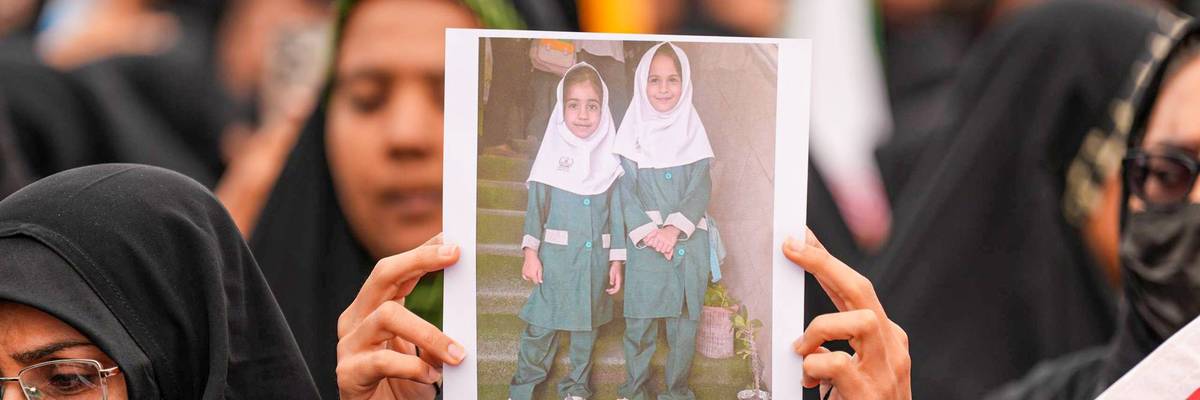
Mourners hold a portrait of a students during a funeral ceremony for children, who lost their lives after a primary school in Iran's Hormozgan province was targeted in US and Israeli attacks, on March 3, 2026 in Minab, Iran.
What if I were under the rubble right now? What if I had I just learned that my daughter is 12 years old again and the girls’ school she attended in Iran—in Minab—had just been bombed by an American plane?
Writing a column is like sitting atop a large hill, looking down lovingly—and angrily—at the surrounding world, embracing it in a moral perspective and sharing your analysis of what you see. Primarily, this means telling people what’s wrong.
Today, as I climbed up the hill—this is called research—something felt different, troubling. Where I used to feel enthusiasm, I felt hollow: bereft of self-confidence and certainty. I’ve been writing a weekly column for nearly half of my life, first at a local paper in Chicago for 10 years, then the current column, syndicated until recently by the Chicago Tribune, for the last 27 years. What’s going on here?
I was no longer atop that hill. Suddenly I had nothing to say. The doubt I was feeling—that I had anything relevant and valuable to add to our collective grasp of the world—overwhelmed me.
I had decided to write about what I almost always write about... war. Both current and eternal. Indeed, I had begun scrolling the internet, looking for provocative points of view. I googled the words “terrorism vs. waging war,” seeking to learn what I already knew: that the “official” world has declared a distinction between the two terms as definite as the distinction between “evil” and “good.”
Perhaps the flow of pain I felt was the realization that opposing war in relative safety is too easy. It’s not enough.
My first pop-up response was an AI Overview: “Terrorism and waging war differ fundamentally in their targets, legal frameworks, and combatants. Terrorism targets civilians to induce fear for political or ideological goals. Waging war is typically an armed conflict between states or organized groups, where lawful combatants target military objectives.”
Of course, of course. Terrorists represent evil, plain and simple. They kill real people, always for selfish reasons. But war is official. It’s state-sponsored and legal. It’s registered with God, for God’s sake. And while there’s always an evil side—the enemy—the winners, the good guys, are simply doing what they must. Civilization couldn’t have evolved without it. And that’s how we organize history: from one war to the next. This is the official understanding, which we’re spoon-fed as we grow up.
I see beyond this official certainty and have devoted my life to dismantling it. But the AI Overview explanation, seemingly such an easy target for my ruthless analysis, had an unexpected effect. I felt stabbed with a sense of depression so sharp I could hardly move, let alone write. All I could do was go back to bed, cover my head with my pillow, I wanted to hide.
But the emotional pain didn’t stop. It continued piercing me. I got back up. I saw no relief. I was terrified that old age had set in. Oh my God, am I too old to write anymore (a month and a half away from age 80)? I was ready to give up, blow the column off... spend the rest of the day secretly crying.
Instead, I started writing—cluelessly. I had no idea where my words might go. I was no longer atop a hill. I didn’t know where I was. But an awareness started clutching me. What if I were under the rubble right now? What if I had I just learned that my daughter is 12 years old again and the girls’ school she attended in Iran—in Minab—had just been bombed by an American plane?
A hole had suddenly opened in my life. No, those imaginings aren’t real—not for me—but they are for some of us. Perhaps the flow of pain I felt was the realization that opposing war in relative safety is too easy. It’s not enough. And beyond the realization is simply a dark emptiness. I had nowhere to go. I couldn’t even cry.
All I can do, right now, is reach deeper into my soul, to bless every human I encounter, and to publicly share the largest cry I can make for change. The cry tears loose from a poem I wrote a decade ago, which I also shared in a column I sent out last December. It’s called “The Gods Get in Touch with Their Feminine Side:”
I stroke the unknown,
the dark silence, the
soul of a mother. I
pray, if that’s what
prayer is: to stir the certainties of
pride and flag and brittle
God, to stir
the hollow lost.
I pray open
the big craters
and trenches of
obedience and manhood.
Now is the time
to cherish the apple,
to touch the wound and love even
the turned cheeks and bullet tips,
to swaddle anew
the helpless future
and know
and not know
what happens next.
Dear Common Dreams reader, It’s been nearly 30 years since I co-founded Common Dreams with my late wife, Lina Newhouser. We had the radical notion that journalism should serve the public good, not corporate profits. It was clear to us from the outset what it would take to build such a project. No paid advertisements. No corporate sponsors. No millionaire publisher telling us what to think or do. Many people said we wouldn't last a year, but we proved those doubters wrong. Together with a tremendous team of journalists and dedicated staff, we built an independent media outlet free from the constraints of profits and corporate control. Our mission has always been simple: To inform. To inspire. To ignite change for the common good. Building Common Dreams was not easy. Our survival was never guaranteed. When you take on the most powerful forces—Wall Street greed, fossil fuel industry destruction, Big Tech lobbyists, and uber-rich oligarchs who have spent billions upon billions rigging the economy and democracy in their favor—the only bulwark you have is supporters who believe in your work. But here’s the urgent message from me today. It's never been this bad out there. And it's never been this hard to keep us going. At the very moment Common Dreams is most needed, the threats we face are intensifying. We need your support now more than ever. We don't accept corporate advertising and never will. We don't have a paywall because we don't think people should be blocked from critical news based on their ability to pay. Everything we do is funded by the donations of readers like you. When everyone does the little they can afford, we are strong. But if that support retreats or dries up, so do we. Will you donate now to make sure Common Dreams not only survives but thrives? —Craig Brown, Co-founder |
Writing a column is like sitting atop a large hill, looking down lovingly—and angrily—at the surrounding world, embracing it in a moral perspective and sharing your analysis of what you see. Primarily, this means telling people what’s wrong.
Today, as I climbed up the hill—this is called research—something felt different, troubling. Where I used to feel enthusiasm, I felt hollow: bereft of self-confidence and certainty. I’ve been writing a weekly column for nearly half of my life, first at a local paper in Chicago for 10 years, then the current column, syndicated until recently by the Chicago Tribune, for the last 27 years. What’s going on here?
I was no longer atop that hill. Suddenly I had nothing to say. The doubt I was feeling—that I had anything relevant and valuable to add to our collective grasp of the world—overwhelmed me.
I had decided to write about what I almost always write about... war. Both current and eternal. Indeed, I had begun scrolling the internet, looking for provocative points of view. I googled the words “terrorism vs. waging war,” seeking to learn what I already knew: that the “official” world has declared a distinction between the two terms as definite as the distinction between “evil” and “good.”
Perhaps the flow of pain I felt was the realization that opposing war in relative safety is too easy. It’s not enough.
My first pop-up response was an AI Overview: “Terrorism and waging war differ fundamentally in their targets, legal frameworks, and combatants. Terrorism targets civilians to induce fear for political or ideological goals. Waging war is typically an armed conflict between states or organized groups, where lawful combatants target military objectives.”
Of course, of course. Terrorists represent evil, plain and simple. They kill real people, always for selfish reasons. But war is official. It’s state-sponsored and legal. It’s registered with God, for God’s sake. And while there’s always an evil side—the enemy—the winners, the good guys, are simply doing what they must. Civilization couldn’t have evolved without it. And that’s how we organize history: from one war to the next. This is the official understanding, which we’re spoon-fed as we grow up.
I see beyond this official certainty and have devoted my life to dismantling it. But the AI Overview explanation, seemingly such an easy target for my ruthless analysis, had an unexpected effect. I felt stabbed with a sense of depression so sharp I could hardly move, let alone write. All I could do was go back to bed, cover my head with my pillow, I wanted to hide.
But the emotional pain didn’t stop. It continued piercing me. I got back up. I saw no relief. I was terrified that old age had set in. Oh my God, am I too old to write anymore (a month and a half away from age 80)? I was ready to give up, blow the column off... spend the rest of the day secretly crying.
Instead, I started writing—cluelessly. I had no idea where my words might go. I was no longer atop a hill. I didn’t know where I was. But an awareness started clutching me. What if I were under the rubble right now? What if I had I just learned that my daughter is 12 years old again and the girls’ school she attended in Iran—in Minab—had just been bombed by an American plane?
A hole had suddenly opened in my life. No, those imaginings aren’t real—not for me—but they are for some of us. Perhaps the flow of pain I felt was the realization that opposing war in relative safety is too easy. It’s not enough. And beyond the realization is simply a dark emptiness. I had nowhere to go. I couldn’t even cry.
All I can do, right now, is reach deeper into my soul, to bless every human I encounter, and to publicly share the largest cry I can make for change. The cry tears loose from a poem I wrote a decade ago, which I also shared in a column I sent out last December. It’s called “The Gods Get in Touch with Their Feminine Side:”
I stroke the unknown,
the dark silence, the
soul of a mother. I
pray, if that’s what
prayer is: to stir the certainties of
pride and flag and brittle
God, to stir
the hollow lost.
I pray open
the big craters
and trenches of
obedience and manhood.
Now is the time
to cherish the apple,
to touch the wound and love even
the turned cheeks and bullet tips,
to swaddle anew
the helpless future
and know
and not know
what happens next.
Writing a column is like sitting atop a large hill, looking down lovingly—and angrily—at the surrounding world, embracing it in a moral perspective and sharing your analysis of what you see. Primarily, this means telling people what’s wrong.
Today, as I climbed up the hill—this is called research—something felt different, troubling. Where I used to feel enthusiasm, I felt hollow: bereft of self-confidence and certainty. I’ve been writing a weekly column for nearly half of my life, first at a local paper in Chicago for 10 years, then the current column, syndicated until recently by the Chicago Tribune, for the last 27 years. What’s going on here?
I was no longer atop that hill. Suddenly I had nothing to say. The doubt I was feeling—that I had anything relevant and valuable to add to our collective grasp of the world—overwhelmed me.
I had decided to write about what I almost always write about... war. Both current and eternal. Indeed, I had begun scrolling the internet, looking for provocative points of view. I googled the words “terrorism vs. waging war,” seeking to learn what I already knew: that the “official” world has declared a distinction between the two terms as definite as the distinction between “evil” and “good.”
Perhaps the flow of pain I felt was the realization that opposing war in relative safety is too easy. It’s not enough.
My first pop-up response was an AI Overview: “Terrorism and waging war differ fundamentally in their targets, legal frameworks, and combatants. Terrorism targets civilians to induce fear for political or ideological goals. Waging war is typically an armed conflict between states or organized groups, where lawful combatants target military objectives.”
Of course, of course. Terrorists represent evil, plain and simple. They kill real people, always for selfish reasons. But war is official. It’s state-sponsored and legal. It’s registered with God, for God’s sake. And while there’s always an evil side—the enemy—the winners, the good guys, are simply doing what they must. Civilization couldn’t have evolved without it. And that’s how we organize history: from one war to the next. This is the official understanding, which we’re spoon-fed as we grow up.
I see beyond this official certainty and have devoted my life to dismantling it. But the AI Overview explanation, seemingly such an easy target for my ruthless analysis, had an unexpected effect. I felt stabbed with a sense of depression so sharp I could hardly move, let alone write. All I could do was go back to bed, cover my head with my pillow, I wanted to hide.
But the emotional pain didn’t stop. It continued piercing me. I got back up. I saw no relief. I was terrified that old age had set in. Oh my God, am I too old to write anymore (a month and a half away from age 80)? I was ready to give up, blow the column off... spend the rest of the day secretly crying.
Instead, I started writing—cluelessly. I had no idea where my words might go. I was no longer atop a hill. I didn’t know where I was. But an awareness started clutching me. What if I were under the rubble right now? What if I had I just learned that my daughter is 12 years old again and the girls’ school she attended in Iran—in Minab—had just been bombed by an American plane?
A hole had suddenly opened in my life. No, those imaginings aren’t real—not for me—but they are for some of us. Perhaps the flow of pain I felt was the realization that opposing war in relative safety is too easy. It’s not enough. And beyond the realization is simply a dark emptiness. I had nowhere to go. I couldn’t even cry.
All I can do, right now, is reach deeper into my soul, to bless every human I encounter, and to publicly share the largest cry I can make for change. The cry tears loose from a poem I wrote a decade ago, which I also shared in a column I sent out last December. It’s called “The Gods Get in Touch with Their Feminine Side:”
I stroke the unknown,
the dark silence, the
soul of a mother. I
pray, if that’s what
prayer is: to stir the certainties of
pride and flag and brittle
God, to stir
the hollow lost.
I pray open
the big craters
and trenches of
obedience and manhood.
Now is the time
to cherish the apple,
to touch the wound and love even
the turned cheeks and bullet tips,
to swaddle anew
the helpless future
and know
and not know
what happens next.