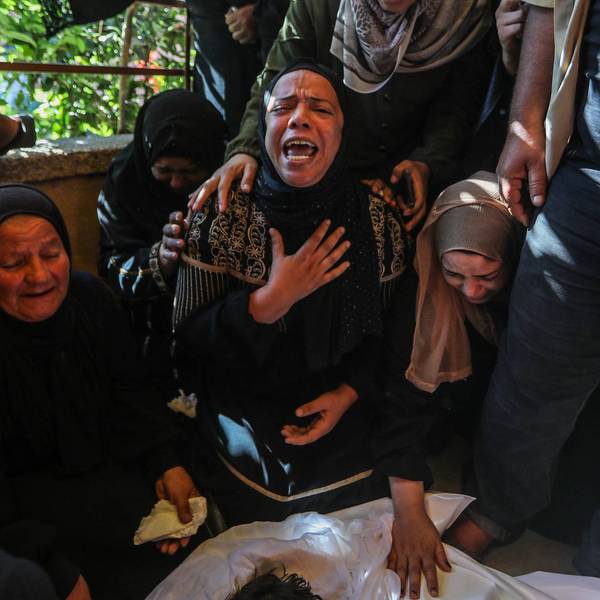

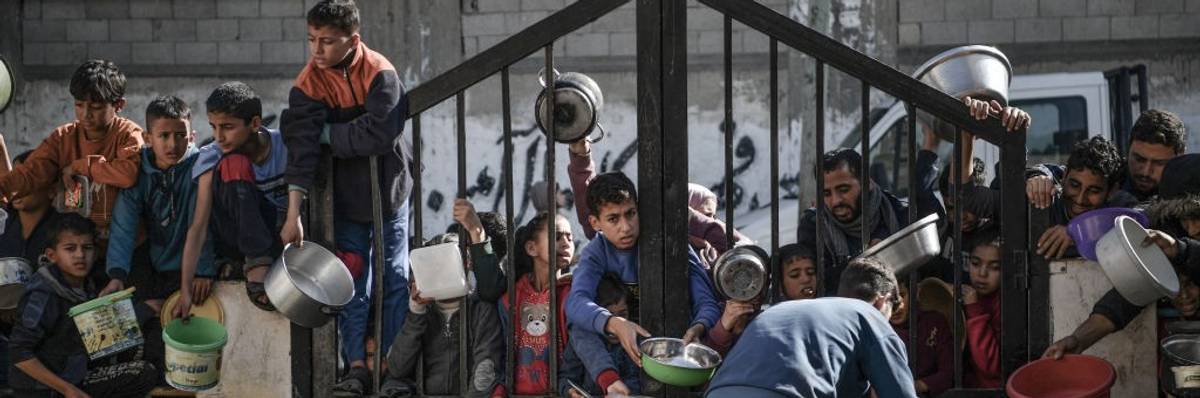
Palestinians receive food and humanitarian aid as Israeli airstrikes continue in Rafah, Gaza on December 19, 2023.
Gaza Genocide Prolonged as US Hides Behind Rhetorical Push for Humanitarian Aid
Aid groups say that a ceasefire, which is opposed by Israel and the US, is necessary to ramp up the delivery of life-saving aid.
A news report in the Israeli daily Haaretz on 4 January provides further evidence for how the US and Israel are using humanitarian aid as a fig leaf for genocide in Gaza.
Israel is deliberating the opening of the northern Erez checkpoint, used to control the movement of people between Gaza and Israel, “under pressure from the United States.” Washington is “conditioning its continued support of the fighting on increased aid” to the territory, the paper reports.
The Biden administration claims to support more aid getting into Gaza, and boasted about the reopening of the Kerem Shalom commercial crossing near the Egyptian border last month.
But the human rights group Gisha, which monitors Israeli movement restrictions, said on Wednesday that “following weeks of siege and incessant bombardments,” aid coming in via Kerem Shalom is “light years away from what’s needed.”
Aid groups say that a ceasefire, which is opposed by Israel and the US, is necessary to ramp up the delivery of life-saving aid. Human rights and humanitarian groups meanwhile contend that Israel is using starvation as a weapon of war in Gaza.
Palestinian organizations have cautioned the UN secretary-general that the world body’s aid agencies in Gaza were “aiding Israel’s war objectives, in breach of international law” by showing deference to its “unlawful restrictions.”
Aid doesn’t reach north
Very little aid, which is being brought in via southern Gaza, is reaching the hundreds of thousands of Palestinians remaining in the north. Most of the territory’s population of 2.3 million Palestinians have been repeatedly displaced, and are increasingly concentrated in Rafah near the border with Egypt.
Haaretz blamed this on the aid that enters via the south being intercepted as soon as it’s brought in.
Gisha said that desperate crowds are swarming aid trucks due to acute need.
“Some parties are attempting to profit from the situation by seizing basic commodities and selling them at exorbitant prices,” the rights group added.
“This is a common phenomenon in areas of conflict and scarcity and must be mitigated in part by increasing the amount of supplies available to the local population.”
Martin Griffiths, the UN human rights chief, pointed to a myriad of factors impeding the delivery of aid in Gaza, many of them resulting from Israeli policy (even if he avoided mentioning Israel): redundant inspections, “a growing list of rejected items,” constant bombardment and aid convoys being shot at.
An Israeli government source told Haaretz that “Israel is providing the US a daily report on the humanitarian situation” – yet another demonstration of how complicit the Biden administration is in Israel’s genocidal campaign in Gaza.
The territory has been under Israeli closure of varying severity for more than half a century, ever since Israel’s military occupied it in 1967.
Israel declared a total siege – a form of collective punishment – on Gaza on 9 October, two days after Hamas’ devastating military operation.
Israeli political and military leaders made clear at the time their intention to make life a living hell in Gaza.
That is one war aim that Israel has been able to achieve, in the absence of a military defeat of Hamas. And it serves Israel’s ultimate aim of rendering Gaza unlivable and coercing a mass expulsion of Palestinians from the territory.
Israeli control
Israel exercises total control over everything that is entering Gaza, which since late October has been limited to “dry food staples, medicine and medical supplies, tents and various equipment for establishing humanitarian compounds in southern Gaza,” according to Haaretz.
The number of aid trucks entering Gaza per day is a small fraction of what was brought into the territory on a daily basis before the war. Israeli import restrictions and the suspension of commercial activities in Gaza are primary factors for the “catastrophic levels of acute food security” in the territory, according to a study by international agencies that monitor famine.
A global public health expert says that if nothing changes, hundreds of thousands of Palestinians who aren’t killed by bombing may die from “preventable health causes and the collapse of the medical system” within a year as a result of Israeli policies.
Haaretz states that Israel has recently allowed the entry of fruits and vegetables in the Gaza aid deliveries, “and intends to add dairy and meat products as well.”
International humanitarian law appears to be another casualty of the US-Israeli genocidal war in Gaza. Nevertheless, “Israel bears obligations towards Gaza’s civilian population … which it has continued to blatantly disavow,” Gisha stated.
“As an occupying power, it has an obligation to provide” humanitarian aid, the rights group added. “Deliberately blocking life-saving humanitarian consignments is a war crime, as is collective punishment.”
Even Karim Khan, the biased chief prosecutor of the International Criminal Court, has said that “humanitarian assistance must be allowed in at pace, at scale, in Gaza.” He added that if “Israel doesn’t comply now, they shouldn’t complain later.”
The famine brought about by Israel’s siege and blockade on Gaza is also extensively documented in South Africa’s complaint instituting proceedings at the UN’s International Court of Justice.
We are at a crossroads
This country and this world are at a monumental crossroads. In a few short weeks, US voters will have an opportunity to beat back the forces of fascism and confront the billionaires who are rigging the economy, our media system, and our democracy, making it increasingly impossible for ordinary people to get by. We’re not just talking about the election. We’re talking about what must be done once these fascist elements are vanquished from power. We need a bolder set of solutions than what either major party has so far been willing to offer and a working-class movement ready to fight like hell for it. Trump didn't emerge from nowhere. The conditions that fueled MAGA authoritarianism were created by decades of radical neoliberal economic policies and a corrupt political system dominated by corporate interests. They slashed taxes on the super-rich, promising that the benefits would trickle down. They said giveaways to the corporate titans would make life more affordable for the rest of us. It was all bullshit. And when a bitter, betrayed populace searches for someone to blame, right-wing demagogues have little trouble finding scapegoats. People know when they're being lied to, but you won't hear any of this from the corporate media. Only independent journalism—powered and funded by people who believe in building a better world—can deliver truly trustworthy daily news. Our Fall Campaign is underway, and we need your help. To power our newsroom through the rest of the year, we need to raise $125,000 by midnight on October 31. So if you share our vision, please contribute whatever you can to sustain our work. |
A news report in the Israeli daily Haaretz on 4 January provides further evidence for how the US and Israel are using humanitarian aid as a fig leaf for genocide in Gaza.
Israel is deliberating the opening of the northern Erez checkpoint, used to control the movement of people between Gaza and Israel, “under pressure from the United States.” Washington is “conditioning its continued support of the fighting on increased aid” to the territory, the paper reports.
The Biden administration claims to support more aid getting into Gaza, and boasted about the reopening of the Kerem Shalom commercial crossing near the Egyptian border last month.
But the human rights group Gisha, which monitors Israeli movement restrictions, said on Wednesday that “following weeks of siege and incessant bombardments,” aid coming in via Kerem Shalom is “light years away from what’s needed.”
Aid groups say that a ceasefire, which is opposed by Israel and the US, is necessary to ramp up the delivery of life-saving aid. Human rights and humanitarian groups meanwhile contend that Israel is using starvation as a weapon of war in Gaza.
Palestinian organizations have cautioned the UN secretary-general that the world body’s aid agencies in Gaza were “aiding Israel’s war objectives, in breach of international law” by showing deference to its “unlawful restrictions.”
Aid doesn’t reach north
Very little aid, which is being brought in via southern Gaza, is reaching the hundreds of thousands of Palestinians remaining in the north. Most of the territory’s population of 2.3 million Palestinians have been repeatedly displaced, and are increasingly concentrated in Rafah near the border with Egypt.
Haaretz blamed this on the aid that enters via the south being intercepted as soon as it’s brought in.
Gisha said that desperate crowds are swarming aid trucks due to acute need.
“Some parties are attempting to profit from the situation by seizing basic commodities and selling them at exorbitant prices,” the rights group added.
“This is a common phenomenon in areas of conflict and scarcity and must be mitigated in part by increasing the amount of supplies available to the local population.”
Martin Griffiths, the UN human rights chief, pointed to a myriad of factors impeding the delivery of aid in Gaza, many of them resulting from Israeli policy (even if he avoided mentioning Israel): redundant inspections, “a growing list of rejected items,” constant bombardment and aid convoys being shot at.
An Israeli government source told Haaretz that “Israel is providing the US a daily report on the humanitarian situation” – yet another demonstration of how complicit the Biden administration is in Israel’s genocidal campaign in Gaza.
The territory has been under Israeli closure of varying severity for more than half a century, ever since Israel’s military occupied it in 1967.
Israel declared a total siege – a form of collective punishment – on Gaza on 9 October, two days after Hamas’ devastating military operation.
Israeli political and military leaders made clear at the time their intention to make life a living hell in Gaza.
That is one war aim that Israel has been able to achieve, in the absence of a military defeat of Hamas. And it serves Israel’s ultimate aim of rendering Gaza unlivable and coercing a mass expulsion of Palestinians from the territory.
Israeli control
Israel exercises total control over everything that is entering Gaza, which since late October has been limited to “dry food staples, medicine and medical supplies, tents and various equipment for establishing humanitarian compounds in southern Gaza,” according to Haaretz.
The number of aid trucks entering Gaza per day is a small fraction of what was brought into the territory on a daily basis before the war. Israeli import restrictions and the suspension of commercial activities in Gaza are primary factors for the “catastrophic levels of acute food security” in the territory, according to a study by international agencies that monitor famine.
A global public health expert says that if nothing changes, hundreds of thousands of Palestinians who aren’t killed by bombing may die from “preventable health causes and the collapse of the medical system” within a year as a result of Israeli policies.
Haaretz states that Israel has recently allowed the entry of fruits and vegetables in the Gaza aid deliveries, “and intends to add dairy and meat products as well.”
International humanitarian law appears to be another casualty of the US-Israeli genocidal war in Gaza. Nevertheless, “Israel bears obligations towards Gaza’s civilian population … which it has continued to blatantly disavow,” Gisha stated.
“As an occupying power, it has an obligation to provide” humanitarian aid, the rights group added. “Deliberately blocking life-saving humanitarian consignments is a war crime, as is collective punishment.”
Even Karim Khan, the biased chief prosecutor of the International Criminal Court, has said that “humanitarian assistance must be allowed in at pace, at scale, in Gaza.” He added that if “Israel doesn’t comply now, they shouldn’t complain later.”
The famine brought about by Israel’s siege and blockade on Gaza is also extensively documented in South Africa’s complaint instituting proceedings at the UN’s International Court of Justice.
A news report in the Israeli daily Haaretz on 4 January provides further evidence for how the US and Israel are using humanitarian aid as a fig leaf for genocide in Gaza.
Israel is deliberating the opening of the northern Erez checkpoint, used to control the movement of people between Gaza and Israel, “under pressure from the United States.” Washington is “conditioning its continued support of the fighting on increased aid” to the territory, the paper reports.
The Biden administration claims to support more aid getting into Gaza, and boasted about the reopening of the Kerem Shalom commercial crossing near the Egyptian border last month.
But the human rights group Gisha, which monitors Israeli movement restrictions, said on Wednesday that “following weeks of siege and incessant bombardments,” aid coming in via Kerem Shalom is “light years away from what’s needed.”
Aid groups say that a ceasefire, which is opposed by Israel and the US, is necessary to ramp up the delivery of life-saving aid. Human rights and humanitarian groups meanwhile contend that Israel is using starvation as a weapon of war in Gaza.
Palestinian organizations have cautioned the UN secretary-general that the world body’s aid agencies in Gaza were “aiding Israel’s war objectives, in breach of international law” by showing deference to its “unlawful restrictions.”
Aid doesn’t reach north
Very little aid, which is being brought in via southern Gaza, is reaching the hundreds of thousands of Palestinians remaining in the north. Most of the territory’s population of 2.3 million Palestinians have been repeatedly displaced, and are increasingly concentrated in Rafah near the border with Egypt.
Haaretz blamed this on the aid that enters via the south being intercepted as soon as it’s brought in.
Gisha said that desperate crowds are swarming aid trucks due to acute need.
“Some parties are attempting to profit from the situation by seizing basic commodities and selling them at exorbitant prices,” the rights group added.
“This is a common phenomenon in areas of conflict and scarcity and must be mitigated in part by increasing the amount of supplies available to the local population.”
Martin Griffiths, the UN human rights chief, pointed to a myriad of factors impeding the delivery of aid in Gaza, many of them resulting from Israeli policy (even if he avoided mentioning Israel): redundant inspections, “a growing list of rejected items,” constant bombardment and aid convoys being shot at.
An Israeli government source told Haaretz that “Israel is providing the US a daily report on the humanitarian situation” – yet another demonstration of how complicit the Biden administration is in Israel’s genocidal campaign in Gaza.
The territory has been under Israeli closure of varying severity for more than half a century, ever since Israel’s military occupied it in 1967.
Israel declared a total siege – a form of collective punishment – on Gaza on 9 October, two days after Hamas’ devastating military operation.
Israeli political and military leaders made clear at the time their intention to make life a living hell in Gaza.
That is one war aim that Israel has been able to achieve, in the absence of a military defeat of Hamas. And it serves Israel’s ultimate aim of rendering Gaza unlivable and coercing a mass expulsion of Palestinians from the territory.
Israeli control
Israel exercises total control over everything that is entering Gaza, which since late October has been limited to “dry food staples, medicine and medical supplies, tents and various equipment for establishing humanitarian compounds in southern Gaza,” according to Haaretz.
The number of aid trucks entering Gaza per day is a small fraction of what was brought into the territory on a daily basis before the war. Israeli import restrictions and the suspension of commercial activities in Gaza are primary factors for the “catastrophic levels of acute food security” in the territory, according to a study by international agencies that monitor famine.
A global public health expert says that if nothing changes, hundreds of thousands of Palestinians who aren’t killed by bombing may die from “preventable health causes and the collapse of the medical system” within a year as a result of Israeli policies.
Haaretz states that Israel has recently allowed the entry of fruits and vegetables in the Gaza aid deliveries, “and intends to add dairy and meat products as well.”
International humanitarian law appears to be another casualty of the US-Israeli genocidal war in Gaza. Nevertheless, “Israel bears obligations towards Gaza’s civilian population … which it has continued to blatantly disavow,” Gisha stated.
“As an occupying power, it has an obligation to provide” humanitarian aid, the rights group added. “Deliberately blocking life-saving humanitarian consignments is a war crime, as is collective punishment.”
Even Karim Khan, the biased chief prosecutor of the International Criminal Court, has said that “humanitarian assistance must be allowed in at pace, at scale, in Gaza.” He added that if “Israel doesn’t comply now, they shouldn’t complain later.”
The famine brought about by Israel’s siege and blockade on Gaza is also extensively documented in South Africa’s complaint instituting proceedings at the UN’s International Court of Justice.