SUBSCRIBE TO OUR FREE NEWSLETTER
Daily news & progressive opinion—funded by the people, not the corporations—delivered straight to your inbox.
5
#000000
#FFFFFF
To donate by check, phone, or other method, see our More Ways to Give page.
Daily news & progressive opinion—funded by the people, not the corporations—delivered straight to your inbox.
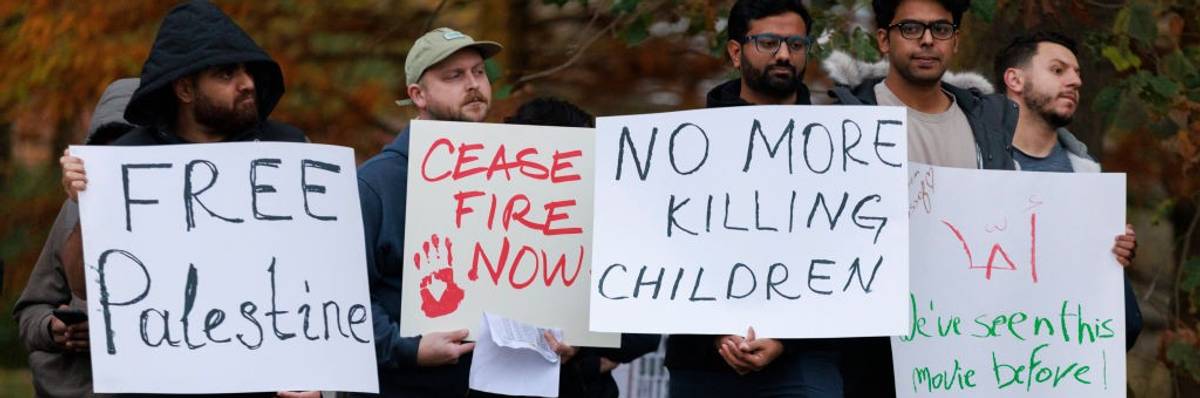
Protesters hold placards in Dunn Meadow at Indiana University to protest against the Israeli ground operation into Gaza. The rally was titled, "Stand With Gaza. Rally and Mourn The Innocent Lives of Palestinians."
If "security" is the reason that pro-Palestinian voices are being silence on campus, the question must be asked: whose security?
Indiana University President Whitten and her administration have recently suspended Abdulkader Sinno, the tenured faculty advisor of the Palestine Solidarity Committee student group, and then canceled a long-planned Ezkenazi Museum exhibit featuring the work of acclaimed artist Samia Halaby, a Palestinian intellectual who has been very critical of the current Israeli bombardment of Gaza.
These measures were taken shortly after Rep. Jim Banks’s very public demand that Whitten crackdown on pro-Palestinian activism on campus. It begs credulity to consider this a coincidence. And it seems to many, myself included, that the suspension and the cancellation were Whitten’s way of answering Banks’s demands, and of demonstrating that she will not equivocate in the manner of those Ivy League presidents who refused to simply declare that they would ban certain forms of pro-Palestinian speech.
The administration, to the extent that it has made any effort to explain these measures, insists that they are justified by the university’s obligation to provide “security” and guarantee “public safety” for controversial campus activities, and that pro-Palestinian events, being controversial, require special security measures.
But if “security” is the administration’s concern, a number of questions immediately present themselves.
The most obvious question is the simplest one: if current controversies related to Israel-Palestine are so heated that they place people on campus in jeopardy, why is it only the pro-Palestinian events that require special security attention?
Why haven’t pro-Israeli or even all Jewish events on campus received the same level of attention and scrutiny? Provost Shrivastav declared last week at the Bloomington Faculty Council that even a slight chance of danger would lead him to cancel events at risk. But no non-Palestinian events have been canceled.
Perhaps the administration doubts that there are serious risks to pro-Israeli or Jewish campus events? I hope there are good reasons for such doubt. But if there are such reasons, then what’s all the commotion being made, by Jim Banks, and the American Jewish Affairs Committee of Indiana, and President Whitten herself, about the need to “get serious” about antisemitism? Either there is real danger, in which case the logic applied to the pro-Palestinian events should apply to the Jewish events too, or there is not.
In the absence of greater clarity, another question arises: what’s all the commotion about the security threats at pro-Palestinian events anyway? Who is so threatening?
The clear implication of IU’s cancelations is that people who are against Palestinian events might disrupt the events and harm event participants. Which people? In the U.S. today, there is only one group of people that is very publicly identified with opposition to pro-Palestinian events: a large segment of the Jewish community, including many Hillel and AIPAC-affiliated Jewish students, the Indianapolis Jewish Community Relations Council, and the American Jewish Affairs Committee of Indiana (the latter has been very loud in its demands that pro-Palestinian advocacy be restricted).
Does the administration mean to imply that those pro-Zionist Jews who oppose Palestinian advocacy are so dangerous and disruptive on campus that Palestinian events need special security precautions to protect event participants from these disrupters?
And if so, on what evidence? To insinuate such a thing without evidence would mean that the administration considers Zionism inherently dangerous. Such thinking would have to be considered anti-Zionist and, according to the administration’s own publicly stated logic, antisemitic, even if unwittingly so. Could that possibly be?
Alternatively, perhaps the administration has evidence of actual threats to pro-Palestinian events ?
According to the New York Times, pro-Palestinian student demonstrators at Columbia University this week were sprayed with a foul-smelling and toxic liquid, allegedly by aggressive counter-protesters who called the protesters “terrorists.” Many students were injured, police reports were filed, and university officials notified. Days later, according to the Columbia Spectator, the Interim University Provost banned “alleged perpetrators” from campus following “what appear to have been serious crimes, possibly hate crimes” against the pro-Palestinian demonstrators, some of whom were Jewish.
Is it the possibility of a similar attack taking place here that has led the IU administration to cancel Sinno and Halaby?
However you cut it, there is a striking disconnect between the “security” claims being used to justify the administration’s cancellations, and the idea that it is campus antisemitism that must be opposed. For if only pro-Palestinian events are threatened, then perhaps it is anti-Palestinian bigotry that is the real problem? Or does the administration believe the pro-Palestinian students will disrupt the very events they are organizing?
Such questions abound.
There is, of course, another possibility: that the appeal to “public safety” doesn’t add up because it is merely an excuse, and the real reason the administration has shut down pro-Palestinian events is not because they are uniquely vulnerable but because they are uniquely objectionable to those the administration wishes to please. In other words, it has shut down pro-Palestinian events because they are pro-Palestinian.
It would surely sound vulgar–and illegal—to say this publicly.
So the administration instead says it is restricting the events because they endanger “safety.”
The Oxford English Dictionary defines “prevarication” as “Avoidance of straightforward statement of the truth; equivocation, evasiveness, misrepresentation; deceit; an instance of this.”
Is there any better word to describe what is going on right now at Indiana University?
Dear Common Dreams reader, It’s been nearly 30 years since I co-founded Common Dreams with my late wife, Lina Newhouser. We had the radical notion that journalism should serve the public good, not corporate profits. It was clear to us from the outset what it would take to build such a project. No paid advertisements. No corporate sponsors. No millionaire publisher telling us what to think or do. Many people said we wouldn't last a year, but we proved those doubters wrong. Together with a tremendous team of journalists and dedicated staff, we built an independent media outlet free from the constraints of profits and corporate control. Our mission has always been simple: To inform. To inspire. To ignite change for the common good. Building Common Dreams was not easy. Our survival was never guaranteed. When you take on the most powerful forces—Wall Street greed, fossil fuel industry destruction, Big Tech lobbyists, and uber-rich oligarchs who have spent billions upon billions rigging the economy and democracy in their favor—the only bulwark you have is supporters who believe in your work. But here’s the urgent message from me today. It's never been this bad out there. And it's never been this hard to keep us going. At the very moment Common Dreams is most needed, the threats we face are intensifying. We need your support now more than ever. We don't accept corporate advertising and never will. We don't have a paywall because we don't think people should be blocked from critical news based on their ability to pay. Everything we do is funded by the donations of readers like you. When everyone does the little they can afford, we are strong. But if that support retreats or dries up, so do we. Will you donate now to make sure Common Dreams not only survives but thrives? —Craig Brown, Co-founder |
Indiana University President Whitten and her administration have recently suspended Abdulkader Sinno, the tenured faculty advisor of the Palestine Solidarity Committee student group, and then canceled a long-planned Ezkenazi Museum exhibit featuring the work of acclaimed artist Samia Halaby, a Palestinian intellectual who has been very critical of the current Israeli bombardment of Gaza.
These measures were taken shortly after Rep. Jim Banks’s very public demand that Whitten crackdown on pro-Palestinian activism on campus. It begs credulity to consider this a coincidence. And it seems to many, myself included, that the suspension and the cancellation were Whitten’s way of answering Banks’s demands, and of demonstrating that she will not equivocate in the manner of those Ivy League presidents who refused to simply declare that they would ban certain forms of pro-Palestinian speech.
The administration, to the extent that it has made any effort to explain these measures, insists that they are justified by the university’s obligation to provide “security” and guarantee “public safety” for controversial campus activities, and that pro-Palestinian events, being controversial, require special security measures.
But if “security” is the administration’s concern, a number of questions immediately present themselves.
The most obvious question is the simplest one: if current controversies related to Israel-Palestine are so heated that they place people on campus in jeopardy, why is it only the pro-Palestinian events that require special security attention?
Why haven’t pro-Israeli or even all Jewish events on campus received the same level of attention and scrutiny? Provost Shrivastav declared last week at the Bloomington Faculty Council that even a slight chance of danger would lead him to cancel events at risk. But no non-Palestinian events have been canceled.
Perhaps the administration doubts that there are serious risks to pro-Israeli or Jewish campus events? I hope there are good reasons for such doubt. But if there are such reasons, then what’s all the commotion being made, by Jim Banks, and the American Jewish Affairs Committee of Indiana, and President Whitten herself, about the need to “get serious” about antisemitism? Either there is real danger, in which case the logic applied to the pro-Palestinian events should apply to the Jewish events too, or there is not.
In the absence of greater clarity, another question arises: what’s all the commotion about the security threats at pro-Palestinian events anyway? Who is so threatening?
The clear implication of IU’s cancelations is that people who are against Palestinian events might disrupt the events and harm event participants. Which people? In the U.S. today, there is only one group of people that is very publicly identified with opposition to pro-Palestinian events: a large segment of the Jewish community, including many Hillel and AIPAC-affiliated Jewish students, the Indianapolis Jewish Community Relations Council, and the American Jewish Affairs Committee of Indiana (the latter has been very loud in its demands that pro-Palestinian advocacy be restricted).
Does the administration mean to imply that those pro-Zionist Jews who oppose Palestinian advocacy are so dangerous and disruptive on campus that Palestinian events need special security precautions to protect event participants from these disrupters?
And if so, on what evidence? To insinuate such a thing without evidence would mean that the administration considers Zionism inherently dangerous. Such thinking would have to be considered anti-Zionist and, according to the administration’s own publicly stated logic, antisemitic, even if unwittingly so. Could that possibly be?
Alternatively, perhaps the administration has evidence of actual threats to pro-Palestinian events ?
According to the New York Times, pro-Palestinian student demonstrators at Columbia University this week were sprayed with a foul-smelling and toxic liquid, allegedly by aggressive counter-protesters who called the protesters “terrorists.” Many students were injured, police reports were filed, and university officials notified. Days later, according to the Columbia Spectator, the Interim University Provost banned “alleged perpetrators” from campus following “what appear to have been serious crimes, possibly hate crimes” against the pro-Palestinian demonstrators, some of whom were Jewish.
Is it the possibility of a similar attack taking place here that has led the IU administration to cancel Sinno and Halaby?
However you cut it, there is a striking disconnect between the “security” claims being used to justify the administration’s cancellations, and the idea that it is campus antisemitism that must be opposed. For if only pro-Palestinian events are threatened, then perhaps it is anti-Palestinian bigotry that is the real problem? Or does the administration believe the pro-Palestinian students will disrupt the very events they are organizing?
Such questions abound.
There is, of course, another possibility: that the appeal to “public safety” doesn’t add up because it is merely an excuse, and the real reason the administration has shut down pro-Palestinian events is not because they are uniquely vulnerable but because they are uniquely objectionable to those the administration wishes to please. In other words, it has shut down pro-Palestinian events because they are pro-Palestinian.
It would surely sound vulgar–and illegal—to say this publicly.
So the administration instead says it is restricting the events because they endanger “safety.”
The Oxford English Dictionary defines “prevarication” as “Avoidance of straightforward statement of the truth; equivocation, evasiveness, misrepresentation; deceit; an instance of this.”
Is there any better word to describe what is going on right now at Indiana University?
Indiana University President Whitten and her administration have recently suspended Abdulkader Sinno, the tenured faculty advisor of the Palestine Solidarity Committee student group, and then canceled a long-planned Ezkenazi Museum exhibit featuring the work of acclaimed artist Samia Halaby, a Palestinian intellectual who has been very critical of the current Israeli bombardment of Gaza.
These measures were taken shortly after Rep. Jim Banks’s very public demand that Whitten crackdown on pro-Palestinian activism on campus. It begs credulity to consider this a coincidence. And it seems to many, myself included, that the suspension and the cancellation were Whitten’s way of answering Banks’s demands, and of demonstrating that she will not equivocate in the manner of those Ivy League presidents who refused to simply declare that they would ban certain forms of pro-Palestinian speech.
The administration, to the extent that it has made any effort to explain these measures, insists that they are justified by the university’s obligation to provide “security” and guarantee “public safety” for controversial campus activities, and that pro-Palestinian events, being controversial, require special security measures.
But if “security” is the administration’s concern, a number of questions immediately present themselves.
The most obvious question is the simplest one: if current controversies related to Israel-Palestine are so heated that they place people on campus in jeopardy, why is it only the pro-Palestinian events that require special security attention?
Why haven’t pro-Israeli or even all Jewish events on campus received the same level of attention and scrutiny? Provost Shrivastav declared last week at the Bloomington Faculty Council that even a slight chance of danger would lead him to cancel events at risk. But no non-Palestinian events have been canceled.
Perhaps the administration doubts that there are serious risks to pro-Israeli or Jewish campus events? I hope there are good reasons for such doubt. But if there are such reasons, then what’s all the commotion being made, by Jim Banks, and the American Jewish Affairs Committee of Indiana, and President Whitten herself, about the need to “get serious” about antisemitism? Either there is real danger, in which case the logic applied to the pro-Palestinian events should apply to the Jewish events too, or there is not.
In the absence of greater clarity, another question arises: what’s all the commotion about the security threats at pro-Palestinian events anyway? Who is so threatening?
The clear implication of IU’s cancelations is that people who are against Palestinian events might disrupt the events and harm event participants. Which people? In the U.S. today, there is only one group of people that is very publicly identified with opposition to pro-Palestinian events: a large segment of the Jewish community, including many Hillel and AIPAC-affiliated Jewish students, the Indianapolis Jewish Community Relations Council, and the American Jewish Affairs Committee of Indiana (the latter has been very loud in its demands that pro-Palestinian advocacy be restricted).
Does the administration mean to imply that those pro-Zionist Jews who oppose Palestinian advocacy are so dangerous and disruptive on campus that Palestinian events need special security precautions to protect event participants from these disrupters?
And if so, on what evidence? To insinuate such a thing without evidence would mean that the administration considers Zionism inherently dangerous. Such thinking would have to be considered anti-Zionist and, according to the administration’s own publicly stated logic, antisemitic, even if unwittingly so. Could that possibly be?
Alternatively, perhaps the administration has evidence of actual threats to pro-Palestinian events ?
According to the New York Times, pro-Palestinian student demonstrators at Columbia University this week were sprayed with a foul-smelling and toxic liquid, allegedly by aggressive counter-protesters who called the protesters “terrorists.” Many students were injured, police reports were filed, and university officials notified. Days later, according to the Columbia Spectator, the Interim University Provost banned “alleged perpetrators” from campus following “what appear to have been serious crimes, possibly hate crimes” against the pro-Palestinian demonstrators, some of whom were Jewish.
Is it the possibility of a similar attack taking place here that has led the IU administration to cancel Sinno and Halaby?
However you cut it, there is a striking disconnect between the “security” claims being used to justify the administration’s cancellations, and the idea that it is campus antisemitism that must be opposed. For if only pro-Palestinian events are threatened, then perhaps it is anti-Palestinian bigotry that is the real problem? Or does the administration believe the pro-Palestinian students will disrupt the very events they are organizing?
Such questions abound.
There is, of course, another possibility: that the appeal to “public safety” doesn’t add up because it is merely an excuse, and the real reason the administration has shut down pro-Palestinian events is not because they are uniquely vulnerable but because they are uniquely objectionable to those the administration wishes to please. In other words, it has shut down pro-Palestinian events because they are pro-Palestinian.
It would surely sound vulgar–and illegal—to say this publicly.
So the administration instead says it is restricting the events because they endanger “safety.”
The Oxford English Dictionary defines “prevarication” as “Avoidance of straightforward statement of the truth; equivocation, evasiveness, misrepresentation; deceit; an instance of this.”
Is there any better word to describe what is going on right now at Indiana University?