SUBSCRIBE TO OUR FREE NEWSLETTER
Daily news & progressive opinion—funded by the people, not the corporations—delivered straight to your inbox.
5
#000000
#FFFFFF
To donate by check, phone, or other method, see our More Ways to Give page.
Daily news & progressive opinion—funded by the people, not the corporations—delivered straight to your inbox.
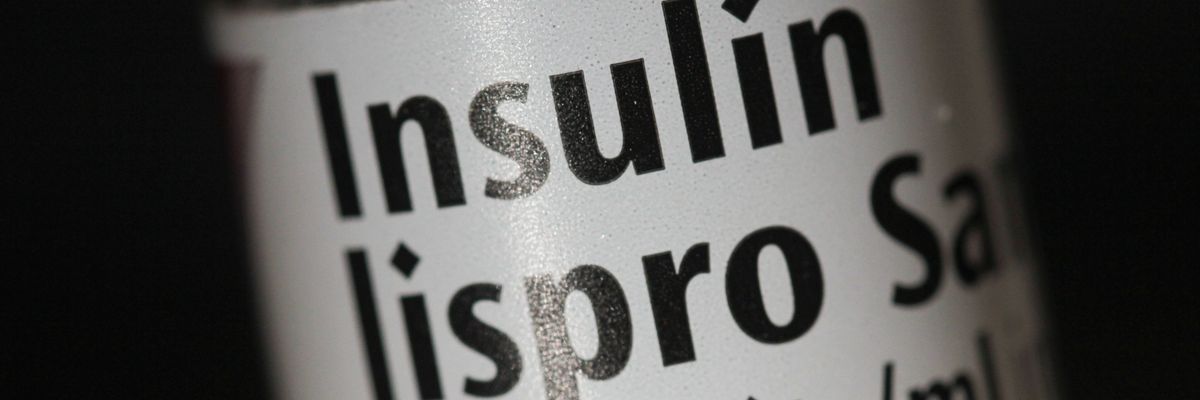
An empty bottle of Insulin lispro by French multinational pharmaceutical company Sanofi is photographed as an arranged illustration in London on February 21, 2019.
A lower-priced insulin doesn’t save lives if it’s unavailable. It is simply a strategic public relations move.
On March 1, Eli Lilly announced it would reduce the list prices of some of its insulins, including the generic Lispro, the same product as the name-brand Humalog. At a recent congressional hearing with the CEOs of insulin manufacturers and pharmacy benefit managers, David Ricks, Eli Lilly’s CEO, again celebrated that $25 insulin lispro was available to patients as of May 1. People with diabetes have worked tirelessly to reduce insulin costs for decades. So why aren’t we universally celebrating this announcement of lower prices?
Because it is now the end of May, and I—along with many others in my community—still haven’t been able to get the promised $25 insulin.
I have lived with type 1 diabetes for 22 years, more than ⅔ of my life. In that time, I’ve watched the price of insulin climb, while simultaneously listening to promises from big pharma and the organizations that accept their funding that ultimately led nowhere. However, when I first read that Eli Lilly was going to offer $25 vials of Lispro starting May 1, I was optimistic about what this could mean for the 7+ million people who rely on insulin daily.
I don't usually use insulin Lispro (but rather it’s brand name cousin per my insurance guidelines) so after Eli Lilly’s news, I confirmed with my insurance company that I wouldn’t need a new prescription to access Lispro. They said I wouldn’t—great, and off to the pharmacy I went to purchase my $25 insulin!
I went to my local pharmacy when my refill was up. But when I requested Lispro, the pharmacist shook his head: “We don’t have that in stock.” When I asked when it would be back in stock, he shrugged, “they send Lispro when they have it.” I decided to return at a later date as I happened to have a supply of insulin on hand at home, two weeks later, we had a similar exchange.
The experience was frustrating, however, it ended only in frustration because I was fortunate enough to have extra insulin at home, a prescription for the brand name equivalent, insurance to cover the brand name, and an income that allows me to do so. That is a combination of privilege and luck that many aren’t afforded. In another situation that frustration could have easily turned to a life-threatening and dangerous situation.
If Eli Lilly is going to promise $25 vials of insulin Lispro, it needs to be accessible. A lower-priced insulin doesn’t save lives if it’s unavailable, it is simply a strategic PR move.
And patients don’t have time to wait for Eli Lilly and other insulin manufacturers to follow through on their promises. Now is the time to cap the list price of all insulins.
This country and this world are at a monumental crossroads. US voters have an opportunity to beat back the forces of fascism and confront the billionaires who are rigging the economy, our media system, and our democracy, making it increasingly impossible for ordinary people to get by. We’re not just talking about the election. We’re talking about what must be done once these fascist elements are vanquished from power. We need a bolder set of solutions than what either major party has so far been willing to offer and a working-class movement ready to fight like hell for it. Trump didn't emerge from nowhere. The conditions that fueled MAGA authoritarianism were created by decades of radical neoliberal economic policies and a corrupt political system dominated by corporate interests. They slashed taxes on the super-rich, promising that the benefits would trickle down. They said giveaways to the corporate titans would make life more affordable for the rest of us. It was all bullshit. And when a bitter, betrayed populace searches for someone to blame, right-wing demagogues have little trouble finding scapegoats. People know when they're being lied to, but you won't hear any of this from the corporate media. Only independent journalism—powered and funded by people who believe in building a better world—can deliver truly trustworthy daily news. If you share our vision, please contribute whatever you can to sustain our work. |
On March 1, Eli Lilly announced it would reduce the list prices of some of its insulins, including the generic Lispro, the same product as the name-brand Humalog. At a recent congressional hearing with the CEOs of insulin manufacturers and pharmacy benefit managers, David Ricks, Eli Lilly’s CEO, again celebrated that $25 insulin lispro was available to patients as of May 1. People with diabetes have worked tirelessly to reduce insulin costs for decades. So why aren’t we universally celebrating this announcement of lower prices?
Because it is now the end of May, and I—along with many others in my community—still haven’t been able to get the promised $25 insulin.
I have lived with type 1 diabetes for 22 years, more than ⅔ of my life. In that time, I’ve watched the price of insulin climb, while simultaneously listening to promises from big pharma and the organizations that accept their funding that ultimately led nowhere. However, when I first read that Eli Lilly was going to offer $25 vials of Lispro starting May 1, I was optimistic about what this could mean for the 7+ million people who rely on insulin daily.
I don't usually use insulin Lispro (but rather it’s brand name cousin per my insurance guidelines) so after Eli Lilly’s news, I confirmed with my insurance company that I wouldn’t need a new prescription to access Lispro. They said I wouldn’t—great, and off to the pharmacy I went to purchase my $25 insulin!
I went to my local pharmacy when my refill was up. But when I requested Lispro, the pharmacist shook his head: “We don’t have that in stock.” When I asked when it would be back in stock, he shrugged, “they send Lispro when they have it.” I decided to return at a later date as I happened to have a supply of insulin on hand at home, two weeks later, we had a similar exchange.
The experience was frustrating, however, it ended only in frustration because I was fortunate enough to have extra insulin at home, a prescription for the brand name equivalent, insurance to cover the brand name, and an income that allows me to do so. That is a combination of privilege and luck that many aren’t afforded. In another situation that frustration could have easily turned to a life-threatening and dangerous situation.
If Eli Lilly is going to promise $25 vials of insulin Lispro, it needs to be accessible. A lower-priced insulin doesn’t save lives if it’s unavailable, it is simply a strategic PR move.
And patients don’t have time to wait for Eli Lilly and other insulin manufacturers to follow through on their promises. Now is the time to cap the list price of all insulins.