SUBSCRIBE TO OUR FREE NEWSLETTER
Daily news & progressive opinion—funded by the people, not the corporations—delivered straight to your inbox.
5
#000000
#FFFFFF
To donate by check, phone, or other method, see our More Ways to Give page.
Daily news & progressive opinion—funded by the people, not the corporations—delivered straight to your inbox.
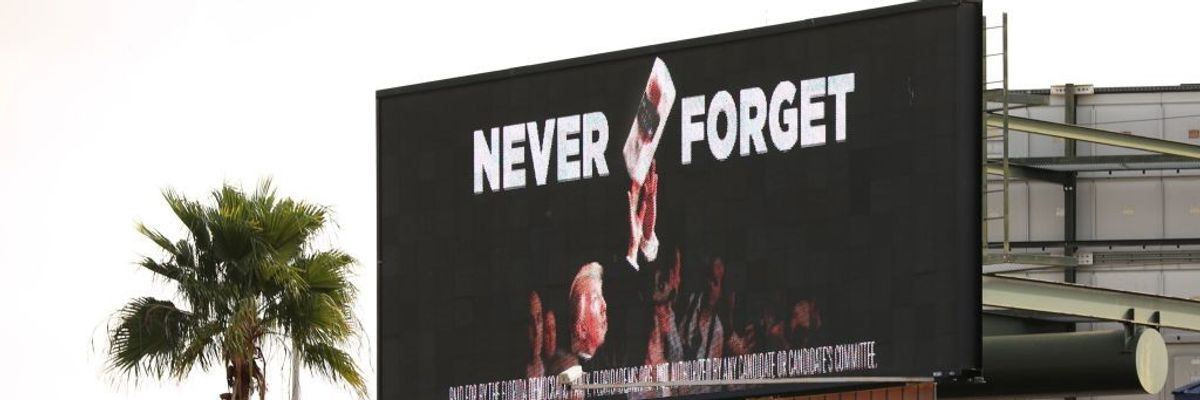
An electronic billboard advertisement paid for by the Florida Democratic Party reading “Never Forget”and showing former U.S. President Donald Trump throwing a roll of paper towels is seen along the Florida Turnpike in Kissimmee, Florida on January 16, 2020.
It’s clear that Trump isn’t concerned about helping disaster victims and that with an exponentially warming climate, we will continue to see increased extreme weather events and consequently more victims in need of support.
I was 10 years old when Hurricane Sandy hit my home city of Baltimore, Maryland. I remember vividly my family all sleeping in the living room together, towels covering the floor to soak up the water that seeped into our house from unexpected places. I remember watching the storm from the dining room window and seeing a tree fall—just missing my next-door neighbor, who was outside in the storm. There were 72 direct deaths as a result of Hurricane Sandy in the Mid-Atlantic region alone.
Sandy was only a Category 1 Hurricane when it hit Baltimore, but it was seared into my mind as one of the scariest events of my life. It was also one of the first times I felt unsafe—even though I was at home and under the watch of my parents.
In the span of 12 days, Florida, Georgia, North Carolina, and surrounding states were hit with not one, but two deadly hurricanes, Hurricane Helene and Milton, that were far more destructive and traumatic than the one that I experienced 12 years ago. So far, it has been recorded that more than 250 people have died as a result of Hurricane Helene and Milton. There are still over a million people without power, or access to food, water, and shelter.
Extreme weather is killing people long after the weather event is over.
The destruction from a hurricane or any extreme weather event doesn’t just end when the power lines are restored and the schools open again. To most victims, the physical rebuilding is only the beginning of the recovery process. The rest remains invisible to everyone else.
Survivors of hurricanes grapple with losing family members and neighbors, homes, and local businesses like cafés and movie theaters that make their communities special. It isn’t hard to understand why the climate crisis and mental health crisis go hand in hand.
Currently, our rates of mental illness—especially that of young adults—are at an all-time high. It has been shown that suicide rates in the two years after a hurricane significantly increase by 31%. And this doesn’t account for the effect of extreme weather on the exacerbation of PTSD, substance abuse disorders, depression, and other mental illnesses. Extreme weather is killing people long after the weather event is over.
Climate change in general can have a detrimental impact on mental health—especially for young people. In a survey of more than 10,000 children and young people around the world, almost half stated that their feelings about climate change negatively affect their daily life and functioning. As Dr. Britt Wray writes in her book, Generation Dread, young people’s distress is also “linked to perceptions of government betrayal and being lied to by leaders who are taking inadequate climate action while pretending otherwise.”
It is crucial, now more than ever, that we elect leaders who will fight climate change and all the destruction it causes to our communities, homes, minds, and spirits.
While in office, former U.S. President Donald Trump withheld disaster and emergency aid multiple times—initially refusing wildfire assistance in California in 2018, withholding wildfire assistance to Washington in 2020, and refusing hurricane disaster funds to Puerto Rico in 2017, all because he didn’t receive political support from those places. And he continues to invest in the companies that are fueling this extreme weather.
It’s clear that Trump isn’t concerned about helping disaster victims, and it’s also clear that with an exponentially warming climate, we will continue to see increased extreme weather events and consequently more victims in need of support.
Vice President Kamala Harris, on the other hand, understands the urgency of tackling the climate crisis while also recognizing that investing in technologies of the future can fuel economic growth.
In fact, with the Biden administration, she’s created over 300,000 new clean energy jobs through the Inflation Reduction Act and spurred a clean-energy manufacturing boom, all while investing billions in climate resilience—making sure that victims and potential victims are supported by the federal government even before a disaster happens. She has also prioritized tackling the youth mental health crisis, announcing $285 million earlier this year for schools to hire 14,000 mental health counselors to give students the support they need to thrive.
What America needs, now more than ever, are leaders who will take climate change and the mental health crisis seriously, and who will assist anyone who is victimized by extreme weather, not just those who are politically like-minded. That’s why we should elect Vice President Kamala Harris and Minnesota Gov. Tim Walz.
Dear Common Dreams reader, It’s been nearly 30 years since I co-founded Common Dreams with my late wife, Lina Newhouser. We had the radical notion that journalism should serve the public good, not corporate profits. It was clear to us from the outset what it would take to build such a project. No paid advertisements. No corporate sponsors. No millionaire publisher telling us what to think or do. Many people said we wouldn't last a year, but we proved those doubters wrong. Together with a tremendous team of journalists and dedicated staff, we built an independent media outlet free from the constraints of profits and corporate control. Our mission has always been simple: To inform. To inspire. To ignite change for the common good. Building Common Dreams was not easy. Our survival was never guaranteed. When you take on the most powerful forces—Wall Street greed, fossil fuel industry destruction, Big Tech lobbyists, and uber-rich oligarchs who have spent billions upon billions rigging the economy and democracy in their favor—the only bulwark you have is supporters who believe in your work. But here’s the urgent message from me today. It's never been this bad out there. And it's never been this hard to keep us going. At the very moment Common Dreams is most needed, the threats we face are intensifying. We need your support now more than ever. We don't accept corporate advertising and never will. We don't have a paywall because we don't think people should be blocked from critical news based on their ability to pay. Everything we do is funded by the donations of readers like you. When everyone does the little they can afford, we are strong. But if that support retreats or dries up, so do we. Will you donate now to make sure Common Dreams not only survives but thrives? —Craig Brown, Co-founder |
I was 10 years old when Hurricane Sandy hit my home city of Baltimore, Maryland. I remember vividly my family all sleeping in the living room together, towels covering the floor to soak up the water that seeped into our house from unexpected places. I remember watching the storm from the dining room window and seeing a tree fall—just missing my next-door neighbor, who was outside in the storm. There were 72 direct deaths as a result of Hurricane Sandy in the Mid-Atlantic region alone.
Sandy was only a Category 1 Hurricane when it hit Baltimore, but it was seared into my mind as one of the scariest events of my life. It was also one of the first times I felt unsafe—even though I was at home and under the watch of my parents.
In the span of 12 days, Florida, Georgia, North Carolina, and surrounding states were hit with not one, but two deadly hurricanes, Hurricane Helene and Milton, that were far more destructive and traumatic than the one that I experienced 12 years ago. So far, it has been recorded that more than 250 people have died as a result of Hurricane Helene and Milton. There are still over a million people without power, or access to food, water, and shelter.
Extreme weather is killing people long after the weather event is over.
The destruction from a hurricane or any extreme weather event doesn’t just end when the power lines are restored and the schools open again. To most victims, the physical rebuilding is only the beginning of the recovery process. The rest remains invisible to everyone else.
Survivors of hurricanes grapple with losing family members and neighbors, homes, and local businesses like cafés and movie theaters that make their communities special. It isn’t hard to understand why the climate crisis and mental health crisis go hand in hand.
Currently, our rates of mental illness—especially that of young adults—are at an all-time high. It has been shown that suicide rates in the two years after a hurricane significantly increase by 31%. And this doesn’t account for the effect of extreme weather on the exacerbation of PTSD, substance abuse disorders, depression, and other mental illnesses. Extreme weather is killing people long after the weather event is over.
Climate change in general can have a detrimental impact on mental health—especially for young people. In a survey of more than 10,000 children and young people around the world, almost half stated that their feelings about climate change negatively affect their daily life and functioning. As Dr. Britt Wray writes in her book, Generation Dread, young people’s distress is also “linked to perceptions of government betrayal and being lied to by leaders who are taking inadequate climate action while pretending otherwise.”
It is crucial, now more than ever, that we elect leaders who will fight climate change and all the destruction it causes to our communities, homes, minds, and spirits.
While in office, former U.S. President Donald Trump withheld disaster and emergency aid multiple times—initially refusing wildfire assistance in California in 2018, withholding wildfire assistance to Washington in 2020, and refusing hurricane disaster funds to Puerto Rico in 2017, all because he didn’t receive political support from those places. And he continues to invest in the companies that are fueling this extreme weather.
It’s clear that Trump isn’t concerned about helping disaster victims, and it’s also clear that with an exponentially warming climate, we will continue to see increased extreme weather events and consequently more victims in need of support.
Vice President Kamala Harris, on the other hand, understands the urgency of tackling the climate crisis while also recognizing that investing in technologies of the future can fuel economic growth.
In fact, with the Biden administration, she’s created over 300,000 new clean energy jobs through the Inflation Reduction Act and spurred a clean-energy manufacturing boom, all while investing billions in climate resilience—making sure that victims and potential victims are supported by the federal government even before a disaster happens. She has also prioritized tackling the youth mental health crisis, announcing $285 million earlier this year for schools to hire 14,000 mental health counselors to give students the support they need to thrive.
What America needs, now more than ever, are leaders who will take climate change and the mental health crisis seriously, and who will assist anyone who is victimized by extreme weather, not just those who are politically like-minded. That’s why we should elect Vice President Kamala Harris and Minnesota Gov. Tim Walz.
I was 10 years old when Hurricane Sandy hit my home city of Baltimore, Maryland. I remember vividly my family all sleeping in the living room together, towels covering the floor to soak up the water that seeped into our house from unexpected places. I remember watching the storm from the dining room window and seeing a tree fall—just missing my next-door neighbor, who was outside in the storm. There were 72 direct deaths as a result of Hurricane Sandy in the Mid-Atlantic region alone.
Sandy was only a Category 1 Hurricane when it hit Baltimore, but it was seared into my mind as one of the scariest events of my life. It was also one of the first times I felt unsafe—even though I was at home and under the watch of my parents.
In the span of 12 days, Florida, Georgia, North Carolina, and surrounding states were hit with not one, but two deadly hurricanes, Hurricane Helene and Milton, that were far more destructive and traumatic than the one that I experienced 12 years ago. So far, it has been recorded that more than 250 people have died as a result of Hurricane Helene and Milton. There are still over a million people without power, or access to food, water, and shelter.
Extreme weather is killing people long after the weather event is over.
The destruction from a hurricane or any extreme weather event doesn’t just end when the power lines are restored and the schools open again. To most victims, the physical rebuilding is only the beginning of the recovery process. The rest remains invisible to everyone else.
Survivors of hurricanes grapple with losing family members and neighbors, homes, and local businesses like cafés and movie theaters that make their communities special. It isn’t hard to understand why the climate crisis and mental health crisis go hand in hand.
Currently, our rates of mental illness—especially that of young adults—are at an all-time high. It has been shown that suicide rates in the two years after a hurricane significantly increase by 31%. And this doesn’t account for the effect of extreme weather on the exacerbation of PTSD, substance abuse disorders, depression, and other mental illnesses. Extreme weather is killing people long after the weather event is over.
Climate change in general can have a detrimental impact on mental health—especially for young people. In a survey of more than 10,000 children and young people around the world, almost half stated that their feelings about climate change negatively affect their daily life and functioning. As Dr. Britt Wray writes in her book, Generation Dread, young people’s distress is also “linked to perceptions of government betrayal and being lied to by leaders who are taking inadequate climate action while pretending otherwise.”
It is crucial, now more than ever, that we elect leaders who will fight climate change and all the destruction it causes to our communities, homes, minds, and spirits.
While in office, former U.S. President Donald Trump withheld disaster and emergency aid multiple times—initially refusing wildfire assistance in California in 2018, withholding wildfire assistance to Washington in 2020, and refusing hurricane disaster funds to Puerto Rico in 2017, all because he didn’t receive political support from those places. And he continues to invest in the companies that are fueling this extreme weather.
It’s clear that Trump isn’t concerned about helping disaster victims, and it’s also clear that with an exponentially warming climate, we will continue to see increased extreme weather events and consequently more victims in need of support.
Vice President Kamala Harris, on the other hand, understands the urgency of tackling the climate crisis while also recognizing that investing in technologies of the future can fuel economic growth.
In fact, with the Biden administration, she’s created over 300,000 new clean energy jobs through the Inflation Reduction Act and spurred a clean-energy manufacturing boom, all while investing billions in climate resilience—making sure that victims and potential victims are supported by the federal government even before a disaster happens. She has also prioritized tackling the youth mental health crisis, announcing $285 million earlier this year for schools to hire 14,000 mental health counselors to give students the support they need to thrive.
What America needs, now more than ever, are leaders who will take climate change and the mental health crisis seriously, and who will assist anyone who is victimized by extreme weather, not just those who are politically like-minded. That’s why we should elect Vice President Kamala Harris and Minnesota Gov. Tim Walz.