SUBSCRIBE TO OUR FREE NEWSLETTER
Daily news & progressive opinion—funded by the people, not the corporations—delivered straight to your inbox.
5
#000000
#FFFFFF
To donate by check, phone, or other method, see our More Ways to Give page.
Daily news & progressive opinion—funded by the people, not the corporations—delivered straight to your inbox.
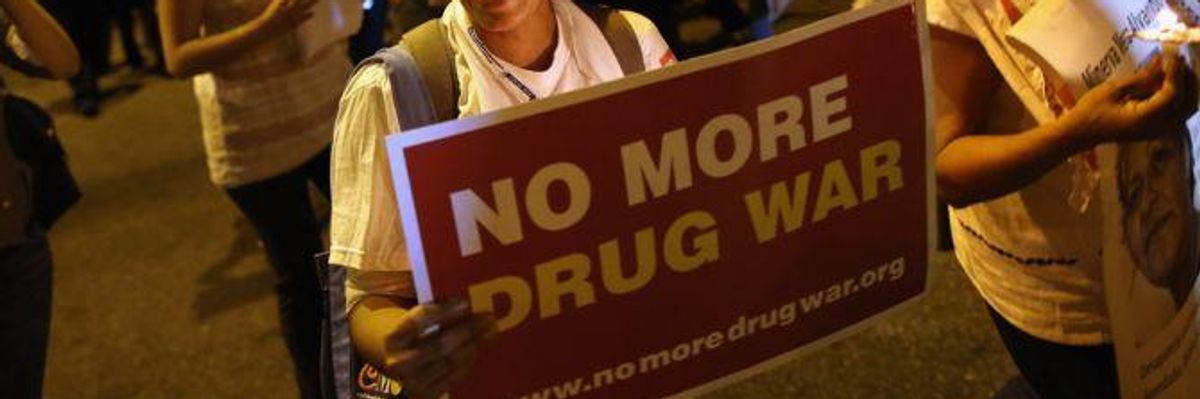
Protesters hold a candlelight vigil and a march calling for the end of the drug war on September 6, 2012 in New York City.
In order to address the root causes of rising overdose and homelessness rates, policymakers, elected officials, and funders need to stop investing in strategies that focus on criminalization and punishment.
In the latest attack on people who use drugs, San Francisco’s mayor, London Breed, advocates for requiring substance abuse screening and treatment for low-income residents to be eligible for welfare funds. Earlier this year, Breed deployed 130 officers into the city’s streets to arrest people who use drugs and force them into drug treatment.
Fifty-eight people were arrested between May and June 2023, 60% of which were arrests involving people of color. As of late September, 476 people have been arrested on suspicion of using drugs or being under the influence of drugs in public. Yet, according to police chief Bill Scott, only two of the nearly 500 people arrested have entered drug treatment.
Recent drug enforcement efforts in San Francisco resemble war on drug policies from the 1980s that disproportionately impacted marginalized communities of color, especially in the criminal justice and legal systems.
There is bipartisan agreement that the war on drugs was a complete policy failure. So, why are policymakers inviting similar policies back into communities?
Some refer to the strategy of arresting people who use drugs as “tough love,” emphasizing that arresting them might be their only path to sobriety or recovery. But not every person who uses drugs has the end goal of recovery, and criminalization is not compassionate care.
The “tough love” approach removes agency and autonomy from people who use drugs. They are viewed as incapable of knowing and doing what is best for themselves while the state is viewed as some sort of savior by proponents of such policies.
Decades of evidence shows that arresting people to solve the overdose and homelessness crises is not a viable solution. There is bipartisan agreement that the war on drugs was a complete policy failure. So, why are policymakers inviting similar policies back into communities?
San Francisco is on track to see more overdose deaths this year than in 2020 when more than 700 people died from drug overdoses.
According to recent data released by the San Francisco Medical Examiner’s office, there have been 563 overdose deaths in just the first eight months of 2023. Some might argue that policing is the only way to resolve the overdose and homelessness crises, but hyper-policing and escalating drug war policies during a time when drug overdose and homelessness rates are on the rise will only lead to cycles of incarceration, prolonged homelessness, and even more preventable deaths.
Prison and jail cells should not be an alternative to housing or treatment. An increase in police presence puts marginalized communities at risk of being wrongfully targeted and charged for selling or using drugs.
Evidence demonstrates that incarceration puts people at increased risk of overdose and overdose death upon release due to loss of tolerance and limited access to drug treatment while incarcerated. Placing people who use drugs behind bars separates them from social supports and blocks access to healthcare, harm reduction, and housing services. These resources are critical, especially for people living at the margins of substance use and homelessness.
Drug criminalization is also incredibly costly. An estimated $47 billion is spent on enforcing drug prohibition each year. In 2021 alone, taxpayers spent $3.3 billion to fund the Drug Enforcement Administration (DEA). These are funds that could be redirected to support communities most impacted by homelessness and substance use.
Policies adopted in other cities have shown that decriminalization can be effective. A recent study shows that drug decriminalization laws in Oregon and Washington state were not associated with increases in fatal drug overdose rates.
In order to address the root causes of rising overdose and homelessness rates, policymakers, elected officials, and funders need to stop investing in strategies that focus on criminalization and punishment and instead shift resources to support evidence-based public health solutions that prioritize the needs of these communities first.
People who use drugs and people experiencing homelessness are deserving of compassionate care. This must not include locking them up or requiring them to be drug free.
Dear Common Dreams reader, It’s been nearly 30 years since I co-founded Common Dreams with my late wife, Lina Newhouser. We had the radical notion that journalism should serve the public good, not corporate profits. It was clear to us from the outset what it would take to build such a project. No paid advertisements. No corporate sponsors. No millionaire publisher telling us what to think or do. Many people said we wouldn't last a year, but we proved those doubters wrong. Together with a tremendous team of journalists and dedicated staff, we built an independent media outlet free from the constraints of profits and corporate control. Our mission has always been simple: To inform. To inspire. To ignite change for the common good. Building Common Dreams was not easy. Our survival was never guaranteed. When you take on the most powerful forces—Wall Street greed, fossil fuel industry destruction, Big Tech lobbyists, and uber-rich oligarchs who have spent billions upon billions rigging the economy and democracy in their favor—the only bulwark you have is supporters who believe in your work. But here’s the urgent message from me today. It's never been this bad out there. And it's never been this hard to keep us going. At the very moment Common Dreams is most needed, the threats we face are intensifying. We need your support now more than ever. We don't accept corporate advertising and never will. We don't have a paywall because we don't think people should be blocked from critical news based on their ability to pay. Everything we do is funded by the donations of readers like you. When everyone does the little they can afford, we are strong. But if that support retreats or dries up, so do we. Will you donate now to make sure Common Dreams not only survives but thrives? —Craig Brown, Co-founder |
In the latest attack on people who use drugs, San Francisco’s mayor, London Breed, advocates for requiring substance abuse screening and treatment for low-income residents to be eligible for welfare funds. Earlier this year, Breed deployed 130 officers into the city’s streets to arrest people who use drugs and force them into drug treatment.
Fifty-eight people were arrested between May and June 2023, 60% of which were arrests involving people of color. As of late September, 476 people have been arrested on suspicion of using drugs or being under the influence of drugs in public. Yet, according to police chief Bill Scott, only two of the nearly 500 people arrested have entered drug treatment.
Recent drug enforcement efforts in San Francisco resemble war on drug policies from the 1980s that disproportionately impacted marginalized communities of color, especially in the criminal justice and legal systems.
There is bipartisan agreement that the war on drugs was a complete policy failure. So, why are policymakers inviting similar policies back into communities?
Some refer to the strategy of arresting people who use drugs as “tough love,” emphasizing that arresting them might be their only path to sobriety or recovery. But not every person who uses drugs has the end goal of recovery, and criminalization is not compassionate care.
The “tough love” approach removes agency and autonomy from people who use drugs. They are viewed as incapable of knowing and doing what is best for themselves while the state is viewed as some sort of savior by proponents of such policies.
Decades of evidence shows that arresting people to solve the overdose and homelessness crises is not a viable solution. There is bipartisan agreement that the war on drugs was a complete policy failure. So, why are policymakers inviting similar policies back into communities?
San Francisco is on track to see more overdose deaths this year than in 2020 when more than 700 people died from drug overdoses.
According to recent data released by the San Francisco Medical Examiner’s office, there have been 563 overdose deaths in just the first eight months of 2023. Some might argue that policing is the only way to resolve the overdose and homelessness crises, but hyper-policing and escalating drug war policies during a time when drug overdose and homelessness rates are on the rise will only lead to cycles of incarceration, prolonged homelessness, and even more preventable deaths.
Prison and jail cells should not be an alternative to housing or treatment. An increase in police presence puts marginalized communities at risk of being wrongfully targeted and charged for selling or using drugs.
Evidence demonstrates that incarceration puts people at increased risk of overdose and overdose death upon release due to loss of tolerance and limited access to drug treatment while incarcerated. Placing people who use drugs behind bars separates them from social supports and blocks access to healthcare, harm reduction, and housing services. These resources are critical, especially for people living at the margins of substance use and homelessness.
Drug criminalization is also incredibly costly. An estimated $47 billion is spent on enforcing drug prohibition each year. In 2021 alone, taxpayers spent $3.3 billion to fund the Drug Enforcement Administration (DEA). These are funds that could be redirected to support communities most impacted by homelessness and substance use.
Policies adopted in other cities have shown that decriminalization can be effective. A recent study shows that drug decriminalization laws in Oregon and Washington state were not associated with increases in fatal drug overdose rates.
In order to address the root causes of rising overdose and homelessness rates, policymakers, elected officials, and funders need to stop investing in strategies that focus on criminalization and punishment and instead shift resources to support evidence-based public health solutions that prioritize the needs of these communities first.
People who use drugs and people experiencing homelessness are deserving of compassionate care. This must not include locking them up or requiring them to be drug free.
In the latest attack on people who use drugs, San Francisco’s mayor, London Breed, advocates for requiring substance abuse screening and treatment for low-income residents to be eligible for welfare funds. Earlier this year, Breed deployed 130 officers into the city’s streets to arrest people who use drugs and force them into drug treatment.
Fifty-eight people were arrested between May and June 2023, 60% of which were arrests involving people of color. As of late September, 476 people have been arrested on suspicion of using drugs or being under the influence of drugs in public. Yet, according to police chief Bill Scott, only two of the nearly 500 people arrested have entered drug treatment.
Recent drug enforcement efforts in San Francisco resemble war on drug policies from the 1980s that disproportionately impacted marginalized communities of color, especially in the criminal justice and legal systems.
There is bipartisan agreement that the war on drugs was a complete policy failure. So, why are policymakers inviting similar policies back into communities?
Some refer to the strategy of arresting people who use drugs as “tough love,” emphasizing that arresting them might be their only path to sobriety or recovery. But not every person who uses drugs has the end goal of recovery, and criminalization is not compassionate care.
The “tough love” approach removes agency and autonomy from people who use drugs. They are viewed as incapable of knowing and doing what is best for themselves while the state is viewed as some sort of savior by proponents of such policies.
Decades of evidence shows that arresting people to solve the overdose and homelessness crises is not a viable solution. There is bipartisan agreement that the war on drugs was a complete policy failure. So, why are policymakers inviting similar policies back into communities?
San Francisco is on track to see more overdose deaths this year than in 2020 when more than 700 people died from drug overdoses.
According to recent data released by the San Francisco Medical Examiner’s office, there have been 563 overdose deaths in just the first eight months of 2023. Some might argue that policing is the only way to resolve the overdose and homelessness crises, but hyper-policing and escalating drug war policies during a time when drug overdose and homelessness rates are on the rise will only lead to cycles of incarceration, prolonged homelessness, and even more preventable deaths.
Prison and jail cells should not be an alternative to housing or treatment. An increase in police presence puts marginalized communities at risk of being wrongfully targeted and charged for selling or using drugs.
Evidence demonstrates that incarceration puts people at increased risk of overdose and overdose death upon release due to loss of tolerance and limited access to drug treatment while incarcerated. Placing people who use drugs behind bars separates them from social supports and blocks access to healthcare, harm reduction, and housing services. These resources are critical, especially for people living at the margins of substance use and homelessness.
Drug criminalization is also incredibly costly. An estimated $47 billion is spent on enforcing drug prohibition each year. In 2021 alone, taxpayers spent $3.3 billion to fund the Drug Enforcement Administration (DEA). These are funds that could be redirected to support communities most impacted by homelessness and substance use.
Policies adopted in other cities have shown that decriminalization can be effective. A recent study shows that drug decriminalization laws in Oregon and Washington state were not associated with increases in fatal drug overdose rates.
In order to address the root causes of rising overdose and homelessness rates, policymakers, elected officials, and funders need to stop investing in strategies that focus on criminalization and punishment and instead shift resources to support evidence-based public health solutions that prioritize the needs of these communities first.
People who use drugs and people experiencing homelessness are deserving of compassionate care. This must not include locking them up or requiring them to be drug free.