SUBSCRIBE TO OUR FREE NEWSLETTER
Daily news & progressive opinion—funded by the people, not the corporations—delivered straight to your inbox.
5
#000000
#FFFFFF
To donate by check, phone, or other method, see our More Ways to Give page.
Daily news & progressive opinion—funded by the people, not the corporations—delivered straight to your inbox.
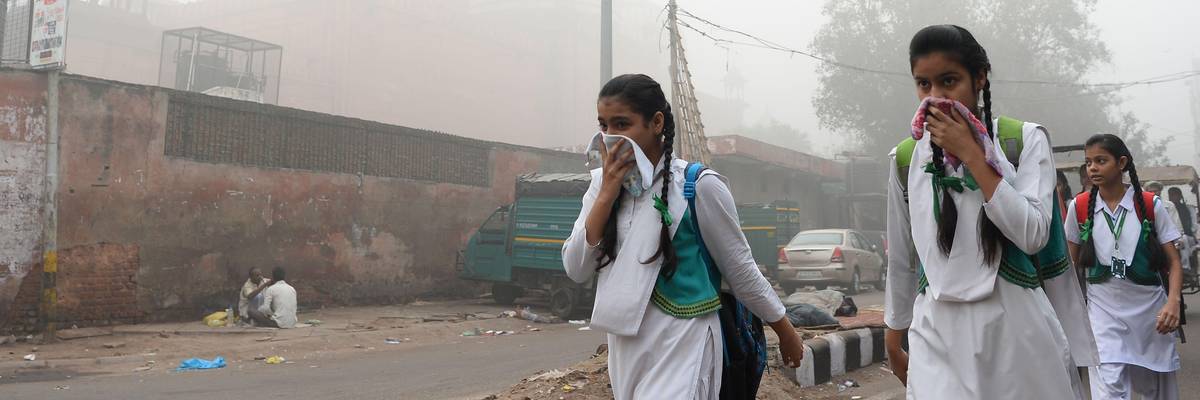
Two women walk down a polluted street in Delhi, India.
New data last week from University of Chicago researchers showed that across South Asia, air pollution—mostly from burning fossil fuels—is robbing people of five years of life on average.
When we talk about “humanity,” we are, statistically, mostly talking about Asia—just under 60% of our sisters and brothers live there. But they don’t live anywhere near as long as they should.
New data last week from University of Chicago researchers showed that across South Asia, air pollution—mostly from burning fossil fuels—is robbing people of five years of life on average. Five years! If you live in Delhi, the most polluted big city on the planet, that number is an unimaginable 11.9 years. If you would have lived to 70, you died at 58. Thank about that. Across the region, “particulate pollution levels are currently more than 50% higher than at the start of the century and now overshadow” other health risks. Every breath that people take is killing them, every hour of every day.
When you burn fossil fuel you produce particulates which lodge in lungs and kill you, and when you burn fossil fuel you produce carbon, which lodges in the atmosphere, driving heatwaves and floods that kill you.
But those other health risks are also rising fast, spurred on by the climate disasters that also come with burning fossil fuel. A remarkable report in Tuesday’s Washington Post (which has been doing a lot of remarkable climate coverage lately) was headlined "Climate-Linked Ills Threaten Humanity," and for a while was the lead story in the paper. It looked at Pakistan, home to last year’s record-breaking flood and a series of devastating heatwaves, and found almost unimaginable levels of misery. Here’s the big picture:
Pakistan is the epicenter of a new global wave of disease and death linked to climate change, according to a Washington Post analysis of climate data, leading scientific studies, interviews with experts, and reporting from some of the places bearing the brunt of Earth’s heating. This examination of climate-fueled illnesses—tied to hotter temperatures, and swifter passage of pathogens and toxins—shows how countries across the globe are ill-prepared for the insidious, intensifying risks to almost every facet of human health.
And here’s what it looks like on the ground:
On a recent 109°F day, babies wailed and adults vomited into buckets in the crowded heat stroke ward of Syed Abdullah Shah Institute of Medical Sciences, a 350-bed government medical center in central Sindh. With just seven beds for heat stroke victims, patients’ parents and relatives crowded together on the mattresses. Nurses in green scrubs attached bags of intravenous hydration fluids to the arms of even the tiniest patients as fans whirled and two air conditioners dripped and chugged.
The number of heat stroke patients coming to the hospital in summer has increased around 20% a year in the last five years, according to M. Moinuddin Siddiqui, the hospital’s medical director, at a time when Pakistan experienced three of its five hottest years on record.
So, bottom line: When you burn fossil fuel you produce particulates which lodge in lungs and kill you (1 death in 5 on the planet comes from breathing the byproducts of fossil fuel combustion), and when you burn fossil fuel you produce carbon, which lodges in the atmosphere, driving heatwaves and floods that kill you.
If fossil fuel was the only way we had to power our lives, I suppose you could tot up its advantages and decide that, on balance, it was still worth burning. Or not. But fossil fuel is not the only way we have to power our lives. India has 300 clear and sunny days a year on average, enough to produce 5,000 trillion kilowatt-hours (kWh) per year. Which is, um, more than they need—solar farms on a small percentage of “low-conflict wastelands” in the country could provide four times its power requirements. According to a recent World Bank study, utilizing just 0.071% of Pakistan’s area for solar PV would meet the country’s current electricity demand. No, none of this comes for free—you have to mine lithium and cobalt. But the damage from those activities doesn’t begin to compare in scale to the toll that fossil fuel is exacting every hour from billions of human bodies.
By any measurable moral calculation, focusing the planet’s efforts and finances on rapidly converting Asia (and Africa and South America) to renewable energy would provide the largest imaginable payoff, both in the short-term and the long, and for both the people who live there, and for the smallish percentage of humans who don’t. But that would mean standing up to the fossil fuel industry—including in America, where that industry is eager to export more, not less, fossil fuel to Asia.
Carbon dioxide molecules are invisible, and particulates are too small to be seen with the naked eye. But they will break our bodies, and our civilizations, unless we break the power of the fossil fuel industry. That is the choice.
America set us on the hydrocarbon path. Asia, with help from the whole world, could be the place that got us off.
Dear Common Dreams reader, It’s been nearly 30 years since I co-founded Common Dreams with my late wife, Lina Newhouser. We had the radical notion that journalism should serve the public good, not corporate profits. It was clear to us from the outset what it would take to build such a project. No paid advertisements. No corporate sponsors. No millionaire publisher telling us what to think or do. Many people said we wouldn't last a year, but we proved those doubters wrong. Together with a tremendous team of journalists and dedicated staff, we built an independent media outlet free from the constraints of profits and corporate control. Our mission has always been simple: To inform. To inspire. To ignite change for the common good. Building Common Dreams was not easy. Our survival was never guaranteed. When you take on the most powerful forces—Wall Street greed, fossil fuel industry destruction, Big Tech lobbyists, and uber-rich oligarchs who have spent billions upon billions rigging the economy and democracy in their favor—the only bulwark you have is supporters who believe in your work. But here’s the urgent message from me today. It's never been this bad out there. And it's never been this hard to keep us going. At the very moment Common Dreams is most needed, the threats we face are intensifying. We need your support now more than ever. We don't accept corporate advertising and never will. We don't have a paywall because we don't think people should be blocked from critical news based on their ability to pay. Everything we do is funded by the donations of readers like you. When everyone does the little they can afford, we are strong. But if that support retreats or dries up, so do we. Will you donate now to make sure Common Dreams not only survives but thrives? —Craig Brown, Co-founder |
When we talk about “humanity,” we are, statistically, mostly talking about Asia—just under 60% of our sisters and brothers live there. But they don’t live anywhere near as long as they should.
New data last week from University of Chicago researchers showed that across South Asia, air pollution—mostly from burning fossil fuels—is robbing people of five years of life on average. Five years! If you live in Delhi, the most polluted big city on the planet, that number is an unimaginable 11.9 years. If you would have lived to 70, you died at 58. Thank about that. Across the region, “particulate pollution levels are currently more than 50% higher than at the start of the century and now overshadow” other health risks. Every breath that people take is killing them, every hour of every day.
When you burn fossil fuel you produce particulates which lodge in lungs and kill you, and when you burn fossil fuel you produce carbon, which lodges in the atmosphere, driving heatwaves and floods that kill you.
But those other health risks are also rising fast, spurred on by the climate disasters that also come with burning fossil fuel. A remarkable report in Tuesday’s Washington Post (which has been doing a lot of remarkable climate coverage lately) was headlined "Climate-Linked Ills Threaten Humanity," and for a while was the lead story in the paper. It looked at Pakistan, home to last year’s record-breaking flood and a series of devastating heatwaves, and found almost unimaginable levels of misery. Here’s the big picture:
Pakistan is the epicenter of a new global wave of disease and death linked to climate change, according to a Washington Post analysis of climate data, leading scientific studies, interviews with experts, and reporting from some of the places bearing the brunt of Earth’s heating. This examination of climate-fueled illnesses—tied to hotter temperatures, and swifter passage of pathogens and toxins—shows how countries across the globe are ill-prepared for the insidious, intensifying risks to almost every facet of human health.
And here’s what it looks like on the ground:
On a recent 109°F day, babies wailed and adults vomited into buckets in the crowded heat stroke ward of Syed Abdullah Shah Institute of Medical Sciences, a 350-bed government medical center in central Sindh. With just seven beds for heat stroke victims, patients’ parents and relatives crowded together on the mattresses. Nurses in green scrubs attached bags of intravenous hydration fluids to the arms of even the tiniest patients as fans whirled and two air conditioners dripped and chugged.
The number of heat stroke patients coming to the hospital in summer has increased around 20% a year in the last five years, according to M. Moinuddin Siddiqui, the hospital’s medical director, at a time when Pakistan experienced three of its five hottest years on record.
So, bottom line: When you burn fossil fuel you produce particulates which lodge in lungs and kill you (1 death in 5 on the planet comes from breathing the byproducts of fossil fuel combustion), and when you burn fossil fuel you produce carbon, which lodges in the atmosphere, driving heatwaves and floods that kill you.
If fossil fuel was the only way we had to power our lives, I suppose you could tot up its advantages and decide that, on balance, it was still worth burning. Or not. But fossil fuel is not the only way we have to power our lives. India has 300 clear and sunny days a year on average, enough to produce 5,000 trillion kilowatt-hours (kWh) per year. Which is, um, more than they need—solar farms on a small percentage of “low-conflict wastelands” in the country could provide four times its power requirements. According to a recent World Bank study, utilizing just 0.071% of Pakistan’s area for solar PV would meet the country’s current electricity demand. No, none of this comes for free—you have to mine lithium and cobalt. But the damage from those activities doesn’t begin to compare in scale to the toll that fossil fuel is exacting every hour from billions of human bodies.
By any measurable moral calculation, focusing the planet’s efforts and finances on rapidly converting Asia (and Africa and South America) to renewable energy would provide the largest imaginable payoff, both in the short-term and the long, and for both the people who live there, and for the smallish percentage of humans who don’t. But that would mean standing up to the fossil fuel industry—including in America, where that industry is eager to export more, not less, fossil fuel to Asia.
Carbon dioxide molecules are invisible, and particulates are too small to be seen with the naked eye. But they will break our bodies, and our civilizations, unless we break the power of the fossil fuel industry. That is the choice.
America set us on the hydrocarbon path. Asia, with help from the whole world, could be the place that got us off.
When we talk about “humanity,” we are, statistically, mostly talking about Asia—just under 60% of our sisters and brothers live there. But they don’t live anywhere near as long as they should.
New data last week from University of Chicago researchers showed that across South Asia, air pollution—mostly from burning fossil fuels—is robbing people of five years of life on average. Five years! If you live in Delhi, the most polluted big city on the planet, that number is an unimaginable 11.9 years. If you would have lived to 70, you died at 58. Thank about that. Across the region, “particulate pollution levels are currently more than 50% higher than at the start of the century and now overshadow” other health risks. Every breath that people take is killing them, every hour of every day.
When you burn fossil fuel you produce particulates which lodge in lungs and kill you, and when you burn fossil fuel you produce carbon, which lodges in the atmosphere, driving heatwaves and floods that kill you.
But those other health risks are also rising fast, spurred on by the climate disasters that also come with burning fossil fuel. A remarkable report in Tuesday’s Washington Post (which has been doing a lot of remarkable climate coverage lately) was headlined "Climate-Linked Ills Threaten Humanity," and for a while was the lead story in the paper. It looked at Pakistan, home to last year’s record-breaking flood and a series of devastating heatwaves, and found almost unimaginable levels of misery. Here’s the big picture:
Pakistan is the epicenter of a new global wave of disease and death linked to climate change, according to a Washington Post analysis of climate data, leading scientific studies, interviews with experts, and reporting from some of the places bearing the brunt of Earth’s heating. This examination of climate-fueled illnesses—tied to hotter temperatures, and swifter passage of pathogens and toxins—shows how countries across the globe are ill-prepared for the insidious, intensifying risks to almost every facet of human health.
And here’s what it looks like on the ground:
On a recent 109°F day, babies wailed and adults vomited into buckets in the crowded heat stroke ward of Syed Abdullah Shah Institute of Medical Sciences, a 350-bed government medical center in central Sindh. With just seven beds for heat stroke victims, patients’ parents and relatives crowded together on the mattresses. Nurses in green scrubs attached bags of intravenous hydration fluids to the arms of even the tiniest patients as fans whirled and two air conditioners dripped and chugged.
The number of heat stroke patients coming to the hospital in summer has increased around 20% a year in the last five years, according to M. Moinuddin Siddiqui, the hospital’s medical director, at a time when Pakistan experienced three of its five hottest years on record.
So, bottom line: When you burn fossil fuel you produce particulates which lodge in lungs and kill you (1 death in 5 on the planet comes from breathing the byproducts of fossil fuel combustion), and when you burn fossil fuel you produce carbon, which lodges in the atmosphere, driving heatwaves and floods that kill you.
If fossil fuel was the only way we had to power our lives, I suppose you could tot up its advantages and decide that, on balance, it was still worth burning. Or not. But fossil fuel is not the only way we have to power our lives. India has 300 clear and sunny days a year on average, enough to produce 5,000 trillion kilowatt-hours (kWh) per year. Which is, um, more than they need—solar farms on a small percentage of “low-conflict wastelands” in the country could provide four times its power requirements. According to a recent World Bank study, utilizing just 0.071% of Pakistan’s area for solar PV would meet the country’s current electricity demand. No, none of this comes for free—you have to mine lithium and cobalt. But the damage from those activities doesn’t begin to compare in scale to the toll that fossil fuel is exacting every hour from billions of human bodies.
By any measurable moral calculation, focusing the planet’s efforts and finances on rapidly converting Asia (and Africa and South America) to renewable energy would provide the largest imaginable payoff, both in the short-term and the long, and for both the people who live there, and for the smallish percentage of humans who don’t. But that would mean standing up to the fossil fuel industry—including in America, where that industry is eager to export more, not less, fossil fuel to Asia.
Carbon dioxide molecules are invisible, and particulates are too small to be seen with the naked eye. But they will break our bodies, and our civilizations, unless we break the power of the fossil fuel industry. That is the choice.
America set us on the hydrocarbon path. Asia, with help from the whole world, could be the place that got us off.