SUBSCRIBE TO OUR FREE NEWSLETTER
Daily news & progressive opinion—funded by the people, not the corporations—delivered straight to your inbox.
5
#000000
#FFFFFF
To donate by check, phone, or other method, see our More Ways to Give page.
Daily news & progressive opinion—funded by the people, not the corporations—delivered straight to your inbox.
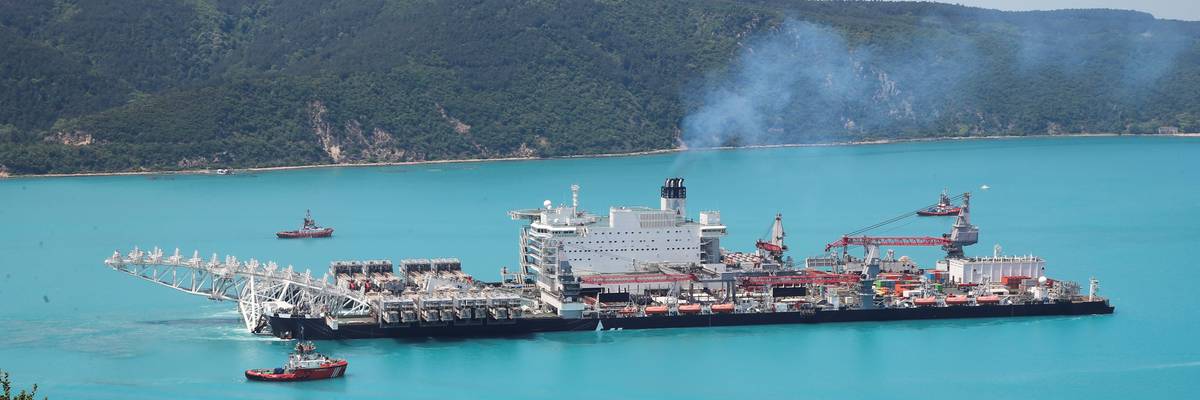
Pioneering Spirit, a pipelayer and construction vessel, passes through Bosphorus on its way to Anapa Port of Russia where it will work on the TurkStream offshore gas pipeline installation, in Istanbul, Turkey on Nay 31, 2017.
It is essential to stop all of Russia's fossil fuel exports, not only to help the climate but to dry up Putin's war chest and help achieve peace in Ukraine.
A few years ago, there were multiple reports about the coming fossil fuel climate catastrophe-inducing "carbon bombs" that Russia was developing. Yet since Russia invaded Ukraine on February 24, 2022, it has become clear that these same Russian fossil fuel export projects are also the largest funding source for the real bombs and rockets that Russia rains upon Ukraine daily. It is essential to stop all of Russia's fossil fuel exports, not only to help the climate but to dry up Putin's war chest and help achieve peace in Ukraine. Thus, this article places it's focus on one of Russia's biggest export projects, the Russian gas hub in Turkey.
At the outset of 2024, reports surfaced of a forthcoming Russian gas hub in Turkey, signalling significant implications for both nations and the broader European landscape. This development, while crucial for Russia's geopolitical and economic strategies, raises alarming concerns for Ukraine and Europe, particularly amid ongoing Russian aggression, which would not be possible without profits made from liquefied natural gas (LNG) to sustain Putin's thirst for blood.
Russia's gas hub in Turkey must be stopped, and instead the world should be focusing on the necessary clean energy transition that will drive our future energy needs.
Turkey's strategic pursuit of establishing a gas hub aligns with its ambitions to become a pivotal energy player in bridging East and West. However, recent collaborations between Moscow and Ankara have sparked apprehensions, especially regarding potential implications for European energy security and Ukraine's ongoing conflict.
Recent offers from Moscow to assist Ankara in achieving this objective have sparked concerns in Ukraine and beyond. There have been suggestions that Russia might leverage Turkey to regain its lost market share in Europe, especially in light of Europe's intention to cease Russian gas imports by 2027.
Russian President Vladimir Putin unveiled the gas hub concept in 2022, aiming to circumvent traditional gas supply routes to Europe, particularly in light of disruptions to projects like Nord Stream. The envisaged hub would leverage Turkey as a conduit for Russian gas, potentially reshaping energy dynamics across Southeast Europe.
The hub is set to develop an extensive infrastructure for gas reception, storage, and subsequent redistribution. A Turkish-Russian gas hub would geographically span critical transport routes, linking Russia and Europe via Turkey.
While specific details on the hub's capacity and transactions remain undisclosed, it's important to note the project's dependency on substantial investments, implementation time, and susceptibility to external factors like international sanctions and gas market dynamics.
"We have agreed with our partners to develop an appropriate roadmap, to be adopted soon, within which we will strive to initiate this project," stated Russian Deputy Prime Minister Alexander Novak. "Our Turkish counterparts will shortly visit St. Petersburg to familiarise themselves with our experience, which I believe will aid in establishing an electronic trading platform and a hub in Turkey," he added, suggesting that the Turkish electronic trading platform aims to formulate a gas price quote for Southeast Europe.
Despite the somewhat unclear nature of the Turkish-Russian gas hub, concerns arise due to Russia and Turkey's interventionist tendencies, potentially resulting in a lack of free trade, transparency, and competition. A recent leak of the Turkey-Bulgaria contract sheds light on the nature of the arrangements, giving rise to suspicions and complexities surrounding the project. Under this specific agreement, Bulgargaz in Bulgaria can secure LNG supplies that are deliverable to Turkey. Conversely, Turkey's BOTAS can redirect these supplies to any European destination, reciprocating with equivalent pipeline gas supplies to Bulgaria.
Furthermore, BOTAS has the ability to directly supply gas to Bulgarian consumers or Eastern European nations through Bulgaria's internal transport network. Notably, BOTAS has initiated export deals with neighbouring country enterprises, including one with a Moldovan firm reportedly linked to the U.S.-sanctioned billionaire Vlad Plahotniuc, who is a resident of Turkey.
This deal, under E.U. scrutiny, particularly after the European Commission's antitrust investigation initiation in October over Bulgargaz's potential monopolistic role in Turkish gas distribution, underscores the project's complexities and suspicions. While the idea teeters between ambition and reality, diplomatic efforts from Ukraine, the E.U., and the U.S. are crucial to ensure it does not facilitate the re-export of Russian gas to the E.U.
It is important to note that Europe does not need more Russian LNG. Europe is seeing unprecedented declines in the use of fossil fuels by transitioning to cleaner and more sustainable energy sources, mitigating economic losses in the trillions. Record-breaking growth of renewables not only solves energy demand but also mitigates climate challenges that drain the economy by trillions of euros.
With ample gas stockpiles and the proven capability of the U.S. to provide gas to Europe, it is time to resist the encroachment of Russian gas that not only threatens energy security but also fuels Putin's war chest in Ukraine and allows him to continue killing innocent Ukrainians.
As we stand at the crossroads of energy ambitions and geopolitical realities, Ukraine, the E.U., and the U.S. must shape the narrative and actively safeguard their interests.
Now is the time for concrete action, for Ukraine, the E.U., and the U.S. to collaborate in protecting regional stability, energy independence, and thwarting the funding streams that sustain Putin's war chest. We must leverage our collective strength to foster a future without compromising energy security and geopolitical stability. Russia's gas hub in Turkey must be stopped, and instead the world should be focusing on the necessary clean energy transition that will drive our future energy needs.
Dear Common Dreams reader, It’s been nearly 30 years since I co-founded Common Dreams with my late wife, Lina Newhouser. We had the radical notion that journalism should serve the public good, not corporate profits. It was clear to us from the outset what it would take to build such a project. No paid advertisements. No corporate sponsors. No millionaire publisher telling us what to think or do. Many people said we wouldn't last a year, but we proved those doubters wrong. Together with a tremendous team of journalists and dedicated staff, we built an independent media outlet free from the constraints of profits and corporate control. Our mission has always been simple: To inform. To inspire. To ignite change for the common good. Building Common Dreams was not easy. Our survival was never guaranteed. When you take on the most powerful forces—Wall Street greed, fossil fuel industry destruction, Big Tech lobbyists, and uber-rich oligarchs who have spent billions upon billions rigging the economy and democracy in their favor—the only bulwark you have is supporters who believe in your work. But here’s the urgent message from me today. It's never been this bad out there. And it's never been this hard to keep us going. At the very moment Common Dreams is most needed, the threats we face are intensifying. We need your support now more than ever. We don't accept corporate advertising and never will. We don't have a paywall because we don't think people should be blocked from critical news based on their ability to pay. Everything we do is funded by the donations of readers like you. When everyone does the little they can afford, we are strong. But if that support retreats or dries up, so do we. Will you donate now to make sure Common Dreams not only survives but thrives? —Craig Brown, Co-founder |
A few years ago, there were multiple reports about the coming fossil fuel climate catastrophe-inducing "carbon bombs" that Russia was developing. Yet since Russia invaded Ukraine on February 24, 2022, it has become clear that these same Russian fossil fuel export projects are also the largest funding source for the real bombs and rockets that Russia rains upon Ukraine daily. It is essential to stop all of Russia's fossil fuel exports, not only to help the climate but to dry up Putin's war chest and help achieve peace in Ukraine. Thus, this article places it's focus on one of Russia's biggest export projects, the Russian gas hub in Turkey.
At the outset of 2024, reports surfaced of a forthcoming Russian gas hub in Turkey, signalling significant implications for both nations and the broader European landscape. This development, while crucial for Russia's geopolitical and economic strategies, raises alarming concerns for Ukraine and Europe, particularly amid ongoing Russian aggression, which would not be possible without profits made from liquefied natural gas (LNG) to sustain Putin's thirst for blood.
Russia's gas hub in Turkey must be stopped, and instead the world should be focusing on the necessary clean energy transition that will drive our future energy needs.
Turkey's strategic pursuit of establishing a gas hub aligns with its ambitions to become a pivotal energy player in bridging East and West. However, recent collaborations between Moscow and Ankara have sparked apprehensions, especially regarding potential implications for European energy security and Ukraine's ongoing conflict.
Recent offers from Moscow to assist Ankara in achieving this objective have sparked concerns in Ukraine and beyond. There have been suggestions that Russia might leverage Turkey to regain its lost market share in Europe, especially in light of Europe's intention to cease Russian gas imports by 2027.
Russian President Vladimir Putin unveiled the gas hub concept in 2022, aiming to circumvent traditional gas supply routes to Europe, particularly in light of disruptions to projects like Nord Stream. The envisaged hub would leverage Turkey as a conduit for Russian gas, potentially reshaping energy dynamics across Southeast Europe.
The hub is set to develop an extensive infrastructure for gas reception, storage, and subsequent redistribution. A Turkish-Russian gas hub would geographically span critical transport routes, linking Russia and Europe via Turkey.
While specific details on the hub's capacity and transactions remain undisclosed, it's important to note the project's dependency on substantial investments, implementation time, and susceptibility to external factors like international sanctions and gas market dynamics.
"We have agreed with our partners to develop an appropriate roadmap, to be adopted soon, within which we will strive to initiate this project," stated Russian Deputy Prime Minister Alexander Novak. "Our Turkish counterparts will shortly visit St. Petersburg to familiarise themselves with our experience, which I believe will aid in establishing an electronic trading platform and a hub in Turkey," he added, suggesting that the Turkish electronic trading platform aims to formulate a gas price quote for Southeast Europe.
Despite the somewhat unclear nature of the Turkish-Russian gas hub, concerns arise due to Russia and Turkey's interventionist tendencies, potentially resulting in a lack of free trade, transparency, and competition. A recent leak of the Turkey-Bulgaria contract sheds light on the nature of the arrangements, giving rise to suspicions and complexities surrounding the project. Under this specific agreement, Bulgargaz in Bulgaria can secure LNG supplies that are deliverable to Turkey. Conversely, Turkey's BOTAS can redirect these supplies to any European destination, reciprocating with equivalent pipeline gas supplies to Bulgaria.
Furthermore, BOTAS has the ability to directly supply gas to Bulgarian consumers or Eastern European nations through Bulgaria's internal transport network. Notably, BOTAS has initiated export deals with neighbouring country enterprises, including one with a Moldovan firm reportedly linked to the U.S.-sanctioned billionaire Vlad Plahotniuc, who is a resident of Turkey.
This deal, under E.U. scrutiny, particularly after the European Commission's antitrust investigation initiation in October over Bulgargaz's potential monopolistic role in Turkish gas distribution, underscores the project's complexities and suspicions. While the idea teeters between ambition and reality, diplomatic efforts from Ukraine, the E.U., and the U.S. are crucial to ensure it does not facilitate the re-export of Russian gas to the E.U.
It is important to note that Europe does not need more Russian LNG. Europe is seeing unprecedented declines in the use of fossil fuels by transitioning to cleaner and more sustainable energy sources, mitigating economic losses in the trillions. Record-breaking growth of renewables not only solves energy demand but also mitigates climate challenges that drain the economy by trillions of euros.
With ample gas stockpiles and the proven capability of the U.S. to provide gas to Europe, it is time to resist the encroachment of Russian gas that not only threatens energy security but also fuels Putin's war chest in Ukraine and allows him to continue killing innocent Ukrainians.
As we stand at the crossroads of energy ambitions and geopolitical realities, Ukraine, the E.U., and the U.S. must shape the narrative and actively safeguard their interests.
Now is the time for concrete action, for Ukraine, the E.U., and the U.S. to collaborate in protecting regional stability, energy independence, and thwarting the funding streams that sustain Putin's war chest. We must leverage our collective strength to foster a future without compromising energy security and geopolitical stability. Russia's gas hub in Turkey must be stopped, and instead the world should be focusing on the necessary clean energy transition that will drive our future energy needs.
A few years ago, there were multiple reports about the coming fossil fuel climate catastrophe-inducing "carbon bombs" that Russia was developing. Yet since Russia invaded Ukraine on February 24, 2022, it has become clear that these same Russian fossil fuel export projects are also the largest funding source for the real bombs and rockets that Russia rains upon Ukraine daily. It is essential to stop all of Russia's fossil fuel exports, not only to help the climate but to dry up Putin's war chest and help achieve peace in Ukraine. Thus, this article places it's focus on one of Russia's biggest export projects, the Russian gas hub in Turkey.
At the outset of 2024, reports surfaced of a forthcoming Russian gas hub in Turkey, signalling significant implications for both nations and the broader European landscape. This development, while crucial for Russia's geopolitical and economic strategies, raises alarming concerns for Ukraine and Europe, particularly amid ongoing Russian aggression, which would not be possible without profits made from liquefied natural gas (LNG) to sustain Putin's thirst for blood.
Russia's gas hub in Turkey must be stopped, and instead the world should be focusing on the necessary clean energy transition that will drive our future energy needs.
Turkey's strategic pursuit of establishing a gas hub aligns with its ambitions to become a pivotal energy player in bridging East and West. However, recent collaborations between Moscow and Ankara have sparked apprehensions, especially regarding potential implications for European energy security and Ukraine's ongoing conflict.
Recent offers from Moscow to assist Ankara in achieving this objective have sparked concerns in Ukraine and beyond. There have been suggestions that Russia might leverage Turkey to regain its lost market share in Europe, especially in light of Europe's intention to cease Russian gas imports by 2027.
Russian President Vladimir Putin unveiled the gas hub concept in 2022, aiming to circumvent traditional gas supply routes to Europe, particularly in light of disruptions to projects like Nord Stream. The envisaged hub would leverage Turkey as a conduit for Russian gas, potentially reshaping energy dynamics across Southeast Europe.
The hub is set to develop an extensive infrastructure for gas reception, storage, and subsequent redistribution. A Turkish-Russian gas hub would geographically span critical transport routes, linking Russia and Europe via Turkey.
While specific details on the hub's capacity and transactions remain undisclosed, it's important to note the project's dependency on substantial investments, implementation time, and susceptibility to external factors like international sanctions and gas market dynamics.
"We have agreed with our partners to develop an appropriate roadmap, to be adopted soon, within which we will strive to initiate this project," stated Russian Deputy Prime Minister Alexander Novak. "Our Turkish counterparts will shortly visit St. Petersburg to familiarise themselves with our experience, which I believe will aid in establishing an electronic trading platform and a hub in Turkey," he added, suggesting that the Turkish electronic trading platform aims to formulate a gas price quote for Southeast Europe.
Despite the somewhat unclear nature of the Turkish-Russian gas hub, concerns arise due to Russia and Turkey's interventionist tendencies, potentially resulting in a lack of free trade, transparency, and competition. A recent leak of the Turkey-Bulgaria contract sheds light on the nature of the arrangements, giving rise to suspicions and complexities surrounding the project. Under this specific agreement, Bulgargaz in Bulgaria can secure LNG supplies that are deliverable to Turkey. Conversely, Turkey's BOTAS can redirect these supplies to any European destination, reciprocating with equivalent pipeline gas supplies to Bulgaria.
Furthermore, BOTAS has the ability to directly supply gas to Bulgarian consumers or Eastern European nations through Bulgaria's internal transport network. Notably, BOTAS has initiated export deals with neighbouring country enterprises, including one with a Moldovan firm reportedly linked to the U.S.-sanctioned billionaire Vlad Plahotniuc, who is a resident of Turkey.
This deal, under E.U. scrutiny, particularly after the European Commission's antitrust investigation initiation in October over Bulgargaz's potential monopolistic role in Turkish gas distribution, underscores the project's complexities and suspicions. While the idea teeters between ambition and reality, diplomatic efforts from Ukraine, the E.U., and the U.S. are crucial to ensure it does not facilitate the re-export of Russian gas to the E.U.
It is important to note that Europe does not need more Russian LNG. Europe is seeing unprecedented declines in the use of fossil fuels by transitioning to cleaner and more sustainable energy sources, mitigating economic losses in the trillions. Record-breaking growth of renewables not only solves energy demand but also mitigates climate challenges that drain the economy by trillions of euros.
With ample gas stockpiles and the proven capability of the U.S. to provide gas to Europe, it is time to resist the encroachment of Russian gas that not only threatens energy security but also fuels Putin's war chest in Ukraine and allows him to continue killing innocent Ukrainians.
As we stand at the crossroads of energy ambitions and geopolitical realities, Ukraine, the E.U., and the U.S. must shape the narrative and actively safeguard their interests.
Now is the time for concrete action, for Ukraine, the E.U., and the U.S. to collaborate in protecting regional stability, energy independence, and thwarting the funding streams that sustain Putin's war chest. We must leverage our collective strength to foster a future without compromising energy security and geopolitical stability. Russia's gas hub in Turkey must be stopped, and instead the world should be focusing on the necessary clean energy transition that will drive our future energy needs.