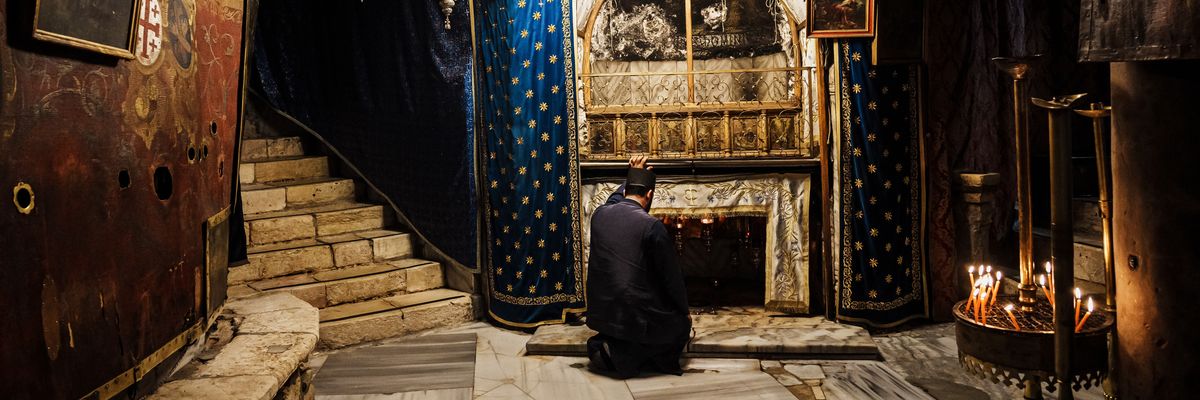
Fr. Issa Thaljieh poses for a portrait inside the Grotto of the Nativity, an underground crypt, where Jesus is said to have been born, underground inside the Church of the Nativity in Bethlehem, Occupied West Bank , Saturday, December 16, 2023.
With Christmas Cancelled in Bethlehem, What Can I Give My Daughter?
I give you my promise, that I will do my best to help create a future that does not repeat the violent history of the past.
I’m sorry that I didn’t buy a single present for you this year. It’s not in my heart. Maybe I will pick up some candy canes on my way home from CVS. I know you like candy canes.
In Bethlehem, the place Jesus was born, they cancelled Christmas this year.
The only joy in my heart is bittersweet. But I treasure every second of it, the blessing of your delightful, warm skin still attached to your strong, delicate bones, the privilege of listening to your breath while you are sleeping, feeling your heart beat against my fingertips as I lift you into bed. The reminder that these are privileges that our cousins’ cousins in Gaza do not have.
For our Palestinian and Lebanese family, the warplanes are rarely silent.
My father, your grandfather, when he was the same age as you, was forced to leave his home in Jerusalem during the first Nakba. My grandmother packed the house neatly. They told the children they were going on vacation in Egypt. They had the means to escape, a privilege that their cousins did not have. During the first Nakba, which means catastrophe in Arabic, Zionist militias expelled over 750,000 Palestinians from their homes and villages, in the process of creating the state of Israel in 1948. Then, as now, the world powers endorsed this violent expulsion of our people.
In 1917 British Foreign Secretary Arthur James Balfour endorsed the creation of a “Jewish national home in Palestine,” in a letter which is now known as the Balfour Declaration. And many of those with the least luck of all were shuttled into Gaza, which has become an “open-air prison,” according to Human Rights Watch. “The only conflict in the world in which people are not even allowed to flee,” as then-U.N. High Commissioner for Human Rights António Guterres has said.
Israeli leaders have been clear for weeks: The Gaza Nakba is underway. Israeli real estate agents have already posted images online advertising “pre-sale” deals for beachfront villas in Gaza. Now even the U.N. special rapporteur on the human rights of internally displaced persons warns that Israel is actively working to expel the civilian population of Gaza.
So what gift can I give you this year? I find a grain of truth amid the knowledge that the timing of this holiday has more to do with ancient solstice celebrations than the exact birthday of any religious leader. Those holidays held a hope in the deep of winter for a prosperous planting season to come.
And so this year, I give you my promise, that I will do my best to help create a future that does not repeat the violent history of the past. A future where no father or mother wails over their child’s cold body, where no child’s eyes stare blankly at the world, wounded with no surviving family.
As Palestinian poet Marwan Makhoul has written, “In order for me to write poetry that isn’t political, I must listen to the birds and in order to hear the birds the warplanes must be silent.”
For our Palestinian and Lebanese family, the warplanes are rarely silent. I hope someday we can help our neighbors in the heart of this world power to see that bombs overseas “explode at home,” as Martin Luther King, Jr. has said. So that someday we can all sing together with our whole hearts, about joy in the world, golden suns, spiders, and little stars. And I will try to remember to bring home some candy canes, because I know you like them so much.
We are at a crossroads
This country and this world are at a monumental crossroads. In a few short weeks, US voters will have an opportunity to beat back the forces of fascism and confront the billionaires who are rigging the economy, our media system, and our democracy, making it increasingly impossible for ordinary people to get by. We’re not just talking about the election. We’re talking about what must be done once these fascist elements are vanquished from power. We need a bolder set of solutions than what either major party has so far been willing to offer and a working-class movement ready to fight like hell for it. Trump didn't emerge from nowhere. The conditions that fueled MAGA authoritarianism were created by decades of radical neoliberal economic policies and a corrupt political system dominated by corporate interests. They slashed taxes on the super-rich, promising that the benefits would trickle down. They said giveaways to the corporate titans would make life more affordable for the rest of us. It was all bullshit. And when a bitter, betrayed populace searches for someone to blame, right-wing demagogues have little trouble finding scapegoats. People know when they're being lied to, but you won't hear any of this from the corporate media. Only independent journalism—powered and funded by people who believe in building a better world—can deliver truly trustworthy daily news. Our Fall Campaign is underway, and we need your help. To power our newsroom through the rest of the year, we need to raise $125,000 by midnight on October 31. So if you share our vision, please contribute whatever you can to sustain our work. |
I’m sorry that I didn’t buy a single present for you this year. It’s not in my heart. Maybe I will pick up some candy canes on my way home from CVS. I know you like candy canes.
In Bethlehem, the place Jesus was born, they cancelled Christmas this year.
The only joy in my heart is bittersweet. But I treasure every second of it, the blessing of your delightful, warm skin still attached to your strong, delicate bones, the privilege of listening to your breath while you are sleeping, feeling your heart beat against my fingertips as I lift you into bed. The reminder that these are privileges that our cousins’ cousins in Gaza do not have.
For our Palestinian and Lebanese family, the warplanes are rarely silent.
My father, your grandfather, when he was the same age as you, was forced to leave his home in Jerusalem during the first Nakba. My grandmother packed the house neatly. They told the children they were going on vacation in Egypt. They had the means to escape, a privilege that their cousins did not have. During the first Nakba, which means catastrophe in Arabic, Zionist militias expelled over 750,000 Palestinians from their homes and villages, in the process of creating the state of Israel in 1948. Then, as now, the world powers endorsed this violent expulsion of our people.
In 1917 British Foreign Secretary Arthur James Balfour endorsed the creation of a “Jewish national home in Palestine,” in a letter which is now known as the Balfour Declaration. And many of those with the least luck of all were shuttled into Gaza, which has become an “open-air prison,” according to Human Rights Watch. “The only conflict in the world in which people are not even allowed to flee,” as then-U.N. High Commissioner for Human Rights António Guterres has said.
Israeli leaders have been clear for weeks: The Gaza Nakba is underway. Israeli real estate agents have already posted images online advertising “pre-sale” deals for beachfront villas in Gaza. Now even the U.N. special rapporteur on the human rights of internally displaced persons warns that Israel is actively working to expel the civilian population of Gaza.
So what gift can I give you this year? I find a grain of truth amid the knowledge that the timing of this holiday has more to do with ancient solstice celebrations than the exact birthday of any religious leader. Those holidays held a hope in the deep of winter for a prosperous planting season to come.
And so this year, I give you my promise, that I will do my best to help create a future that does not repeat the violent history of the past. A future where no father or mother wails over their child’s cold body, where no child’s eyes stare blankly at the world, wounded with no surviving family.
As Palestinian poet Marwan Makhoul has written, “In order for me to write poetry that isn’t political, I must listen to the birds and in order to hear the birds the warplanes must be silent.”
For our Palestinian and Lebanese family, the warplanes are rarely silent. I hope someday we can help our neighbors in the heart of this world power to see that bombs overseas “explode at home,” as Martin Luther King, Jr. has said. So that someday we can all sing together with our whole hearts, about joy in the world, golden suns, spiders, and little stars. And I will try to remember to bring home some candy canes, because I know you like them so much.
- Israelis Made to Suffer the Cruel Price for Oppression of Palestinians in Gaza ›
- Israel Is Wiping Out Entire Palestinian Families on Purpose ›
- Jesus of Palestine. Jesus of the Gaza Strip ›
I’m sorry that I didn’t buy a single present for you this year. It’s not in my heart. Maybe I will pick up some candy canes on my way home from CVS. I know you like candy canes.
In Bethlehem, the place Jesus was born, they cancelled Christmas this year.
The only joy in my heart is bittersweet. But I treasure every second of it, the blessing of your delightful, warm skin still attached to your strong, delicate bones, the privilege of listening to your breath while you are sleeping, feeling your heart beat against my fingertips as I lift you into bed. The reminder that these are privileges that our cousins’ cousins in Gaza do not have.
For our Palestinian and Lebanese family, the warplanes are rarely silent.
My father, your grandfather, when he was the same age as you, was forced to leave his home in Jerusalem during the first Nakba. My grandmother packed the house neatly. They told the children they were going on vacation in Egypt. They had the means to escape, a privilege that their cousins did not have. During the first Nakba, which means catastrophe in Arabic, Zionist militias expelled over 750,000 Palestinians from their homes and villages, in the process of creating the state of Israel in 1948. Then, as now, the world powers endorsed this violent expulsion of our people.
In 1917 British Foreign Secretary Arthur James Balfour endorsed the creation of a “Jewish national home in Palestine,” in a letter which is now known as the Balfour Declaration. And many of those with the least luck of all were shuttled into Gaza, which has become an “open-air prison,” according to Human Rights Watch. “The only conflict in the world in which people are not even allowed to flee,” as then-U.N. High Commissioner for Human Rights António Guterres has said.
Israeli leaders have been clear for weeks: The Gaza Nakba is underway. Israeli real estate agents have already posted images online advertising “pre-sale” deals for beachfront villas in Gaza. Now even the U.N. special rapporteur on the human rights of internally displaced persons warns that Israel is actively working to expel the civilian population of Gaza.
So what gift can I give you this year? I find a grain of truth amid the knowledge that the timing of this holiday has more to do with ancient solstice celebrations than the exact birthday of any religious leader. Those holidays held a hope in the deep of winter for a prosperous planting season to come.
And so this year, I give you my promise, that I will do my best to help create a future that does not repeat the violent history of the past. A future where no father or mother wails over their child’s cold body, where no child’s eyes stare blankly at the world, wounded with no surviving family.
As Palestinian poet Marwan Makhoul has written, “In order for me to write poetry that isn’t political, I must listen to the birds and in order to hear the birds the warplanes must be silent.”
For our Palestinian and Lebanese family, the warplanes are rarely silent. I hope someday we can help our neighbors in the heart of this world power to see that bombs overseas “explode at home,” as Martin Luther King, Jr. has said. So that someday we can all sing together with our whole hearts, about joy in the world, golden suns, spiders, and little stars. And I will try to remember to bring home some candy canes, because I know you like them so much.
- Israelis Made to Suffer the Cruel Price for Oppression of Palestinians in Gaza ›
- Israel Is Wiping Out Entire Palestinian Families on Purpose ›
- Jesus of Palestine. Jesus of the Gaza Strip ›