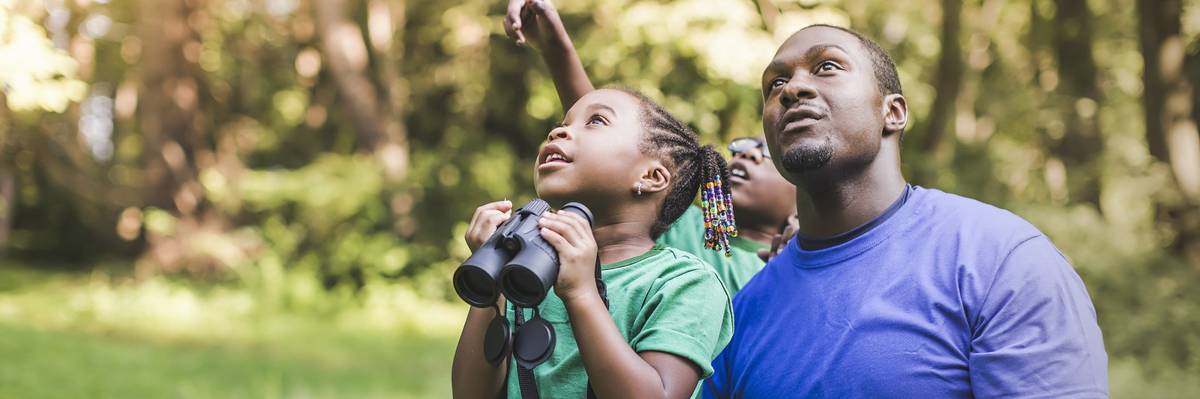
A young father with son and daughter bird-watching in an eco-forest camp
Healthcare and Green Groups Should Work Together on Equal Childhood Access to Nature
This can be done at the individual patient level through providers, at the society level through education and impactful recommendations, and at the federal level through legislation and collaboration.
In Detroit, the Detroit Outdoors collaborative has been introducing many local high schoolers to overnight camping for the first time. By providing gear, training, and guidance, the goal is to inspire the students and equip them with the knowledge to spend more time outdoors.
For historically underserved communities—including majority Black, Indigenous, People of Color (BIPOC), or lower-income communities—programs like Detroit Outdoors can be key for preventing a number of chronic physical and mental conditions and improving overall well-being. An estimated 59% of an individual’s health determinants can be positively influenced by nature-based health interventions, according to the Network for Excellence in Health Innovation. The solution is simpler than camping. A recent survey of Children’s Health data showed a statistically significant association between mental flourishing and the availability of neighborhood amenities for Black adolescents, including sidewalks, recreational centers, parks, and libraries.
Yet the children who would potentially benefit the most from access to green spaces and safe outdoor recreational facilities have inequitable access to either quality nature or healthcare. It’s an unfortunate fact that lower-income and BIPOC neighborhoods have fewer quality parks and public green spaces. A report from the Center for American Progress and Hispanic Access Fund found that 76% of people in lower-income communities of color live in nature-deprived places. Not only do these communities face higher levels of childhood asthma, obesity, developmental delays, and toxic stress, but these inequities are compounded by climate change, as regions of the country without adequate tree cover and water drainage disproportionately suffer from the effects of heat islands, flooding, vector borne illnesses, and mental distress.
Many medical associations directly related to improving the physical and mental health of patients do not have a policy statement or official recommendation related to outdoor time and barriers to equitable access.
It is time for healthcare providers and conservation groups to work together to be part of the solution. Happy, healthy children are a shared goal of both groups, and a growing collection of research is showing that access to nature can make a huge difference, particularly in underserved communities. Many medical associations directly related to improving the physical and mental health of patients do not have a policy statement or official recommendation related to outdoor time and barriers to equitable access. In the same vein, many conservation organizations have not fully embraced the role healthcare advocates can play in their overall strategy.
There are already a number of efforts underway to improve equity in outdoor access, but we can greatly expand upon this by including healthcare advocates. The current administration’s Nature in Communities Act recently invoked a 10-agency collaboration to work on nature access but, crucially, the Department of Health and Human Services—the federal driver of health care, particularly in underserved communities—is not listed as one of those agencies.
We are calling on healthcare providers, medical associations, conservation organizations, and Congress to work together on advocating for outdoor time to improve human health for all and to increase environmental stewardship. This can be done at the individual patient level through providers, at the society level through education and impactful recommendations, and at the federal level through legislation and collaboration.
The Outdoors for All Act is one way we can push for this. The bill, if passed, would formally establish the Outdoor Recreation Legacy Partnership program, a National Park Service grant program aimed at helping economically disadvantaged communities with little to no access to public outdoor recreation spaces. It has funded dozens of projects, including the Belle Isle Park Athletic Complex in Detroit, Michigan; Three Mile Creek Greenway Project in Mobile, Alabama; and Bay Point Wetland Restoration and Public Access Project in California. Support for this legislation would ensure that dozens more communities can receive backing for projects that will provide local children with more opportunities to spend time safely outdoors
We are at a crossroads
This country and this world are at a monumental crossroads. In a few short weeks, US voters will have an opportunity to beat back the forces of fascism and confront the billionaires who are rigging the economy, our media system, and our democracy, making it increasingly impossible for ordinary people to get by. We’re not just talking about the election. We’re talking about what must be done once these fascist elements are vanquished from power. We need a bolder set of solutions than what either major party has so far been willing to offer and a working-class movement ready to fight like hell for it. Trump didn't emerge from nowhere. The conditions that fueled MAGA authoritarianism were created by decades of radical neoliberal economic policies and a corrupt political system dominated by corporate interests. They slashed taxes on the super-rich, promising that the benefits would trickle down. They said giveaways to the corporate titans would make life more affordable for the rest of us. It was all bullshit. And when a bitter, betrayed populace searches for someone to blame, right-wing demagogues have little trouble finding scapegoats. People know when they're being lied to, but you won't hear any of this from the corporate media. Only independent journalism—powered and funded by people who believe in building a better world—can deliver truly trustworthy daily news. Our Fall Campaign is underway, and we need your help. To power our newsroom through the rest of the year, we need to raise $125,000 by midnight on October 31. So if you share our vision, please contribute whatever you can to sustain our work. |
In Detroit, the Detroit Outdoors collaborative has been introducing many local high schoolers to overnight camping for the first time. By providing gear, training, and guidance, the goal is to inspire the students and equip them with the knowledge to spend more time outdoors.
For historically underserved communities—including majority Black, Indigenous, People of Color (BIPOC), or lower-income communities—programs like Detroit Outdoors can be key for preventing a number of chronic physical and mental conditions and improving overall well-being. An estimated 59% of an individual’s health determinants can be positively influenced by nature-based health interventions, according to the Network for Excellence in Health Innovation. The solution is simpler than camping. A recent survey of Children’s Health data showed a statistically significant association between mental flourishing and the availability of neighborhood amenities for Black adolescents, including sidewalks, recreational centers, parks, and libraries.
Yet the children who would potentially benefit the most from access to green spaces and safe outdoor recreational facilities have inequitable access to either quality nature or healthcare. It’s an unfortunate fact that lower-income and BIPOC neighborhoods have fewer quality parks and public green spaces. A report from the Center for American Progress and Hispanic Access Fund found that 76% of people in lower-income communities of color live in nature-deprived places. Not only do these communities face higher levels of childhood asthma, obesity, developmental delays, and toxic stress, but these inequities are compounded by climate change, as regions of the country without adequate tree cover and water drainage disproportionately suffer from the effects of heat islands, flooding, vector borne illnesses, and mental distress.
Many medical associations directly related to improving the physical and mental health of patients do not have a policy statement or official recommendation related to outdoor time and barriers to equitable access.
It is time for healthcare providers and conservation groups to work together to be part of the solution. Happy, healthy children are a shared goal of both groups, and a growing collection of research is showing that access to nature can make a huge difference, particularly in underserved communities. Many medical associations directly related to improving the physical and mental health of patients do not have a policy statement or official recommendation related to outdoor time and barriers to equitable access. In the same vein, many conservation organizations have not fully embraced the role healthcare advocates can play in their overall strategy.
There are already a number of efforts underway to improve equity in outdoor access, but we can greatly expand upon this by including healthcare advocates. The current administration’s Nature in Communities Act recently invoked a 10-agency collaboration to work on nature access but, crucially, the Department of Health and Human Services—the federal driver of health care, particularly in underserved communities—is not listed as one of those agencies.
We are calling on healthcare providers, medical associations, conservation organizations, and Congress to work together on advocating for outdoor time to improve human health for all and to increase environmental stewardship. This can be done at the individual patient level through providers, at the society level through education and impactful recommendations, and at the federal level through legislation and collaboration.
The Outdoors for All Act is one way we can push for this. The bill, if passed, would formally establish the Outdoor Recreation Legacy Partnership program, a National Park Service grant program aimed at helping economically disadvantaged communities with little to no access to public outdoor recreation spaces. It has funded dozens of projects, including the Belle Isle Park Athletic Complex in Detroit, Michigan; Three Mile Creek Greenway Project in Mobile, Alabama; and Bay Point Wetland Restoration and Public Access Project in California. Support for this legislation would ensure that dozens more communities can receive backing for projects that will provide local children with more opportunities to spend time safely outdoors
- A Walk in the Woods: A Right or Privilege? ›
- Opinion | Tell Congress: It’s the Perfect Time for Fourth Graders to Go to a Park | Common Dreams ›
In Detroit, the Detroit Outdoors collaborative has been introducing many local high schoolers to overnight camping for the first time. By providing gear, training, and guidance, the goal is to inspire the students and equip them with the knowledge to spend more time outdoors.
For historically underserved communities—including majority Black, Indigenous, People of Color (BIPOC), or lower-income communities—programs like Detroit Outdoors can be key for preventing a number of chronic physical and mental conditions and improving overall well-being. An estimated 59% of an individual’s health determinants can be positively influenced by nature-based health interventions, according to the Network for Excellence in Health Innovation. The solution is simpler than camping. A recent survey of Children’s Health data showed a statistically significant association between mental flourishing and the availability of neighborhood amenities for Black adolescents, including sidewalks, recreational centers, parks, and libraries.
Yet the children who would potentially benefit the most from access to green spaces and safe outdoor recreational facilities have inequitable access to either quality nature or healthcare. It’s an unfortunate fact that lower-income and BIPOC neighborhoods have fewer quality parks and public green spaces. A report from the Center for American Progress and Hispanic Access Fund found that 76% of people in lower-income communities of color live in nature-deprived places. Not only do these communities face higher levels of childhood asthma, obesity, developmental delays, and toxic stress, but these inequities are compounded by climate change, as regions of the country without adequate tree cover and water drainage disproportionately suffer from the effects of heat islands, flooding, vector borne illnesses, and mental distress.
Many medical associations directly related to improving the physical and mental health of patients do not have a policy statement or official recommendation related to outdoor time and barriers to equitable access.
It is time for healthcare providers and conservation groups to work together to be part of the solution. Happy, healthy children are a shared goal of both groups, and a growing collection of research is showing that access to nature can make a huge difference, particularly in underserved communities. Many medical associations directly related to improving the physical and mental health of patients do not have a policy statement or official recommendation related to outdoor time and barriers to equitable access. In the same vein, many conservation organizations have not fully embraced the role healthcare advocates can play in their overall strategy.
There are already a number of efforts underway to improve equity in outdoor access, but we can greatly expand upon this by including healthcare advocates. The current administration’s Nature in Communities Act recently invoked a 10-agency collaboration to work on nature access but, crucially, the Department of Health and Human Services—the federal driver of health care, particularly in underserved communities—is not listed as one of those agencies.
We are calling on healthcare providers, medical associations, conservation organizations, and Congress to work together on advocating for outdoor time to improve human health for all and to increase environmental stewardship. This can be done at the individual patient level through providers, at the society level through education and impactful recommendations, and at the federal level through legislation and collaboration.
The Outdoors for All Act is one way we can push for this. The bill, if passed, would formally establish the Outdoor Recreation Legacy Partnership program, a National Park Service grant program aimed at helping economically disadvantaged communities with little to no access to public outdoor recreation spaces. It has funded dozens of projects, including the Belle Isle Park Athletic Complex in Detroit, Michigan; Three Mile Creek Greenway Project in Mobile, Alabama; and Bay Point Wetland Restoration and Public Access Project in California. Support for this legislation would ensure that dozens more communities can receive backing for projects that will provide local children with more opportunities to spend time safely outdoors
- A Walk in the Woods: A Right or Privilege? ›
- Opinion | Tell Congress: It’s the Perfect Time for Fourth Graders to Go to a Park | Common Dreams ›