

SUBSCRIBE TO OUR FREE NEWSLETTER
Daily news & progressive opinion—funded by the people, not the corporations—delivered straight to your inbox.
5
#000000
#FFFFFF
To donate by check, phone, or other method, see our More Ways to Give page.
Daily news & progressive opinion—funded by the people, not the corporations—delivered straight to your inbox.
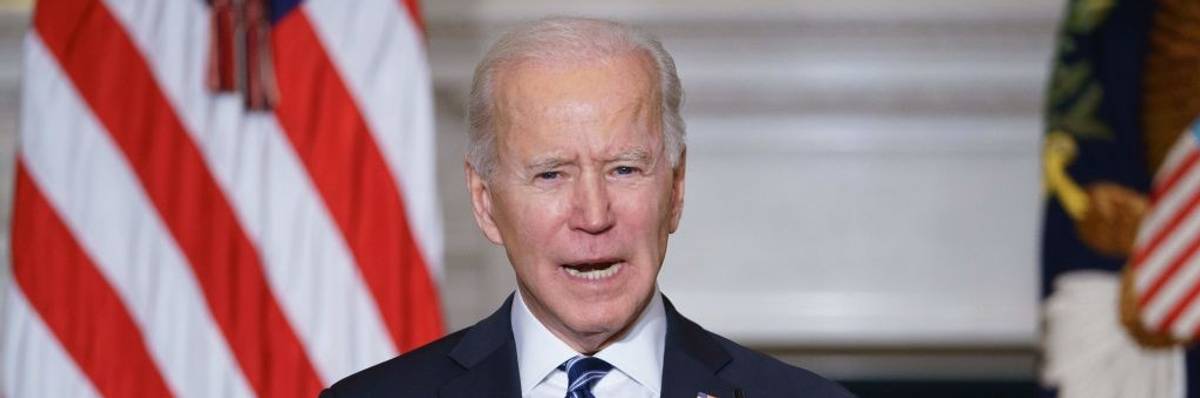
U.S. President Joe Biden speaks on climate change, creating jobs, and restoring scientific integrity before signing executive orders in the State Dining Room of the White House in Washington, DC on January 27, 2021.
The president has made it clear he believes scientific integrity is an important value. Now he must show it more forcefully.
Just a week after his inauguration nearly two years ago, President Joe Biden issued an all-agency directive to strengthen the scientific integrity policies commissioned under former President Barack Obama and that had proven to be utterly ineffectual during the "alternative facts" tenure of President Donald Trump.
Biden's directive laid out an elaborate process overseen by his White House Office of Science and Technology Policy (OSTP) that has already fallen months behind schedule.
This January 12th, OSTP unveiled its "Framework for Federal Scientific Integrity Policy and Practice" to guide some 30 separate federal agencies into toughening their scientific integrity rules. Agencies are now slated to submit "updated" draft policies to OSTP within two months and provide for "public input" within six months as part of an iterative process that is supposed to culminate in the adoption of new policies within the year.
This Framework addresses a range of issues, such as whether government scientists are free to publish their research or to answer reporters' questions. It also advocates rules fostering accuracy and objectivity in federal research and purports to ban manipulation or suppression of research for political or other reasons beyond the "technical merit" of the work.
While these goals are laudable, the Framework is plagued by several conundrums, starting with why the White House is not imposing government-wide rules but instead relying upon individual agencies to integrate gauzy guidance. After all, these agencies are typically reluctant to unilaterally confer new privileges on professional staff and are equally loath to cede control over what they consider "internal" information.
In a transmittal memo, OSTP opaquely declares:
OSTP recognizes the need for agency flexibility and autonomy in implementation of scientific integrity policies and practices while also recognizing the critical need to ensure comprehensive and consistent implementation and iterative improvement across the Federal Government.
On the other hand, the OSTP Framework adopts a uniform government-wide definition of scientific integrity and then states that federal agencies "should adopt this definition, incorporate it into their scientific integrity policy, and communicate it to their workforce."
If there is a uniform definition of scientific integrity, why shouldn't there be a uniform policy to ensure its maintenance? For example, why should a scientist from the Fish and Wildlife Service be allowed to submit a manuscript for publication without official clearance while a scientist from the National Oceanic and Atmospheric Administration must obtain permission?
Similarly, the Framework model policy prescribes that all allegations of scientific misconduct should, after an initial review, undergo "a fact-finding process, an agency adjudication or determination including description of remedies and preventative measures to safeguard the science, an appeals process, follow-up to track implementation of remedies, and reporting."
It is unclear why investigative and adjudicatory functions should vary from agency to agency. Do scientists in one agency deserve more due process than their colleagues in sister agencies?
It is also unclear how the agencies are supposed to develop new or "updated" policies through an OSTP-overseen drafting process beginning this March. The OSTP memo says:
Agencies need not send this draft through their internal agency clearance processes before sending to OSTP for the initial review.
What? Who, or on whose authority, decides to send a new draft policy to the White House without getting agency approval?
This byzantine Biden process is, in large part, a reaction to the experience under Obama, who issued a similar directive in March 2009. A year later, his OSTP also issued vague guidance for agency policy development. Not surprisingly, the policies that agencies adopted varied widely in their scope and rigor. Yet, Obama's OSTP rejected no agency policy, no matter how weak or incomplete. In 2023, it is unclear whether there will be a different result.
President Biden has made it clear he believes scientific integrity is an important value. He should also make it clear that he will override weak agency policies and order the adoption of procedures with more backbone. Better yet, he should take steps to inject some degree of independence and outside scrutiny to scientific integrity matters that are now handled behind closed doors.
Dear Common Dreams reader, It’s been nearly 30 years since I co-founded Common Dreams with my late wife, Lina Newhouser. We had the radical notion that journalism should serve the public good, not corporate profits. It was clear to us from the outset what it would take to build such a project. No paid advertisements. No corporate sponsors. No millionaire publisher telling us what to think or do. Many people said we wouldn't last a year, but we proved those doubters wrong. Together with a tremendous team of journalists and dedicated staff, we built an independent media outlet free from the constraints of profits and corporate control. Our mission has always been simple: To inform. To inspire. To ignite change for the common good. Building Common Dreams was not easy. Our survival was never guaranteed. When you take on the most powerful forces—Wall Street greed, fossil fuel industry destruction, Big Tech lobbyists, and uber-rich oligarchs who have spent billions upon billions rigging the economy and democracy in their favor—the only bulwark you have is supporters who believe in your work. But here’s the urgent message from me today. It's never been this bad out there. And it's never been this hard to keep us going. At the very moment Common Dreams is most needed, the threats we face are intensifying. We need your support now more than ever. We don't accept corporate advertising and never will. We don't have a paywall because we don't think people should be blocked from critical news based on their ability to pay. Everything we do is funded by the donations of readers like you. When everyone does the little they can afford, we are strong. But if that support retreats or dries up, so do we. Will you donate now to make sure Common Dreams not only survives but thrives? —Craig Brown, Co-founder |
Just a week after his inauguration nearly two years ago, President Joe Biden issued an all-agency directive to strengthen the scientific integrity policies commissioned under former President Barack Obama and that had proven to be utterly ineffectual during the "alternative facts" tenure of President Donald Trump.
Biden's directive laid out an elaborate process overseen by his White House Office of Science and Technology Policy (OSTP) that has already fallen months behind schedule.
This January 12th, OSTP unveiled its "Framework for Federal Scientific Integrity Policy and Practice" to guide some 30 separate federal agencies into toughening their scientific integrity rules. Agencies are now slated to submit "updated" draft policies to OSTP within two months and provide for "public input" within six months as part of an iterative process that is supposed to culminate in the adoption of new policies within the year.
This Framework addresses a range of issues, such as whether government scientists are free to publish their research or to answer reporters' questions. It also advocates rules fostering accuracy and objectivity in federal research and purports to ban manipulation or suppression of research for political or other reasons beyond the "technical merit" of the work.
While these goals are laudable, the Framework is plagued by several conundrums, starting with why the White House is not imposing government-wide rules but instead relying upon individual agencies to integrate gauzy guidance. After all, these agencies are typically reluctant to unilaterally confer new privileges on professional staff and are equally loath to cede control over what they consider "internal" information.
In a transmittal memo, OSTP opaquely declares:
OSTP recognizes the need for agency flexibility and autonomy in implementation of scientific integrity policies and practices while also recognizing the critical need to ensure comprehensive and consistent implementation and iterative improvement across the Federal Government.
On the other hand, the OSTP Framework adopts a uniform government-wide definition of scientific integrity and then states that federal agencies "should adopt this definition, incorporate it into their scientific integrity policy, and communicate it to their workforce."
If there is a uniform definition of scientific integrity, why shouldn't there be a uniform policy to ensure its maintenance? For example, why should a scientist from the Fish and Wildlife Service be allowed to submit a manuscript for publication without official clearance while a scientist from the National Oceanic and Atmospheric Administration must obtain permission?
Similarly, the Framework model policy prescribes that all allegations of scientific misconduct should, after an initial review, undergo "a fact-finding process, an agency adjudication or determination including description of remedies and preventative measures to safeguard the science, an appeals process, follow-up to track implementation of remedies, and reporting."
It is unclear why investigative and adjudicatory functions should vary from agency to agency. Do scientists in one agency deserve more due process than their colleagues in sister agencies?
It is also unclear how the agencies are supposed to develop new or "updated" policies through an OSTP-overseen drafting process beginning this March. The OSTP memo says:
Agencies need not send this draft through their internal agency clearance processes before sending to OSTP for the initial review.
What? Who, or on whose authority, decides to send a new draft policy to the White House without getting agency approval?
This byzantine Biden process is, in large part, a reaction to the experience under Obama, who issued a similar directive in March 2009. A year later, his OSTP also issued vague guidance for agency policy development. Not surprisingly, the policies that agencies adopted varied widely in their scope and rigor. Yet, Obama's OSTP rejected no agency policy, no matter how weak or incomplete. In 2023, it is unclear whether there will be a different result.
President Biden has made it clear he believes scientific integrity is an important value. He should also make it clear that he will override weak agency policies and order the adoption of procedures with more backbone. Better yet, he should take steps to inject some degree of independence and outside scrutiny to scientific integrity matters that are now handled behind closed doors.
Just a week after his inauguration nearly two years ago, President Joe Biden issued an all-agency directive to strengthen the scientific integrity policies commissioned under former President Barack Obama and that had proven to be utterly ineffectual during the "alternative facts" tenure of President Donald Trump.
Biden's directive laid out an elaborate process overseen by his White House Office of Science and Technology Policy (OSTP) that has already fallen months behind schedule.
This January 12th, OSTP unveiled its "Framework for Federal Scientific Integrity Policy and Practice" to guide some 30 separate federal agencies into toughening their scientific integrity rules. Agencies are now slated to submit "updated" draft policies to OSTP within two months and provide for "public input" within six months as part of an iterative process that is supposed to culminate in the adoption of new policies within the year.
This Framework addresses a range of issues, such as whether government scientists are free to publish their research or to answer reporters' questions. It also advocates rules fostering accuracy and objectivity in federal research and purports to ban manipulation or suppression of research for political or other reasons beyond the "technical merit" of the work.
While these goals are laudable, the Framework is plagued by several conundrums, starting with why the White House is not imposing government-wide rules but instead relying upon individual agencies to integrate gauzy guidance. After all, these agencies are typically reluctant to unilaterally confer new privileges on professional staff and are equally loath to cede control over what they consider "internal" information.
In a transmittal memo, OSTP opaquely declares:
OSTP recognizes the need for agency flexibility and autonomy in implementation of scientific integrity policies and practices while also recognizing the critical need to ensure comprehensive and consistent implementation and iterative improvement across the Federal Government.
On the other hand, the OSTP Framework adopts a uniform government-wide definition of scientific integrity and then states that federal agencies "should adopt this definition, incorporate it into their scientific integrity policy, and communicate it to their workforce."
If there is a uniform definition of scientific integrity, why shouldn't there be a uniform policy to ensure its maintenance? For example, why should a scientist from the Fish and Wildlife Service be allowed to submit a manuscript for publication without official clearance while a scientist from the National Oceanic and Atmospheric Administration must obtain permission?
Similarly, the Framework model policy prescribes that all allegations of scientific misconduct should, after an initial review, undergo "a fact-finding process, an agency adjudication or determination including description of remedies and preventative measures to safeguard the science, an appeals process, follow-up to track implementation of remedies, and reporting."
It is unclear why investigative and adjudicatory functions should vary from agency to agency. Do scientists in one agency deserve more due process than their colleagues in sister agencies?
It is also unclear how the agencies are supposed to develop new or "updated" policies through an OSTP-overseen drafting process beginning this March. The OSTP memo says:
Agencies need not send this draft through their internal agency clearance processes before sending to OSTP for the initial review.
What? Who, or on whose authority, decides to send a new draft policy to the White House without getting agency approval?
This byzantine Biden process is, in large part, a reaction to the experience under Obama, who issued a similar directive in March 2009. A year later, his OSTP also issued vague guidance for agency policy development. Not surprisingly, the policies that agencies adopted varied widely in their scope and rigor. Yet, Obama's OSTP rejected no agency policy, no matter how weak or incomplete. In 2023, it is unclear whether there will be a different result.
President Biden has made it clear he believes scientific integrity is an important value. He should also make it clear that he will override weak agency policies and order the adoption of procedures with more backbone. Better yet, he should take steps to inject some degree of independence and outside scrutiny to scientific integrity matters that are now handled behind closed doors.

