SUBSCRIBE TO OUR FREE NEWSLETTER
Daily news & progressive opinion—funded by the people, not the corporations—delivered straight to your inbox.
5
#000000
#FFFFFF
To donate by check, phone, or other method, see our More Ways to Give page.
Daily news & progressive opinion—funded by the people, not the corporations—delivered straight to your inbox.
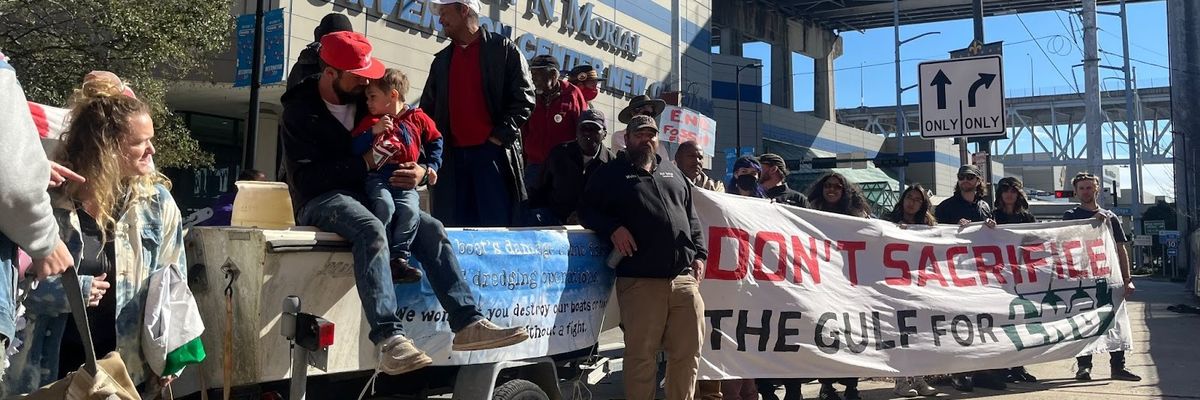
Frontline fishers and environmental activists protest the buildout of liquefied natural gas export infrastructure in Louisiana outside a meeting of Americas Energy Summit in New Orleans on January 19, 2023.
It’s up to the administration to prevent export terminals from destroying what’s left of Louisiana’s seafood industry.
In January, the White House announced a pause on liquefied natural gas terminals, called “LNGs” in industry jargon. Though it ruffled feathers in the oil and gas industry, the “pause” did little to stop their ongoing operations; it just meant that the federal government was taking a break from approving new export terminals—facilities that have yet to be built. For those of us who make a living fishing and shrimping here on the Gulf of Mexico, the pause has made little visible difference.
Our coastline and fisheries are already littered with gas export terminals. To build the plants—each larger than a football stadium—the industry digs up wetlands and pours concrete, destroying estuaries, fishing grounds, and the coast that protects us from storms. To make room for massive supertankers, the gas export industry digs up and dredges the shallows near shore, which has destroyed the habitats of Louisiana oysters and shrimp. My fellow fishermen and I are forced out of the way when supertankers cut through our fishing grounds. We have to pull up our nets, and we lose at least half a day’s work.
Every part of the operation is disruptive and destructive to our trade. Where we used to be able to pull up enough shrimp to bring to market, the dredging and shipping is so disruptive to aquatic life, it barely leaves enough shrimp behind for us to feed ourselves and our families. It’s not just the industry’s disruptions to our work though; it’s their outright attack on Louisiana’s fishing community.
My fellow fishermen and I are doing our part to hold the LNG companies accountable... But we cannot and should not have to fight this Goliath alone.
Last month, I witnessed a tanker barging through our local waters where shrimpers and fishermen usually put in. The ship whipped past us fishermen at such a speed that it caused a wake taller than the nearby boats. One of them—the one closest to the tanker—was sunk completely by wake, costing the fishermen who own it an untold sum and threatening the lives of everyone on board. To this day, none of us have heard of the tanker’s owner reaching out with an apology or an offer of compensation.
A couple of weeks after that boat was sunk, I went down to the dock to start my day, only to find my own boat sinking in shallow water. That morning and the night before, we hadn’t had any rain. My boat did not have any leaks. Yet somehow, on a clear day, my seaworthy vessel was almost completely submerged.
I’ll never know exactly how this happened to my boat, or who may have caused it to happen, but what I do know is that this industry has created an air of fear and intimidation. What I can say with certainty is that the more the industry encroaches on our fishing grounds, and the more that local fishermen like me speak out, the more accidents seem to happen.
I’ve lost thousands of dollars because of the industry’s actions—and that doesn’t include lost income from the depleted stocks of fish and shrimp, or from the lost days of work. One time, a tanker came through with skimmers in the water near shore, causing a sucking action that pulled in water from every direction. I watched helplessly as the vessel pulled the entire aluminum frame for my fishing nets, crumpling it like paper. To get it repaired, I had to take a day off work, drive nearly 200 miles round trip, and spend thousands on aluminum welding.
Another time, an LNG dredger was parked near our dock. The suction from the dredge almost caused me to capsize and lose everything. When I told the dredge operator what had just happened, he yelled at me, “Ain’t my effin’ problem.”
He didn’t say “effin.’”
That’s been the attitude of the LNG export industry since they’ve come here. They’ve taken our homes, our fisheries, and our livelihoods, and treated us like we’re just a nuisance standing in their way.
My fellow fishermen and I are doing our part to hold the LNG companies accountable. We’re tracking these assaults and keeping records of the decline in our fish, shrimp, and oyster catches. But we cannot and should not have to fight this Goliath alone.
This administration must make its pause on LNG export approvals permanent and direct the Federal Energy Regulatory Commission to stop rubber-stamping permits for new terminals. It’s up to them to prevent this industry from destroying what’s left of Louisiana’s seafood industry, a cornerstone of culinary culture in America. We need President Joe Biden to see reason and save the Gulf’s fishing families.
Dear Common Dreams reader, It’s been nearly 30 years since I co-founded Common Dreams with my late wife, Lina Newhouser. We had the radical notion that journalism should serve the public good, not corporate profits. It was clear to us from the outset what it would take to build such a project. No paid advertisements. No corporate sponsors. No millionaire publisher telling us what to think or do. Many people said we wouldn't last a year, but we proved those doubters wrong. Together with a tremendous team of journalists and dedicated staff, we built an independent media outlet free from the constraints of profits and corporate control. Our mission has always been simple: To inform. To inspire. To ignite change for the common good. Building Common Dreams was not easy. Our survival was never guaranteed. When you take on the most powerful forces—Wall Street greed, fossil fuel industry destruction, Big Tech lobbyists, and uber-rich oligarchs who have spent billions upon billions rigging the economy and democracy in their favor—the only bulwark you have is supporters who believe in your work. But here’s the urgent message from me today. It's never been this bad out there. And it's never been this hard to keep us going. At the very moment Common Dreams is most needed, the threats we face are intensifying. We need your support now more than ever. We don't accept corporate advertising and never will. We don't have a paywall because we don't think people should be blocked from critical news based on their ability to pay. Everything we do is funded by the donations of readers like you. When everyone does the little they can afford, we are strong. But if that support retreats or dries up, so do we. Will you donate now to make sure Common Dreams not only survives but thrives? —Craig Brown, Co-founder |
In January, the White House announced a pause on liquefied natural gas terminals, called “LNGs” in industry jargon. Though it ruffled feathers in the oil and gas industry, the “pause” did little to stop their ongoing operations; it just meant that the federal government was taking a break from approving new export terminals—facilities that have yet to be built. For those of us who make a living fishing and shrimping here on the Gulf of Mexico, the pause has made little visible difference.
Our coastline and fisheries are already littered with gas export terminals. To build the plants—each larger than a football stadium—the industry digs up wetlands and pours concrete, destroying estuaries, fishing grounds, and the coast that protects us from storms. To make room for massive supertankers, the gas export industry digs up and dredges the shallows near shore, which has destroyed the habitats of Louisiana oysters and shrimp. My fellow fishermen and I are forced out of the way when supertankers cut through our fishing grounds. We have to pull up our nets, and we lose at least half a day’s work.
Every part of the operation is disruptive and destructive to our trade. Where we used to be able to pull up enough shrimp to bring to market, the dredging and shipping is so disruptive to aquatic life, it barely leaves enough shrimp behind for us to feed ourselves and our families. It’s not just the industry’s disruptions to our work though; it’s their outright attack on Louisiana’s fishing community.
My fellow fishermen and I are doing our part to hold the LNG companies accountable... But we cannot and should not have to fight this Goliath alone.
Last month, I witnessed a tanker barging through our local waters where shrimpers and fishermen usually put in. The ship whipped past us fishermen at such a speed that it caused a wake taller than the nearby boats. One of them—the one closest to the tanker—was sunk completely by wake, costing the fishermen who own it an untold sum and threatening the lives of everyone on board. To this day, none of us have heard of the tanker’s owner reaching out with an apology or an offer of compensation.
A couple of weeks after that boat was sunk, I went down to the dock to start my day, only to find my own boat sinking in shallow water. That morning and the night before, we hadn’t had any rain. My boat did not have any leaks. Yet somehow, on a clear day, my seaworthy vessel was almost completely submerged.
I’ll never know exactly how this happened to my boat, or who may have caused it to happen, but what I do know is that this industry has created an air of fear and intimidation. What I can say with certainty is that the more the industry encroaches on our fishing grounds, and the more that local fishermen like me speak out, the more accidents seem to happen.
I’ve lost thousands of dollars because of the industry’s actions—and that doesn’t include lost income from the depleted stocks of fish and shrimp, or from the lost days of work. One time, a tanker came through with skimmers in the water near shore, causing a sucking action that pulled in water from every direction. I watched helplessly as the vessel pulled the entire aluminum frame for my fishing nets, crumpling it like paper. To get it repaired, I had to take a day off work, drive nearly 200 miles round trip, and spend thousands on aluminum welding.
Another time, an LNG dredger was parked near our dock. The suction from the dredge almost caused me to capsize and lose everything. When I told the dredge operator what had just happened, he yelled at me, “Ain’t my effin’ problem.”
He didn’t say “effin.’”
That’s been the attitude of the LNG export industry since they’ve come here. They’ve taken our homes, our fisheries, and our livelihoods, and treated us like we’re just a nuisance standing in their way.
My fellow fishermen and I are doing our part to hold the LNG companies accountable. We’re tracking these assaults and keeping records of the decline in our fish, shrimp, and oyster catches. But we cannot and should not have to fight this Goliath alone.
This administration must make its pause on LNG export approvals permanent and direct the Federal Energy Regulatory Commission to stop rubber-stamping permits for new terminals. It’s up to them to prevent this industry from destroying what’s left of Louisiana’s seafood industry, a cornerstone of culinary culture in America. We need President Joe Biden to see reason and save the Gulf’s fishing families.
In January, the White House announced a pause on liquefied natural gas terminals, called “LNGs” in industry jargon. Though it ruffled feathers in the oil and gas industry, the “pause” did little to stop their ongoing operations; it just meant that the federal government was taking a break from approving new export terminals—facilities that have yet to be built. For those of us who make a living fishing and shrimping here on the Gulf of Mexico, the pause has made little visible difference.
Our coastline and fisheries are already littered with gas export terminals. To build the plants—each larger than a football stadium—the industry digs up wetlands and pours concrete, destroying estuaries, fishing grounds, and the coast that protects us from storms. To make room for massive supertankers, the gas export industry digs up and dredges the shallows near shore, which has destroyed the habitats of Louisiana oysters and shrimp. My fellow fishermen and I are forced out of the way when supertankers cut through our fishing grounds. We have to pull up our nets, and we lose at least half a day’s work.
Every part of the operation is disruptive and destructive to our trade. Where we used to be able to pull up enough shrimp to bring to market, the dredging and shipping is so disruptive to aquatic life, it barely leaves enough shrimp behind for us to feed ourselves and our families. It’s not just the industry’s disruptions to our work though; it’s their outright attack on Louisiana’s fishing community.
My fellow fishermen and I are doing our part to hold the LNG companies accountable... But we cannot and should not have to fight this Goliath alone.
Last month, I witnessed a tanker barging through our local waters where shrimpers and fishermen usually put in. The ship whipped past us fishermen at such a speed that it caused a wake taller than the nearby boats. One of them—the one closest to the tanker—was sunk completely by wake, costing the fishermen who own it an untold sum and threatening the lives of everyone on board. To this day, none of us have heard of the tanker’s owner reaching out with an apology or an offer of compensation.
A couple of weeks after that boat was sunk, I went down to the dock to start my day, only to find my own boat sinking in shallow water. That morning and the night before, we hadn’t had any rain. My boat did not have any leaks. Yet somehow, on a clear day, my seaworthy vessel was almost completely submerged.
I’ll never know exactly how this happened to my boat, or who may have caused it to happen, but what I do know is that this industry has created an air of fear and intimidation. What I can say with certainty is that the more the industry encroaches on our fishing grounds, and the more that local fishermen like me speak out, the more accidents seem to happen.
I’ve lost thousands of dollars because of the industry’s actions—and that doesn’t include lost income from the depleted stocks of fish and shrimp, or from the lost days of work. One time, a tanker came through with skimmers in the water near shore, causing a sucking action that pulled in water from every direction. I watched helplessly as the vessel pulled the entire aluminum frame for my fishing nets, crumpling it like paper. To get it repaired, I had to take a day off work, drive nearly 200 miles round trip, and spend thousands on aluminum welding.
Another time, an LNG dredger was parked near our dock. The suction from the dredge almost caused me to capsize and lose everything. When I told the dredge operator what had just happened, he yelled at me, “Ain’t my effin’ problem.”
He didn’t say “effin.’”
That’s been the attitude of the LNG export industry since they’ve come here. They’ve taken our homes, our fisheries, and our livelihoods, and treated us like we’re just a nuisance standing in their way.
My fellow fishermen and I are doing our part to hold the LNG companies accountable. We’re tracking these assaults and keeping records of the decline in our fish, shrimp, and oyster catches. But we cannot and should not have to fight this Goliath alone.
This administration must make its pause on LNG export approvals permanent and direct the Federal Energy Regulatory Commission to stop rubber-stamping permits for new terminals. It’s up to them to prevent this industry from destroying what’s left of Louisiana’s seafood industry, a cornerstone of culinary culture in America. We need President Joe Biden to see reason and save the Gulf’s fishing families.