SUBSCRIBE TO OUR FREE NEWSLETTER
Daily news & progressive opinion—funded by the people, not the corporations—delivered straight to your inbox.
5
#000000
#FFFFFF
To donate by check, phone, or other method, see our More Ways to Give page.


Daily news & progressive opinion—funded by the people, not the corporations—delivered straight to your inbox.
Reprieve’s press office: 44 (0) 207 553 8140 / clemency.wells@reprieve.org.uk
A torture expert has called for an independent medical assessment of a Pakistani sentenced to death as a child and set for execution next week, who was tortured by police into 'confessing'.
In a statement given to his lawyer, Shafqat Hussain, whose execution date has been set for June 9th, described how police 'burned me with cigarettes', 'pulled out my fingernails' and 'even electrocuted me'. Based on this statement, as well as information from Shafqat's lawyer about the scars she saw on his body, torture expert Dr Frank Arnold has called for Shafqat to have an independent medical assessment, as required under international law.
In his report, released today by human rights charity Reprieve, Dr Frank Arnold says 'The Istanbul Protocol requires a medical rapporteur to make an overall evaluation of the likelihood that some or all of their clinical findings are due to torture. Mr. Hussain's descriptions and those of Ms. Haq [Shafqat's lawyer] are in accordance with torture by suspension, handcuffing, and electrocution.' The Istanbul Protocol is a set of UN guidelines governing international standards on the investigation and assessment of individuals who allege torture.
Shafqat Hussain was convicted of kidnap and murder and sentenced to death in 2004. His conviction was based on the 'confession' extracted by police following days of the torture he described to his lawyer. Evidence collected by Shafqat's legal team shows that he was under 18 at the time of his arrest. On Monday the government issued an execution warrant for Shafqat, despite the execution of juveniles being illegal under both Pakistani and international law.
In order to suggest that Shafqat was not a juvenile at the time of his conviction, and carry out his execution, the government's Federal Investigation Authority (FIA) led inquiry into his age relied almost exclusively on the trial record in making its assessment of Shafqat's age. This is despite a significant number of inconsistencies and errors in Government statements regarding the case, which have yet to be resolved - including an admission by the Interior Minister himself that the jail's doctor and jail authorities contradicted one another on Shafqat's age - and the existence of school records (currently in the possession of the Government) which showed him to have been under 18 at the time of his arrest.
The only inquiry undertaken into Shafqat's age has been by Pakistan's Federal Investigation Authority (FIA) - an organisation which the Interior Minister said earlier this month requires a "clean-up operation...to weed out corrupt elements." A Pakistani court described the FIA inquiry as 'prima facie illegal'.
On Tuesday, lawyers for Shafqat submitted a mercy petition to the President of Pakistan, asking him to commute Shafqat's sentence on the basis of doubts as to the safety of his conviction.
Maya Foa, the director of Reprieve's death penalty team said: "The Pakistani government's relentless attempt to execute Shafqat Hussain refuses to be bound by basic standards of justice or humanity. Quite aside from all the evidence showing Shafqat was just a child when he was arrested, his conviction was based solely on a 'confession' extracted following horrific police torture. International and Pakistani standards are clear that torture must be independently assessed and investigated, yet the government is continuing to turn a blind eye to this and cover-up the myriad problems surrounding Shafqat's case. They must halt his execution at once so and allow some light to be shone into the darkest corners of Pakistan's criminal justice system."
Reprieve is a UK-based human rights organization that uses the law to enforce the human rights of prisoners, from death row to Guantanamo Bay.
One expert warned of a "direct hit on consumer prices" if the Iran war persists.
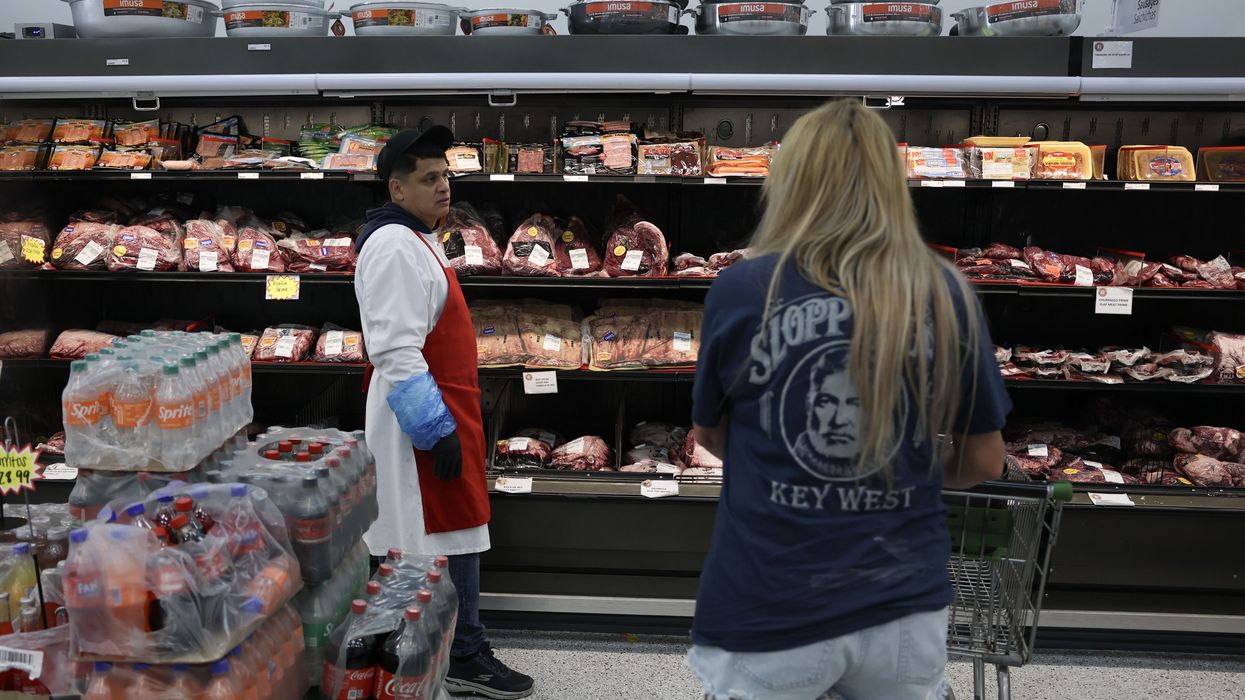
President Donald Trump's unprovoked and unconstitutional war against Iran has already been raising gas prices for US drivers, and could soon raise the cost of food both in the US and all over the world.
NBC News reported on Tuesday that the price of diesel fuel has now soared above $5 per gallon for the first time since December 2022. If the price of diesel remains high, the report explained, it will raise the price of all goods delivered by trucks throughout the US, including food.
Paul Dietrich, chief investment strategist at Wedbush Securities, told NBC News that diesel prices will become a "direct hit on consumer prices" if they remain elevated, as "groceries get more expensive, delivery costs rise, and household budgets are tightened."
"Diesel is what moves the real economy," explained Dietrich. "It hauls the food, the packages, the building supplies, and the inventory sitting on store shelves."
The cost of diesel isn't the only factor that could spike food prices, as the Iran war has also put a strain on fertilizer that farmers need to grow crops.
Al Jazeera reported on Wednesday that there is growing concern that the rising price of fertilizer caused by the closure of the Strait of Hormuz could lead to a global food crisis.
As Al Jazeera explained, almost half of the global supply of urea, the most commonly used fertilizer, is shipped from Middle Eastern nations through the Strait of Hormuz.
With the strait closed by Iran in response to US and Israeli attacks, Al Jazeera wrote, "urea export prices from the Middle East have surged by about 40%, rising from just less than $500 to a little more than $700 per metric ton as of last Friday."
Al Jazeera also cited an estimate from data and analytics firm Kpler projecting that up to one-third of the global fertilizer trade could be disrupted if the strait remains closed for a prolonged period.
Carl Skau, deputy executive director and chief operating officer of the World Food Program, warned on Tuesday that the Iran war could push millions of people into extreme hunger should it persist.
"If this conflict continues, it will send shockwaves across the globe, and families who already cannot afford their next meal will be hit the hardest," said Skau. "Without an adequately funded humanitarian response, it could spell catastrophe for millions already on the edge."
WFP said the disruption in fertilizer markets offers "the most recent proof that conflict is the number one driver of hunger."
"Conflict forces people from their homes, destroys infrastructure, fuels inflation, and wipes out jobs," said the agency. "All of this makes it nearly impossible for people to find or afford enough food to survive. And children are always hit hardest: A child living in a country ravaged by conflict is more than twice as likely to be malnourished and out of school than their peers in peaceful settings."
Warnings about the war's impact on the price of food come as the US economy is showing signs of accelerating inflation.
As reported by CNBC on Wednesday, wholesale prices in February surged by 0.7%, more than double economists' consensus estimate of 0.3%.
On a year-over-year basis, wholesale prices rose by 3.4% in February—the highest increase in a year.
Spikes in wholesale prices, which reflect the amount that firms pay for inputs for their products, typically also lead to increased consumer prices, as companies pass on their cost increases to customers.
"The report suggests that pipeline inflation pressures remain persistent, particularly on the services side, complicating the Fed’s path as it weighs how long to keep interest rates elevated," CNBC noted.
"The US publicly threatens Cuba, almost daily, with overthrowing the constitutional order by force," said Miguel Díaz-Canel.
Cuban President Miguel Díaz-Canel on Tuesday condemned US President Donald Trump's open threat to forcibly seize control of the island nation and vowed that any such aggression would be met with "impregnable resistance."
"The US publicly threatens Cuba, almost daily, with overthrowing the constitutional order by force," Díaz-Canel wrote on social media. "And it uses an outrageous pretext: the harsh limitations of the weakened economy that they have attacked and sought to isolate for more than six decades."
"They intend and announce plans to seize the country, its resources, its properties, and even the very economy they seek to strangle to make us surrender," the Cuban president added. "Only in this way can the fierce economic war be explained, which is applied as collective punishment against the entire people. In the face of the worst scenario, Cuba is accompanied by a certainty: Any external aggressor will clash with an impregnable resistance."
Díaz-Canel's statement came a day after Trump said from the Oval Office of the White House that he believes he will have "the honor of taking Cuba" as it faces a grave humanitarian crisis fueled by the administration's oil embargo, which began shortly after the US abducted Venezuelan President Nicolás Maduro in early January.
"I think I can do anything I want with it," Trump said of Cuba on Monday.
The New York Times reported earlier this week that Trump administration officials are demanding Díaz-Canel's ouster as part of any negotiated deal between the two countries.
US Secretary of State Marco Rubio, the son of Cuban immigrants and a longtime supporter of regime change on the island, said publicly on Tuesday that Cuba "has to get new people in charge." Trump said earlier this month that he's "going to put Marco over there and we’ll see how that works out."
A YouGov poll out this week shows that more Americans disapprove than approve of the US embargo on Cuba. The same survey found that only 13% of US voters would support attacking Cuba, and a mere 18% would support using military force to overthrow the country's government.
Trump's threats came as his oil embargo and the broader, decadeslong, and illegal economic warfare against Cuba continued to take their toll on the island's population, most recently in the form of an island-wide blackout that lasted nearly 30 hours.
On Wednesday, the first delegation of the Nuestra América Convoy arrived in Havana as part of an effort by individuals and organizations to deliver critical humanitarian aid to the Cuban people as the US besieges the island's economy and threatens its sovereignty.
Nathan J. Robinson and Alex Skopic, editors of the left-wing magazine Current Affairs, announced Wednesday that they are heading to Cuba to cover the mission, which they characterized as part of a "proud tradition of internationalism" on the American left.
"Beyond food, medicine, and energy infrastructure, this mission sends a message," Robinson and Skopic wrote. "As Americans, we want to make it crystal clear that the Trump administration does not speak for us when it talks about 'taking over' Cuba, and we’re sickened by what Trump and Rubio are doing to the Cuban people in the name of U.S. foreign policy. But we’re determined to do what we can, and we’re going to make sure the people of Cuba do not stand alone."
"It’s time to kick AIPAC and other billionaire-funded super PACs out of Democratic primaries."
The American Israel Public Affairs Committee failed on Tuesday to secure wins in the two Illinois US House primaries it invested the most money in, the latest electoral flop for the pro-Israel lobbying organization whose brand has become increasingly noxious to Democratic voters amid Israel's genocidal assault on Gaza.
In Illinois' 7th and 9th Congressional Districts, AIPAC spent millions backing Chicago treasurer Melissa Conyears-Ervin, who finished second, and Democratic State Sen. Laura Fine, who finished third. In the latter race, AIPAC pivoted from initially attacking Evanston Mayor Daniel Biss—who ultimately won—to concentrate on defeating Justice Democrats-backed Kat Abughazaleh.
AIPAC, which faced backlash for trying to conceal its spending in the Illinois contests using shell organizations, tried to spin the 9th Congressional District results as a win, despite spending more against Biss than against Abughazaleh.
"Though Kat narrowly lost this race, we are proud to have backed this campaign that helped ensure the people of IL-09 would not be represented by another AIPAC shill," Alexandra Rojas, executive director of Justice Democrats, said in a statement. "This outcome is a massive loss for AIPAC as they lose more and more influence within the Democratic Party. No amount of shell PACs or covert funding can hide their toxicity from Democratic voters, their monopoly over this party’s agenda is coming to an end.”
Two AIPAC-backed candidates did prevail Tuesday: Cook County Commissioner Donna Miller in the 2nd Congressional District and former Rep. Melissa Bean in the 8th Congressional District.
AIPAC's mixed results came amid broad alarm over outside spending that flooded Tuesday's midterm primary elections in Illinois, driven by pro-Israel, crypto, and AI special interest groups. Overall, more than $92 million was spent on campaign ads in Tuesday's contests in Illinois, a state record.
"I think we can safely say that almost $100 million spent in a handful of primaries is a full-spectrum disaster for democracy," wrote David Dayen, executive editor of The American Prospect, which called the torrent of spending "a corruption of democracy that is relatively unprecedented in modern elections."
The National Journal reported Tuesday that when the national midterm cycle is over, "the price tag for the Illinois primary will be an important footnote in what’s projected to be the most expensive midterm election ever."
"The nonpartisan research firm AdImpact estimates that more than $10.8 billion will be spent on ads alone this cycle," the Journal observed. "Even as the competitive map gets smaller, the price tag keeps increasing as more outside deep-pocketed groups invest more in primaries."
Super PACs, entities that can spend unlimited sums boosting their preferred candidates, pumped roughly $31 million into Tuesday's US House primaries in Illinois. AIPAC-linked organizations accounted for around $22 million of the total.
"It’s time to kick AIPAC and other billionaire-funded super PACs out of Democratic primaries," US Sen. Bernie Sanders (I-Vt.) wrote ahead of Tuesday's races.