June, 01 2009, 02:13pm EDT
For Immediate Release
Contact:
Ronnie Cummins (218) 226-4164
Alexis Baden-Mayer (202) 744-0853
Monsanto's Genetically Engineered Wheat Rejected Globally
Groups Respond to Industry Plans for GE Wheat
Montréal, Ottawa, Washington, Canberra
Farmers,
consumers and civil society organizations in Australia, Canada and the
U.S. released a joint statement confirming their collective commitment
to stop commercialization of genetically engineered (GE) wheat. (1) In
2004, global pressure prevented biotechnology company Monsanto from
pushing GE wheat onto an unwilling market.
The statement
"Definitive Global Rejection of Genetically Engineered Wheat" was
released to counter a May 14 "Wheat Commercialization Statement" from
industry lobby groups in the three countries. (2) The industry pledged
to "work toward the goal of synchronized commercialization of biotech
traits in our wheat crops." Today's statement was released by 15 groups
in Australia, Canada and the US, including the Organic Consumers
Association, and counters the six stated industry arguments in favor of
GE wheat.
"GE wheat is a potential disaster of huge proportions.
People do not want GE in their bread," said Terry Boehm, Vice President
of the National Farmers Union of Canada, "We refuse to allow industry
groups to restart any campaign to commercialize GE wheat."
The
group statement centers on the pledge: "In light of our existing
experience with genetic engineering, and recognizing the global
consumer rejection of genetically engineered wheat, we restate our
definitive opposition to GE wheat and our commitment to stopping the
commercialization of GE traits in our wheat crops."
"Genetic
engineering for wheat would be a calamity for all wheat farmers.
Consumers across the world have already rejected the idea of GE wheat
but corporations are intent on controlling this crop through their gene
patents," said Julie Newman of the Network of Concerned Farmers in
Australia.
In 2004, Monsanto withdrew its applications for
approval of GE wheat in Canada and the U.S., due to intensive consumer
and farmer protest. The wheat is engineered to be tolerant to
Monsanto's brand-name herbicide Roundup.
"Monsanto and industry groups in our countries need to abandon their agenda of
forcing GE wheat onto a market that doesn't want or need it," said
Katherine Ozer, Executive Director of the National Family Farm
Coalition in the U.S.
The groups are also asking other
organizations around the world to join them by signing on to the
statement before August 31, 2009 (at www.cban.ca/globalstopGEwheat).
The Organic Consumers Association (OCA) is an online and grassroots 501(c)3 nonprofit public interest organization, and the only organization in the U.S. focused exclusively on promoting the views and interests of the nation's estimated 50 million consumers of organically and socially responsibly produced food and other products. OCA educates and advocates on behalf of organic consumers, engages consumers in marketplace pressure campaigns, and works to advance sound food and farming policy through grassroots lobbying. We address crucial issues around food safety, industrial agriculture, genetic engineering, children's health, corporate accountability, Fair Trade, environmental sustainability, including pesticide use, and other food- and agriculture-related topics.
LATEST NEWS
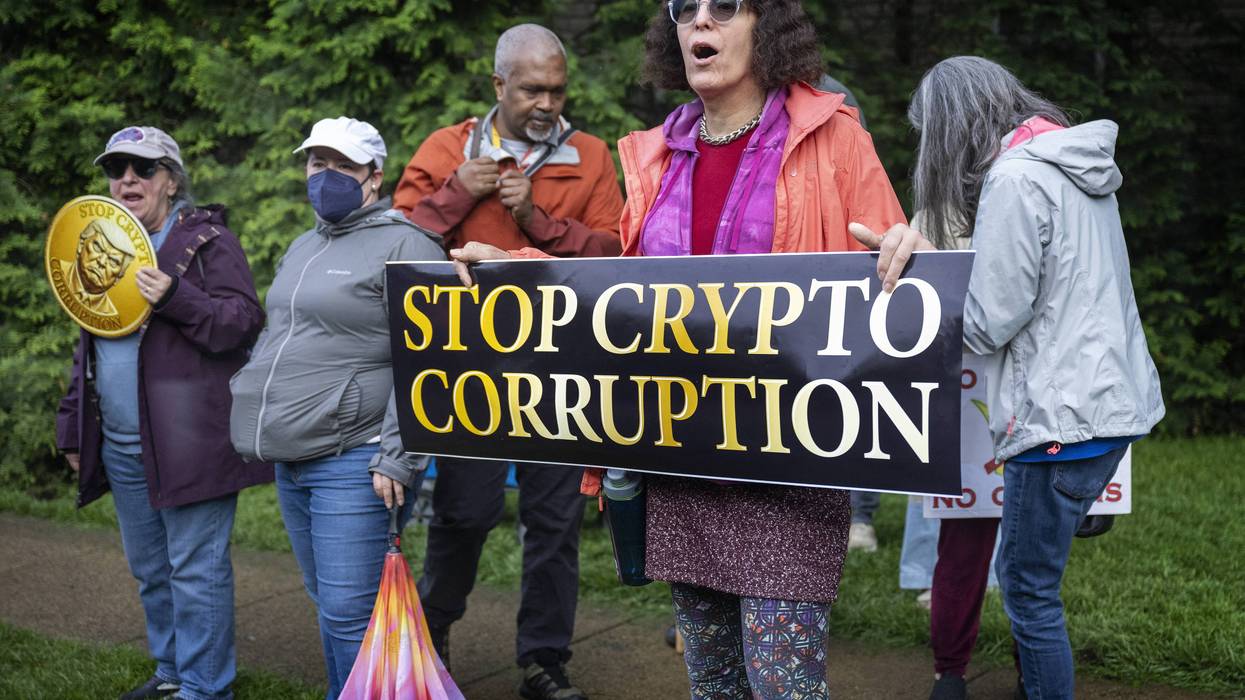
'Fuck This Coin': Trump Crypto Gala Admission Price Plummets as Meme Coin Value Down Over 90%
The president and his family made billions off Trump meme coins while investors got fleeced.
Apr 24, 2026
The price to attend Saturday's second "VIP reception" for investors in President Donald Trump's meme coin has plunged nearly as much as the cryptocurrency itself, leaving investors bamboozled and bankrupt.
Meme coins are highly volatile cryptocurrencies inspired by internet memes, jokes, or cultural trends. While many thousands of meme coins are introduced daily, the overwhelming majority of them fail after a short period as influencer-driven hype and investor "FOMO"—fear of missing out—subside.
The president's $TRUMP meme coin debuted just before his January 2025 return to the White House. Its price soared by more than 50% after its website announced last April that the coin’s top 220 investors would be invited to a private gala dinner with the president. The watchdog Citizens for Responsibility and Ethics in Washington (CREW) revealed that invitees included dozens of investors in crypto assets named after white supremacist and outright Nazi themes.
However, even then, $TRUMP was already down significantly from its high of over $75 just after its launch. On Friday, it was trading at less than $3, and the top-tier entry price to Saturday's gala at the president's Mar-a-Lago resort in Palm Beach, Florida is indicative of that precipitous plunge.
Tomorrow, President Trump will host an event for 297 $TRUMP memecoin holders at Mar-a-Lago. It’s the second time in less than a year that the president has offered special access to people who can afford to buy enough of his memecoin—and it’s somehow even worse than the first.🧵
— CREW (@citizensforethics.org) April 24, 2026 at 7:36 AM
According to the Financial Times, the 29 premier access attendees of Saturday's event held a median investment of $539,000. That's nearly 84% less than the $3.28 million median investment they had prior to last year's gala. Furthermore, the newspaper reported that many premier access winners have apparently liquidated their $TRUMP holdings since securing their VIP spots.
“Nobody likes it,” Morten Christensen, a crypto investor who went to last year's gala and plans on attending the Mar-a-Lago dinner, told Politico Thursday. “People are losing on the coin, and they are vocal. They are the people on Twitter like, ‘Fuck this coin’ or, ‘It’s a scam.’ And they’re right, basically.”
That's not stopping the gala organizers from touting what they're calling “THE MOST EXCLUSIVE CRYPTO & BUSINESS CONFERENCE IN THE WORLD!”
As Politico reported Thursday:
It is open to the top 297 $TRUMP investors, who will get the chance to hear from an eclectic lineup of speakers that includes several crypto executives, boxing legend Mike Tyson, motivational coach Tony Robbins, and Trump, who will speak during the event’s luncheon, according to promotional materials. He is expected to be in Washington later in the day for the White House Correspondents’ Dinner.
While $TRUMP investors may be losing big, Trump and his family have made billions of dollars in crypto profits, while the Trump family and the coin's creators raked in $320 million in trading fees, even as the coin's value tanked.
A small group of elite investors has likewise been spared severe losses, including insiders who bought up $MELANIA, First Lady Melania Trump's meme coin, prior to its launch, a practice known as "sniping" that netted them around $100 million, according to the Financial Times.
$MELANIA launched on the eve of Trump's second inauguration and soared to an all-time high of $13.73 on Inauguration Day. It's now trading at $0.12, a 99% dive. Investors subsequently sued $MELANIA's creators, alleging that it's part of a fraudulent "pump-and-dump" scheme in which they manipulated the launch of $MELANIA and other coins in order to enrich themselves while later investors got wiped out.
That's not the only lawsuit targeting the president's family over alleged crypto fraud. Billionaire investor Justin Sun is suing World Liberty Financial, a cryptocurrency firm co-founded by Trump and his sons, accusing the company of illegally blocking Sun from selling up to $1 billion worth of digital tokens. Sun said last year that he's the world's largest single holder of the president's meme coin.
Last year, US Sens. Elizabeth Warren (D-Mass.), Adam Schiff (D-Calif.), and Richard Blumenthal (D-Conn.), as well as Rep. Jamie Raskin (D-Md.), launched investigations into $TRUMP events.
“He’s normalized his corruption,” Blumenthal said of Trump during a Thursday interview, adding that the Mar-a-Lago gala is “simply another way to generate more money for himself, profiting directly from his office."
Trump—who once said he's "not a fan" of cryptocurrencies, "whose value is highly volatile and based on thin air"—has pushed crypto since returning to office, most notably in a January 2025 executive order calling for the establishment of a working group on digital assets to explore the possibility of creating a “national digit asset stockpile," a top crypto industry wish list item.
“It is literally cashing in on the presidency—creating a financial instrument so people can transfer money to the president’s family in connection with his office,” Campaign Legal Center executive director Adav Noti said last year.
Experts have warned prospective investors about the dangers associated with $TRUMP.
“Two exclusive promotional events offering access to the president created temporary price increases but did not reverse the long-term downward trend,” Marquette University finance professor emeritus David Krause wrote last month.
“With approximately 80% of the token supply controlled by Trump-affiliated entities and over $324 million in trading fees accruing to insiders, the token raises significant questions about the alignment of promotional activities with retail investor protection,” Krause added. “As political meme coins continue to emerge, the $TRUMP token may serve as a cautionary case for the risks of speculative assets tied to political figures.”
Looking forward to Saturday's Mar-a-Lago gathering—which Trump may not even attend, according to small print on the event's website—CREW said Wednesday that "like the first event, Trump will almost certainly host holders of alt-right and racist coins, foreign attendees—including those with potential ties to foreign governments—and people seeking favors."
"This weekend will provide a prime example of the level of corruption and profiteering that no other president would have even dreamt of engaging in, but Trump is comfortable doing so openly," the group added.
Keep ReadingShow Less
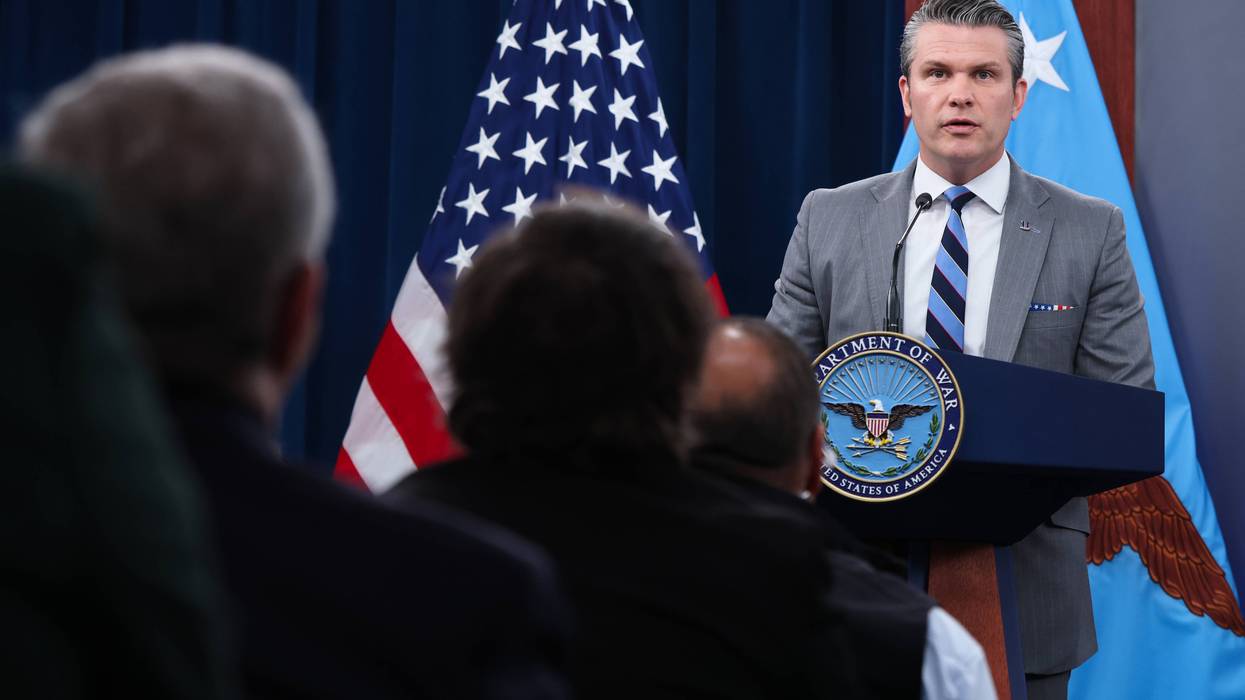
PEN America Sounds Alarm Over Pentagon's Firing of Stars and Stripes Ombudsman
"Even as the nation is at war, Pentagon leadership is silencing independent voices that uphold credible reporting, part of a broader pattern of restricting press access to evade scrutiny."
Apr 24, 2026
PEN America, one of the nation's leading free expression groups, voiced alarm Friday at the Pentagon's firing of the ombudsman for the military newspaper Stars and Stripes, warning the move marks yet another blow to US press freedoms amid the Trump administration's war of choice in Iran and other lawless actions across the globe.
"Even as the nation is at war, Pentagon leadership is silencing independent voices that uphold credible reporting, part of a broader pattern of restricting press access to evade scrutiny," Tim Richardson, PEN America's journalism and disinformation program director, said in a statement. "Congress must defend the statutory independence of Stars and Stripes so that service members can continue to rely on it for independent reporting.”
Jacqueline Smith, who was tasked with upholding the Stars and Stripes' editorial independence from the Pentagon—which partially funds the newspaper—publicly announced her firing on Thursday in a defiant editorial, writing: "Apparently the Pentagon... doesn’t want you to hear from me anymore about threats to the editorial independence of Stars and Stripes."
Smith, who has served in the congressionally mandated ombudsman role since December 2023, wrote in Stars and Stripes that while she was not given a reason for her firing, "no one should be surprised" by the decision.
"For nearly a year, Pentagon leadership has placed more and more restrictions on the mainstream media. The New York Times sued and when the Defense/War Department lost in court, instead of following the judge’s ruling Secretary [Pete] Hegseth and company pivoted, finding another way to restrict journalists. The judge rejected that attempt, too," Smith wrote. "The laser beam turned to Stars and Stripes on Jan. 15 when Sean Parnell posted on X four paragraphs announcing a 'refocus' of the newspaper. Parnell is Assistant to the Secretary of Defense/War (Public Affairs); my firing notice came from his office."
"Since his 'refocus' post, I’ve been outspoken in my columns, media interviews, talks with national free press groups and communications with Congress about the Pentagon’s moves to take control of Stripes’ content," Smith added. "This newspaper has a long history of commitment to the military community and to journalistic values. Please don’t let it be controlled by Pentagon brass."
"My responsibility to Stripes and the First Amendment was paramount."
In January, the Pentagon announced plans to overhaul Stars and Stripes with the stated goal of moving its content "away from woke distractions that syphon morale"—without offering any examples of such content.
Weeks later, the Pentagon issued a memo declaring that the newspaper was "prohibited" from using "news stories, features, syndicated columns, comic strips and editorial cartoons from commercial news media." The directive barred the paper from reprinting material from The Associated Press and Reuters.
Smith criticized the Pentagon directive as another blatant and "unacceptable" attempt to infringe on the newspaper's editorial independence.
"What is happening with Stripes is within the broader context of the Pentagon attempting to restrict the mainstream media," she wrote in an April column. "At first it was by closing off areas of the complex where journalists previously had been able to go unescorted, then it followed last fall with the demand for the press to sign an agreement essentially saying it would not use any information not authorized by the department. That’s when more than two dozen journalists from mainstream media turned in their press badges and walked out. They still cover the news."
In a message to Stars and Stripes staff following her firing, Smith said she "knew it was risky to speak out."
"But my responsibility to Stripes and the First Amendment was paramount," she added.
Keep ReadingShow Less
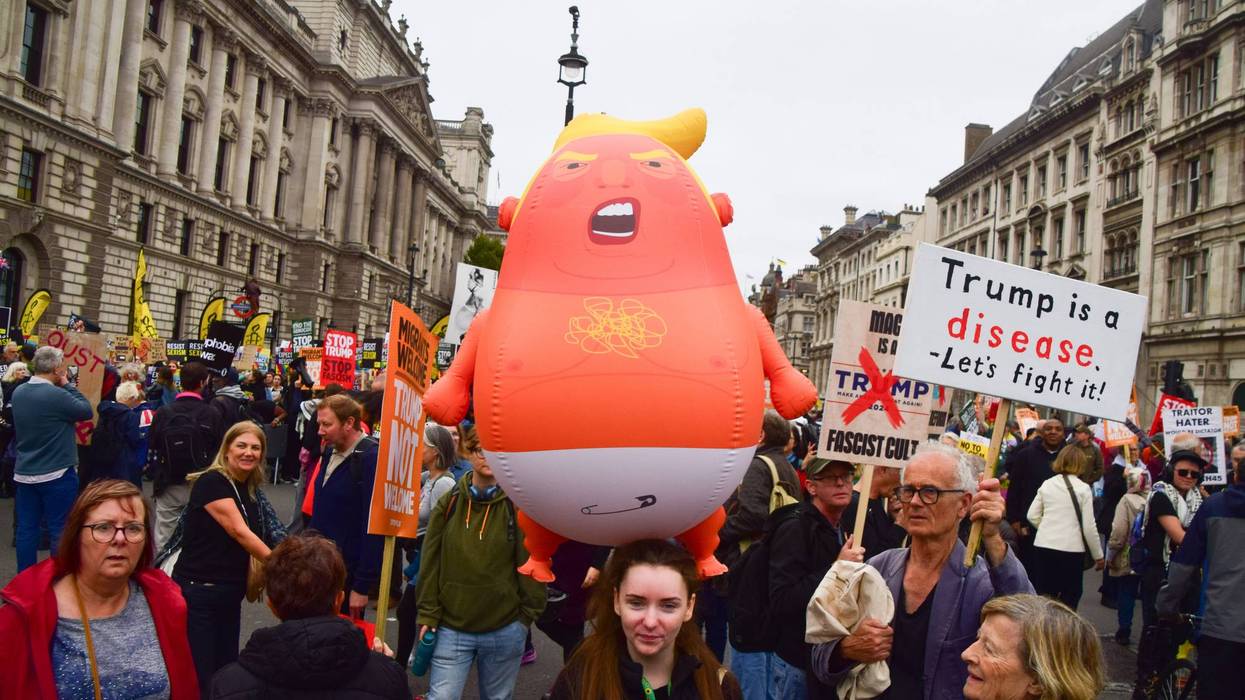
Despite 'Big Tariff' Threat From Trump, UK Urged to 'Raise, Not Abolish' Tax on Tech Giants
"We need to stop kowtowing to him, stop offering him humiliating and unpopular 'state' visits, and start enacting economic policies that put the interest of people here ahead of Donald Trump," said one campaigner.
Apr 24, 2026
After President Donald Trump threatened to impose a new tariff on the United Kingdom over its Digital Services Tax, the head of a UK economic justice organization on Friday called for standing up to the US leader and even increasing the levy.
The 2% tax on digital companies such as search engines and social media networks that derive value from UK users—which applies to US tech giants such as Apple, Amazon, and Alphabet's Google—has generated significant revenue annually, including £808 million, or over $1 billion, for the 2024-25 financial year.
"We don't like it when they target American companies... whether we like those companies or don't like 'em," Trump—whose inauguration last year featured several ultrarich tech executives—said Thursday. He accused the UK of trying to "make an easy buck" and warned that "they better be careful."
"If they don't drop the tax, we'll probably put a big tariff on the UK," the president continued, suggesting that the tariff would be "more than what they're getting" from the policy targeting Big Tech.
Responding in a Friday statement, Nick Dearden, director of UK-based advocacy group Global Justice Now, said that "Trump's latest threats prove, yet again, that if you give in to a bully, they'll just come back for more."
Just months after striking a bilateral trade deal that notably did not alter the tax on tech companies, Trump and UK Prime Minister Keir Starmer signed an artificial intelligence pact last September. The latter, said Dearden, "rolled out the red carpet to Trump's Big Tech barons."
"But this wasn't the end of the story. Rather, the pact has given Trump an ongoing vehicle to bully the British government," the campaigner continued. "It's time to admit that Stramer's strategy towards Trump has been an abject failure. We should raise, not abolish the digital services tax, which has already raised billions of pounds for the British economy."
"Trump won't like this but that's just too bad, we need to stop kowtowing to him, stop offering him humiliating and unpopular 'state' visits, and start enacting economic policies that put the interest of people here ahead of Donald Trump," he argued—as the UK's King Charles III and his wife Camilla, the queen consort, prepare to meet with Trump at the White House on Monday.
Asked about Trump's tech tax threats, a spokesperson for Starmer's office told The Guardian that "our position on that is unchanged... It is a hugely important tax to make sure that those businesses continue to pay their share. So it is a fair and proportionate approach to taxing business activities in the UK."
As the newspaper noted:
The digital services tax is only meant to be an interim measure, and the UK government agreed in 2021 to phase it out, averting the threat of retaliatory tariffs on British products from the US.
The tax was meant to be replaced in 2024 with a new global system after the Organization for Economic Cooperation and Development (OECD) brokered a deal between 140 countries, including the UK, that proposed large multinational companies paying tax in the countries where they do business committed themselves to a minimum 15% corporation tax rate. Implementation has been beset with delays as a number of countries have continued to raise objections over the regime.
Trump's tariff threat comes after he has lashed out at Starmer—and other European officials—in recent weeks over their limited support for his illegal war on Iran. The US leader suggested to the BBC this week that he and the UK prime minister could only "recover" if the Labour leader embraced stricter immigration policies and "opened the North Sea" to the fossil fuel industry.
"I'm here to serve the British people always, to have their interests and to make sure that I make the right decisions for them," Starmer told the British broadcaster. "That is why I took the decision that we would not be dragged into the war in Iran."
Keep ReadingShow Less
Most Popular