SUBSCRIBE TO OUR FREE NEWSLETTER
Daily news & progressive opinion—funded by the people, not the corporations—delivered straight to your inbox.
5
#000000
#FFFFFF
To donate by check, phone, or other method, see our More Ways to Give page.
Daily news & progressive opinion—funded by the people, not the corporations—delivered straight to your inbox.
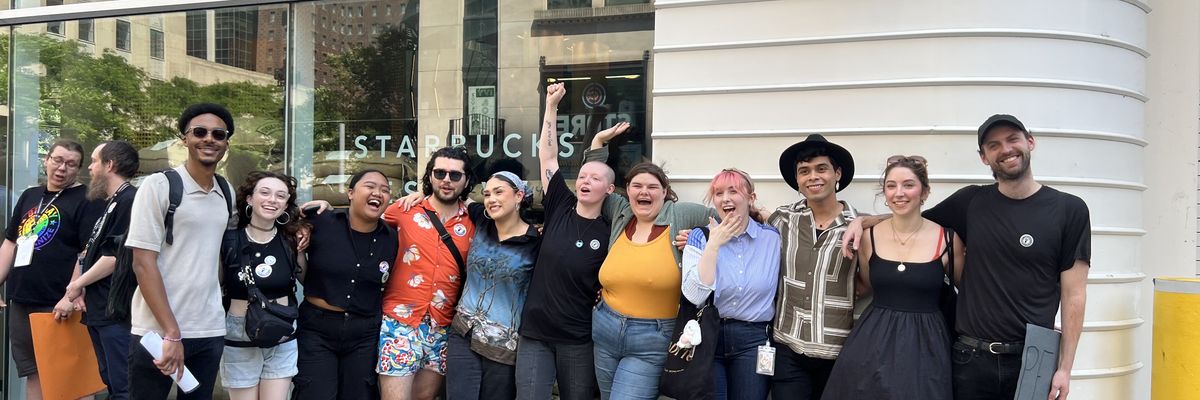
Employees of the Starbucks Reserve Roastery in Chicago, Illinois filed for a union election on July 14, 2023.
"We are tired of seeing our coworkers burnt out, bullied, and mistreated every day," said an operations lead at the roastery. "We've tried expressing this to management, and we've been ignored and degraded."
Workers at the world's largest Starbucks in Chicago filed for a union election on Friday, joining more than 8,500 of the coffee chain's "partners" at over 330 locations across the United States who are fighting for the right to organize and contracts.
"We are tired of seeing our coworkers burnt out, bullied, and mistreated every day. I love my job, I love my coworkers, and I love the people we serve. I know we all deserve to experience the roastery the way it should be—as a space where everyone feels welcome, appreciated, and valued," said Jamie Williamson, operations lead at the Illinois store, in a statement.
"We've tried expressing this to management, and we've been ignored and degraded," Williamson added. "The only people we can rely on are our fellow partners. Now, we want to turn that trust into power to change the roastery for the better."
The Starbucks Reserve Roastery in Chicago takes up 35,000 square feet on the city's Magnificent Mile. The other two North American roasteries, in Seattle and New York City, both won their union elections last year—though none of the hundreds of newly formed labor groups nationwide have secured a contract with the company yet.
"The prospective bargaining unit includes about 230 baristas and mixologists who serve elaborate coffee-based drinks and cocktails, bakers who make pastries in-house, and operations leads who work in retail and customer service at the five-story caffeine emporium," according to the Chicago Tribune. "People who work roasting coffee at the Roastery are not retail employees and are not included in the unit."
Barista and mixologist Kyra Supnet said in a statement that "yes, we are the largest Starbucks with the largest number of partners that work here. Getting everyone together seemed impossible at first, but when you zoom out and see the bigger picture—you realize that everyone shares the same issues."
"Everyone in the space is equally as frustrated and some even more," Supnet continued. "But together we will stand together and become one voice that management can't ignore for much longer."
The Seattle-based company, which has over 32,000 stores across 80 countries, has come under fire from its workers, labor rights advocates, federal lawmakers, and the National Labor Relations Board for how it has responded to union drives in the United States since the first successful vote to unionize at a Buffalo, New York location in December 2021.
Starbucks spokesperson Andrew Trull told the Tribune that the company remains "committed to supporting our Chicago roastery partners."
"Our partners and their safety are core to our operation,” Trull said. "We work with urgency to address any reported issues that may impact the well-being of our partners and the experience we offer at our Chicago roastery."
The newspaper noted that "Starbucks has been found in violation [of] national labor law numerous times by administrative law judges over the course of the campaign, including in Chicago, where a judge found the coffee giant had illegally fired a Hyde Park barista who led the union campaign at his store and threatened workers at two cafes over their union activity. Starbucks is appealing that ruling; the coffee giant has generally denied accusations and findings of lawbreaking."
Dear Common Dreams reader, It’s been nearly 30 years since I co-founded Common Dreams with my late wife, Lina Newhouser. We had the radical notion that journalism should serve the public good, not corporate profits. It was clear to us from the outset what it would take to build such a project. No paid advertisements. No corporate sponsors. No millionaire publisher telling us what to think or do. Many people said we wouldn't last a year, but we proved those doubters wrong. Together with a tremendous team of journalists and dedicated staff, we built an independent media outlet free from the constraints of profits and corporate control. Our mission has always been simple: To inform. To inspire. To ignite change for the common good. Building Common Dreams was not easy. Our survival was never guaranteed. When you take on the most powerful forces—Wall Street greed, fossil fuel industry destruction, Big Tech lobbyists, and uber-rich oligarchs who have spent billions upon billions rigging the economy and democracy in their favor—the only bulwark you have is supporters who believe in your work. But here’s the urgent message from me today. It's never been this bad out there. And it's never been this hard to keep us going. At the very moment Common Dreams is most needed, the threats we face are intensifying. We need your support now more than ever. We don't accept corporate advertising and never will. We don't have a paywall because we don't think people should be blocked from critical news based on their ability to pay. Everything we do is funded by the donations of readers like you. When everyone does the little they can afford, we are strong. But if that support retreats or dries up, so do we. Will you donate now to make sure Common Dreams not only survives but thrives? —Craig Brown, Co-founder |
Workers at the world's largest Starbucks in Chicago filed for a union election on Friday, joining more than 8,500 of the coffee chain's "partners" at over 330 locations across the United States who are fighting for the right to organize and contracts.
"We are tired of seeing our coworkers burnt out, bullied, and mistreated every day. I love my job, I love my coworkers, and I love the people we serve. I know we all deserve to experience the roastery the way it should be—as a space where everyone feels welcome, appreciated, and valued," said Jamie Williamson, operations lead at the Illinois store, in a statement.
"We've tried expressing this to management, and we've been ignored and degraded," Williamson added. "The only people we can rely on are our fellow partners. Now, we want to turn that trust into power to change the roastery for the better."
The Starbucks Reserve Roastery in Chicago takes up 35,000 square feet on the city's Magnificent Mile. The other two North American roasteries, in Seattle and New York City, both won their union elections last year—though none of the hundreds of newly formed labor groups nationwide have secured a contract with the company yet.
"The prospective bargaining unit includes about 230 baristas and mixologists who serve elaborate coffee-based drinks and cocktails, bakers who make pastries in-house, and operations leads who work in retail and customer service at the five-story caffeine emporium," according to the Chicago Tribune. "People who work roasting coffee at the Roastery are not retail employees and are not included in the unit."
Barista and mixologist Kyra Supnet said in a statement that "yes, we are the largest Starbucks with the largest number of partners that work here. Getting everyone together seemed impossible at first, but when you zoom out and see the bigger picture—you realize that everyone shares the same issues."
"Everyone in the space is equally as frustrated and some even more," Supnet continued. "But together we will stand together and become one voice that management can't ignore for much longer."
The Seattle-based company, which has over 32,000 stores across 80 countries, has come under fire from its workers, labor rights advocates, federal lawmakers, and the National Labor Relations Board for how it has responded to union drives in the United States since the first successful vote to unionize at a Buffalo, New York location in December 2021.
Starbucks spokesperson Andrew Trull told the Tribune that the company remains "committed to supporting our Chicago roastery partners."
"Our partners and their safety are core to our operation,” Trull said. "We work with urgency to address any reported issues that may impact the well-being of our partners and the experience we offer at our Chicago roastery."
The newspaper noted that "Starbucks has been found in violation [of] national labor law numerous times by administrative law judges over the course of the campaign, including in Chicago, where a judge found the coffee giant had illegally fired a Hyde Park barista who led the union campaign at his store and threatened workers at two cafes over their union activity. Starbucks is appealing that ruling; the coffee giant has generally denied accusations and findings of lawbreaking."
Workers at the world's largest Starbucks in Chicago filed for a union election on Friday, joining more than 8,500 of the coffee chain's "partners" at over 330 locations across the United States who are fighting for the right to organize and contracts.
"We are tired of seeing our coworkers burnt out, bullied, and mistreated every day. I love my job, I love my coworkers, and I love the people we serve. I know we all deserve to experience the roastery the way it should be—as a space where everyone feels welcome, appreciated, and valued," said Jamie Williamson, operations lead at the Illinois store, in a statement.
"We've tried expressing this to management, and we've been ignored and degraded," Williamson added. "The only people we can rely on are our fellow partners. Now, we want to turn that trust into power to change the roastery for the better."
The Starbucks Reserve Roastery in Chicago takes up 35,000 square feet on the city's Magnificent Mile. The other two North American roasteries, in Seattle and New York City, both won their union elections last year—though none of the hundreds of newly formed labor groups nationwide have secured a contract with the company yet.
"The prospective bargaining unit includes about 230 baristas and mixologists who serve elaborate coffee-based drinks and cocktails, bakers who make pastries in-house, and operations leads who work in retail and customer service at the five-story caffeine emporium," according to the Chicago Tribune. "People who work roasting coffee at the Roastery are not retail employees and are not included in the unit."
Barista and mixologist Kyra Supnet said in a statement that "yes, we are the largest Starbucks with the largest number of partners that work here. Getting everyone together seemed impossible at first, but when you zoom out and see the bigger picture—you realize that everyone shares the same issues."
"Everyone in the space is equally as frustrated and some even more," Supnet continued. "But together we will stand together and become one voice that management can't ignore for much longer."
The Seattle-based company, which has over 32,000 stores across 80 countries, has come under fire from its workers, labor rights advocates, federal lawmakers, and the National Labor Relations Board for how it has responded to union drives in the United States since the first successful vote to unionize at a Buffalo, New York location in December 2021.
Starbucks spokesperson Andrew Trull told the Tribune that the company remains "committed to supporting our Chicago roastery partners."
"Our partners and their safety are core to our operation,” Trull said. "We work with urgency to address any reported issues that may impact the well-being of our partners and the experience we offer at our Chicago roastery."
The newspaper noted that "Starbucks has been found in violation [of] national labor law numerous times by administrative law judges over the course of the campaign, including in Chicago, where a judge found the coffee giant had illegally fired a Hyde Park barista who led the union campaign at his store and threatened workers at two cafes over their union activity. Starbucks is appealing that ruling; the coffee giant has generally denied accusations and findings of lawbreaking."