SUBSCRIBE TO OUR FREE NEWSLETTER
Daily news & progressive opinion—funded by the people, not the corporations—delivered straight to your inbox.
5
#000000
#FFFFFF
To donate by check, phone, or other method, see our More Ways to Give page.
Daily news & progressive opinion—funded by the people, not the corporations—delivered straight to your inbox.
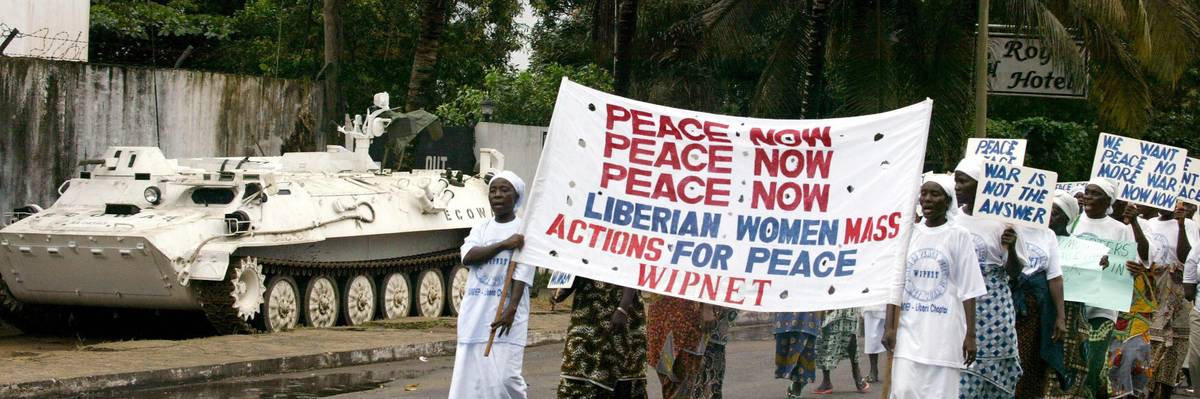
Liberian women stage a protest demanding an end to the country's civil war in Monrovia on August 28, 2003.
"Women and girls are often the first responders to the world's crises," said one women's rights leader. "Their voice matters in peace-building."
As communities and governments around the world marked International Women's Day on Wednesday, the need to include women in peace negotiations and place the needs of women and girls at the center of peace-building was a key theme of discussions at the United Nations Security Council.
The council met Tuesday to address the status of a resolution adopted nearly 23 years ago in October 2000, when international policymakers agreed on "the important role of women in the prevention and resolution of conflicts, peace negotiations, peace-building, peacekeeping, humanitarian response, and in post-conflict reconstruction."
The current state of Resolution 1325, said Sima Bahous, executive director of U.N. Women, shows that the world is in need of "a radical change of direction" regarding gender equality.
Bahous noted that days after the security council met in 2020 to mark the 20th anniversary of the resolution, a conflict broke out in the Tigray region of Ethiopia. During two years of fighting, sexual violence was "committed at a staggering scale," and child marriage increased by 51%.
"Since the 20th anniversary," Bahous said, "there have been several military coups in conflict-affected countries, from the Sahel and Sudan to Myanmar, dramatically shrinking the civic space for women's organizations and activists, if not altogether closing it."
"Women's participation increases the probability of a peace agreement lasting at least two years by 20%, and by 35% the probability of a peace agreement lasting 15 years."
Women and girls also make up 90% of the nearly eight million Ukrainians who have been forced to flee to other countries since Russia invaded Ukraine in February 2022, and 68% of those who are internally displaced.
While the suffering of women and girls has been central to these conflicts, women were "excluded from 80% of peace negotiations from 2005 to 2020," Bahous said, adding, "We have neither significantly changed the composition of peace tables, nor the impunity enjoyed by those who commit atrocities against women and girls."
In a 2015 report on implementation of Resolution 1325, U.N. Women showed that the agreement led to "a substantial increase in the frequency of gender-responsive language in peace agreements and the number of women, women's groups, and gender experts who serve as official negotiators, mediators, or signatories."
Women's inclusion is frequently temporary and "more symbolic than substantive," according to the report, failing to lead to "a shift in dynamics, a broadening of the issues discussed."
An analysis of 40 worldwide peace agreements since the end of the Cold War showed that negotiators had a much higher chance of reaching a deal "in cases where women were able to exercise a strong influence on the negotiation process."
"Women's participation increases the probability of a peace agreement lasting at least two years by 20%, and by 35% the probability of a peace agreement lasting 15 years," the U.N. Women report reads.
Evidence of the importance of women's involvement in peace processes "is there staring us in the face," said Lord Tariq Ahmad of Wimbledon, the United Kingdom's minister of state for the Middle East, North Africa, South Asia, and the United Nations.
"This council, this security council, knows that mediation, conflict prevention, and resolution have proven more successful time and time again when they are inclusive," said Ahmad. "They work better. They last longer when women are central to peace and building progressive societies... Yet it is an undeniable fact. Here we sit in 2023 and we are seeing tragically, a stagnation of the women, peace, and security agenda and a regression in women's rights around the world."
Former Colombia President Juan Manuel Santos has spoken frequently about the inclusion of women in peace talks in his country following decades of civil war, leading to a section of the peace accords that ensures women will receive specific benefits post-conflict in recognition of the disproportionate effects war has on women and girls.
"The participation of women at the formal negotiating table and within the wider peace process has been a crucial aspect of the journey towards peace in Colombia," said Santos on Monday, in a statement he made as a member of The Elders, a group of global leaders working for peace.
"But the task of women peace-builders is not an easy one," Santos added. "All too often, they face threats and denigration from within their own communities. It is incumbent on political leaders, governments and international organizations to recognize and defend their role, and put the necessary measures in place to ensure their safety and security."
Former Liberian President Ellen Johnson Sirleaf, another Elder, said that "women and girls are often the first responders to the world's crises, working across the dividing lines of conflict."
While Colombia's peace negotiations centered women, Bineta Diop, the African Union Commission's special envoy on women, peace, and security, reported that many women in African countries experiencing conflict "are engaged in the community and peace-building initiatives," but "their voice is yet to be heard in peace negotiations and mediation where roadmaps to return to peace are drawn."
Bahous suggested the security council change direction with "mandates, conditions, quotas, funding earmarks, incentives, and consequences for non-compliance."
"We cannot expect 2025 to be any different," she said, "if the bulk of our interventions continue to be trainings, sensitization, guidance, capacity building, setting up networks, and holding one event after another to talk about women's participation, rather than mandating it in every meeting and decision-making process in which we have authority."
Dear Common Dreams reader, It’s been nearly 30 years since I co-founded Common Dreams with my late wife, Lina Newhouser. We had the radical notion that journalism should serve the public good, not corporate profits. It was clear to us from the outset what it would take to build such a project. No paid advertisements. No corporate sponsors. No millionaire publisher telling us what to think or do. Many people said we wouldn't last a year, but we proved those doubters wrong. Together with a tremendous team of journalists and dedicated staff, we built an independent media outlet free from the constraints of profits and corporate control. Our mission has always been simple: To inform. To inspire. To ignite change for the common good. Building Common Dreams was not easy. Our survival was never guaranteed. When you take on the most powerful forces—Wall Street greed, fossil fuel industry destruction, Big Tech lobbyists, and uber-rich oligarchs who have spent billions upon billions rigging the economy and democracy in their favor—the only bulwark you have is supporters who believe in your work. But here’s the urgent message from me today. It's never been this bad out there. And it's never been this hard to keep us going. At the very moment Common Dreams is most needed, the threats we face are intensifying. We need your support now more than ever. We don't accept corporate advertising and never will. We don't have a paywall because we don't think people should be blocked from critical news based on their ability to pay. Everything we do is funded by the donations of readers like you. When everyone does the little they can afford, we are strong. But if that support retreats or dries up, so do we. Will you donate now to make sure Common Dreams not only survives but thrives? —Craig Brown, Co-founder |
As communities and governments around the world marked International Women's Day on Wednesday, the need to include women in peace negotiations and place the needs of women and girls at the center of peace-building was a key theme of discussions at the United Nations Security Council.
The council met Tuesday to address the status of a resolution adopted nearly 23 years ago in October 2000, when international policymakers agreed on "the important role of women in the prevention and resolution of conflicts, peace negotiations, peace-building, peacekeeping, humanitarian response, and in post-conflict reconstruction."
The current state of Resolution 1325, said Sima Bahous, executive director of U.N. Women, shows that the world is in need of "a radical change of direction" regarding gender equality.
Bahous noted that days after the security council met in 2020 to mark the 20th anniversary of the resolution, a conflict broke out in the Tigray region of Ethiopia. During two years of fighting, sexual violence was "committed at a staggering scale," and child marriage increased by 51%.
"Since the 20th anniversary," Bahous said, "there have been several military coups in conflict-affected countries, from the Sahel and Sudan to Myanmar, dramatically shrinking the civic space for women's organizations and activists, if not altogether closing it."
"Women's participation increases the probability of a peace agreement lasting at least two years by 20%, and by 35% the probability of a peace agreement lasting 15 years."
Women and girls also make up 90% of the nearly eight million Ukrainians who have been forced to flee to other countries since Russia invaded Ukraine in February 2022, and 68% of those who are internally displaced.
While the suffering of women and girls has been central to these conflicts, women were "excluded from 80% of peace negotiations from 2005 to 2020," Bahous said, adding, "We have neither significantly changed the composition of peace tables, nor the impunity enjoyed by those who commit atrocities against women and girls."
In a 2015 report on implementation of Resolution 1325, U.N. Women showed that the agreement led to "a substantial increase in the frequency of gender-responsive language in peace agreements and the number of women, women's groups, and gender experts who serve as official negotiators, mediators, or signatories."
Women's inclusion is frequently temporary and "more symbolic than substantive," according to the report, failing to lead to "a shift in dynamics, a broadening of the issues discussed."
An analysis of 40 worldwide peace agreements since the end of the Cold War showed that negotiators had a much higher chance of reaching a deal "in cases where women were able to exercise a strong influence on the negotiation process."
"Women's participation increases the probability of a peace agreement lasting at least two years by 20%, and by 35% the probability of a peace agreement lasting 15 years," the U.N. Women report reads.
Evidence of the importance of women's involvement in peace processes "is there staring us in the face," said Lord Tariq Ahmad of Wimbledon, the United Kingdom's minister of state for the Middle East, North Africa, South Asia, and the United Nations.
"This council, this security council, knows that mediation, conflict prevention, and resolution have proven more successful time and time again when they are inclusive," said Ahmad. "They work better. They last longer when women are central to peace and building progressive societies... Yet it is an undeniable fact. Here we sit in 2023 and we are seeing tragically, a stagnation of the women, peace, and security agenda and a regression in women's rights around the world."
Former Colombia President Juan Manuel Santos has spoken frequently about the inclusion of women in peace talks in his country following decades of civil war, leading to a section of the peace accords that ensures women will receive specific benefits post-conflict in recognition of the disproportionate effects war has on women and girls.
"The participation of women at the formal negotiating table and within the wider peace process has been a crucial aspect of the journey towards peace in Colombia," said Santos on Monday, in a statement he made as a member of The Elders, a group of global leaders working for peace.
"But the task of women peace-builders is not an easy one," Santos added. "All too often, they face threats and denigration from within their own communities. It is incumbent on political leaders, governments and international organizations to recognize and defend their role, and put the necessary measures in place to ensure their safety and security."
Former Liberian President Ellen Johnson Sirleaf, another Elder, said that "women and girls are often the first responders to the world's crises, working across the dividing lines of conflict."
While Colombia's peace negotiations centered women, Bineta Diop, the African Union Commission's special envoy on women, peace, and security, reported that many women in African countries experiencing conflict "are engaged in the community and peace-building initiatives," but "their voice is yet to be heard in peace negotiations and mediation where roadmaps to return to peace are drawn."
Bahous suggested the security council change direction with "mandates, conditions, quotas, funding earmarks, incentives, and consequences for non-compliance."
"We cannot expect 2025 to be any different," she said, "if the bulk of our interventions continue to be trainings, sensitization, guidance, capacity building, setting up networks, and holding one event after another to talk about women's participation, rather than mandating it in every meeting and decision-making process in which we have authority."
As communities and governments around the world marked International Women's Day on Wednesday, the need to include women in peace negotiations and place the needs of women and girls at the center of peace-building was a key theme of discussions at the United Nations Security Council.
The council met Tuesday to address the status of a resolution adopted nearly 23 years ago in October 2000, when international policymakers agreed on "the important role of women in the prevention and resolution of conflicts, peace negotiations, peace-building, peacekeeping, humanitarian response, and in post-conflict reconstruction."
The current state of Resolution 1325, said Sima Bahous, executive director of U.N. Women, shows that the world is in need of "a radical change of direction" regarding gender equality.
Bahous noted that days after the security council met in 2020 to mark the 20th anniversary of the resolution, a conflict broke out in the Tigray region of Ethiopia. During two years of fighting, sexual violence was "committed at a staggering scale," and child marriage increased by 51%.
"Since the 20th anniversary," Bahous said, "there have been several military coups in conflict-affected countries, from the Sahel and Sudan to Myanmar, dramatically shrinking the civic space for women's organizations and activists, if not altogether closing it."
"Women's participation increases the probability of a peace agreement lasting at least two years by 20%, and by 35% the probability of a peace agreement lasting 15 years."
Women and girls also make up 90% of the nearly eight million Ukrainians who have been forced to flee to other countries since Russia invaded Ukraine in February 2022, and 68% of those who are internally displaced.
While the suffering of women and girls has been central to these conflicts, women were "excluded from 80% of peace negotiations from 2005 to 2020," Bahous said, adding, "We have neither significantly changed the composition of peace tables, nor the impunity enjoyed by those who commit atrocities against women and girls."
In a 2015 report on implementation of Resolution 1325, U.N. Women showed that the agreement led to "a substantial increase in the frequency of gender-responsive language in peace agreements and the number of women, women's groups, and gender experts who serve as official negotiators, mediators, or signatories."
Women's inclusion is frequently temporary and "more symbolic than substantive," according to the report, failing to lead to "a shift in dynamics, a broadening of the issues discussed."
An analysis of 40 worldwide peace agreements since the end of the Cold War showed that negotiators had a much higher chance of reaching a deal "in cases where women were able to exercise a strong influence on the negotiation process."
"Women's participation increases the probability of a peace agreement lasting at least two years by 20%, and by 35% the probability of a peace agreement lasting 15 years," the U.N. Women report reads.
Evidence of the importance of women's involvement in peace processes "is there staring us in the face," said Lord Tariq Ahmad of Wimbledon, the United Kingdom's minister of state for the Middle East, North Africa, South Asia, and the United Nations.
"This council, this security council, knows that mediation, conflict prevention, and resolution have proven more successful time and time again when they are inclusive," said Ahmad. "They work better. They last longer when women are central to peace and building progressive societies... Yet it is an undeniable fact. Here we sit in 2023 and we are seeing tragically, a stagnation of the women, peace, and security agenda and a regression in women's rights around the world."
Former Colombia President Juan Manuel Santos has spoken frequently about the inclusion of women in peace talks in his country following decades of civil war, leading to a section of the peace accords that ensures women will receive specific benefits post-conflict in recognition of the disproportionate effects war has on women and girls.
"The participation of women at the formal negotiating table and within the wider peace process has been a crucial aspect of the journey towards peace in Colombia," said Santos on Monday, in a statement he made as a member of The Elders, a group of global leaders working for peace.
"But the task of women peace-builders is not an easy one," Santos added. "All too often, they face threats and denigration from within their own communities. It is incumbent on political leaders, governments and international organizations to recognize and defend their role, and put the necessary measures in place to ensure their safety and security."
Former Liberian President Ellen Johnson Sirleaf, another Elder, said that "women and girls are often the first responders to the world's crises, working across the dividing lines of conflict."
While Colombia's peace negotiations centered women, Bineta Diop, the African Union Commission's special envoy on women, peace, and security, reported that many women in African countries experiencing conflict "are engaged in the community and peace-building initiatives," but "their voice is yet to be heard in peace negotiations and mediation where roadmaps to return to peace are drawn."
Bahous suggested the security council change direction with "mandates, conditions, quotas, funding earmarks, incentives, and consequences for non-compliance."
"We cannot expect 2025 to be any different," she said, "if the bulk of our interventions continue to be trainings, sensitization, guidance, capacity building, setting up networks, and holding one event after another to talk about women's participation, rather than mandating it in every meeting and decision-making process in which we have authority."