SUBSCRIBE TO OUR FREE NEWSLETTER
Daily news & progressive opinion—funded by the people, not the corporations—delivered straight to your inbox.
5
#000000
#FFFFFF
To donate by check, phone, or other method, see our More Ways to Give page.

The average U.S. taxpayer was forced to contribute more to militarized programs than to Medicare and Medicaid combined in 2023, according to a new analysis released Tuesday by the National Priorities Project.
Published ahead of Tax Day, the analysis sheds light on the extent to which the federal income tax dollars of ordinary Americans are fueling "militarism and its support systems" such as the Pentagon, which currently accounts for roughly half of the federal government's total discretionary budget.
"Overall, in 2023, the average taxpayer contributed $5,109 for militarism and its support systems—including war and the Pentagon, veterans' programs, deportations and border militarization, and federal spending on policing and prisons," according to NPP, which is a project of the Institute for Policy Studies.
By comparison, the typical U.S. taxpayer contributed $4,308 to Medicare and Medicaid, $346 to K-12 education, $516 to nutrition assistance for low-income Americans, and $58 to diplomacy-related programs.
"Right now, millions of Americans are struggling to stay afloat—it's become so expensive to live, eat, and have a home. Yet, instead of addressing the cost-of-living crisis or funding measures to address our communities' needs, this year $5,109 of the average American's taxpayer dollars went to fund the military and its support systems," said Alliyah Lusuegro, NPP's outreach coordinator and a co-author of the new analysis.
"A far greater portion of our tax dollars goes toward militarism at home and abroad, and toward harming and separating immigrant families, when we should be investing instead in safe and healthy conditions for our communities and our futures," Lusuegro added.
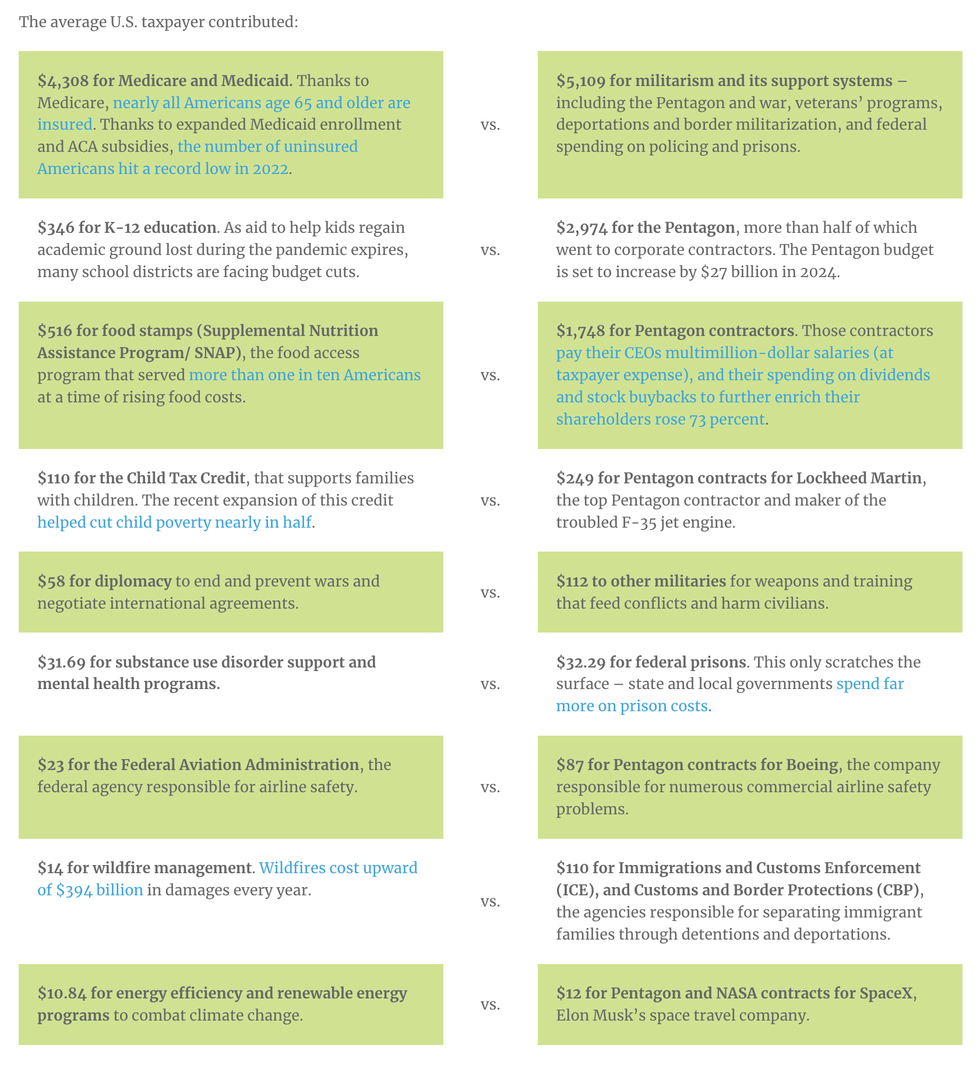
Last year, according to NPP, $1,748 of the average American's income tax contributions went to the pockets of Pentagon contractors such as Lockheed Martin and Boeing, which lobby Congress aggressively for an ever-larger military budget—much of which ends up in private hands.
Lindsay Koshgarian, NPP's program director, said Tuesday that "it's outrageous that the average taxpayer is giving the equivalent of a month's rent to Pentagon contractors."
"These big corporations are already not paying their fair share in taxes," said Koshgarian. "Instead, ordinary people are subsidizing those corporations' profits and multi-million dollar CEO pay packages. Taxpayer dollars should be going to real needs like schools, food and housing programs, or renewable energy—not lining the pockets of corporations."
The analysis comes weeks after President Joe Biden signed into law an $825 billion military spending package for fiscal year 2024 that includes "includes $33.5 billion to build eight ships and allocates funds for 86 F-35 and 24 F-15EX fighter jets as well as 15 KC-46A tankers," Defense News reported.
Last month, Biden released a budget proposal that called for $850 billion for the Pentagon and more than $1 trillion overall in militarized funding.
"Just like our personal expenses, our income tax payments can change our lives for the better—or not," NPP said Tuesday. "If we put more funds into education, we'll probably see kids and families better off. If we put more into Pentagon contracts, we'll see their CEOs and shareholders better off—and we'll see U.S. weapons used in conflicts around the world."
The average U.S. taxpayer was forced to contribute more to militarized programs than to Medicare and Medicaid combined in 2023, according to a new analysis released Tuesday by the National Priorities Project.
Published ahead of Tax Day, the analysis sheds light on the extent to which the federal income tax dollars of ordinary Americans are fueling "militarism and its support systems" such as the Pentagon, which currently accounts for roughly half of the federal government's total discretionary budget.
"Overall, in 2023, the average taxpayer contributed $5,109 for militarism and its support systems—including war and the Pentagon, veterans' programs, deportations and border militarization, and federal spending on policing and prisons," according to NPP, which is a project of the Institute for Policy Studies.
By comparison, the typical U.S. taxpayer contributed $4,308 to Medicare and Medicaid, $346 to K-12 education, $516 to nutrition assistance for low-income Americans, and $58 to diplomacy-related programs.
"Right now, millions of Americans are struggling to stay afloat—it's become so expensive to live, eat, and have a home. Yet, instead of addressing the cost-of-living crisis or funding measures to address our communities' needs, this year $5,109 of the average American's taxpayer dollars went to fund the military and its support systems," said Alliyah Lusuegro, NPP's outreach coordinator and a co-author of the new analysis.
"A far greater portion of our tax dollars goes toward militarism at home and abroad, and toward harming and separating immigrant families, when we should be investing instead in safe and healthy conditions for our communities and our futures," Lusuegro added.
Last year, according to NPP, $1,748 of the average American's income tax contributions went to the pockets of Pentagon contractors such as Lockheed Martin and Boeing, which lobby Congress aggressively for an ever-larger military budget—much of which ends up in private hands.
Lindsay Koshgarian, NPP's program director, said Tuesday that "it's outrageous that the average taxpayer is giving the equivalent of a month's rent to Pentagon contractors."
"These big corporations are already not paying their fair share in taxes," said Koshgarian. "Instead, ordinary people are subsidizing those corporations' profits and multi-million dollar CEO pay packages. Taxpayer dollars should be going to real needs like schools, food and housing programs, or renewable energy—not lining the pockets of corporations."
The analysis comes weeks after President Joe Biden signed into law an $825 billion military spending package for fiscal year 2024 that includes "includes $33.5 billion to build eight ships and allocates funds for 86 F-35 and 24 F-15EX fighter jets as well as 15 KC-46A tankers," Defense News reported.
Last month, Biden released a budget proposal that called for $850 billion for the Pentagon and more than $1 trillion overall in militarized funding.
"Just like our personal expenses, our income tax payments can change our lives for the better—or not," NPP said Tuesday. "If we put more funds into education, we'll probably see kids and families better off. If we put more into Pentagon contracts, we'll see their CEOs and shareholders better off—and we'll see U.S. weapons used in conflicts around the world."
The average U.S. taxpayer was forced to contribute more to militarized programs than to Medicare and Medicaid combined in 2023, according to a new analysis released Tuesday by the National Priorities Project.
Published ahead of Tax Day, the analysis sheds light on the extent to which the federal income tax dollars of ordinary Americans are fueling "militarism and its support systems" such as the Pentagon, which currently accounts for roughly half of the federal government's total discretionary budget.
"Overall, in 2023, the average taxpayer contributed $5,109 for militarism and its support systems—including war and the Pentagon, veterans' programs, deportations and border militarization, and federal spending on policing and prisons," according to NPP, which is a project of the Institute for Policy Studies.
By comparison, the typical U.S. taxpayer contributed $4,308 to Medicare and Medicaid, $346 to K-12 education, $516 to nutrition assistance for low-income Americans, and $58 to diplomacy-related programs.
"Right now, millions of Americans are struggling to stay afloat—it's become so expensive to live, eat, and have a home. Yet, instead of addressing the cost-of-living crisis or funding measures to address our communities' needs, this year $5,109 of the average American's taxpayer dollars went to fund the military and its support systems," said Alliyah Lusuegro, NPP's outreach coordinator and a co-author of the new analysis.
"A far greater portion of our tax dollars goes toward militarism at home and abroad, and toward harming and separating immigrant families, when we should be investing instead in safe and healthy conditions for our communities and our futures," Lusuegro added.
Last year, according to NPP, $1,748 of the average American's income tax contributions went to the pockets of Pentagon contractors such as Lockheed Martin and Boeing, which lobby Congress aggressively for an ever-larger military budget—much of which ends up in private hands.
Lindsay Koshgarian, NPP's program director, said Tuesday that "it's outrageous that the average taxpayer is giving the equivalent of a month's rent to Pentagon contractors."
"These big corporations are already not paying their fair share in taxes," said Koshgarian. "Instead, ordinary people are subsidizing those corporations' profits and multi-million dollar CEO pay packages. Taxpayer dollars should be going to real needs like schools, food and housing programs, or renewable energy—not lining the pockets of corporations."
The analysis comes weeks after President Joe Biden signed into law an $825 billion military spending package for fiscal year 2024 that includes "includes $33.5 billion to build eight ships and allocates funds for 86 F-35 and 24 F-15EX fighter jets as well as 15 KC-46A tankers," Defense News reported.
Last month, Biden released a budget proposal that called for $850 billion for the Pentagon and more than $1 trillion overall in militarized funding.
"Just like our personal expenses, our income tax payments can change our lives for the better—or not," NPP said Tuesday. "If we put more funds into education, we'll probably see kids and families better off. If we put more into Pentagon contracts, we'll see their CEOs and shareholders better off—and we'll see U.S. weapons used in conflicts around the world."