

SUBSCRIBE TO OUR FREE NEWSLETTER
Daily news & progressive opinion—funded by the people, not the corporations—delivered straight to your inbox.
5
#000000
#FFFFFF
To donate by check, phone, or other method, see our More Ways to Give page.
Daily news & progressive opinion—funded by the people, not the corporations—delivered straight to your inbox.
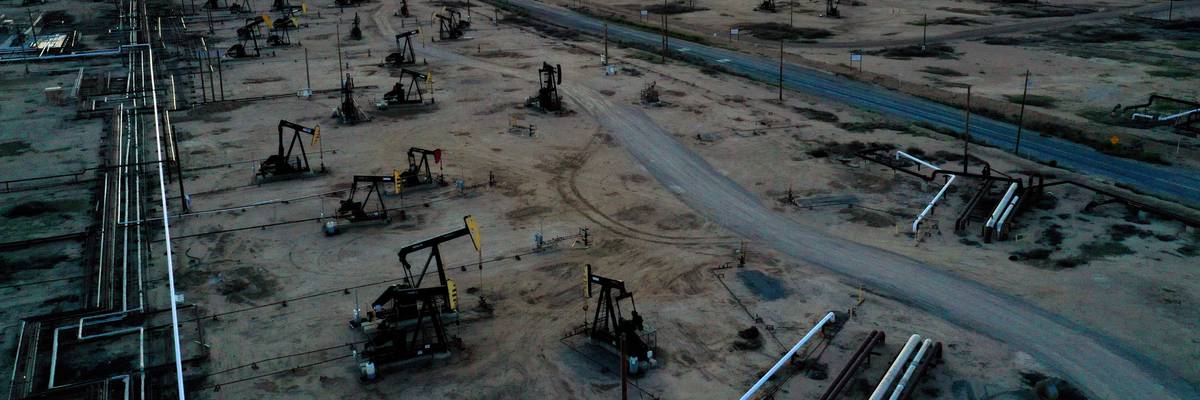
There are over 1,100 oil-producing wells in the McKittrick oil field, just north of the town of McKittrick, California.
"The science is clear: No new oil and gas fields, or the planet gets pushed past what it can handle," said one analyst.
Fossil fuel-producing countries late last year pledged to "transition away from fossil fuels," but a report on new energy projects shows that with the United States leading the way in continuing to extract oil and gas, governments' true views on renewable energy are closer to a statement by a Saudi oil executive Amin Nasser earlier this month.
"We should abandon the fantasy of phasing out oil and gas," the CEO of Saudi Aramco, the world's largest oil company, said at an energy conference in Houston.
A new report published Wednesday by Global Energy Monitor (GEM) suggests the U.S. in particular has abandoned any plans to adhere to warnings from climate scientists and the International Energy Agency (IEA), which said in 2021 that new oil and gas infrastructure has no place on a pathway to limiting planetary heating to 1.5°C.
Despite the stark warning, last year at least 20 oil and gas fields worldwide reached "final investment decision," the point at which companies decide to move ahead with construction and development. Those approvals paved the way for the extraction of 8 billion barrels of oil equivalent (boe).
By the end of the decade, companies aim to sanction nearly four times that amount, producing 31.2 billion boe from 64 oil and gas fields.
The U.S. led the way in approving new oil and gas projects over the past two years, GEM's analysis found.
An analysis by Carbon Brief of GEM's findings shows that burning all the oil and gas from newly discovered fields and approved projects would emit at least 14.1 billion tonnes of carbon dioxide.
"This is equivalent to more than one-third of the CO2 emissions from global energy use in 2022, or all the emissions from burning oil that year," said Carbon Brief.
GEM noted in its analysis that oil companies and the policymakers who continue to support their planet-heating activities have come up with numerous "extraction justifications" even as the IEA has been clear that new fossil fuel projects are incompatible with avoiding catastrophic planetary heating.
The report notes that U.S. Sen. Lisa Murkowski (R-Alaska) "supported ConocoPhillips' Willow oil field, arguing that the Alaskan oil and gas industry has a 'better environmental track record,' and not approving the project 'impoverish[es] Alaska Natives and blame[s] them for changes in the climate that they did not cause.'"
Carbon Brief reported that oil executives have claimed they are powerless to stop extracting fossil fuels since demand for oil and gas exists for people's energy needs, with ExxonMobil CEO Darren Woods telling Fortune last month that members of the public "aren't willing to spend the money" on renewable energy sources.
A poll by Pew Research Center last year found 67% of Americans supported the development of alternative energy sources. Another recent survey by Eligo Energy showed that 65% of U.S. consumers were willing to pay more for renewable energy.
"Oil and gas producers have given all kinds of reasons for continuing to discover and develop new fields, but none of these hold water," said Scott Zimmerman, project manager for the Global Oil and Gas Extraction Tracker at GEM. "The science is clear: No new oil and gas fields, or the planet gets pushed past what it can handle."
Climate scientist and writer Bill McGuire summarized the viewpoint of oil and gas executives and pro-fossil fuel lawmakers: "Climate emergency? What climate emergency?"
The continued development of new oil and gas fields, he added, amounts to "pure insanity."
Dear Common Dreams reader, It’s been nearly 30 years since I co-founded Common Dreams with my late wife, Lina Newhouser. We had the radical notion that journalism should serve the public good, not corporate profits. It was clear to us from the outset what it would take to build such a project. No paid advertisements. No corporate sponsors. No millionaire publisher telling us what to think or do. Many people said we wouldn't last a year, but we proved those doubters wrong. Together with a tremendous team of journalists and dedicated staff, we built an independent media outlet free from the constraints of profits and corporate control. Our mission has always been simple: To inform. To inspire. To ignite change for the common good. Building Common Dreams was not easy. Our survival was never guaranteed. When you take on the most powerful forces—Wall Street greed, fossil fuel industry destruction, Big Tech lobbyists, and uber-rich oligarchs who have spent billions upon billions rigging the economy and democracy in their favor—the only bulwark you have is supporters who believe in your work. But here’s the urgent message from me today. It's never been this bad out there. And it's never been this hard to keep us going. At the very moment Common Dreams is most needed, the threats we face are intensifying. We need your support now more than ever. We don't accept corporate advertising and never will. We don't have a paywall because we don't think people should be blocked from critical news based on their ability to pay. Everything we do is funded by the donations of readers like you. When everyone does the little they can afford, we are strong. But if that support retreats or dries up, so do we. Will you donate now to make sure Common Dreams not only survives but thrives? —Craig Brown, Co-founder |
Fossil fuel-producing countries late last year pledged to "transition away from fossil fuels," but a report on new energy projects shows that with the United States leading the way in continuing to extract oil and gas, governments' true views on renewable energy are closer to a statement by a Saudi oil executive Amin Nasser earlier this month.
"We should abandon the fantasy of phasing out oil and gas," the CEO of Saudi Aramco, the world's largest oil company, said at an energy conference in Houston.
A new report published Wednesday by Global Energy Monitor (GEM) suggests the U.S. in particular has abandoned any plans to adhere to warnings from climate scientists and the International Energy Agency (IEA), which said in 2021 that new oil and gas infrastructure has no place on a pathway to limiting planetary heating to 1.5°C.
Despite the stark warning, last year at least 20 oil and gas fields worldwide reached "final investment decision," the point at which companies decide to move ahead with construction and development. Those approvals paved the way for the extraction of 8 billion barrels of oil equivalent (boe).
By the end of the decade, companies aim to sanction nearly four times that amount, producing 31.2 billion boe from 64 oil and gas fields.
The U.S. led the way in approving new oil and gas projects over the past two years, GEM's analysis found.
An analysis by Carbon Brief of GEM's findings shows that burning all the oil and gas from newly discovered fields and approved projects would emit at least 14.1 billion tonnes of carbon dioxide.
"This is equivalent to more than one-third of the CO2 emissions from global energy use in 2022, or all the emissions from burning oil that year," said Carbon Brief.
GEM noted in its analysis that oil companies and the policymakers who continue to support their planet-heating activities have come up with numerous "extraction justifications" even as the IEA has been clear that new fossil fuel projects are incompatible with avoiding catastrophic planetary heating.
The report notes that U.S. Sen. Lisa Murkowski (R-Alaska) "supported ConocoPhillips' Willow oil field, arguing that the Alaskan oil and gas industry has a 'better environmental track record,' and not approving the project 'impoverish[es] Alaska Natives and blame[s] them for changes in the climate that they did not cause.'"
Carbon Brief reported that oil executives have claimed they are powerless to stop extracting fossil fuels since demand for oil and gas exists for people's energy needs, with ExxonMobil CEO Darren Woods telling Fortune last month that members of the public "aren't willing to spend the money" on renewable energy sources.
A poll by Pew Research Center last year found 67% of Americans supported the development of alternative energy sources. Another recent survey by Eligo Energy showed that 65% of U.S. consumers were willing to pay more for renewable energy.
"Oil and gas producers have given all kinds of reasons for continuing to discover and develop new fields, but none of these hold water," said Scott Zimmerman, project manager for the Global Oil and Gas Extraction Tracker at GEM. "The science is clear: No new oil and gas fields, or the planet gets pushed past what it can handle."
Climate scientist and writer Bill McGuire summarized the viewpoint of oil and gas executives and pro-fossil fuel lawmakers: "Climate emergency? What climate emergency?"
The continued development of new oil and gas fields, he added, amounts to "pure insanity."
Fossil fuel-producing countries late last year pledged to "transition away from fossil fuels," but a report on new energy projects shows that with the United States leading the way in continuing to extract oil and gas, governments' true views on renewable energy are closer to a statement by a Saudi oil executive Amin Nasser earlier this month.
"We should abandon the fantasy of phasing out oil and gas," the CEO of Saudi Aramco, the world's largest oil company, said at an energy conference in Houston.
A new report published Wednesday by Global Energy Monitor (GEM) suggests the U.S. in particular has abandoned any plans to adhere to warnings from climate scientists and the International Energy Agency (IEA), which said in 2021 that new oil and gas infrastructure has no place on a pathway to limiting planetary heating to 1.5°C.
Despite the stark warning, last year at least 20 oil and gas fields worldwide reached "final investment decision," the point at which companies decide to move ahead with construction and development. Those approvals paved the way for the extraction of 8 billion barrels of oil equivalent (boe).
By the end of the decade, companies aim to sanction nearly four times that amount, producing 31.2 billion boe from 64 oil and gas fields.
The U.S. led the way in approving new oil and gas projects over the past two years, GEM's analysis found.
An analysis by Carbon Brief of GEM's findings shows that burning all the oil and gas from newly discovered fields and approved projects would emit at least 14.1 billion tonnes of carbon dioxide.
"This is equivalent to more than one-third of the CO2 emissions from global energy use in 2022, or all the emissions from burning oil that year," said Carbon Brief.
GEM noted in its analysis that oil companies and the policymakers who continue to support their planet-heating activities have come up with numerous "extraction justifications" even as the IEA has been clear that new fossil fuel projects are incompatible with avoiding catastrophic planetary heating.
The report notes that U.S. Sen. Lisa Murkowski (R-Alaska) "supported ConocoPhillips' Willow oil field, arguing that the Alaskan oil and gas industry has a 'better environmental track record,' and not approving the project 'impoverish[es] Alaska Natives and blame[s] them for changes in the climate that they did not cause.'"
Carbon Brief reported that oil executives have claimed they are powerless to stop extracting fossil fuels since demand for oil and gas exists for people's energy needs, with ExxonMobil CEO Darren Woods telling Fortune last month that members of the public "aren't willing to spend the money" on renewable energy sources.
A poll by Pew Research Center last year found 67% of Americans supported the development of alternative energy sources. Another recent survey by Eligo Energy showed that 65% of U.S. consumers were willing to pay more for renewable energy.
"Oil and gas producers have given all kinds of reasons for continuing to discover and develop new fields, but none of these hold water," said Scott Zimmerman, project manager for the Global Oil and Gas Extraction Tracker at GEM. "The science is clear: No new oil and gas fields, or the planet gets pushed past what it can handle."
Climate scientist and writer Bill McGuire summarized the viewpoint of oil and gas executives and pro-fossil fuel lawmakers: "Climate emergency? What climate emergency?"
The continued development of new oil and gas fields, he added, amounts to "pure insanity."

