SUBSCRIBE TO OUR FREE NEWSLETTER
Daily news & progressive opinion—funded by the people, not the corporations—delivered straight to your inbox.
5
#000000
#FFFFFF
To donate by check, phone, or other method, see our More Ways to Give page.
Daily news & progressive opinion—funded by the people, not the corporations—delivered straight to your inbox.
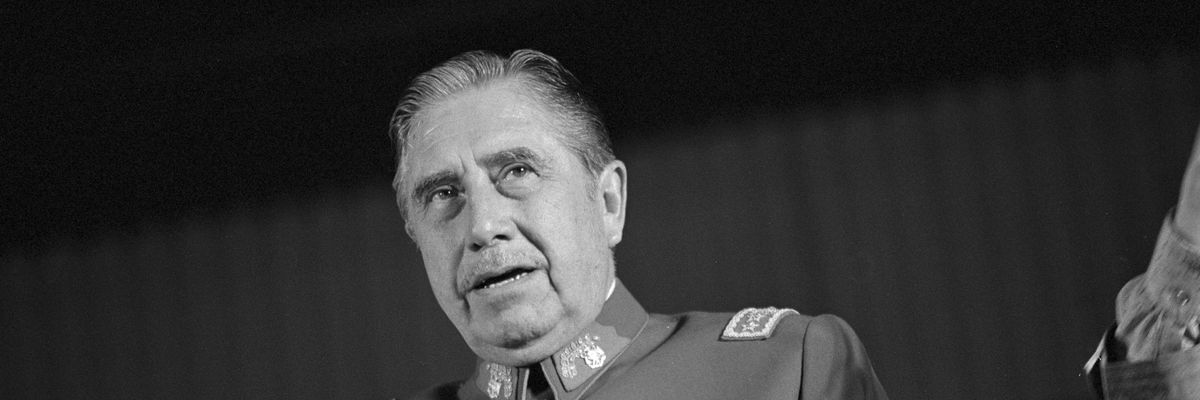
Chilean dictator Augusto Pinochet delivering a speech on September 11, 1980.
"Huge congratulations to the U.S. members who made this call from the delegation, and to all those who have fought like hell to declassify these files and bring justice for the bloody crimes of September 1973."
The U.S. State Department has declassified a pair of documents related to events leading up to the 1973 coup in Chile, a violent assault on democracycovertly backed by the Central Intelligence Agency.
The two documents were made public late last week following renewed calls for transparency by U.S. Reps. Alexandria Ocasio-Cortez (D-N.Y.), Greg Casar (D-Texas), and other progressive lawmakers who visited Chile earlier this month as part of a broader Latin America trip. The Chilean government and international human rights groups have also been calling for the declassification of documents containing details about the U.S.-backed coup for years.
The newly declassified files are daily briefs President Richard Nixon received on September 11, 1973—the day of the overthrow of Salvador Allende—and three days prior to the coup.
"A number of reports have been received... indicating the possibility of an early military coup," reads Nixon's daily brief for September 8, 1973. "Navy men plotting to overthrow the government now claim army and air force support."
The brief notes that Fatherland and Freedom, a fascist paramilitary group, "has been blocking roads and provoking clashes with the national police, adding to the tension caused by continuing strikes and opposition political moves. President Allende earlier this week said he believed the armed forces will ask for his resignation if he does not change his economic and political policies."
Nixon—who was closely involved in efforts to block Allende from assuming office and once ordered the CIA to "make the [Chilean] economy scream"—also received a daily brief on the day of the coup, just before Allende's ouster. The democratically elected left-wing president took his own life during the coup after refusing to step down.
"Plans by navy officers to trigger military action against the Allende government are supported by some key army units," the September 11 brief reads. "The navy is also counting on help from the air force and national police."
"Socialists, leftists, extremists, and Communists are equally determined not to compromise," the brief adds. "They are gambling that the military and political opposition cannot carry out moves to oust the government or even to impose restraints on it. President Allende, for his part, still hopes that temporizing will fend off a showdown."
Led by Gen. Augusto Pinochet, the Chilean military seized control of the government on September 11. What followed was a vicious, decades-long reign of terror and repression during which tens of thousands of Chileans were killed, tortured, or disappeared by the Pinochet regime, which continued to receive support from the CIA.
As the CIA admitted in a 2000 report, "Many of Pinochet's officers were involved in systematic and widespread human rights abuses... Some of these were contacts or agents of the CIA or U.S. military."
Pinochet was arrested in 1998 and later indicted for a range of human rights violations. The dictator died before facing trial.
Peter Kornbluh of the nonprofit National Security Archive welcomed the declassification of the two presidential briefs but questioned why they had been kept under such tight secrecy for decades, given that they don't "contain not a single sentence that could compromise U.S. national security."
"I'm happy that the Freedom of Information Act, together with some positive diplomacy by the Chilean government, broke a secrecy barrier that has kept us from knowing this history for 50 years," said Kornbluh, National Security Archive's Chile specialist. "I hope the [Biden] administration will reinforce its commitment to transparency by releasing all the documents that, inexplicably, remain secret after all this time."
The Chilean government, currently led by progressive President Gabriel Boric, also hailed the release of the documents.
Gloria de la Fuente, Chile's undersecretary of foreign affairs, thanked the Biden administration for "its willingness to accept the request to declassify files related to our country."
"Fifty years after the coup d'état," the diplomat said, "the declassification of archives of this documentation promotes the search for truth and reinforces the commitment of our countries to our democratic values."
Dear Common Dreams reader, It’s been nearly 30 years since I co-founded Common Dreams with my late wife, Lina Newhouser. We had the radical notion that journalism should serve the public good, not corporate profits. It was clear to us from the outset what it would take to build such a project. No paid advertisements. No corporate sponsors. No millionaire publisher telling us what to think or do. Many people said we wouldn't last a year, but we proved those doubters wrong. Together with a tremendous team of journalists and dedicated staff, we built an independent media outlet free from the constraints of profits and corporate control. Our mission has always been simple: To inform. To inspire. To ignite change for the common good. Building Common Dreams was not easy. Our survival was never guaranteed. When you take on the most powerful forces—Wall Street greed, fossil fuel industry destruction, Big Tech lobbyists, and uber-rich oligarchs who have spent billions upon billions rigging the economy and democracy in their favor—the only bulwark you have is supporters who believe in your work. But here’s the urgent message from me today. It's never been this bad out there. And it's never been this hard to keep us going. At the very moment Common Dreams is most needed, the threats we face are intensifying. We need your support now more than ever. We don't accept corporate advertising and never will. We don't have a paywall because we don't think people should be blocked from critical news based on their ability to pay. Everything we do is funded by the donations of readers like you. When everyone does the little they can afford, we are strong. But if that support retreats or dries up, so do we. Will you donate now to make sure Common Dreams not only survives but thrives? —Craig Brown, Co-founder |
The U.S. State Department has declassified a pair of documents related to events leading up to the 1973 coup in Chile, a violent assault on democracycovertly backed by the Central Intelligence Agency.
The two documents were made public late last week following renewed calls for transparency by U.S. Reps. Alexandria Ocasio-Cortez (D-N.Y.), Greg Casar (D-Texas), and other progressive lawmakers who visited Chile earlier this month as part of a broader Latin America trip. The Chilean government and international human rights groups have also been calling for the declassification of documents containing details about the U.S.-backed coup for years.
The newly declassified files are daily briefs President Richard Nixon received on September 11, 1973—the day of the overthrow of Salvador Allende—and three days prior to the coup.
"A number of reports have been received... indicating the possibility of an early military coup," reads Nixon's daily brief for September 8, 1973. "Navy men plotting to overthrow the government now claim army and air force support."
The brief notes that Fatherland and Freedom, a fascist paramilitary group, "has been blocking roads and provoking clashes with the national police, adding to the tension caused by continuing strikes and opposition political moves. President Allende earlier this week said he believed the armed forces will ask for his resignation if he does not change his economic and political policies."
Nixon—who was closely involved in efforts to block Allende from assuming office and once ordered the CIA to "make the [Chilean] economy scream"—also received a daily brief on the day of the coup, just before Allende's ouster. The democratically elected left-wing president took his own life during the coup after refusing to step down.
"Plans by navy officers to trigger military action against the Allende government are supported by some key army units," the September 11 brief reads. "The navy is also counting on help from the air force and national police."
"Socialists, leftists, extremists, and Communists are equally determined not to compromise," the brief adds. "They are gambling that the military and political opposition cannot carry out moves to oust the government or even to impose restraints on it. President Allende, for his part, still hopes that temporizing will fend off a showdown."
Led by Gen. Augusto Pinochet, the Chilean military seized control of the government on September 11. What followed was a vicious, decades-long reign of terror and repression during which tens of thousands of Chileans were killed, tortured, or disappeared by the Pinochet regime, which continued to receive support from the CIA.
As the CIA admitted in a 2000 report, "Many of Pinochet's officers were involved in systematic and widespread human rights abuses... Some of these were contacts or agents of the CIA or U.S. military."
Pinochet was arrested in 1998 and later indicted for a range of human rights violations. The dictator died before facing trial.
Peter Kornbluh of the nonprofit National Security Archive welcomed the declassification of the two presidential briefs but questioned why they had been kept under such tight secrecy for decades, given that they don't "contain not a single sentence that could compromise U.S. national security."
"I'm happy that the Freedom of Information Act, together with some positive diplomacy by the Chilean government, broke a secrecy barrier that has kept us from knowing this history for 50 years," said Kornbluh, National Security Archive's Chile specialist. "I hope the [Biden] administration will reinforce its commitment to transparency by releasing all the documents that, inexplicably, remain secret after all this time."
The Chilean government, currently led by progressive President Gabriel Boric, also hailed the release of the documents.
Gloria de la Fuente, Chile's undersecretary of foreign affairs, thanked the Biden administration for "its willingness to accept the request to declassify files related to our country."
"Fifty years after the coup d'état," the diplomat said, "the declassification of archives of this documentation promotes the search for truth and reinforces the commitment of our countries to our democratic values."
The U.S. State Department has declassified a pair of documents related to events leading up to the 1973 coup in Chile, a violent assault on democracycovertly backed by the Central Intelligence Agency.
The two documents were made public late last week following renewed calls for transparency by U.S. Reps. Alexandria Ocasio-Cortez (D-N.Y.), Greg Casar (D-Texas), and other progressive lawmakers who visited Chile earlier this month as part of a broader Latin America trip. The Chilean government and international human rights groups have also been calling for the declassification of documents containing details about the U.S.-backed coup for years.
The newly declassified files are daily briefs President Richard Nixon received on September 11, 1973—the day of the overthrow of Salvador Allende—and three days prior to the coup.
"A number of reports have been received... indicating the possibility of an early military coup," reads Nixon's daily brief for September 8, 1973. "Navy men plotting to overthrow the government now claim army and air force support."
The brief notes that Fatherland and Freedom, a fascist paramilitary group, "has been blocking roads and provoking clashes with the national police, adding to the tension caused by continuing strikes and opposition political moves. President Allende earlier this week said he believed the armed forces will ask for his resignation if he does not change his economic and political policies."
Nixon—who was closely involved in efforts to block Allende from assuming office and once ordered the CIA to "make the [Chilean] economy scream"—also received a daily brief on the day of the coup, just before Allende's ouster. The democratically elected left-wing president took his own life during the coup after refusing to step down.
"Plans by navy officers to trigger military action against the Allende government are supported by some key army units," the September 11 brief reads. "The navy is also counting on help from the air force and national police."
"Socialists, leftists, extremists, and Communists are equally determined not to compromise," the brief adds. "They are gambling that the military and political opposition cannot carry out moves to oust the government or even to impose restraints on it. President Allende, for his part, still hopes that temporizing will fend off a showdown."
Led by Gen. Augusto Pinochet, the Chilean military seized control of the government on September 11. What followed was a vicious, decades-long reign of terror and repression during which tens of thousands of Chileans were killed, tortured, or disappeared by the Pinochet regime, which continued to receive support from the CIA.
As the CIA admitted in a 2000 report, "Many of Pinochet's officers were involved in systematic and widespread human rights abuses... Some of these were contacts or agents of the CIA or U.S. military."
Pinochet was arrested in 1998 and later indicted for a range of human rights violations. The dictator died before facing trial.
Peter Kornbluh of the nonprofit National Security Archive welcomed the declassification of the two presidential briefs but questioned why they had been kept under such tight secrecy for decades, given that they don't "contain not a single sentence that could compromise U.S. national security."
"I'm happy that the Freedom of Information Act, together with some positive diplomacy by the Chilean government, broke a secrecy barrier that has kept us from knowing this history for 50 years," said Kornbluh, National Security Archive's Chile specialist. "I hope the [Biden] administration will reinforce its commitment to transparency by releasing all the documents that, inexplicably, remain secret after all this time."
The Chilean government, currently led by progressive President Gabriel Boric, also hailed the release of the documents.
Gloria de la Fuente, Chile's undersecretary of foreign affairs, thanked the Biden administration for "its willingness to accept the request to declassify files related to our country."
"Fifty years after the coup d'état," the diplomat said, "the declassification of archives of this documentation promotes the search for truth and reinforces the commitment of our countries to our democratic values."