SUBSCRIBE TO OUR FREE NEWSLETTER
Daily news & progressive opinion—funded by the people, not the corporations—delivered straight to your inbox.
5
#000000
#FFFFFF
To donate by check, phone, or other method, see our More Ways to Give page.
Daily news & progressive opinion—funded by the people, not the corporations—delivered straight to your inbox.
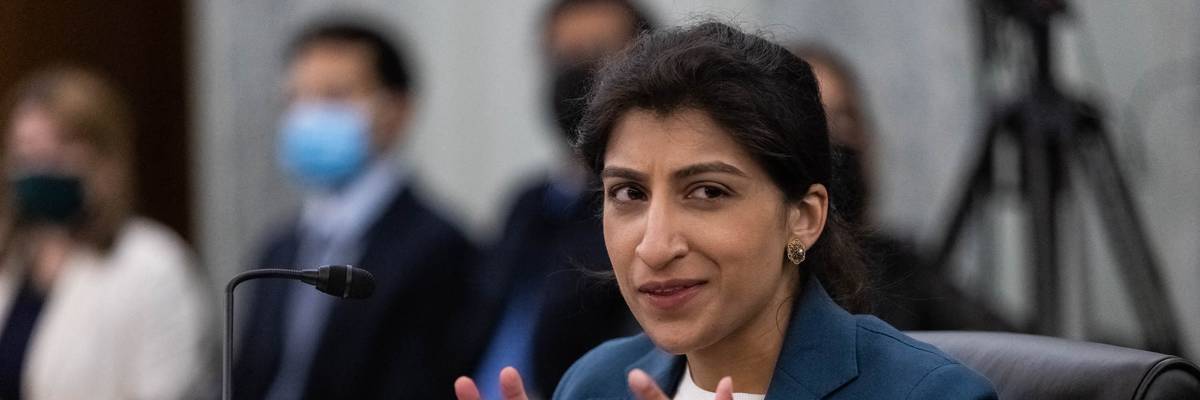
FTC Commissioner Lina Khan testifies during a Senate hearing on April 21, 2021.
"We will keep fighting to free hardworking Americans from unlawful noncompetes," the agency said in response to the decision.
A Trump-appointed federal judge on Wednesday partially blocked a Federal Trade Commission rule banning most noncompete clauses, ubiquitous anti-worker agreements that prevent employees from moving to or starting their own competing businesses.
Judge Ada Brown of the U.S. District Court for the Northern District of Texas issued a preliminary ruling preventing the ban from taking effect against the handful of plaintiffs that sued the FTC over the rule mere hours after it was finalized in April. The plaintiffs include the tax service firm Ryan LLC and the U.S. Chamber of Commerce, the nation's largest corporate lobbying organization.
Researchers at the Revolving Door Project noted Wednesday that Ryan LLC was "represented by [former President Donald] Trump's Labor Secretary, Eugene Scalia, via BigLaw firm Gibson Dunn."
Watchdogs accused the U.S. Chamber, which celebrated Wednesday's decision, of "judge-shopping," a tactic the organization frequently uses to secure favorable legal outcomes. District courts in Texas fall under the purview of the 5th Circuit Court of Appeals, which is dominated by right-wing extremists.
In her Wednesday decision, Brown did not immediately grant the plaintiffs' request for a nationwide injunction against the ban on noncompetes. But the judge signaled she would likely block the rule in its entirety with her final decision in the case on August 30—just days before the ban's scheduled implementation date.
"The court concludes the commission has exceeded its statutory authority in promulgating the noncompete rule, and thus plaintiffs are likely to succeed on the merits," Brown wrote in her 33-page decision.
"The need for judicial reform in Congress has never been more clear as far-right 5th Circuit territory judges have effectively put up a giant neon sign, 'Corporations, Please Sue Here.'"
A spokesperson for the FTC said in response to the ruling that the agency stands by its "clear authority, supported by statute and precedent, to issue this rule."
"We will keep fighting to free hardworking Americans from unlawful noncompetes, which reduce innovation, inhibit economic growth, trap workers, and undermine Americans' economic liberty," the spokesperson added.
The FTC, led by antitrust trailblazer Lina Khan, estimates that roughly 30 million U.S. workers are bound by noncompete agreements that restrict their ability to switch jobs in pursuit of higher wages and better benefits. The commission believes its ban on noncompetes would result in up to $488 billion in wage increases for U.S. workers collectively over the next decade.
Progressive advocacy groups cast Wednesday's decision as the latest attack on workers—and gift to corporations—by a Trump-appointed judge.
"By halting the noncompetes ban, this court is standing in the way of real gains for workers again," said Emily Peterson-Cassin, director of corporate power at Demand Progress. "With the decision overturning Chevron earlier this week, it's a one-two punch against everyday people."
Tony Carrk, executive director of Accountable.US, said in a statement that "the industry-funded U.S. Chamber continues to cost everyday Americans a ton of money with its suing spree against the Biden administration crackdowns on corporate greed, junk fees, and anti-worker barriers."
"The U.S. Chamber's lawsuit holding up the administration's credit card late fee rule is already costing Americans $27 million a day —and now this latest lawsuit could slam the door shut for millions of American workers to begin pursuing better opportunities," said Carrk. "Noncompete clauses could force employees to endure low wages and poor working conditions as the rule drags through the courts. The big bank and Wall Street CEOs on the U.S. Chamber's board have gotten a huge return on their investment while American workers pay the price."
"The need for judicial reform in Congress has never been more clear," Carrk added, "as far-right 5th Circuit territory judges have effectively put up a giant neon sign, 'Corporations, Please Sue Here.'"
Dear Common Dreams reader, It’s been nearly 30 years since I co-founded Common Dreams with my late wife, Lina Newhouser. We had the radical notion that journalism should serve the public good, not corporate profits. It was clear to us from the outset what it would take to build such a project. No paid advertisements. No corporate sponsors. No millionaire publisher telling us what to think or do. Many people said we wouldn't last a year, but we proved those doubters wrong. Together with a tremendous team of journalists and dedicated staff, we built an independent media outlet free from the constraints of profits and corporate control. Our mission has always been simple: To inform. To inspire. To ignite change for the common good. Building Common Dreams was not easy. Our survival was never guaranteed. When you take on the most powerful forces—Wall Street greed, fossil fuel industry destruction, Big Tech lobbyists, and uber-rich oligarchs who have spent billions upon billions rigging the economy and democracy in their favor—the only bulwark you have is supporters who believe in your work. But here’s the urgent message from me today. It's never been this bad out there. And it's never been this hard to keep us going. At the very moment Common Dreams is most needed, the threats we face are intensifying. We need your support now more than ever. We don't accept corporate advertising and never will. We don't have a paywall because we don't think people should be blocked from critical news based on their ability to pay. Everything we do is funded by the donations of readers like you. When everyone does the little they can afford, we are strong. But if that support retreats or dries up, so do we. Will you donate now to make sure Common Dreams not only survives but thrives? —Craig Brown, Co-founder |
A Trump-appointed federal judge on Wednesday partially blocked a Federal Trade Commission rule banning most noncompete clauses, ubiquitous anti-worker agreements that prevent employees from moving to or starting their own competing businesses.
Judge Ada Brown of the U.S. District Court for the Northern District of Texas issued a preliminary ruling preventing the ban from taking effect against the handful of plaintiffs that sued the FTC over the rule mere hours after it was finalized in April. The plaintiffs include the tax service firm Ryan LLC and the U.S. Chamber of Commerce, the nation's largest corporate lobbying organization.
Researchers at the Revolving Door Project noted Wednesday that Ryan LLC was "represented by [former President Donald] Trump's Labor Secretary, Eugene Scalia, via BigLaw firm Gibson Dunn."
Watchdogs accused the U.S. Chamber, which celebrated Wednesday's decision, of "judge-shopping," a tactic the organization frequently uses to secure favorable legal outcomes. District courts in Texas fall under the purview of the 5th Circuit Court of Appeals, which is dominated by right-wing extremists.
In her Wednesday decision, Brown did not immediately grant the plaintiffs' request for a nationwide injunction against the ban on noncompetes. But the judge signaled she would likely block the rule in its entirety with her final decision in the case on August 30—just days before the ban's scheduled implementation date.
"The court concludes the commission has exceeded its statutory authority in promulgating the noncompete rule, and thus plaintiffs are likely to succeed on the merits," Brown wrote in her 33-page decision.
"The need for judicial reform in Congress has never been more clear as far-right 5th Circuit territory judges have effectively put up a giant neon sign, 'Corporations, Please Sue Here.'"
A spokesperson for the FTC said in response to the ruling that the agency stands by its "clear authority, supported by statute and precedent, to issue this rule."
"We will keep fighting to free hardworking Americans from unlawful noncompetes, which reduce innovation, inhibit economic growth, trap workers, and undermine Americans' economic liberty," the spokesperson added.
The FTC, led by antitrust trailblazer Lina Khan, estimates that roughly 30 million U.S. workers are bound by noncompete agreements that restrict their ability to switch jobs in pursuit of higher wages and better benefits. The commission believes its ban on noncompetes would result in up to $488 billion in wage increases for U.S. workers collectively over the next decade.
Progressive advocacy groups cast Wednesday's decision as the latest attack on workers—and gift to corporations—by a Trump-appointed judge.
"By halting the noncompetes ban, this court is standing in the way of real gains for workers again," said Emily Peterson-Cassin, director of corporate power at Demand Progress. "With the decision overturning Chevron earlier this week, it's a one-two punch against everyday people."
Tony Carrk, executive director of Accountable.US, said in a statement that "the industry-funded U.S. Chamber continues to cost everyday Americans a ton of money with its suing spree against the Biden administration crackdowns on corporate greed, junk fees, and anti-worker barriers."
"The U.S. Chamber's lawsuit holding up the administration's credit card late fee rule is already costing Americans $27 million a day —and now this latest lawsuit could slam the door shut for millions of American workers to begin pursuing better opportunities," said Carrk. "Noncompete clauses could force employees to endure low wages and poor working conditions as the rule drags through the courts. The big bank and Wall Street CEOs on the U.S. Chamber's board have gotten a huge return on their investment while American workers pay the price."
"The need for judicial reform in Congress has never been more clear," Carrk added, "as far-right 5th Circuit territory judges have effectively put up a giant neon sign, 'Corporations, Please Sue Here.'"
A Trump-appointed federal judge on Wednesday partially blocked a Federal Trade Commission rule banning most noncompete clauses, ubiquitous anti-worker agreements that prevent employees from moving to or starting their own competing businesses.
Judge Ada Brown of the U.S. District Court for the Northern District of Texas issued a preliminary ruling preventing the ban from taking effect against the handful of plaintiffs that sued the FTC over the rule mere hours after it was finalized in April. The plaintiffs include the tax service firm Ryan LLC and the U.S. Chamber of Commerce, the nation's largest corporate lobbying organization.
Researchers at the Revolving Door Project noted Wednesday that Ryan LLC was "represented by [former President Donald] Trump's Labor Secretary, Eugene Scalia, via BigLaw firm Gibson Dunn."
Watchdogs accused the U.S. Chamber, which celebrated Wednesday's decision, of "judge-shopping," a tactic the organization frequently uses to secure favorable legal outcomes. District courts in Texas fall under the purview of the 5th Circuit Court of Appeals, which is dominated by right-wing extremists.
In her Wednesday decision, Brown did not immediately grant the plaintiffs' request for a nationwide injunction against the ban on noncompetes. But the judge signaled she would likely block the rule in its entirety with her final decision in the case on August 30—just days before the ban's scheduled implementation date.
"The court concludes the commission has exceeded its statutory authority in promulgating the noncompete rule, and thus plaintiffs are likely to succeed on the merits," Brown wrote in her 33-page decision.
"The need for judicial reform in Congress has never been more clear as far-right 5th Circuit territory judges have effectively put up a giant neon sign, 'Corporations, Please Sue Here.'"
A spokesperson for the FTC said in response to the ruling that the agency stands by its "clear authority, supported by statute and precedent, to issue this rule."
"We will keep fighting to free hardworking Americans from unlawful noncompetes, which reduce innovation, inhibit economic growth, trap workers, and undermine Americans' economic liberty," the spokesperson added.
The FTC, led by antitrust trailblazer Lina Khan, estimates that roughly 30 million U.S. workers are bound by noncompete agreements that restrict their ability to switch jobs in pursuit of higher wages and better benefits. The commission believes its ban on noncompetes would result in up to $488 billion in wage increases for U.S. workers collectively over the next decade.
Progressive advocacy groups cast Wednesday's decision as the latest attack on workers—and gift to corporations—by a Trump-appointed judge.
"By halting the noncompetes ban, this court is standing in the way of real gains for workers again," said Emily Peterson-Cassin, director of corporate power at Demand Progress. "With the decision overturning Chevron earlier this week, it's a one-two punch against everyday people."
Tony Carrk, executive director of Accountable.US, said in a statement that "the industry-funded U.S. Chamber continues to cost everyday Americans a ton of money with its suing spree against the Biden administration crackdowns on corporate greed, junk fees, and anti-worker barriers."
"The U.S. Chamber's lawsuit holding up the administration's credit card late fee rule is already costing Americans $27 million a day —and now this latest lawsuit could slam the door shut for millions of American workers to begin pursuing better opportunities," said Carrk. "Noncompete clauses could force employees to endure low wages and poor working conditions as the rule drags through the courts. The big bank and Wall Street CEOs on the U.S. Chamber's board have gotten a huge return on their investment while American workers pay the price."
"The need for judicial reform in Congress has never been more clear," Carrk added, "as far-right 5th Circuit territory judges have effectively put up a giant neon sign, 'Corporations, Please Sue Here.'"